Thursday, March 6, 2025

Walls of Illusion: Won! (with Summary and Rating)

I have no idea who this woman is. There was never any Walls of Illusion II.
       
Walls of Illusion
Germany
Motelsoft (developer and publisher)
Released as shareware in 1993 for Atari ST
Date Started: 16 February 2025
Date Ended: 4 March 2025
Total Hours: 17
Difficulty:
Hard (4.0/5)
Final Rating: 19
Ranking at time of posting: 182/554 (33%)
    
Walls of Illusion is a Dungeon Master clone, but one that leans so hard into the mechanical puzzle elements and so far away from any RPG elements that it fundamentally feels like a different game. (Its predecessor, Arcan, leaned in this direction but didn't go as far.) There's a sense to which it's more like an escape room than an RPG, an ancestor of Myst and Portal. Enemies are momentary inconveniences on the way to getting stuck at yet another keyhole without a key. I would not have made it without commenters Kalieum and Buck. It's not often that commenters are playing at the same time that I'm playing, running into the same difficulties. We should do that more often.
      
The game consists of nine levels—six above the main level and two below. I spent so long on the first four that I honestly thought they must be the entire game and was surprised and aggrieved when I discovered each new stairway upward. The first four levels are interconnected by multiple stairways, pits, and teleporters; the upper five are far more (but not entirely) self-contained. However, there is no moment in which the game isn't basically linear. Even within the first four levels, you explore them in relatively linear sections, each bit opening the way to the next, such that if you get stuck—as I did, multiple times—you essentially have no recourse.
    
Main +3. Despite its size, there's never more than a couple places to go at any time.
   
Finding your way through the corridors is a matter of understanding all the possibilities inherent in the mechanical puzzles, but this is tough because the game is always introducing new ones. As you explore, the number of things that you have to investigate multiplies. I think this is a relatively exhaustive list of the game's mechanics:
   
  • Doors that require a push of a button to open, but sometimes the button is locked, sometimes by a nearby keyhole or coin slot. Finding the related key or coin is a major part of the game.
  • Areas that can only be accessed by falling down pits. 
  • Pits that you can't see until you've been standing atop them for a couple of seconds; then they suddenly open and dump you unceremoniously to the lower level.
      
A pit opens beneath me just as I'm about to open a door.
       
  • Levers and buttons that remove or insert wall pieces, sometimes opening new areas, sometimes closing them off, sometimes when pulled once, sometimes twice, sometimes in combination with others. I should mention that levers can be seen from the side, but buttons cannot, so you have to face every wall to be sure.
  • Levers and buttons that unlock doors.
  • Invisible barriers, some of which can be turned off with levers, others of which must simply be circumvented. 
       
There's an invisible wall between me and this key. I'll need to walk through an illusory wall and drag a couple of movable walls out of the way before I find the button that deactivates the field.
      
  • Buttons with arrows that can be pushed four times, each time removing some wall pieces and closing others.
      
A rotating arrow button.
     
  • Illusory wall pieces that you can walk right into. Some may contain levers, buttons, or treasures in the wall space. You have to bash into almost every wall, taking damage, to test for these. My characters were almost always at low health because of this, and I accidentally killed them a couple of times when I wasn't paying attention. Imagine dying because you spent your last bit of health throwing yourself against a wall.
  • Pressure plates, some visible, some invisible, that open or close wall pieces.
  • Pressure plates that launch fireballs that you then have to avoid, often by ducking through an illusory wall.
    
Failing to duck through an illusory wall.
      
  • Pressure plates that advance you to the next square in the direction that you're facing, sometimes allowing you to access wall spaces that are otherwise solid.
  • Levers that teleport you from one part of the dungeon to another.
  • Squares that teleport you from one part of the dungeon to another with no warning.
  • Spinners.
  • Moveable walls that you can push or pull to access the area on the other side, only you have to find a place to put them that won't impede movement. While the game does alert you if you bash into such a wall, it only does so if you bash into it head-on. I think I might have missed a number of these by testing the walls by side-bumping them. 
     
Thankfully, it tells you this when you bump into it. You don't have to try to push and pull every wall.
      
  • In at least one place, a door that only opens when you regard a message plaque as a keyhole and a Staff of Wisdom as a key.
  • In at least one place, a lever that makes a previously hard wall illusory.
      
Having played the game, I find a number of mysteries. Credit again goes to Kalieum for anticipating me on many of these in this comment.
   
  • There are four locked doors which I never found a way to open. One of them, on Main -1, is on the outer wall of the dungeon, so I'm guessing that it must be for decoration, which suggests that some of the others similarly do not have solutions.
     
The main level. I never figured out how to open that northern door.
        
  • I found a couple of gold staves. After you use them a couple of times in combat, they turn into what the English version calls "blowpipes." Kalieum clarified that the translation is poor, and they're supposed to just be "batons." Either way, it's a mystery why they change form after you've used them.
  • The game has a lot of niches in walls, some of them with treasure in them. Throughout the game, I suspected that some of the others wanted me to put a particular item in them, but I never found any for which that did anything. If the mechanic is used at all (as it is in Dungeon Master), it isn't to access a required area.
     
A wall niche with nothing in it. These make me paranoid.
       
  • Many of the 38 x 38 maps have large unused areas. I suspect those areas are just not used, but I could have missed something.
  • There are a decent number of levers for which I could find no effect.
  • Up until the end, I was sure that the weird wall messages would produce some kind of message by interleaving the words or lines, but I couldn't make anything out of them. Maybe there's poor translation at work, or maybe the authors were just being deliberately misleading. A few of the messages were related thematically to their areas, but none of them (at least in my case) helped with any of the puzzle solutions. Some samples of the mysterious messages:
    • READ NOT | SAVE THAT | WHICH
    • YOU | SHOULD THINK NOW | UNDETERMINED
    • ONLY ONE STEP | WE MAKE YOU SMALL
    • WALK FROM LIGHT | TO THE | OTHER 
     
Another inexplicable message.
     
  • Kalieum mentions one that I didn't think about because I mostly played without sound: the game is inconsistent and mysterious in its use of some sound effects, which sometimes alert you to hidden areas. More often, they're just odd. There's a message that says, "Caution steps" right next to three staircases. The game plays a "bonk" sound when you go down any of them, but you don't seem to take any damage.
    
In addition to all of this, you sometimes run into one of three enemy types. Except for the final boss, they always appear in pairs. Except for a couple of places, they always appear where you have plenty of room to maneuver around them. Although their movement patterns aren't as predictable as in Dungeon Master, so you can't always settle into a familiar pattern like the "combat waltz," they're slow enough that you can basically run circles around them and attack from the sides and rear. This is important because spellcasting enemies are more than capable of killing some of the weaker party members with a single attack. Because there are no tactics but to avoid them, and because they die fairly quickly, all the character development and equipment acquisition is largely wasted. What difference does it make if your armor class is 35 or 40 if you can't afford to get hit at all?
       
My lead character's inventory at the end of the game.
       
In my previous entries, I was content to compare the combat mechanics to Dungeon Master, but I didn't explain any of what that meant. In combat, each character can attack with an equipped weapon (melee or ranged) or cast a spell. Only the front-rank characters can hit with melee weapons. After choosing an action, there's a "cool down" period of a couple of seconds before you can do anything again, but spells and weapons have different cool downs, so if a character is equipped with both, he can attack twice without much delay. As usual, picking up missile weapons after a battle is annoying.
    
Enemies are confined to their side of the squares they occupy. Characters can only attack enemies on the side that mirrors the character. So if my first and third characters, occupying the left side of the formation, manage to kill the enemy on the left side of the square they're facing, they can't do anything for the rest of the battle. The other two characters have to kill the right-side enemy. You can change the formation, but it's rarely helpful to do so unless you want to change what skills your characters are building. 
   
Harry, shooting regular arrows, can only hit the enemy on the left. Laura, shooting elven arrows, can only hit the one on the right.
       
Many of the character mechanics are brought over from Arcan, where they were used a bit more extensively, and thus under-utilized here. None of my characters had achieved "Master" rank in any skill by the end of the game, even though I used the first two characters for melee and the second two for spellcasting almost exclusively. (All enemies are fixed, so there's no grinding possible even if it were necessary.) The "Wizard" and "Healer" classes only get one spell each, and neither one that you'd cast with much frequency, making it nearly impossible to level in them. Altogether, I only found seven spells, compared to 10 in Arcan, which is a larger game. Each character, meanwhile, has 13 spell slots. There are 12 spots in the grid that shows active spell effects, but only two spells in this game that put anything in the grid.
       
My second character's character sheet. RPG mechanics are such a small part of the game that I didn't really register until now that the game has both experience points and traditional levels as well as class levels.
     
The food and water mechanic also makes little sense. You find plenty of food, and you find a couple of fountains that fill your waterskins and empty jars full of enough water to play nearly the entire game on one visit. Because starvation and thirst aren't a problem, there's no downside to resting to restore health and magic points (which doesn't advance the food/water meter anyway). There's an encumbrance limit, but my characters never hit it despite my never dropping a single item. In short, the engine allows for RPG mechanics that the game doesn't actually use. If it removed enemies entirely, the gameplay experience would hardly change.
     
I don't mean to sound like I'm lodging nothing but complaints. The game's cleverness occasionally delighted me. There's a fiendish teleporter on Main -1 that activates just as you're about to reach a door. It shifts you about 30 spaces to the southwest to an identical-looking door. The automap kind of ruins it, but it can screw up your manual map if you're not paying attention. There are a couple of spinners in just the right place to confound you. On Main -2, there's a square that activates a couple of shooting fireballs, but only after a delay long enough to let you stroll right into their path. I'm relatively neutral on most of the puzzles just because they're not quite why I play RPGs, but I can see some fans enjoying them.
    
The automap helps a little by annotating squares with buttons, levers, movable walls, and other features. I just can't see all the color distinctions.
             
As I said, the first four levels of the dungeon are heavily interconnected. When the game begins, you only have five spaces to explore on the main level before you have no choice but to drop through a pit to Main -1.  Once there, you have a roughly 7 x 7 area to explore before you have to drop down another pit to Main -2. From there, several isolated stairways go up to Main +1. Your explorations on that level are confined to a central area and a couple of side areas. One of these side areas contains the first of many indecipherable messages: "SIDE | CHILDREN | IT'S ALREADY HERE." You have to drop back down to Main via a pit to continue.
    
After quite a few hours noodling around on those first levels, but before I'd opened up all of the available wall space (which I expected, since Arcan used every bit of it), a staircase led up to Main +2, which caused me to rant a bit. I think I would have quit if I'd known there were four more after that. Keep in mind that a 38 x 38 level is 1,444 squares, or the size of about three levels (you have to account for the unused space in the "worm tunnel" approach) in Wizardry or five in a Gold Box game. It also takes a lot longer to explore the space in Walls because of all the testing that you have to do. Still, I persevered.
    
A room with multiple levers. One moved me onward. Seven others teleported me somewhere in the level and forced me to walk back.
      
Main +2 had a large open section with at least seven levers creating different wall configurations. I missed one originally and nearly gave up, but I made a final loop, found the unpulled lever, and opened my way to Main +3, the most linear of the levels—assuming you navigate safely through a section where pits open up the moment you pause on their squares (one of these is necessary to access an optional area of the level below, with some equipment). This level also has the least amount of unused space, which the developers managed at the expense of making a good third of it completely empty—not a single enemy, treasure, or puzzle. Just an alternate fountain for restoring the sustenance you expended while bumping into every stupid wall for over an hour. There's also a small teleporter maze.
   
I wanted to scream when all of this exploration led me to yet another level, Main +4. Messages at the top of the stairs said, "PLAY NOW MY GAME" and "THEN COME TO THE GOAL," which were perhaps the most coherent messages in the game and gave me hope that the endgame was near. Hah.
 
The level was similarly linear, though at least it used less space. The centerpiece was a room with four alcoves, each with a silver coin, each protected by an invisible barrier. The four silver coins were needed to open a succession of walls later on. To deactivate the barriers, I had to pull three levers, each of which was in a hidden area revealed with one of those rotating arrow buttons. Oh, and the room with the coins and the room with the rotating arrow button were both revealed by wall buttons.
     
Coins in niches. Note the invisible walls protecting them.
    
When the result of all of this effort was yet another staircase, I came close to despair. But the endgame was close. Main +5 and Main +6—yes, there was yet another one—both used only about half of the available level space. They also had a couple of new tricks. A couple of easy lever puzzles opened the way to a locked door with a message that read: "WISDOM | IN JUDGEMENT | UNLOCKED THE DOOR." Another sign on an adjacent wall produced no message when I clicked on it.
       
Back on the main level, a door I hadn't been able to open since the game's first hour had a message that mentioned a Staff of Wisdom. I had found a key on Main +3 called the Key of Knowledge, and I assumed it would finally open that door. This proved to be true when a nearby lever teleported me back to the main level. Behind the locked door, a 1 x 1 space had a niche on three sides, each of which looked like its own copy of the Staff of Wisdom. However, when I took the staff, it disappeared from all three niches. Adding to the mystery, any time either of my rear characters touched the staff, it deducted three hit points from their totals, but the same wasn't true of my two lead characters.
       
The Staff of Knowledge. Niches to my right and left have identical copies.
       
A nearby lever warped me back to Main +3, and from there I walked back to the locked "wisdom" door. Buck had to help me at this point. The solution was to pretend the Staff of Wisdom was a key and click on the mute sign as if it were a lock. I don't know how he figured that out.
      
And somehow unlocking a door with it.
     
Beyond that was a corridor in which nearly every square triggered a couple of instant-death fireballs from the opposite end; I had to navigate a series of illusory walls to dodge them.
   
The game's final major puzzle was a large room with a keyed door and three alcoves in the corners. A rotating arrow button caused a different staircase to appear in each alcove. These four staircases led to four small areas of Main +6. In each case, the stairway closed behind me, and I had to find my way to a door that opened to a central staircase back down. Each of the four areas had a key hidden somewhere. One area made extensive use of illusory walls, another of moveable walls. One had a lever puzzle that confounded both me and Buck until Kalieum solved it: I had to pull a lever once to turn a formerly solid wall into an illusory wall; behind that was a second lever opening the way to the key. The problem was, if you pulled the first lever twice, the illusory wall turned into a wall with a niche. Since all of the other three keys had been found in niches, it made it look as if the fourth key was supposed to be there and it had just bugged out.
     
The last level (though not the top one).
         
The four keys opened the way to a final area on Main +5. It was a large 14 x 15 area in which some walls in the middle spelled out "THE END." If that wasn't enough, a sign next to the only door out of the place also said, "THE END." There were a few enemies in this area, but nothing difficult.
   
The last door opened to a 3 x 4 room with a single enemy, presumably the "Bragos" mentioned in a couple of wall messages. He was a spellcaster, with at least twice as many hit points as any other enemy in the game, but he was no faster. Since enemies can only be attacked by characters on their side, two of my characters couldn't materially participate in the final battle.
       
I never did find out who this was or why we invaded his realm and killed him.
      
The second he was dead, the game flashed to the winning screen at the top of this entry, and that was it.
   
As I was preparing this entry, I realized there was one lever in the final area (before Bragos) that I hadn't pulled. It opened up a wall space from which six or eight pairs of enemies swarmed out. They would have been legitimately difficult. I would have had to hide among the walls spelling out "THE END," attacking with guerilla tactics, ensuring I didn't get trapped or surrounded. But since there's absolutely no treasures or equipment upgrades in the area that the enemies come from, and you hardly need any more experience or leveling at this point, I consider it a good thing that I ignored the lever.
      
There's not much else to tell you. We've covered Motelsoft games before; you can learn more about them in my entries on Seven Horror's (1989) and Magic Tower I: Dark Stone Ritual (1992). We will see them at least 16 more times if I make it all the way to 2006. They were very good at analyzing successful elements of major commercial RPGs and replicating at least bits of them, and it's rare for any two of their games to be as similar as Arcan and Walls of Illusion, their final games for the Atari ST. I give Walls a 19 on the GIMLET in comparison to a 23 for Arcan; even though they're the same game mechanically, I thought the original had at least something of a story (good for 1 point) and the RPG elements were a little more meaningful. If you really like those mechanical puzzles, Walls is probably better. Plus, you don't need to translate anything from German (assuming you're not German).
    
There's an extent to which I've admired the Motelsoft games more than I've really enjoyed them, but I think we're about to see a big leap for the company, judging by screenshots for their 1994-1996 offerings. We'll see them next with Escape from Ragor (1994) or Megrims Rache (1994), which may be the same game. I don't think anyone has ever written anything about Walls of Illusion, but I have several commenters whose ability to search out obscure magazine articles and archived web sites dwarfs my own.
    

Monday, March 3, 2025

Unlimited Adventures: More Adventures, Summary, and Rating


Unlimited Adventures
And specifically, "The Heirs to Skull Crag" adventure
United States
MicroMagic, Inc. (developer); Strategic Simulations, Inc. (publisher)
Released 1993 for DOS and Macintosh
Date Started: 31 January 2024
Date Ended: 25 February 2025
Total Hours: 29 (two full adventures, several partial ones)
Difficulty: Moderate (3.0/5), but depends heavily on the adventure
Final Rating: 50
Ranking at time of posting: 516/554 (93%)  
      
Summary:
    
Unlimited Adventures is a creation kit that uses the Gold Box engine, the basis of ten Dungeons & Dragons games and two Buck Rogers games between 1988 and 1992. "The Heirs to Skull Crag" is a short but satisfying adventure that exemplifies the strengths and weaknesses of the creation kit. It casts the party as a group of caravan guards who get caught up in the fate of a fortress whose lord or lady, called the Roadwarden, serves as the protector of trade routes through the Dragonjaw mountains. A cabal of odd enemies has slain the Roadwarden, and her artifact weapons and armor have been scattered among the factions. The party must recover the items while arbitrating a succession feud among the dead Roadwarden's children. There are several side areas and adventures.
   
The module makes excellent use of the variety of enemies allowed by the engine (which is based on the latest commercial version, as seen in 1992's The Dark Queen of Krynn), the tactical combat, the spells, character development, and equipment. Weaknesses are the same as the weaknesses of the Gold Box engine and the Unlimited Adventures kit in general: no interactivity to the environment, a broken economy, and graphics that are all stock art rather than created specifically for this story. It nonetheless stands up well against other Gold Box games.
     
*****
     
The next adventure I checked out was "Ghost of Greyhawk Manor," by Mike Whyte, apparently created as part of a 1993 Halloween contest on America Online. The plot is that the PC (whichever party member was selected when you hit "Begin Game") is on the trail of a malevolent entity named Malhavok. Years ago, Malhavok tortured and slaughtered the PC's family and burned his village. The PC has traced Malhavok, through similarly destroyed cities and scenes of slaughter, to the town of Greyhawk.
    
Right now. This is the first time I'm hearing that name.
    
I decided to do something different and make the main character a cleric surrounded by five paladins. The game starts everyone at a relatively-high Level 9, to include cleric spells through Level 5 and +2 equipment. I envisioned the cleric, Karras, not as a kind, healing cleric, but rather a wrathful, vengeful one. I decided to see how long I could stay alive while giving all offensive spells to the cleric and relying on the paladins' "Lay on Hands" abilities for healing.
   
As the party enters Greyhawk, they witness an altercation between a local lord, Blaine, and a messenger from the duke, who is upset about Blaine's dalliance with the duke's daughter. In the inn, the party hears about the history of Lord Blaine's family. Fifty years ago, the viscount's daughter went insane and murdered her family, then killed herself. Her spirit still haunts the old manor, protecting a hidden vault of riches that succeeding generations have occasionally tried to find, most of them getting slaughtered by the vengeful spirit. Blaine himself barely made it out alive when he went for the treasure.
        
The party gets the main quest from "Duke Skynyrd."
    
The relationship between this haunting and Malhavok is unclear, but when the party meets the duke (amusingly named Skynyrd), he tells them that Malhavok is at the old estate, looking for the one weapon that can kill him: the sword Blackrazor. Lord Blaine (a Level 7 chaotic good human fighter) and one of his companions, Usurp Toe (a Level 10 lawful evil human fighter) join the party on the way out of town. We're soon attacked by a pack of wolves (I immediately start regretting my lack of "Fireball"), which causes Usurp Toe to run off after our victory.
   
The core of the game takes place in the enormous Greyhawk Manor. The author did a great job making the manor seem like a real place with evocative descriptions of rooms and encounters.
 
As you know, I'm a big fan of "flavor text."
       
He also took the time to create original art for the game, or at least digitize it from photographs.
     
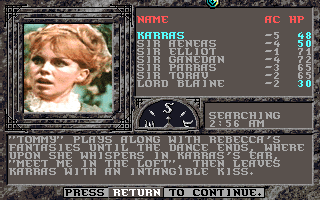
They both look familiar, but I can't quite place them. Are they from Doctor Who?
       
However, it soon became clear that this is not a module in which you want to screw around with unconventional party composition. First, the module calls upon the skills of thieves and magicians; there are locks that need to be picked and doors that need to be "Knocked." Second, enemies are hard. The largely-undead bestiary resists most of the cleric's offensive spells (most of which are fairly useless even against normal enemies; does anyone really ever cast "Cause Blindness" in a Gold Box game?) and attempts to turn them. Many of them drain levels. And you can't easily ride back to town for a quick "Restoration" because the game likes to throw enormous wolf packs at you when you do.
      
We just wanted to get a drink and identify some equipment.
        
Thus, my mind turned to bringing my victorious "Restoration of Gundahab" party into the module. First, I needed something to get them from Level 6 to roughly Level 9. I sorted the list randomly and looked for the first 1993 module with a starting level of between 4 and 8. The first one was "Travelers and Thieves" from May 1993 by a "Turbo007." It creates characters with 40,000 experience points, which was about the average for my party.
   
The adventure does not have a description in the Rose Dragon database, nor does it have a title screen. The opening screen begins: "After your graduation, a group of your friends decides to take a trip to England to sight-see." The visit includes a tour of the ruins of "old town Cambder . . . the birthplace of the youngest king ever to rule England." (The youngest king ever to rule England was Henry VI, born at Windsor Castle in Berkshire. Things are not starting well.) The game uses the "tour" feature to escort us through the ruins, as the tour guide explains that a current archaeological project is underway at the location to "discover the secrets of time travel." The guide leaves the party alone to explore. The air becomes thick. Someone screams for help in the distance. Then . . . nothing. I walked on every square, tested every wall, tried sleeping, etc. Nothing seems to move the story forward. If I go back to the starting square, it just repeats the tour. I looked up a review of the adventure in the Unlimited Adventures newsletter from 2010, and it mentioned the problem but says that the reviewer "got around it." It does not say how. Meanwhile, however, it sounds like the module isn't great: "Nothing made sense."
     
The automap doesn't even show an exit.
      
I went back to the drawing board and selected the next game to match my criteria: "Volcano" from May 1993 by a "Dave C." Unfortunately, the database was wrong: Instead of the Level 5-6 adventure it promised, the adventure starts new characters at 140,000 experience points, or about Level 13 for a fighter.
   
Next up: "Shadow of Moloch" from July 1993 by "Skarsol." It begins on an outdoor map of a pleasant countryside called Lanethorn. We enter a peaceful village where the friendly people smile at us. It's all very suspicious.
    
The game begins on an outdoor map.
        
"Something nags at you," the game says as we leave the town. Before long, we're stopped by a group of armed men who demand to know our business. The leader pretends there's some trouble on the road ahead and suggests we spend the night in his camp. When we refuse, he attacks. The ensuing battle against a bunch of "Bestea knights" and "cult knights" leaves three of us unconscious.
     
I've played enough RPGs to know this won't end well.
      
More guards appear in a mountain pass, where we bluff our way through, then barely survive attacks by ice wolves and cult assassins. On the other side of the mountains is a menu town where the shop sells +2 equipment. 
  
I continue on to a castle on a promontory. A dark, severe-looking man greets me and says that all the priests are "engaged in a prayer convocation" hoping to "bring peace to this troubled land." We can't do anything here. Instead, we enter the village at the base of the castle. It is a full 16 x 8 map with an inn, a shop, a training hall, a tavern, and a temple. But something is clearly wrong. The residents are all fighting with each other. The schoolhouse is empty of children. We're attacked repeatedly by assassins in the street. And when we ask one resident about entering the castle, he returns with a squad of soldiers and tries to kill us.
     
The game has the first use of dialogue options that I've seen with the kit.
       
The problem: there's no way to exit the village. The entry square has no exit, and I've tried every other square and wall. I made some good experience fighting the assassins, and most of my characters leveled up twice, but if I'm going to continue with this module, I'll have to export the characters and start over. It's too bad, because I found this one promising.
      
A typical battle against cult assassins.
     
Thus, a bunch of false starts. I bear neither the kit nor the creators any ill will. They were amateurs attempting a new tool in its first few months of existence. What I'll do when I play the next one is choose one with the best ratings or something. But for now, I'm going to wrap up my current coverage of Unlimited Adventures and give it a rest for at least a few weeks while I make progress on some other games.
     
There is no good way to rate a kit. My usual practice to date has been to rate each game independently if the kit results in a standalone program and to rate them collectively (or based on the demo program) if the player must have the original kit to run the adventure. Obviously, a kit is only as good as the adventures made for it. Since Unlimited Adventures theoretically can accomplish the best of everything previously accomplished with the Gold Box games, a theoretical GIMLET score for it would add up the top score for each category across the series of Gold Box titles. That would be a 68, incidentally, but the highest I ever rated for "economy" was 4, and I think it's possible to create a game with a better one, so let's call it a 70. That means that I think Unlimited Adventures is probably capable of creating a game that rates higher, if only by one point, than any other game I've ever rated. It would tell a story and have encounter and side quest options as interesting as Pool of Radiance or Curse of the Azure Bonds, offer the depth of character classes and character-based role-playing as Champions of Krynn, keep the magic and combat system of any of the titles, and outdo all of them for the economy. Not much could be done about graphics, sound, or interface, which would keep even a perfect Gold Box game from pushing much higher than 70.
    
This is all most Gold Box games needed to immediately gain 3 GIMLET points.
        
But I don't think it's fair to the other games on my list to rate a kit by its hypothetical best product, so I'll give it a rating instead based on "The Heirs to Skull Crag," if for no other purpose than to keep the game from showing up in my list with a row of blank cells:
      
  • 5 points for the game world. I like the small, localized nature of the story. It has a fair amount of lore, but I think the developers could have done a better job setting up the reveal of the final villains. 
  • 6 points for character creation and development. It has all the strengths and weaknesses of the Gold Box engine and the first-edition AD&D system. We're so used to games that offer multiple races, classes, alignments, and meaningful leveling that we sometimes forget what a rarity it was in the early 1990s. 
  • 5 points for NPC Interaction. As with most Gold Box games, this is a weird combination of the people you can actually speak to (who are more "encounters" than "NPCs") and those that join the party. The dialogues, alas, offer little opportunity for choice or role-playing.
  • 6 points for encounters and foes. In terms of description, varieties, and tactics, any game based on D&D was doing monsters better than just about any other game during this period—and most of the exceptions were cribbing from D&D. Between different sorts of physical attacks, spells, effects like poison and paralysis, breaths, and resistances, the player is always having to adjust the strategy. While there are a lot of contextual encounters in the game—both combat and non-combat—there aren't many choices, and very little role-playing. 
     
The Gold Box series doesn't get enough credit for doing this in every module.
       
  • 7 points for magic and combat. I still think the Gold Box engine is one of the best ever designed for tactical combat. This module highlights its strengths superbly, and in general the authors deserve a lot of credit for programming so many spell effects. Most of the weaknesses are weaknesses of the system.
  • 5 points for equipment. You have a lot of equipment slots, plus usable items like potions. I always appreciate how easy it is in a D&D game (Baldur's Gate 3 a notable exception) to compare items. I wouldn't mind some item descriptions and greater randomization, and of course we're a long way off from crafting.
  • 2 points for the economy. It exists. You need money for training and item identification, and there are some magic items to buy. Like with most Gold Box games, which try too hard to stick to D&D rules about wealth and experience, the game is overly generous. The kit is capable of better, though.
  • 4 points for quests. There's a main quest and some side quests and side areas, but few opportunities for choices or role-playing.
  • 5 points for graphics, sound, and interface. We've talked about how, in a weird way, most of the graphics in Gold Box games are symbolic rather than literal, but I still can't bring myself to give it nothing at all. Sound effects, particularly combat sound effects, are sparse but decent. Where the engine really shines is in its controls, which simultaneously allow for intuitive mouse, keyboard, and joystick inputs.
  • 5 points for gameplay. The challenge level is perfect. The length is good, but a little short for everything possible with the engine and characters. There's inherent replayability in any system with so many character choices, but I don't think the plot is replayable. It's fairly linear but does give the player a few choices.
   
That gives us a final score of 50, which puts it right around the quality of the Savage Frontier titles. I agree with this. I think "The Restoration of Gundahab" would rank about the same, the better economy balanced by a slightly more linear and shorter plot.
    
In a November 1993 Computer Gaming World review, Rudy Craft didn't think much of the Gold Box ("sorely lacking"; "far removed . . . from the cutting edge of computer gaming technology"), but he still thought that the program was "the best adventure construction kit available." He points out that, "Origin has not yet released an Ultima Underworld adventure construction kit, nor are they likely to." Apparently, the original release of Unlimited Adventures shipped with bugs and without some crucial documentation, but both problems had been fixed at the time of the review.
 
(As an aside, Craft's description of the game begins with this sentence: "Unlimited Adventures allows the player to design and/or plan an essentially unlimited number of adventures." I have no previous experience with Mr. Craft, but I have to wonder if he's one of the writers who would later insist that "a role-playing game is a game in which you play a role.")
   
The kit sold just over 32,000 copies in its initial run, respectable for a product that was essentially just a repackaging of tools that already existed. I don't imagine expectations were very high; judging by contemporary accounts, SSI was pinning most of its RPG hopes on the subsequent release of Dark Sun: Shattered Lands. I'm not sure why, but the release of the kit marked the end of MicroMagic and was the last commercial release for most of its staff, including founder and lead designer Jason T. Linhart (I attempted to get in touch with Linhart to no avail).
     
My module list grows.
       
The kit accomplished its mission and lived up to its name. A creator/user community popped up immediately and continues to this day. As recent comments pointed out, Unlimited Adventures came out just before the widespread availability of the Internet. Accordingly, the manual simply envisioned players trading modules on floppy disks. But early adopters of the new paradigm took to cyberspace, where they organized an AOL Forum (1993-2001) and shared information on various Usenet groups. Developers and fans uploaded files to university web sites and FTP servers. A Yahoo group ran from 1999 to the late 2010s (Yahoo shut down all groups in 2019). The first web sites were online by 2000, cataloguing the best adventures in perpetuity.
       
The site I've been using lists 648 modules for the PC and 148 for the Macintosh, including around a dozen created in the last two years. Creators soon figured out how to "hack" the kit so that they could include character classes, races, environments, enemies, and equipment in worlds well beyond the Forgotten Realms, including most of the D&D campaign settings, Doom, Star Trek, Star Wars, Middle Earth, Arthurian Britain, and many others.
    
I look forward to sampling some of these as I continue my adventure through time. I obviously can't let myself get too distracted, but I can see inserting an Unlimited Adventure into the occasional streak of 30-point games just so I'll have something to look forward to. I'm taking the kit off my current list, but in no way are we done with it.

Saturday, March 1, 2025

BRIEFs: Crylon (1984), Guarida-Dragon (1986), and Dragon's Den (1985)

The title screen for the updated version of the game.
      
Crylon
Germany (or another German-speaking country)
GSA (developer and original publisher); Multisoft (Later publisher)
Released in 1984 for Commodore 64; re-released in 1990
Rejected for: Insufficient character development
        
Crylon is a somewhat incomprehensible genre-blender from Germany, sold in mail-order catalogues. Someone thought enough of it to update its programming and re-release it six years after the original release.
   
The goal of the game is to find 5 magic stones and bring them to Limbol Castle, which will somehow save the kingdom. In the original, the stones are called limbolsteine, but in the sequel, they're called crylonsteine (Crylon Stones); this suggests that the game was originally meant to be Limbol. You create a character from a list of classes: adventurer, wizard, warrior, elf, thief, and Knight of the Light. Each class starts with different values in strength, intelligence, experience, skill, courage, and magic. All classes begin with 20 rations (you use 0.25 per move), 100 thalers, and a short sword.
       
Character creation.
     
After character creation, you begin in the southwest corner of a world map. It looks like there are a lot of squares on the map, but the character moves three tiles per move, so the map is really only about 14 x 7. You begin in your hometown of Arsa, but something has caused it to become completely deserted. On the map is a temple, a bazaar, something marked with ????, and Limbol castle. Those last two places are on the other side of Todesschlucht, or "Death Gorge," crossed by a single bridge.
     
The world map.
      
The game must have come with some documentation, unavailable anywhere that I can find. I mostly figured it out, but there's clearly still something I'm missing. Movement is with the WASD cluster in the original and WASZ in the remake. In certain encounters, you can hit "F" to flee, "K" to kill, and "H" to parley. The character and inventory screens come up with "Q" in the original and "I" in the remake. You enter locations with the SPACE bar. Spells are cast with the function keys. Each requires you to have a material component, found in random encounters across the map. My best guess is:
 
  • F1: "Magic Missile," but you have to have a physical missile (throwing stars) to throw.
  • F2: "Invisibility."
  • F3: "Charm." If it works, the opponent gives you a hint.
     
Casting "Charm" after several misfires.
      
  • F4: I'm not sure. I just know that it requires a mirror and, like "Charm," it results in the opponent giving you a hint, but then the game crashes.
  • F5: Some kind of physical attack spell.
  • F6: "Create Food." It requires a magic bag.
  • F7: I don't know. It requires a magic potion.
   
Each time you move, there's a probability of some kind of encounter. Some of these are fixed at certain locations, but most are random. Some examples:
       
  • "This is a test!" You get a question about the game's lore (e.g., "Who is the current king of Crylon?"; "Who conquered Arsa?") For each one you get right, you gain 15 strength and 10 intelligence. Wrong answers have no consequence, but you keep getting the same question until you get it right. Some of the answers are determinable from in-game, but others would have had to come from the manual. I was able to answer them eventually by inspecting the code. The questions stop coming after the final one.
       
I was deep into the game before I could answer even this question.
     
  • You enter an area ravaged by plague and lose 2 points of strength.
  • You find an elegant bow. You need it for the next encounter.
  • You see some animals called "zenills," the game world's answer to deer. You can shoot them for rations.
      
Living off the land.
     
  • You find a magic spellbook. This allows you to cast spells.
  • You find a pot of honey, a mysterious mirror, a throwing star, or a wooden paddle. I think these are all necessary for spells.
  • You meet between 1 and 6 robbers, uruks, ogres, wolves, bats, or cunning snakes. You can try to defeat them in combat, through magic, through diplomacy, or by fleeing. Success raises your courage by 10. Fleeing reduces strength by 3, skill by 10, and courage by 5. Winning sometimes gets you gold.
      
The simplistic combat screen. Only strength seems to matter. It serves as both power and hit points.
     
  • You find a shimmering lump of Mithril, a huge diamond, a sapphire, or a lump of gold ore. All of these can be sold at the bazaar.
  • You meet a man named Wesil. He wants you to escort him to the temple. Saying yes increases your intelligence by 10 and courage by 25. Once you deliver him to the temple, all your attributes go up by 30 points and you get one of the Crylon Stones.
  • You find a heavy Dragonsword. I believe this is necessary to cross the bridge.
  • You find a fishing rod. I don't know how to use it. I stood by the lake and hit every key.
  • You find a Crylon Stone. Only one stone is scattered randomly like this. I always found it in the southwest. 
  • You find a boat. This always occurs on the east side of the lake in the northwest. It allows you to row out to the island in the lake.
  • The island has Ruhl Castle, former capital of someone that the game calls ein Toliman. "From here, he ruled the entire empire." You find two Crylon Stones that the Toliman left there. 
      
Two stones at once!
     
  • In by far the most annoying encounter, "You come to an unknown area with hidden pitfalls." Ten "rounds" follow; in each, you must choose to move forward, left, or right. Theoretically, if you choose the correct option, nothing happens, and if you choose the wrong option, you fall down a pit and have to climb out. I verified through save states that what happens is completely scripted, and you always fall down a bunch of pits and always lose about 5-7 strength.
     
Falling into a pit on Step 3. You have to do this 10 times in a row.
       
The priests in the temple just kick you out if you show up without Wesil. At the bazaar, you can theoretically:
    
  • Buy better weapons for between 148 and 191 thalers.
  • Buy armor for between 148 and 154 thalers. 
  • Buy rations for 1 ration per thaler.
  • Get a hint from a fortune teller about a dragon guarding the bridge for 100 thalers.
  • Pay a magician 1000 thalers for boosts to courage and magic. 
  • Sell gems to a moneychanger.
      
The weapons available in the bazaar.
     
The problem is that you only start the game with 100 thalers and the most lucrative encounters only give you 2 or 3. Gems sell for between 10 and 50, but finding them is rare. It was deep in the game before I could afford anything in the town, and I never lasted long enough to get up to 1,000.
        
My map of the game world.
     
If you approach the bridge before you find the Dragonsword and I think before you get the hint from the fortune teller, you are automatically killed by an unknown creature. (Other automatic deaths include falling into the gorge or entering water without a boat.) Once you have both, you can just blithely cross the bridge with no dragon encounter.
   
On the east side of the bridge are two locations of note. One is Limbol Castle, where the endgame must take place. If you go there before you have all five Crylon Stones, you're captured and imprisoned by someone named Ashna and the game ends.  
   
The second location is marked with question marks on the game map. It turns out to be a circle of stones where a voice announces you'll be "tested." In my case, the test always failed, with the voice telling me my skills aren't high enough. This encounter has to be the location of the fifth stone.
      
I'm not good enough, I'm not smart enough, and doggone it, no one likes me.
       
The problem here is that while courage increases from combat, and skill and magic increase from just walking around, I can't find any reliable way to increase strength once the "test" questions have all gone away. I just watch as my strength is slowly sapped by plague-infested areas and those idiotic "pitfall" encounters until I'm dead.
    
I was willing to cheat just to see the endgame, but no key combination seems to allow saving the game in progress, so there's no save file to edit. I tried editing the save state, but I couldn't figure out how attribute values were stored and I gave up. There is some endgame text in the file that reads: "With the help of the stones, the cruel rule of Ashna is ended! Since the dragon is dead, peace finally reigns in the kingdom!" You then have the chance to play again.
    
Although it almost meets my definitions of an RPG, Crylon plays a lot more like a "campaigner" (see the glossary) albeit with a single character. I'm going to reject it on character development grounds, as skill and courage (the only attributes to increase from battle) don't seem to do anything to make battle easier.
     
This ad from 1991 is one of a few pieces of evidence that the game existed.
     
The game is credited to R. Fischer, with 1990 updates by T. Schultz and O. Ludwig. I don't have any information about any of them. I found ads for it in 64'er and GO!64 as late as 1997, but no sign that anyone had ever written anything about it.
   
*******
       
"Which Medellin?" would be an interesting question if this were a more interesting game.
       
Guarida-Dragon
"Dragon's Den"
Colombia, Mexico, Philippines, or Spain
Macrisoft (developer and publisher)
Copy of Dragon's Den (1985), published as type-in code in the December 1985 Compute!'s Gazette
Released in 1986 for Commodore 64
Rejected for: No character development; not even its own game
     
A game that first seems intriguing—our first RPG from one of four countries!—falls apart on scrutiny. The game is nothing more than Clark Book's Dragon's Den (1985), as published as type-in code in the December 1985 Compute!'s Gazette, but with Spanish-language instructions at the beginning and a pre-title screen.
    
Any clues in the use of Spanish?
     
The adapter didn't even change the key commands, which only make sense in English (e.g., L)eft and R)ight), nor did they omit the English title screen. It might not be plagiarism; it might be an honest attempt to just make the game accessible to Spanish-language players with no attempt to commercialize it, but the "Por: Macrisoft" bit on the title screen must give us pause.
      
The game's source.
     
Even the English original isn't all that original. The basic idea goes back to Robert Clardy's Dungeon Campaign (1978): You're thrown into a dungeon and need to find the exit, ideally after grabbing as much gold as you can. In this game, gold is hidden under trap doors, which may also hide the titular dragon.
          
The game begins.
     
The are a couple of cute innovations. If you do reveal the dragon, you have a split second to enter a valid command to exit the room. To avoid getting lost, you can sacrifice your rations to leave a literal trail of breadcrumbs, although this increases the risk you'll starve. Trap doors may have gold, food and water, or one-use magical swords. It's entirely possible that these features exist in some earlier game that Dragon's Den was based on. There are a lot of these proto-RPGs out there, and I haven't played most of them. 
     
Seems a waste to enchant a sword for one hit.
          
There are no statistics, no combats except for the occasional dragon, which are automatic victories if you have a sword and automatic defeats if you don't. I "won" in that I escaped the dungeon with some gold, but it would be silly to number and rate such a simple game.
 
I could probably beat that in another attempt.
     
Unless something else comes up later, this was Colombia's and Mexico's only shot at appearing on the blog. The next game from Spain will be Hero Quest (1994) for the ZX Spectrum. The Philippines will have to wait until Anito: Defend a Land Enraged (2003).
    
Oh, while we're at it, we might as well . . .  
     
****
 
         
Dragon's Den
United States 
Independently developed; published as type-in code in the December 1985 Compute!'s Gazette
Released in 1985 for Commodore 64 and Atari 800
Rejected for: No character development
    
I didn't even realize that this was a separate game on my list until this entry was nearly published. It's the same game as above minus the Spanish title screen and instructions. I trust we've already covered it adequately.