Monday, September 6, 2021

Shadows of Darkness: Won!

I didn't just want to be a hero. I wanted to be a True Hero.
         
As I had suspected, I was most of the way to a "win" when I closed the last time. I only had to figure out a couple more things, and after that most of the rest was scripted. That doesn't mean it was fast.
 
My primary problem was getting the "Aura" spell to work. I eventually looked up spoilers and saw that heroes with no spellcasting ability receive a special amulet from the gypsies instead of the spell. Maybe that works better. With the spell, every time I entered a wraith's square, it instantly drained me fully. Sometimes I could engage it in combat before the scripted death screen, but with no health, I didn't last long.
   
I got this message a lot.
    
Since everything else in the game seemed timed appropriately, and since I was using GOG's usually-accurate configuration, I got hung up on the idea that the problem was poor spellcasting ability. I spent days casting "Aura" repeatedly, resting, and casting again, hoping to improve that ability. This process swiftly improved my skill with "Aura" specifically, but my "Magic" ability increased with maddening lethargy.
   
Because magic depletes fast and regenerates slow, this grinding gave me a lot of time to explore, re-explore, and re-re-explore every corner of the map. Some highlights:
   
  • Dr. Cranium just got creepier and creepier every time I visited. There was a not-too-subtle implication that he would be having sex with his reanimated corpse.
  • Punny Bones gave one final performance at the inn. I didn't think his jokes were any funnier than they were when he supposedly had no sense of humor. Oddly, the gnome had a few passages clearly voiced by John Rhys-Davies rather than his regular actor.
  • As the end of the game neared, I started hearing a lot about Silmaria, the setting of the fifth and last Quest for Glory title. Cranium said that it has an Academy of Science. Punny Bones described it as a warm place.
         
Quit your day job.
       
  • You can talk to the scarecrow outside of town.
        
I'm not saying there's a lot of reason to.
       
  • At some point, I realized I had the "Glide" spell. I'm not sure where I got that. It makes crossing water easier; I can only think to use it in the swamps.
  • I returned to the monastery and burned the dark grimoire. The fire spread and ended up burning the entire monastery down. For several days afterwards, NPCs commented on the arson in dialogue, noting that I was seen at the scene.
  • The necrotaurs at the castle gate always kill you if you climb over the gate. But eventually you get strong enough to force the gate open, at which point you can defeat them one at a time in combat and from there walk to the front door of the castle. You don't get points for this, however, while you do get them for using the secret crypt passage. 
      
The gate open, the necrotaurs dead, I can now walk to the castle.
      
  • Two more tarot readings from Magda elaborated on the histories, presents, and futures of both Katrina and Erana. Katrina, she said, has great power and self-confidence but has been shaped by tragedy. She is currently falling in love with someone (me, duh), which runs contrary to her goals. Erana, meanwhile, had to give up her freedom to contain the Dark One in the past. I will determine her fate.
  • My hesitant courtship with Katrina continued with her tentatively asking me to do her a favor, but never telling me what the favor was.
      
I'm insulted! Does she say this to everyone, or do I have a notably low skill in something?
   
  • Erana's face started appearing in the dreams I had when I fell asleep in her garden or by her staff. The dreams started to indicate that, like Katrina, she's carrying a torch for the hero. Ultimately, they started to depict the beginnings of the ritual that would free Erana's soul from the Dark One's clutches. I'm not sure I reached the end of the sequence. 
      
Boundaries!
     
  • The castle has a few secrets I didn't find last time. There's a room where you get attacked by a wraith, and a couple of chests you can force open for gold and a healing potion. If you oil the door to the main hall before opening it, you can hear an argument between Ad Avis and Katrina. Ad Avis was warning her about me, but she was saying that she wants me to "act from [my] own free will, and not be some puppet whose strings [she] holds." Ad Avis vowed to have his revenge on both me and Katrina.
       
That's good to hear. I was worried she might put me under some kind of geas.
    
  • It's amazing how a single word makes all the difference in the staying power of a family motto.
     
I guess it's time for the War of the Solstice, then.
       
  • During these adventures, I became cognizant of how often in this game you're waiting for night to fall. So much can only be accomplished at night, including killing the wraiths, talking to the domovoi, rendezvousing with Katrina, and breaking into the castle. I spent half the days sleeping.
     
At last, I had to face the fact that grinding "Aura" wasn't doing any good. I took the advice of commenters and cranked down the CPU cycles, and they went down far before I noticed any affect on gameplay. At that point, the wraiths' draining effect slowed enough that I could get to their barrows and initiate combat before my health was half gone. They were still pretty hard. "Frostbite" did nothing against them. Their magic attacks made it very hard to approach (even at a low clock speed, enemies attack too fast for me to jump or parry effectively), and they were able to knock me back if I got too close. I could generally only kill one per night.
        
Hadouken!
      
The wraiths had insane treasure. The first one I killed had a jeweled tiara, 6 gold crowns, and 40 kopeks. The second had 38 crowns and 75 kopeks. The third had 150 crowns. I never even finished spending the 30 crowns I found in Erana's Garden; this money was all superfluous.
         
I'm a paladin. All swords are supposed to be magical.
       
The third wraith also had a magic paladin sword and a scroll with the Heart Ritual. When I returned to town, Piotyr's ghost appeared again and explained that the sword was his. After Erana was trapped fighting the Dark One, Piotyr was overcome with guilt. Abandoning his wife, he began a quest for the six ritual scrolls so that he could open the way to the Dark One and free Erana. Unfortunately, the wraith killed him before he got very far in his quest. He asked me to return his sword to Dmitri, his grandson, and "let his grief be ended." I tried giving the sword to Dmitri the next day. He thanked me for it but didn't actually take it. Afterwards, the next time Piotyr appeared, he asked me to "unleash the darkness so that Erana's spirit might be free." Note how both the sequence of dreams and Piotyr's tale give the hero an excuse for using the rituals later in the game. If you're not paying attention during these passages, you might wonder exactly what he thinks he's doing at the endgame.
   
At this point, there wasn't much to do but rescue Tanya from the castle. There were a couple portends as to how the episode would play out. Tanya's mother had a dream about the girl in which she said I should visit Erana's Staff. Magda the gypsy had a vision that the staff would guard the town until someone cast the "Destiny" spell and sacrificed his life for someone he loved.
     
Maybe learn whatever trick Katrina uses.
       
At the castle, I ran through the same dialogue as before with Tanya and Toby, but this time I presented Tanya with her lost doll, Vana. I had options to tell her that her parents miss her and that "Erana's Staff . . . can make Tanya back into a real little girl again." At Toby's guttural promptings, I had to explain that the staff would require some kind of sacrifice, and the beast understood.
  
The game automatically cut to the town square, where it said I cast the "Ritual of Release" to free the staff. I didn't even know I had that spell. The staff hovered out of the stone and spoke to Toby, noting his authentic love for the child. In his grunts and growls, he indicated that he was willing to sacrifice himself. Before Tanya could protest, the staff sucked away his life force and cured Tanya's vampirism.
     
Toby saves Tanya.
       
The next day, I was hero to the town, particularly to the innkeepers. 
        
This is gushing emotion if you're from Mordavia.
     
A final note from Katrina asking her to meet her by the castle gates triggered the long endgame. When I approached the castle, I found not Katrina but Ad Avis. There were some amusing dialogue options, including "Say Hello" and "Apologize for Killing Ad Avis." They all let to Ad Avis ranting and gloating, capturing me, and tossing me into the castle dungeon, fettered by rusty chains and "taunted" by the nearby presence of a hammer and stake.
      
Ad Avis is voiced competently by Jeff Bennett, but I would have given a 10-point GIMLET bonus for Maurice LaMarche doing his "Brain" voice.
     
It was a setup--made all the clearer when the chains broke with virtually no effort and the two goons guarding the door talked openly of a secret door in the iron maiden. I took the hammer and stake, went through the secret door, and found myself in Katrina's room. Katrina was asleep in her coffin.
 
This is one of those situations in which it was clear what I was not supposed to do. Killing Katrina would fulfill Ad Avis's wildest dreams, freeing him from her control. But I had to see what happened, so I did so anyway. "You never thought killing a vampire would be anywhere near this easy," the game said, just before Ad Avis showed up and turned me to ash with some kind of dragon's breath spell.
          
Whether it's a drink or a spell, "Dragon's Breath" has not been kind to me.
    
So I reloaded and woke up Katrina. She was furious that I had freed Tanya, and she threw me back in the dungeon. Clad in black leather, she amused herself whipping me for a while, then offered me a deal: If I helped her obtain the five Dark One rituals, she wouldn't turn me into a vampire. She also outlined her evil plan, which was to bring the Dark One into the world so that the world would know eternal night, and she'd never have to spend the day helpless in her coffin again.
       
That doesn't seem very heroic.
      
She cast a geas on me (which she pronounced "gee-ass" rather than the more standard "gesh"), charged me with finding the five ritual scrolls, and tossed me out the front door of the castle. This was a bit ironic, as all she had to do was search my backpack to find all five scrolls. Frankly, I think it would be hard to reach this point in the game without finding most of them, although next time I'll definitely try. I'm curious whether the "geas" has any impact on the game.
     
I was able to just turn around and walk right back into the castle. Katrina acknowledged that I had the rituals, and action moved to the Dark One's cave, which she opened with a spell as I and Ad Avis looked on. She then sent me in alone, saying that I would need to get the final ritual from the "high priest" before I could begin casting them.
      
Katrina opens the cave--as she must have done when I first arrived.
    
The "high priest" was a tentacled blob on the floor of the cavern I had originally used a rope to cross. It looked a bit like the "centaurs" of Fallout 3. I threw some knives and rocks and "Frostbite" spells at it from the ledge above before using my rope and grapnel to climb down and hack away its remaining hit points. A diary on its body indicated that it was some mutated version of the last Borgov.
      
The last traditional combat in the game.
       
Beyond the chasm was the second room of the game, the "heart" of the slumbering beast, with four "sphincter" exits leading to other locations. The one on the far right, leading back to the "skeleton" room in which the game started, was pulsating. I ultimately had to enter all four rooms in turn, solving minor puzzles within, activating the altars with the Dark One sigil, and reading the respective rituals. 
        
Are you sure you know what you're doing?
      
The skeleton room just required me to light two torches before reading the ritual. A cage of bones closed around me afterwards, but I was able to just break out of them.
  
To navigate the blood room, I had to walk along some narrow paths and leap across a few gaps. After I read the ritual, the blood got out of control and had to be temporarily staunched with a rock so I could escape. This was the first of many times during this endgame section that solving a puzzle meant interpreting very small graphics in what I felt was an unintuitive way. I solved it by basically clicking around on everything.
      
The solution to this puzzle required me to intuit that the stalagmite two platforms above is interactable and collapsible.
     
This problem is best illustrated in the breath room, which featured a stone organ crafted to look like a hexapod. I could blow into each of the tentacles to produce a tone. The text of the ritual indicated that I should blow the tentacles in order of rightmost, leftmost, center, and high. The problem is that the organ takes up only a small part of the screen. Amid the tangle of curled tentacles, it's hard to tell how many there are, let alone what positions they occupy. This is doubly true with the character standing in front of them holding a torch. I had to save after every "correct" blow to avoid having to start over repeatedly.
     
Can you see anything on that contraption?
      
Once the ritual was done, air started whooshing through the chamber from the trachea on the far wall. My character got whipped around and couldn't walk back to the exit. Again, it was a bunch of clicking around that solved the puzzle, allowing the hero to grab a plant and pull himself out of the wind tunnel.
    
The hero is blown to and fro.
     
The sense ritual began by stripping the hero of his senses. As I navigated the dark, silent void, the senses slowly came back to me, ending with sight. Other than that, no big deal.
   
The Heart Ritual was the final one that I read, in the central chamber. The beast's heart started pumping, and then . . . I had no idea what to do. I had to look up a hint to learn that the way forward was to use my rope and grapnel to climb through the passage above the heart. That didn't look to me like a valid exit, and even if it was, I still don't see anything the grapnel could have snagged.
      
Would you try to climb up there?
     
The endgame took place in a weird "synapse" chamber above the heart. Katrina, Ad Avis, and I each stood on separate "nodes" (I'm not sure what the right word is). Katrina ordered me to finish the Essence Ritual, and I did so to her delight.
  
Suddenly, Ad Avis cast a spell at my node, causing me to fall. An outraged Katrina blasted him with her own spell, which somehow "shattered the bonds that bound [him]." The two vampires exchanged a few spells as Katrina mocked Ad Avis for his comparatively weaker power as both a spellcaster and a vampire.
    
The two vampires fight as I struggle ignominiously to my feet.
      
"But my dear Katrina," Ad Avis said, "I do not need to cast spells at you to destroy you. I intend only to destroy my enemy, the one you seem so fond of. Care to watch him die?"
  
"No!" Katrina howled. "I will not let him die!" Ad Avis began work on the "Dragon's Breath" spell as Katrina teleported herself between the spell and me. Somehow, Avoozl was attracted by the spell's energies. His tentacle yanked Katrina into his dark dimension, and she was gone. "Now Katrina will have all the darkness she so desired," Ad Avis gloated.
    
I finally stood up and had only a moment to take action. Figuring this was the place to use Erana's Staff, I grabbed it from my backpack and it somehow turned into a spear. Ad Avis laughed and invited me to throw it. "I will easily deflect it, then I'll finish with you at my leisure." At this point, any delay or hesitancy caused Ad Avis to explain his plans to feed on the defenseless villagers. He then finished killing me and Avoozl erupted from the mountain, ending the game.
          
I think a high "Communication" skill should have sold this.
      
The solution was to tell the Ultimate Joke learned from Punny Bones and then impale Ad Avis with the spear when he was laughing uncontrollably. 
        
Comedy, m&$*@#$%#r!
     
The spear then reformed as a staff and floated back to my hand telling me to release Erana from imprisonment. I touched the staff to the crystal in the room. For the first time in the series, I saw Erana.
     
You walk in honor and righteousness. This day you have freed the Land of Mordavia from great evil. May you always hold high the way of the Paladin. You have freed me from my imprisonment by the Dark One. I have driven Avoozl back to its own dimension forever. Your magic is of great power to have overcome the evil which was in this place. It seems we shared a dream once. You gave me hope while I was trapped in the darkness. You held me in your arms and showed me your love. I cannot hold you now, nor can we kiss. I am only a spirit, a ghost. It will take more magic than I have ever known before we shall ever be together again. I can only thank you for everything you have done. I shall love you forever. Farewell.
          
Would it be cruel to tell her that I only think of her as a friend?
      
Once again, the hero ended the game in a party surrounded by the various NPCs he met. "The King" (otherwise never named or referred to) appointed Dmitri the new Boyar and gave him Castle Borgov. The swamp is drying up. One by one, the NPCs recounted my exploits.
          
Oh, I think Dmitri would have done the right thing regardless.
           
Then Erasmus and Fenrus crashed into the party via crystal ball, announced that a hero is needed in Silmaria, and teleported me before I had a chance to object.
     
At least this time, I got to enjoy the town's appreciation for two weeks.
     
Somehow, I achieved 500 out of 500 points. This is the first time in the series that I got all the points my first time. I would have thought I'd missed something. As I ended the game, only one statistic ("Climbing") made the game's maximum of 400. "Weapon Use" got to 320, "Strength" to 351, "Vitality" to 301, and "Honor" to 323. Everything else is at a value that could have been achieved in Wages of War. I'm particularly bothered that I never got my flaming sword back. I did as many honorable things as I could.
        
My endgame statistics.
     
I didn't mind the ending of the game mechanically, but I didn't like some of the thematic issues. First, I question whether my paladin would bring the world that close to the possibility of destruction just to free Erana--and not really "free" her at that. I mean, it's not like he had a plan for defeating Katrina and Ad Avis just before the ritual was complete. It just happened to work out that way. That was a big risk. 
   
Second, I thought that Katrina's declaration of love was a little cringey on her part. She barely knows me. We've met a few times at night for a couple minutes each time. I'm not even sure all those meetings were necessary.
      
I don't know if I could love a woman with that hair.
      
I wish the hero had been more of an active agent in certain parts of the story. Take Tanya's healing, for instance. It would have been nice if I'd had the chance to sacrifice myself for the girl, or at least offer. I could see the staff rejecting the sacrifice, saying I'm needed here to stop the Dark One, leaving Toby to step in. At the end, I would have enjoyed a chance to sabotage the ritual rather than willingly participate in it.
   
But the only thing that really upsets me is the Ultimate Joke. The Quest for Glory games have featured plenty of humor, including a lot of the silly, slapstick humor that I often deride, but I've generally groaned and suffered it. Some people never get tired of characters slipping on banana peels. But when slipping on a banana peel is an actual plot point--a strategy used by the hero to overcome the villain--I think it goes too far. I feel like there must have been some character-specific options that could have achieved the same ending. Or at least make it clear that the Ultimate Joke is really a spell (doesn't Dungeons & Dragons have some kind of "Uncontrollable Laughter" spell?) and not an actual joke.
     
"Tell Ad Avis you love him" should have been an option.
      
Let's end on a positive. I do love the bittersweet ending. The hero earns the love of two women--and not just women, but the ultimate Betty and Veronica. But he loses them both. I find Katrina's story particularly tragic for reasons that I'll cover in my final entry but that you can probably guess. Different interpretations in that character led to some drama in the Bolingbroke household when Irene and I played Quest for Glory V in the mid-1990s.
       
That seems kind of demanding.
    
We're going to stick with this one for at least a couple more entries, as I want to check out the thief's experience and probably the wizard's.


Friday, September 3, 2021

Game 432: The Lords of Midnight (1984)

    
The Lords of Midnight
United Kingdom
Independently developed; published by Beyond Software, Amsoft, and Mindscape
Released 1984 for Amstrad CPC and ZX Spectrum; 1985 for Commodore 64
Date Started: 17 August 2021
Date Ended: 29 August 2021
Total Hours: 7
Difficulty: Easy (2/5) to literally win; hard (4/5) to win the hard way
Final Rating: 26
Ranking at Time of Posting: 226/444 (51%) 
     
We often hear about how memory and media limitations put hard lids on what developers were able to accomplish in the early era of microcomputers. In some interview, an RPG author will say that they wanted to offer more sound effects, or better visuals, or an extra dungeon level, but they couldn't because of some hard cap. Usually, the things they say they would have liked to add are not things I feel are obviously missing from the game. The graphics and sound may be a little primitive, but that's normal for the era. An eleventh level would have been cool, but ten levels was fine.
    
The Lords of Midnight is one of the only games I've played where you can almost see the program rattling the bars of its 48K prison. There are moments when the screens seem to be pleading with you: "Look, if I had another 16K to work with, or a proper disk drive, it's obvious what I'd do here. But I can't." I'm well aware that I may be projecting. It's possible that author Mike Singleton accomplished everything he wanted to accomplish, and fans are perfectly happy with the result. I played the game admiring it for what it did but also wishing for more.
  
Lords is hard to classify. It doesn't have the character development (or even character attributes), inventory, or combat of an RPG. There are strategy game-like qualities, but I've never played a strategy game with so few variables and no in-game campaign map. There are those who will default to "adventure game," but I'm sensitive to adventure gamers' arguments that the genre isn't just some default category to be used when nothing else fits. Lords doesn't really have puzzles--inventory or otherwise--that I think adventure gamers would require. Yet it feels vaguely like all of these things. Singleton tries to solve the genre issue by proposing a new term: "epic game." I don't know if that works for me, but I agree that it perhaps needs its own sub-genre, much as I recently argued in relation to Fortress of the Witch King.
        
Morkin alas gets no experience for slaying those ice trolls.
    
The game starts with strong production values, including a 16-page novella that sets up the plot and main cast of characters. The game world is actually called Midnight, meaning that the title is disappointingly literal rather than metaphorical. If I read things correctly, Midnight is a world whose solar year is so long that seasons last for eons. "Summer" is a distant, millennium-old memory. (Specifically, summer was "ten thousand moons ago," which would be 767 Earth years, but of course we don't know for sure what the moon cycle is on this world.) As the last summer waned and famine started to spread across the land, a lord named Ushgarak united the lands under the efficiency of his rule. Unfortunately, he ruled only for a short amount of time before his advisor, Gryfallon the Stargazer, killed him and took the crown. Gryfallon soon adopted a new name: Doomdark, the Witchking. Doomdark has ruled the northern half of the land since then. The southern kingdoms who oppose him (or remain neutral) are known as the Free.
   
The Witchking's power is based on cold, which means that he'll be most powerful at the coming solstice. During this period, he intends to make one of his periodic wars on the Free, but this time there's every chance he'll be successful.
   
The game begins as Luxor, warlord of the Free, has been summoned to the Tower of the Moon for a council of the Wise. Accompanying him is his squire, Morkin, a foundling who Luxor has raised since childhood, and Corleth the Fey. When they arrive at the tower, they find that there is no "council" except for one of the Wise, Rorthron, who is determined to take action while the rest of his colleagues cower. There are all kinds of revelations at Rothron's little council. Luxor is revealed to be the last heir to the House of the Moon and is given the Moon Ring, which will allow him to command and compel enemies from afar. Morkin is revealed to be Luxor's actual son, the product of a fling with a fey woman, and thus the prophesied half-blood hero who can shrug off Doomdark's fear-based magic.
       
Luxor begins the game at the Tower of the Moon, looking southeast.
    
The Tolkien analogs are obvious, but the story is still well-told, and it sets up the main quest well. Rorthron outlines two ways that Doomdark may be defeated: Morkin can sneak into Doomdark's lands, find the Ice Crown in the Temple of Doom, and destroy it; or Luxor can lead the other lords of Midnight to a more conventional victory by having his armies conquer Doomdark's citadel at Ushgarak. The power of the Moon Ring is a plot device that explains how one person (i.e., the player) is able to coordinate the actions of armies scattered across the world and presumably have no instant communication with each other.
   
The game's manual, as well as every site dedicated to the game, repeats the fact that it can be played "three ways": as an adventure game from Morkin's perspective, as a strategy game from Luxor's perspective, or both at the same time. But the game doesn't make you choose explicitly. "Playing as an adventure game with Morkin" just means ignoring the other heroes. "Playing as a strategy game with Luxor" just means ignoring Morkin or treating him like any other hero. "Both" means sending Morkin after the Ice Crown while Luxor raises armies, and you win by whichever succeeds first. No matter what you choose, you only lose definitively if Morkin dies and either Luxor dies or Doomdark conquers the southernmost citadel, Xajorkith.
      
Recruiting new heroes and soldiers is vital to winning the game.
      
During gameplay, the idea is that your heroes move during the day and Doomdark's move at night. The heroes move independently and have their own timers, so you can reach "night" with one of them but switch to another and still find it early morning. Each one can cover around 4-7 squares per day depending on terrain and whether they move laterally or diagonally. The game comes with a crude world map, but you never see top-down map in the game. Instead, every square is experienced like an RPG in 3D view.
    
Midnight is completely surrounded by an impenetrable frozen waste. The explorable part is 61 squares north-south and 64 east-west, for a total of 3,904 (technically a few less because the wastes sometimes "bump out" into the map, but you get the idea). The squares have forests, lakes, mountains, plains, cities, citadels, caves, and ruins, and in these area a variety of encounters, enemies, and items are found.
     
About as much of the game world as I mapped.
      
The game's gimmick is that when you stand in a square, you can look in any one of eight directions, and what you see is the terrain and encounters in the next square and a few squares beyond. Singleton called this graphical perspective "landscaping." I guess maybe it's the earliest we see it. Games were showing distant objects in 3D view going back to the PLATO games, but those were mostly wireframe, and I gather it's harder with full graphics like mountains and castles. Singleton and his publisher were very proud of these views, and the manual suggests you could have fun just wandering around looking at things. The system is impressive for the time and especially the platform, but obviously it wasn't destined to age well, and hanging your hat on some graphical innovation is never a good idea in the long run.
        
While they seem menacing, those monsters are actually in the next square, so I can avoid them. I won't meet them unless I move forward once. If i move forward twice, I'll reach the Cavern of Shadows.
       
When you arrive in a square, your options are just to 1) look at your own stats; 2) change facing direction; 3) move forward; or 4) bring up a contextual menu. The contextual menu includes "seek" (search); this is usually the only option, and in the average square it produces nothing. If there are monsters in the square, "fight" will appear on the contextual menu. If there are other unaligned heroes or soldiers (usually found only in keeps or citadels), you can "recruit." If the square is a cave, ruin, lith (stone), or other special location, there's a chance that you'll find a special object like the swords Dragonslayer or Wolfslayer, the Cup of Dreams (which restores movement points), and the Shadows of Death, which sap all your health. Lakes often contain "Waters of Life," which fully heal you. Towns will also heal you by providing shelter. Towers often contain Wises who provide hints as to the locations of other heroes or objects. Wilderness squares can contain horses, which speed up the journey if you don't already have them.
       
Farflame finds the worst thing possible.
 
Luxor gets an important hint.

Mounted, Morkin will be able to move faster.
       
In these squares, we see what I suggested in the opening paragraphs: interesting material blocked by somewhat frustrating limitations. Consider, for instance, that many of the squares can have random creatures like dragons, ice trolls, wolves, and "skulkrin," this game's version of orcs or goblins. You can fight those creatures, but there's essentially no point in doing so. (It's also somewhat frustrating to do so, since the game tells you only if you won or died, offering no feedback as to how close the battle was or exactly what variables helped you win. When Morkin, supposedly the weakest of the heroes, slays two dragons, it's as unexpected as when Luxor and a company of 265 warriors somehow fall to a few wolves.) There would be a point if you got experience, or items, or treasure, and it's hard to believe that wasn't the original intention. But since they give you nothing, and since you can see them from a square away and thus avoid them, they don't add much to the game.
    
I feel similarly about the limited "inventory" you can acquire--basically just swords that automatically defeat wolves and dragons. How about expanding this just a little bit? There are so many ruins across the landscape; why fill so many of them with identical copies of the swords (which replace each other as you find them)? Why not magical suits of armor or artifacts that boost the power of your armies? Anything to make it a bit more like an RPG.
    
Lord Brith finds one of two magic swords in the game.
    
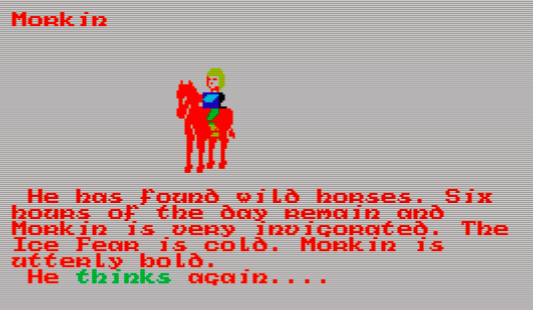
One of the more puzzling aspects of the game to me has to do with character "attributes." There seem to be two basic ones: the character's fatigue level (which also serves as a health meter) and his courage or strength. The former is represented on a scale that starts with "utterly invigorated" and ends at "utterly tired." The second begins at "utterly bold" and ends at "utterly terrified." The courage level seems to be partly an intrinsic variable but partly affected by the presence of Doomdark and his "Ice Fear" ability. I'm not entirely sure. There are a lot of things the manual leaves unanswered. If some characters are otherwise stronger than others, or better leaders, or harder to damage, the specific attributes are left hidden by the game.
         
What Lords does preserve from most RPGs is the joy of discovery. To win the game, you have to map a good portion of those 3,904 squares and annotate what you find there. I initially thought the game would randomize object and ally placement for each new game, but this doesn't seem to be the case. Thus, as you map things, your power grows. You learn where to find key allies and key resources, like Cups of Dreams.
   
I won the game the way I suspect everyone first does: the adventure/Morkin way. Over several games, I mapped a few areas and routes, including most of the borders. It became obvious early that to get Morkin to the Tower of Doom, I'd have to loop him above it and come in from the north, since Doomdark's armies patrol heavily in the south. Going up the west side seemed shorter and safer than cutting across and going up the east. Along the way--basically due north of the Tower of Moon--I met a key ally: the dragon Farflame, who lurks in a ruin in Coroth. Farflame, it turns out, is one of four ways to destroy the Ice Crown. The other three (hinted by NPCs in towers) are to drop it in Lake Mirrow, which I never found; give it to Logrim, who I never found; or give it to the creature Fawkrin (a reformed skulkrin--basically Gollum). The strategy I used was to collect Farflame, continue north long enough to recruit the Lord of Lorothil, send Lorothil to distract Doomdark's armies, and hook Farflame and Morkin up around the Mountains of Ugrak to come in at the tower from the north. Morkin leaves Farflame one square behind while he heads to the tower and grabs the crown; then he returns to Farflame's square and ends the turn, which allows Farflame to destroy it.
         
Finding the Ice Crown is a bit anti-climactic. You just have to reach the tower and search.

The "winning screen."
     
In contrast, I didn't even come close with the armies. Every time I met one of Doomdark's forces in combat, he had an overwhelmingly larger force than I did. I suspect the best strategy is to send one "recruiter" through the keeps as fast as possible, then send each hero and army to a central location so that multiple forces at once can engage Doomdark's allies. Or maybe it's to spend a lot longer recruiting soldiers. (Any keep or citadel can have a hero, and all keeps have soldiers.) From what I've read, players debate to this day the optimal path to victory on the "strategy" side of the game.
     
I'm probably going to want to go around.
      
It's particularly difficult to track where everyone is, since you don't get a campaign map. This is doubtless a limitation rather than a feature, but I admit it creates an interesting challenge. I made my map as a grid in Excel like I usually do, but I used text boxes hovering over the cells to annotate where my heroes were at any given time. To win the game strategically, you probably want to do the same for enemies, also perhaps annotating what keeps you and Doomdark control. Otherwise, it's all too easy to step out of the forest and find a phalanx of horse soldiers waiting for you. 
        
Annotating the squares I've explored, and which ones contain my heroes.
     
Other notes:
   
  • After all your heroes exhaust their movement for the day, you hit "U" to finish your turn, at which point Doomdark goes. I found it awfully easy to accidentally hit "U" when I meant another key.
  • After night passes, the game asks whether you want dawn to break so you can take your turn. Why in the world would you ever say no?
       
Has anyone ever answered "no" to this question? Why?
       
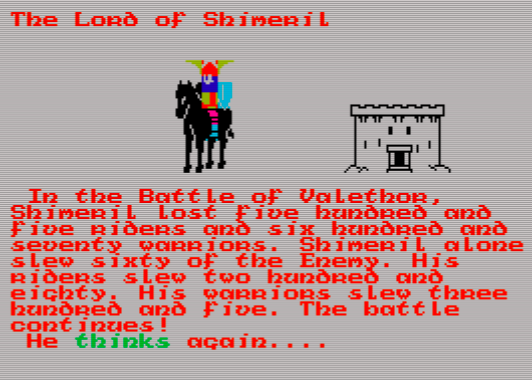
  • You don't actually see battles being fought. You end your turn committing yourself to battle and you start the next turn with the results, which might be a victory, a defeat but the hero is still alive, a defeat with the death of the hero, or the battle is still going on. Just like individual combat with monsters, it's often not clear what factors led to a victory or defeat.
      
A report of a battle in progress.
     
  • Dead heroes don't get removed from the ultimately long list of heroes, so you either have to remember they're dead or skip them manually each turn.
      
My list of heroes seems solid.

But Corleth is already dead.
     
I can't see prioritizing this game over more advanced strategy games of the 1990s, like Warlords, but I do see why ZX Spectrum owners of the 1980s remember it fondly. More important, I see its influence on other games. There's no way the creators of Warlords didn't play it. Some of the faction and place names are the same as in Lords or the sequel. The Kingdom of Krell (1987) would adopt the same use of perspective. More directly, Singleton would apply his strategy game experience in War on Middle Earth (1988). There's a history to that game that hasn't been written, but what I guess is that development started with Singleton in the U.K., and somehow Robert Clardy and Synergistic Software found out about it, and bought the rights to make it for more advanced computers in the U.S. Clardy's version offers a lot of features that Singleton's doesn't, but Singleton's work still would appear to be the genesis of Synergistic's "World Builder" engine.
  
Accounts of Lords' development all say that Singleton (already in his mid-30s at the time) wrote it himself in about three months. He presented the completed result to Beyond for publication. He had a similarly quick turnaround time for Doomdark's Revenge, published the same year, which amps up the complexity and uses a bigger map. A third promised title, The Eye of the Moon, was never completed, but a different sequel--titled simply Lords of Midnight--was published for the PC in 1995. Windows remakes of the original and Doomdark's Revenge were published by GOG in 2013. 
         
The game title was a lot cooler before I found out how literal it was.
     
The original game manuals enticed players to compete in an unusual contest. The game allows players to print each screen with the COPY key. The contest encouraged players to use this feature to assemble a record of a winning game, then send their reams of paper to the publisher. The publisher, in turn, would then hire a fantasy novelist to complete the novella started by Singleton, using the first winning player's screenshots. The winner was promised co-author credit and a share of the royalties. Singleton himself related the rest in a 2004 RetroGamer interview: "The first person to complete the game had actually sent in his roll of thermal paper within about two weeks of the game hitting the shelves, which amazed us all . . . but in the end, no willing publisher was found . . . I know Beyond gave him some sort of other prize but I really can't remember what that was." I find that account a bit unsatisfying. Was self-publishing really such a daunting experience at the time? Ultimately, an "official novel" did come out in 2018, written by English author Drew Wagar, though not based on the original winner's documentation.
   
I'm not sure my coverage has added anything to our collective understanding of this well-covered title (Jimmy Maher's 2014 article is particularly good), but I agree that it is a game that anyone writing about this genre should experience, even if it technically doesn't meet my criteria. I may check out the sequel later this year if time allows.
  

Wednesday, September 1, 2021

Game 431: The Nightmare (1982)

    
The Nightmare
United States
Liberty Software (developer); Epyx (publisher)
Released in 1982 for Atari 800
Date Started: 23 August 2021
Date Ended: 23 August 2021
Total Hours: 2
Difficulty: Very Easy (1/5)
Final Rating: 11
Ranking at Time of Posting: 32/444 (7%)
    
I can't find much on The Nightmare, so let me tell you what I guess about it. First, I guess that it started as a Crystalware game. Crystalware, as you my recall from my 2020 coverage, was a short-lived developer that specialized in quantity over quality. All of their games have a similar look and feel, blending action, adventure, and RPG elements without fully satisfying in any of those three areas. Marc Russell Benioff, who went on to found Salesforce and make billions, was one of Crystalware's programmers, responsible for Quest for Power (1981), The Forgotten Island (1981), and a few other titles. Liberty Software was Benioff's label.
    
A new game begins. There's no character creation.
      
Crystalware started to fall apart around 1982, and Automated Simulations acquired their catalog just as Automated Simulations was changing its name to Epyx. They re-released most of the Crystalware games under new names. For instance, Quest for Power became King Arthur's Heir, and The Forgotten Island became Escape from Vulcan's Island. I can't find any Crystalware precursor for The Nightmare, so I would guess that it was still under development when Crystalware made the hand-off.
   
The Nightmare is the typical Benioff/Crystalware game with the typical Epyx overproduction. That company could make you think a dog turd was a filet mignon. They would take 200 lines of code and accompany it with a 23-page manual full of evocative artwork, quotes from classic literature, and an elaborate framing story. The gameplay experience must have been a let-down for a lot of contemporary players, but the ride home from the computer store must have been epic. In this case, the manual is full of quotes about nightmares and death from Ambrose Bierce, Shakespeare, Dylan Thomas, and "a tombstone in Painswick Churchyard, Gloucester, England." Grotesque, gothic images, some from classical sources I can't identify, accompany the text.
      
A well-designed box suggests a quality of gameplay that isn't here.
     
In reality, there's nothing so nightmarish about gameplay. The setup of The Nightmare is that you're having a nightmare about being trapped in a castle. You have eight hours (real-time) to escape or your nightmare will become reality, and you'll be trapped there forever. The castle has four levels, and you maneuver your little icon through its rooms and corridors with the joystick. There are no keyboard controls. The joystick button calls up a small menu in which you can check your inventory and single "power" statistic.
   
All you have to do is wander around the castle collecting objects. Each floor has a bunch of rooms--their names spelled out on the screen--and about one-tenth of them have something in them. (Examples: Armory, Supply Room, Cloak Room, Lounge, Trophy Room, Annex, Laboratory, Royal Crypt.) Most objects give you access to another room in turn. There are no adventure-game style puzzles here. If you have the right object in your inventory, you can walk through the door or past the guardian that it allows you to pass. The floors aren't very big, and you don't have to map them.
       
The graphics aren't bad, but you can't do anything here.
 
There are exactly three enemies in the game: a rat pack in the dungeon, a "mistress" on the second floor, and a ghost on the third floor. Killing the first one is tough with your starting power of 100, but my experience is that once you've killed the first one--which boosts your power over 200--than the other ones are pretty easy. To really hedge your bets, you can just run from them until you get one of the weapons, after which you're invincible. If you do die, you can "reincarnate" with no items (so I don't know why you wouldn't just start over) or reload, since you can save anywhere.
     
Attacked by a rat pack that looks like a turtle.
     
I won in less than two hours--I can't imagine anyone needing the full eight--and most of that was backtracking. I think the winning sequence was:
    
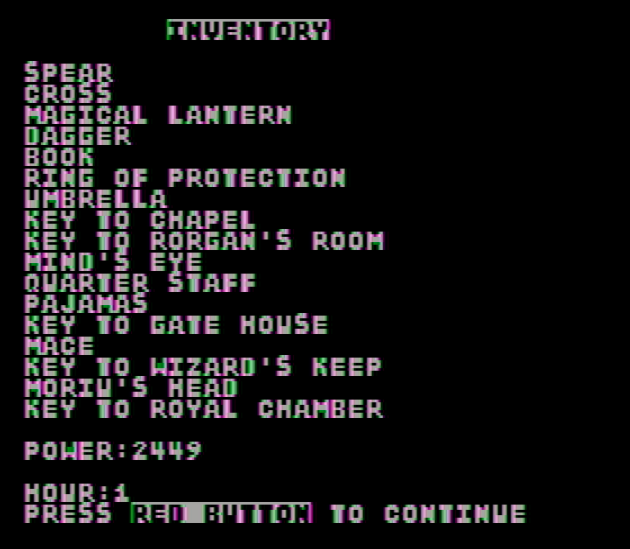
  • Get Moriu's Head in the unlocked Headsman's Room (basement)
  • Get the key to the royal chambers in the Key Room (basement)    
  • Enter Queen's Royal Chambers with key to royal chambers and get umbrella (second floor)
  • Enter Bird Room with umbrella and get key to chapel (third floor)
  • Enter Chapel with chapel key and get cross (first floor) 
  • Enter Vampire's Lair with cross and get dagger (second floor)
  • Get the key to the wizard's keep in the Headsman's room (basement)
         
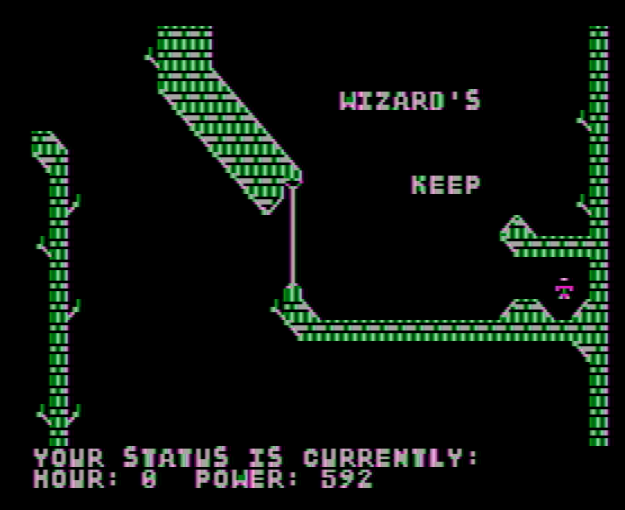
I pick up a key. Another item awaits to my east.
       
  • Enter Wizard's Keep with key and get quarterstaff (third floor) 
  • Get past first and second guardians in Tunnel of Death with the quarterstaff and dagger, get key to Rorgon's Room (third floor)
  • Enter Rorgon's Room with the key, get the key to the gatehouses and the can of mace (basement)
  • Enter gatehouses on first floor and get spear and magic lantern (first floor)
  • Enter Storage Room with magic lantern and get ring of protection (second floor)
    
There is one "side issue": In the Library on the second floor, you find a book. Reading the book (there's a menu command specifically for this) brings up some text that says, "Bath Keeper's Warning: Beware of the Psycho!" If you don't heed this warning and accidentally wander into the bath chamber on the second floor, a "psycho" appears and automatically kills you. You have no ability to move or take any other action.
     
A "psycho" kills me in the bath. That's original.
     
I never figured out what a pair of pajamas in the Royal Crypt got me, but other than that, it's just about finding the right items in sequence. Once you have everything, you got to the third floor, where there's a small mazelike room that the manual calls the "Tunnel of Doom." It has four guardians, and some combination of items--I would guess quarterstaff, dagger, spear, and Moriu's Head--gets you past them. (The guardians aren't enemies. They don't fight. They're like locked doors; they block you if you don't have the right item and let you through if you do.) Maybe the can of mace is important instead of one of the other weapons.
    
I lack the right item to get past this guardian.
    
The Ring of Protection sees you through a final barrier, and then you pick up your Mind's Eye.
      
I don't even know what that means.
      
Taking this back to the entry on the first floor triggers the "congratulations" screen.
      
I guess there was one ghost, but otherwise nothing "haunted" about it.
      
Both of Benioff's previous games featured the same limited, short, easy gameplay. It's too bad because there's a lot of potential in these graphics and room names. With a little text, some more complex controls, more frightening enemies, and a puzzle or two, Epyx could have had a decent adventure-RPG hybrid. There were even Crystalware titles like House of Usher (1980) that could have served as models. 
   
In a GIMLET, it earns:
   
  • 1 point for the game world. It's not much of a setup. They could have come up with a dozen other reasons why a character would have to escape a medieval castle other than "he's having a bad dream."
  • 1 point for character creation and development. That's generous. The "power" statistic doesn't do that much for you.
         
My "power" goes up as I find a new weapon.
      
  • 0 points for no NPCs.
  • 1 point for encounters and foes. That's for the inventory puzzles.
  • 1 point for magic and combat. The simple power comparison and dice rolls aren't worth more.
     
The three combats are resolved based on your "power" and random rolls.
      
  • 1 point for equipment, which adds to your power.
  • 0 points for no economy.
      
My endgame inventory and power.
   
  • 2 points for a main quest.
  • 2 points for graphics, sound, and interface. The graphics actually have some promise. While I normally don't like the joystick, it works okay for such a simple interface. I must not have sound configured correctly in Altirra because I didn't hear anything, whereas a video online indicates that it has various dits and boops.
  • 2 points for gameplay. It gets that for being over quick. It's otherwise linear, not replayable, and far too easy.
    
That gives us a final score of 11, 1 point higher than I gave Benioff's two previous games (this one had slightly better graphics). His talents clearly lay in another industry.

***

Edit: In an article on his blog, El Explorador de RPG suggests that this game probably originated as Glamis Castle, a planned epic title from John and Patty Bell of Crystalware. In a Crystalware newsletter, John Bell announced that he planned to visit the Scottish castle on a trip to the United Kingdom and that the game would use layouts and photographs from the real castle in the game. Either the trip never happened or Bell couldn't incorporate the new material before Crystalware fell apart.