|
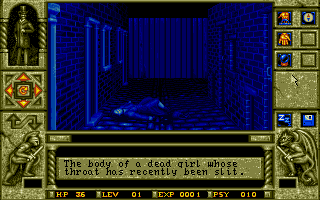
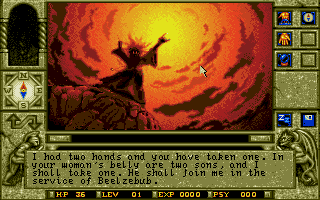
| The party has gotten strong enough to challenge a demon. |
Darklands introduces a combat system that I find hard to call "good," and yet it's perhaps a necessary stopover point to a truly good system. It probably took an RPG outsider like MicroProse to think of it. Every other U.S. title, if it had any complexity to combat at all, showed slavish adherence to a very few precursors: the abstract turn-based system of Wizardry, the action-oriented attack-and-cool-down system of Dungeon Master, and the tactical grid of Ultima IV-V and the Gold Box series.
Still, the Darklands system has a few antecedents. It is perhaps closest to Drakkhen (1989), which had a "studio" perspective. The moment combat began, characters carried out actions as previously set by the player. The player could change actions in the middle of combat, but he had no way to pause and think while doing so. Ultima VI also offers some hints of the Darklands system, with the player able to set computer or manual control, as well as general combat strategies, for each character. We should also note that the British Legend (1992) had characters mostly act on their own. The player could pause to consider new tactics but could not issue commands while paused.
Darklands is the first game to combine all of these elements: a) independent character action in the absence of specific orders; b) combat in which the player sets general strategies and targets but otherwise mostly watches the action; and c) the ability to pause combat to issue new orders. I believe the style would reach its zenith in the Infinity Engine games, although there are so many titles from the post-1990 period that I haven't played that I'm open to the possibility there are even better ones.
 |
| Assessing my enemy, which in this case is a bear. |
Combat begins paused, with the party grouped in a standard formation and the enemy often off-screen. The player can choose "Enemy Info" to see what types of enemies he faces, but I don't think there's really any way to gauge how many there are. It also doesn't tell you anything about their hit points. At the outset of combat, characters don't do anything on their own unless an enemy attacks them in melee range.
Once you see the enemy, you can select each character and then issue an order: walk somewhere, flee somewhere, throw a potion, fire a missile weapon, or perform one of four types of melee attacks: a defensive parry, a standard attack, an attack that tries to seek vulnerable areas on the enemy, and an all-out "berserk." You can cycle through the characters, assigning a different action to each. Hitting the SPACE bar then un-pauses combat and the actions execute.
Characters have minds of their own, both fortunately and unfortunately. On the positive side, they're smart enough to switch to a melee attack if an enemy comes into melee range, and they usually choose the best one based on their current endurance and strength, their weapon, and the enemy's armor. For instance, if the character has a short sword, a "berserk" attack would be wasted on an enemy in plate armor. Instead, it makes more sense to restrain yourself and wait for a vulnerable spot. Characters are also smart enough to target a new enemy once the current enemy is dead.
There are times I don't even need to participate in combat. If I get attacked by thieves in an alleyway at night, I just let them come to me, activate my characters, and my characters' AI does the rest. Enemies, for their part, never seem to concentrate attacks on a single character the way it would make sense to do. They always try to engage everyone.
At any point during combat, you can enter the characters' sheets, switch equipment, pray for saintly aid, and drink potions. Those don't even seem to count as actions.
So far, this doesn't sound too bad, but there are numerous problems with Darklands' nascent approach.
I also don't particularly like the system by which current strength and endurance serve as your pool of hit points and stamina, respectively. It hardly seems worth micromanaging the characters' armor to avoid encumbrance when losing a few hit points in combat knocks down their strength and leaves them encumbered anyway. In fact, although encumbrance supposedly hurts weapon speed and skill, I'm beginning to think that it's worth having encumbered characters (even at maximum strength) just to gain the benefits of the better armor.
Let's talk more about magic. It's a pain in the neck. If I want to mix up a batch of five "Thunderbolt" potions, which act a bit like fireballs, it's a long process. First, I have to know the formula. If I don't know it at the start of the game, I have to purchase or trade for it with an alchemist. Alchemists are irritable bastards who frequently tell you to buzz off every time you ask for anything, and if that happens, you can't visit them again (in the same town) for a couple of days.
Assuming you get the formula, you then have to get the ingredients. Although a lot of places sell them, I always seem to be low on one reagent or another. In particular, "Aqua Regia," which almost every potion uses, seems to be in short supply.
Then you have to take the time to mix them. You can mix a couple of potions per day depending on skill, and there's a chance that the mixture may fail. There's also a chance that it might blow up and damage you.
But assuming you get past all this, congratulations, you have three "Thunderbolt" potions, which will last only about five minutes in a tough combat (assuming you can even get a clear shot) and will collectively do as much damage as a first-level casting of "Fireball" in a Dungeons and Dragons game. Yes, I know that the potions get more effective as your skill goes up, but training skills is a pain in the neck, too. You have to get a trainer to agree to train you, then take the time each day and pay the fee, and you maybe get a 1 point increase every 4-5 days that you pay, and the trainer disappears after a couple of weeks, forcing you to enlist him again.
Having used a lot of potions in combat in this last session, my considered opinion is:
1. You're better off just buying potions instead of buying ingredients and then trying to make potions. Yes, they cost a lot of money. That's what all the quests are for. Plus, it gives you a reason to keep looting equipment from the battlefield.
2. You're better off focusing on defensive potions. I've found a lot of the buffing potions helpful, such as "Deadly Blade" (improves weapon damage), "Strongedge" (improves penetration), "Great Power" (increases weapon quality), "Hardarmor" (increase armor quality), "Ironarm" (increases strength), "Quickmove" (increases agility), and "New Wind" (increases endurance). Most useful of all is "Essence of Grace," which restores endurance and strength, and is thus equivalent to the standard "healing potion" of other RPGs.
I should mention that potions are also often used from menus, as a solution to various puzzles and to get you out of various situations, so it's good to have a few bottles of just about every potion for that reason. "Thunderbolt," for instance, works as a kind of demolition spell if you need to destroy a pagan altar or break the wall of a crypt.
I began this long session continuing my movements around the landscape, solving quests and engaging in random combats. Everyone's "Impact Weapons" skill neared 99. I made fortunes in florins, spent them, and made them again. I've learned dozens of saints, but I still can't find any place to teach me of St. Wenceslaus, which means I still have to deal with the Wild Hunt practically every time I'm outdoors.
I think I got a bead on the main quest when I visited a random hut and found a woman performing satanic rituals. After defeating her pet wolves, the party captured her and had various options, one of which was to "reveal the time and place of the witch cult's next High Sabbat." She told me it was on 26 December, south of Salzburg. It was 31 October at the time. I checked the map and saw that Salzburg was pretty far to my southeast, but I figured I could just make it.
When I got to the area, snow was on the ground. South of Salzburg, the only structure I could see was a castle. When I tried to approach, I got a message that "The First seal is intact. The Castle of the Apocalypse is secure," and I was unable to approach closer than that. Nothing changed on 26 December itself.
I wasn't sure if the witches were meeting somewhere else nearby or if I just didn't have some precursor item to get into the castle. I reloaded to before 26 December and dithered around looking for it for a while, but I have a lot of trouble picking out structures on the overland map even when the ground is clear. Finally, I had my party mess around for three months until the snow cleared, at which point I could see some kind of building or monument to the west of the castle. Reloading, I headed for that area on 26 December.
Pretty soon, I had infiltrated the large gathering of the witch cult. I got there early, and there were a couple of days where I had the option to investigate various witch activities like cannibalism, flying broomsticks, and participating in a mock baptism ceremony. I could participate in these things (for a loss of virtue) or try to sabotage them; for instance, by freeing the captives intended for the evening meal. There were a lot of skill checks during this process, and I confess that I reloaded a few times just because I wanted to see how different options played out.
On Christmas night, the party had a vision in which someone said, "You must find the location of the fortress monastery. This is the next step of your quest."
The next day, the gathering culminated in the summoning of a demon. We tried to sabotage the altar but it didn't seem to work. We decided to let the demon appear and then attack it. I fully expected to have to reload, but the demon was actually pretty easy. A lot harder were the waves of witches that followed. We must have killed 50 of them. When the battle was over, we purified the site, found an evil book, and destroyed it to break the first seal.
As for the "fortress monastery," its location was given during the ritual when the high priest made reference to it, and someone else shouted out, "The Great Monastery--isn't that northwest of Flensburg?" The funny thing is, I had already found it, way back in my first session with the game, when I got attacked and slaughtered by some Templars.
Flensburg was at this point at the opposite end of the map, so I headed that direction on a round-about route, turning in quests as I went. On the way, I finally solved one of the mine quests, near Breslau. Unlike the one I failed, which involved a demonic gate deep in the mine, this one was much simpler: the kobolds were rebelling against their dwarven slavemasters, and the conflict had boiled up to the upper levels.
Both parties wanted my assistance. I chose to help the kobolds for some reason. Probably because I found the entrance to the dwarven region first. After I killed a bunch of dwarves and subdued the leader, the kobolds gave me a bunch of reagents and my fame went up by about 30.
As I noted in a previous entry, indoor exploration is like being in combat mode permanently, except that when no enemies are on the screen, you are able to move the party as a unit. There are also other exploration-related commands such as open door, pick lock, and disarm trap. The latter only works on chest and door traps; it appears that the floor traps cannot be disarmed and simply have to be avoided.
Such indoor exploration is used in a lot of places in the game, including some of the minor crypt/altar quests where you have to retrieve an item, and the robber knight quests when you decide to just attack the castle rather than sneak in or call the robber knight out.
As I made my way to Flensburg, I started to notice that combats were a lot harder. Battles against enemies that hardly damaged me before were now leaving me laid up for two weeks in the next town. I'm not sure if the game kicks up the difficulty after the witch quest or something.
Whatever the case, I thought I was prepared to take on the Templars, and boy was I wrong. The fortress is very large, with numerous staircases up and down, and I'd barely explored a fraction of it before I exhausted my potions. Even with plate armor and 99 skill with his weapon, my lead character got torn apart by the Templars, and my other three fared even worse. It's clear that I'm going to have to do a lot more grinding before taking on this fortress. In particular, I need to improve my missile weapon skills; I bought everyone pistols and shot, but they suck with them. I bet if I get those to 99 and fire off a few volleys before the Templars enter melee range, it will make a difference.
I also need to build my finances and buy a lot more potions. I'm thinking that every character is going to need 50 "Essence of Grace" potions or more before I try the temple again, plus lots of other buffing potions. Until now, the game had lured me into thinking that combat was easy, but now it's clear that I'm going to need to take another review of the tactics.
Before I go, I have some information for Jakub Majewski, who asked me to visit Thorn and Bromberg on the far east side of the empire. Thorn is ruled by a vogt under the Teutonic Knights. Its political area is called the markt, and there's a fortress overlooking the city called the Altes Schloss. The Rathaus is the central market, and the inn is the Gasthaus. There is a dom plus a church of St. Jakobi and a monastery called the Deutschherrenhaus ("German men house?"). I didn't see any other special locations.
Bromberg is "a small city with a population mixture of Poles and Germans." It is ruled by a burggraf for the Teutonic Knights. The political center is called the stadtplatz and the fortress is just "the burg." The central market is the markt and the inn is again the Gasthaus. Churches are just a generic kirche and a kloster.
That's all probably disappointing in its non-specificity, but at least it's fun to see your hometown in a game. I never get sick of the "Far Harbor" expansion to Fallout 4.
Time so far: 48 hours
Once you see the enemy, you can select each character and then issue an order: walk somewhere, flee somewhere, throw a potion, fire a missile weapon, or perform one of four types of melee attacks: a defensive parry, a standard attack, an attack that tries to seek vulnerable areas on the enemy, and an all-out "berserk." You can cycle through the characters, assigning a different action to each. Hitting the SPACE bar then un-pauses combat and the actions execute.
 |
| Bianca is in the middle of reloading her gun as I switch her to a melee attack. Note the symbols in the lower left of each character. Maximian is executing a regular attack; Lambert a vulnerable attack, and Viridia is walking to her target. |
Characters have minds of their own, both fortunately and unfortunately. On the positive side, they're smart enough to switch to a melee attack if an enemy comes into melee range, and they usually choose the best one based on their current endurance and strength, their weapon, and the enemy's armor. For instance, if the character has a short sword, a "berserk" attack would be wasted on an enemy in plate armor. Instead, it makes more sense to restrain yourself and wait for a vulnerable spot. Characters are also smart enough to target a new enemy once the current enemy is dead.
There are times I don't even need to participate in combat. If I get attacked by thieves in an alleyway at night, I just let them come to me, activate my characters, and my characters' AI does the rest. Enemies, for their part, never seem to concentrate attacks on a single character the way it would make sense to do. They always try to engage everyone.
 |
| Two groups of witches. Viridia is about to throw a potion on the group to the west (off-screen). |
At any point during combat, you can enter the characters' sheets, switch equipment, pray for saintly aid, and drink potions. Those don't even seem to count as actions.
So far, this doesn't sound too bad, but there are numerous problems with Darklands' nascent approach.
- Characters don't obey. If I want a character to leave his current opponent and run across the battlefield to engage a different opponent (for instance, to save a weak character), I'm out of luck. Characters might accept my choice of two targets within melee range but they almost never leave melee range to go fight someone else. Sometimes I have luck getting them to "flee" in a particular direction, then re-engaging, but that's a lot of micro-managing.
- There's no way to select all or multiple characters at once. This was a major benefit of the Infinity Engine games. If you wanted all six of your characters to fill a particular target full of arrows, you just had to select all of them and then execute a joint command. Here, everyone has to be tasked separately.
- Actions unselect characters. Let's say I want a character to walk to a particular point, then turn around and throw a potion. I can specify the first action, but then hitting SPACE de-selects the character and I have to select him again to perform the second action once he gets where he's going. Another way to say this is that the very act of selecting a character pauses the action. In the Infinity Engine, pause was separated from selecting and issuing orders.
- The game is very literal about vision paths. You can't toss a potion above the heads of other characters or fire a missile weapon just over a companion's shoulder. Any use of a ranged weapon has to have an absolutely clear shot to the enemy. This makes missile weapons a lot less useful than they could be. For instance, you can't have your lead character block a doorway, fighting oncoming enemies one-by-one while your rear characters fill them full of holes. They'll refuse to shoot with the lead character in the way.
 |
| Viridia can't target this potion because Winchester is standing in front of her. |
- The game is equally literal about movement paths. In the Infinity Engine, characters had no problem nudging each other out of the way. Here, you get tangled up into clumps all the time and you have to carefully pick them apart so everyone can move.
- Everything is really slow, especially when there are a lot of enemies on the screen. You can crank up the DOSBox cycles to speed things up but then you run the risk of the game over-reading key inputs and accidentally drinking two potions and such.
- There's no way to keep a character completely out of combat. Enemies will lock onto him and chase him to the ends of the world. In such cases, you hope that your endurance runs out before your strength. If your endurance runs out, you just collapse and are revived at the end of combat. If your strength runs out, you die.
- Potions are not exactly spells. I'll cover this in more detail in a minute.
I also don't particularly like the system by which current strength and endurance serve as your pool of hit points and stamina, respectively. It hardly seems worth micromanaging the characters' armor to avoid encumbrance when losing a few hit points in combat knocks down their strength and leaves them encumbered anyway. In fact, although encumbrance supposedly hurts weapon speed and skill, I'm beginning to think that it's worth having encumbered characters (even at maximum strength) just to gain the benefits of the better armor.
 |
| Targeting a demon with a pistol. |
Let's talk more about magic. It's a pain in the neck. If I want to mix up a batch of five "Thunderbolt" potions, which act a bit like fireballs, it's a long process. First, I have to know the formula. If I don't know it at the start of the game, I have to purchase or trade for it with an alchemist. Alchemists are irritable bastards who frequently tell you to buzz off every time you ask for anything, and if that happens, you can't visit them again (in the same town) for a couple of days.
Assuming you get the formula, you then have to get the ingredients. Although a lot of places sell them, I always seem to be low on one reagent or another. In particular, "Aqua Regia," which almost every potion uses, seems to be in short supply.
 |
| I was lucky to find it here. |
Then you have to take the time to mix them. You can mix a couple of potions per day depending on skill, and there's a chance that the mixture may fail. There's also a chance that it might blow up and damage you.
But assuming you get past all this, congratulations, you have three "Thunderbolt" potions, which will last only about five minutes in a tough combat (assuming you can even get a clear shot) and will collectively do as much damage as a first-level casting of "Fireball" in a Dungeons and Dragons game. Yes, I know that the potions get more effective as your skill goes up, but training skills is a pain in the neck, too. You have to get a trainer to agree to train you, then take the time each day and pay the fee, and you maybe get a 1 point increase every 4-5 days that you pay, and the trainer disappears after a couple of weeks, forcing you to enlist him again.
 |
| Getting ready to toss a potion at a group of Templars. |
Having used a lot of potions in combat in this last session, my considered opinion is:
1. You're better off just buying potions instead of buying ingredients and then trying to make potions. Yes, they cost a lot of money. That's what all the quests are for. Plus, it gives you a reason to keep looting equipment from the battlefield.
2. You're better off focusing on defensive potions. I've found a lot of the buffing potions helpful, such as "Deadly Blade" (improves weapon damage), "Strongedge" (improves penetration), "Great Power" (increases weapon quality), "Hardarmor" (increase armor quality), "Ironarm" (increases strength), "Quickmove" (increases agility), and "New Wind" (increases endurance). Most useful of all is "Essence of Grace," which restores endurance and strength, and is thus equivalent to the standard "healing potion" of other RPGs.
 |
| "Truesight" is particularly valuable for dungeon exploration. |
I should mention that potions are also often used from menus, as a solution to various puzzles and to get you out of various situations, so it's good to have a few bottles of just about every potion for that reason. "Thunderbolt," for instance, works as a kind of demolition spell if you need to destroy a pagan altar or break the wall of a crypt.
I began this long session continuing my movements around the landscape, solving quests and engaging in random combats. Everyone's "Impact Weapons" skill neared 99. I made fortunes in florins, spent them, and made them again. I've learned dozens of saints, but I still can't find any place to teach me of St. Wenceslaus, which means I still have to deal with the Wild Hunt practically every time I'm outdoors.
I think I got a bead on the main quest when I visited a random hut and found a woman performing satanic rituals. After defeating her pet wolves, the party captured her and had various options, one of which was to "reveal the time and place of the witch cult's next High Sabbat." She told me it was on 26 December, south of Salzburg. It was 31 October at the time. I checked the map and saw that Salzburg was pretty far to my southeast, but I figured I could just make it.
 |
| I think I see the loophole in the first one. |
When I got to the area, snow was on the ground. South of Salzburg, the only structure I could see was a castle. When I tried to approach, I got a message that "The First seal is intact. The Castle of the Apocalypse is secure," and I was unable to approach closer than that. Nothing changed on 26 December itself.
 |
| We're just here to listen to the music of the night. |
I wasn't sure if the witches were meeting somewhere else nearby or if I just didn't have some precursor item to get into the castle. I reloaded to before 26 December and dithered around looking for it for a while, but I have a lot of trouble picking out structures on the overland map even when the ground is clear. Finally, I had my party mess around for three months until the snow cleared, at which point I could see some kind of building or monument to the west of the castle. Reloading, I headed for that area on 26 December.
Pretty soon, I had infiltrated the large gathering of the witch cult. I got there early, and there were a couple of days where I had the option to investigate various witch activities like cannibalism, flying broomsticks, and participating in a mock baptism ceremony. I could participate in these things (for a loss of virtue) or try to sabotage them; for instance, by freeing the captives intended for the evening meal. There were a lot of skill checks during this process, and I confess that I reloaded a few times just because I wanted to see how different options played out.
 |
| Different options for messing around with the witches. |
On Christmas night, the party had a vision in which someone said, "You must find the location of the fortress monastery. This is the next step of your quest."
The next day, the gathering culminated in the summoning of a demon. We tried to sabotage the altar but it didn't seem to work. We decided to let the demon appear and then attack it. I fully expected to have to reload, but the demon was actually pretty easy. A lot harder were the waves of witches that followed. We must have killed 50 of them. When the battle was over, we purified the site, found an evil book, and destroyed it to break the first seal.
 |
| Solving the quest came with significant virtue rewards. |
As for the "fortress monastery," its location was given during the ritual when the high priest made reference to it, and someone else shouted out, "The Great Monastery--isn't that northwest of Flensburg?" The funny thing is, I had already found it, way back in my first session with the game, when I got attacked and slaughtered by some Templars.
 |
| There it is just to the northwest of the city. It couldn't be more obvious. |
Flensburg was at this point at the opposite end of the map, so I headed that direction on a round-about route, turning in quests as I went. On the way, I finally solved one of the mine quests, near Breslau. Unlike the one I failed, which involved a demonic gate deep in the mine, this one was much simpler: the kobolds were rebelling against their dwarven slavemasters, and the conflict had boiled up to the upper levels.
Both parties wanted my assistance. I chose to help the kobolds for some reason. Probably because I found the entrance to the dwarven region first. After I killed a bunch of dwarves and subdued the leader, the kobolds gave me a bunch of reagents and my fame went up by about 30.
 |
| The dwarven king had a poetic surrender. |
As I noted in a previous entry, indoor exploration is like being in combat mode permanently, except that when no enemies are on the screen, you are able to move the party as a unit. There are also other exploration-related commands such as open door, pick lock, and disarm trap. The latter only works on chest and door traps; it appears that the floor traps cannot be disarmed and simply have to be avoided.
Such indoor exploration is used in a lot of places in the game, including some of the minor crypt/altar quests where you have to retrieve an item, and the robber knight quests when you decide to just attack the castle rather than sneak in or call the robber knight out.
As I made my way to Flensburg, I started to notice that combats were a lot harder. Battles against enemies that hardly damaged me before were now leaving me laid up for two weeks in the next town. I'm not sure if the game kicks up the difficulty after the witch quest or something.
 |
| Approaching the Templar fortress. |
Whatever the case, I thought I was prepared to take on the Templars, and boy was I wrong. The fortress is very large, with numerous staircases up and down, and I'd barely explored a fraction of it before I exhausted my potions. Even with plate armor and 99 skill with his weapon, my lead character got torn apart by the Templars, and my other three fared even worse. It's clear that I'm going to have to do a lot more grinding before taking on this fortress. In particular, I need to improve my missile weapon skills; I bought everyone pistols and shot, but they suck with them. I bet if I get those to 99 and fire off a few volleys before the Templars enter melee range, it will make a difference.
I also need to build my finances and buy a lot more potions. I'm thinking that every character is going to need 50 "Essence of Grace" potions or more before I try the temple again, plus lots of other buffing potions. Until now, the game had lured me into thinking that combat was easy, but now it's clear that I'm going to need to take another review of the tactics.
 |
| Each one of these guys is at least as hard as a robber knight. They all have plate and two-handed swords. And there are multiple rooms full of them. |
Before I go, I have some information for Jakub Majewski, who asked me to visit Thorn and Bromberg on the far east side of the empire. Thorn is ruled by a vogt under the Teutonic Knights. Its political area is called the markt, and there's a fortress overlooking the city called the Altes Schloss. The Rathaus is the central market, and the inn is the Gasthaus. There is a dom plus a church of St. Jakobi and a monastery called the Deutschherrenhaus ("German men house?"). I didn't see any other special locations.
 |
| Approaching Thorn. |
Bromberg is "a small city with a population mixture of Poles and Germans." It is ruled by a burggraf for the Teutonic Knights. The political center is called the stadtplatz and the fortress is just "the burg." The central market is the markt and the inn is again the Gasthaus. Churches are just a generic kirche and a kloster.
 |
| Main street options in Bromberg. |
That's all probably disappointing in its non-specificity, but at least it's fun to see your hometown in a game. I never get sick of the "Far Harbor" expansion to Fallout 4.
Time so far: 48 hours