Tuesday, January 9, 2018

Shadow Keep: Splish Splash

The Shadow Keep overworld.
      
If my wife ever needs evidence necessary to secure an involuntary psychiatric commitment, she probably won't have to go much further than the map I made of Shadow Keep's game world. I did it over about four hours, by taking individual screenshots of the small map window and assembling them together. (I did the same thing, although less extensively, for Skariten.) For anyone trying to do this yourself, don't try to make the edges line up. That's a recipe for madness. Instead, find physical feature like trees that you can put at the edge of each new screenshot, carefully positioning it to overlap the same features on previous shots. Even then, you have to allow that the map will get out-of-whack. Individual mis-aligned pixels add up fast.

There's no need for this kind of precision, and yet I chafe at the inaccuracies inherent in trying to do a rough sketch by hand. It's a source of constant anxiety whenever I play a top-down game with no automap. Even the roughest paper map in the game documentation is like a balm on that angst, but Shadow Keep didn't supply one.

The exercise was ultimately worth it. Not only did I find all the key locations in the game world, the combats I fought during the experience brought my martial skill to Level 9 and provided me enough gold to buy the best available equipment.
         
One guess why it's called "Sea of Serpents."
      
The Shadow Keep game world is a large portrait-oriented rectangle with the titular Shadow Keep in the far northwest. A river and lake system winds through the map's center. The largest lake is called the Sea of Serpents, and an island in the middle holds a cave that's probably the final dungeon of the game; the Evil Overlord is rumored to be in there.

A small village southwest of Shadow Keep has a general store. There's a second village, populated by gnomes, in the upper-middle of the map, just to the west of a river. It has an inn, an arms and armor shop, and a hidden entrance to the Labyrinth.
         
It's -5F here in Maine right now. This inn looks cozy.
      
East of the Sea of Serpents is a potion shop. Fortunately, vials of antidote for scorpion and giant spider venom cost just about as much as those creatures drop, so even though I had to return multiple times to stock up, it wasn't a large net blow to my finances.
        
Finding the magic shop was a god-send.
       
The southwest corner has a cemetery with an entrance to the Catacombs. There's an unnamed cave (that no one has mentioned in dialogue) amid a small cluster of mountains south of the Sea of Serpents. In a western mountain range is a weird valley with four bird totems, but I can't find anything happening there. 
     
An inset from the map showing the mysterious "totem valley."
     
There are Temples of Life (from which the Ankh was stolen, precipitating the current quest) and Strength to the southeast and northeast, respectively. I feel like there ought to be a third temple, a Temple of Magic, somewhere, but the only possible location is in the middle of an eastern lake. So far, I haven't been able to snag a boat to see if there's anything in there.
          
I get a spell for donating at the temple.
       
Combats were frequent during my journeys. Giant octopuses swarmed the ocean edges of the map as well as the lakes and rivers, and giant serpents were rife in the inland waterways. I decided early on not to waste my health and resources on combats that didn't deliver any gold, if I could avoid them. Land-based combats, which are harder to avoid, include giant vultures, goblins, tree creatures, cyclopes, giant scorpions, and giant spiders. The latter two inevitably result in poison.

Pirate ships are a useful enemy. Defeating them not only carries a large gold reward but also gives you the ship. Unfortunately, unlike the Ultima variety, these ships don't have cannons. They also have a way of disappearing when you stray too far away. They're necessary to explore islands and at least one mountain-ringed area accessible only by water. So far, I haven't seen any in the exterior ocean, nor in the small eastern lake.
       
I acquire a ride.
     
Enemies are frequent but not overwhelming, so mostly I was able to wait and heal when my health got too low. The gold from my victories enabled me to upgrade to a full long sword, a plate helmet, and plate mail, plus keep me stocked with health potions and antidotes. The heavier armor depletes my "strength" bar faster, but even an empty bar doesn't stop you from fighting. You just do less damage and miss more often.

You have to be careful not to attack everyone, because you do meet wandering NPCs in the wild.
       
A helpful elf gives me a key clue.
     
It wasn't until late in the session that I realized I'd been neglecting the game's magic system. Every time I found a scroll, I figured it was a one-use item and kept it in reserve. It turns out that possession of a scroll allows you to cast it as many times as you want, up to the limit of your magic bar (which, like health, slowly recharges). Once I realized what an idiot I'd been, I started making liberal use of "Heal" and "Nourish." Spells I've bought or found but haven't used include "Lightning Bolt," "Freeze," "Turn Undead," and "True Sight."

When I was done mapping the outdoors, I bought a bunch of potions and headed for the dungeon beneath the castle. I didn't bother to map it, but it consists of perhaps a 10 x 10 grid of large rooms swarming with beholders (which drain magic), giant bats, giant spiders, and giant scorpions. At first, I tried to kill them all, but I soon realized that they were respawning as fast as I was slaying. Ultimately, you end up running past a lot of enemies, only fighting when they're literally blocking you.
        
In the midst of the dungeon, among the rewards of two slain enemies. I have to be careful not to walk on those poison bottles.
     
The developer made the dungeon rooms all the same size, with exits in every direction, but blocked off a lot of the exits with poison bombs. As far as I know, there's no way to "clear" those. Ultimately, I emerged from the dungeon with the Sacred Bone, which I need to pass a "guardian" somewhere. I later realized that I never found an NPC named "John," but to do so I need the "True Sight" spell. I suppose I'll have to make another visit.

Among the NPCs in the villages, I learned that the Black Sword is hidden in the Valley of the Unicorn, in the northeast region of Far Land. To get to Far Land, I'll need to traverse the catacombs, but I need a magic amulet before I do that. I'm not sure where that is, but the Catacombs or the random cave is a good bet.

Meanwhile, I'm told that mermaids know how to defeat the Evil Overlord. There's a mermaid in the north sea bobbing about, but she never comes close enough to land that I can talk to her. I need to find out how to reach her.
            
Hey! Come ashore!
          
Depending on how large the other dungeons are, the game is shaping up to be just about the right length. Combat is too boring and character development too minimal to sustain a very long RPG, but if the developer manages to wrap it up before the 15-hour mark, it will be a satisfying little diversion.

Time so far: 7 hours
    

Saturday, January 6, 2018

Game 277: The Tower of Myraglen (1987)

      
The Tower of Myraglen
United States
PBI Software (developer and publisher)
Released in 1987 for Apple IIGS
Date Started: 31 December 2017
Date Ended: 2 January 2018
Total hours: 8
Difficulty: 3/5 (Moderate)
Final Rating: 25
Ranking at Time of Posting: 117/282 (41%)
     
The occasional short action-oriented top-down arcade-style dungeon-crawler offers a nice change of pace. In this case, the change of pace was so welcome that I got to the end before reflecting that the game really isn't an RPG. It fails all three of my core criteria: the only character development is through acquisition of weapons and armor, those items automatically replace inferior ones, and there's no other determinant of combat effectiveness.

And yet, the game shows a certain RPG root. This makes sense, because author Richard Seaborne originally conceived it as a tabletop Dungeons & Dragons module. This is Seaborne's first game, but owing to the screwed-up way I started this blog, it's the last one I'll be reviewing. We previously saw his work on Prophecy: The Fall of Trinadon (1988) and Escape from Hell (1990), the latter a wonderfully meta game in which you play Richard Seaborne, who is stuck in Hell to prevent him from finishing Escape from Hell.
         
"Hell" is something of a theme in Seaborne's work.
      
The backstory here is simple. Evil has beset the kingdom of Myraglen from all sides, and its only hope of survival lies in the Medallion of Soul Stealing, an artifact so evil that its creator, the archmage Mendalick, created a trap- and monster-filled tower just to hide it. Unfortunately, using the wicked medallion is the lesser of two evils at this point, so the king dispatches one of his knights to retrieve it.
       
You can immediately leave the Tower and get a "bad" ending.
      
The player--who doesn't even get to choose a name for his character--has to battle his way up nine tower levels, fighting monsters, collecting gold and upgrades, assembling artifacts and keys, finding secret doors, and solving light puzzles. You can control with the mouse or keyboard. In either case, controls are minimal. Most of what you do is walking (IJKM cluster), opening chests and taking items, checking your inventory, and checking your statistics. Occasionally, you have to use "L" to look at something, or "Y" to yell a password or the answer to a question. The WASX cluster fires arrows in the four directions, but I hardly ever used it. Unusually, when you indicate a direction of movement, you keep moving until an obstacle blocks you or you hit another key. There are times that you only want to move one space at time, so you have to do that by holding down the CTRL key while moving. You can also set the game speed, from excruciatingly slow to so blindingly fast that you can barely stop yourself from running into lava.

I'm going to avoid a blow-by-blow account of the tower, as Crooked Bee has already offered a detailed LP that goes into plenty of detail. Particularly since it isn't an RPG, I'm less interested in writing about the game than about its connections with the rest of Seaborne's work. But I can't get away without at least summarizing it. It starts out fairly easy on the first couple of levels. The monsters are relatively easy to kill and the treasure chests deliver steady upgrades. Except for the rare key or special artifact, the loot found in treasure chests is random. You may get just gold, or gold and a weapon, or gold and some armor, or a "strength" potion that increases your hit points. If you find a weapon or armor that beats what you already have, it automatically equips and thus raises your offensive and defensive scores. Early in the game, the best weapon is a halberd and the best armor is plate mail; later, versions of the same items with "magic" in front of them become the best. Some players will inevitably find those items early in their levels and face an easier game than those who have to build up to them. The same kind of randomness in treasure acquisition characterized Prophecy.
      
I would have had to screw up a lot to be excited about a short sword this late in the game.
     
Potions also make a big difference. If you get lucky and find them regularly, you don't have to worry much about dying. Other players will find potions rarely and thus face a harder game. However, when you die, you have the option to start over at the base of the tower with all your equipment and gold intact, all of the tower rooms, chests, and enemies the way you left them, and a new complement of 1,000 hit points. Thus, persistence will always save you in the end as long as you don't mind marching back up the tower to where you last died. You can also save anywhere and reload, but sometimes your low hit points put you in a walking dead situation where you can't survive in any direction, and thus rebirth is the only way to go.

There are really no combat tactics at all except to try to avoid getting hit by multiple enemies at once. You fight by charging into the enemy and by continuing to move in his direction until he dies or you retreat. Yes, you have a Ring of Unlimited Arrows that lets you shoot arrows in every direction, but enemies close the distance so fast, and the arrows do so little damage, that it's barely a viable tactic.
        
A few of the game's foes. Note the taunting messages.
     
The manual lovingly describes each of the game's couple dozen enemies, but since you only have one way to defeat them, little matters except their hit points and how much damage they do relative to your protection level. A few are capable of ranged attacks. A few are invisible. A couple are disguised as environmental features, such as living walls and living water. At least one, the "indescribable beast," is functionally unkillable. Fortunately, no monster in the game must die, so if the room is open enough, you can often run around them, grab the treasure they're guarding, and head for the exit. Enemies don't follow from screen to screen.
      
There would be no reason to waste hit points killing this dragon. He guards no treasures or passages.
      
What makes Myraglen transcend the typical RPG, or typical action game, is how the story develops during the player's progress. Seaborne strikes me as a developer who fundamentally wanted to tell a story more than he wanted to develop the mechanics of a game: witness his epic intentions for Escape from Hell, which he was forced to cut to three levels from a planned nine. Both Myraglen and Prophecy tell more interesting stories than their mechanics really support, and both have twists and multiple endings.

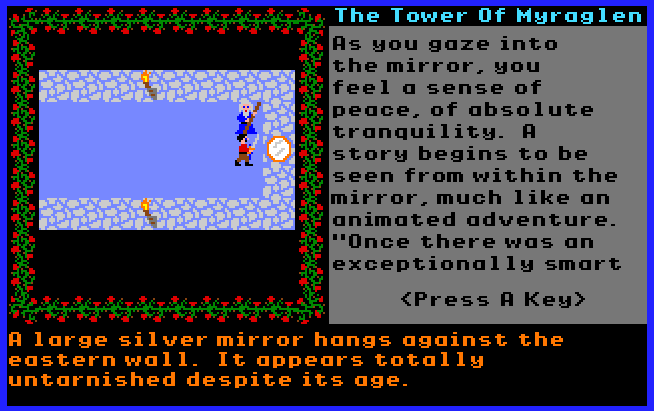
In Myraglen, the first twist comes on the first level, when you look into a mirror and get a long block of text, the first part re-telling the story of how and why Mendalick built the tower. But immediately after it, you see a glimpse of the future, of what will happen when you give the Medallion of Soul Stealing to the king. You realize that the king is actually the source of the kingdom's evil, and that he will use the Medallion not to save Myraglen but to enslave the rest of the world. But you have no choice but to continue the quest anyway, because you've also seen what will happen if the evil already set in motion continues unchecked.
          
I'm not 10 minutes into the game, and the author is pulling out the rug.
       
As you work your way up the tower, you periodically get visions of the "good" and "bad" sides of Mendalick, the former trying to help your quest, the latter trying to subvert it. "Good" Mendalick is strongest on the early levels, but as you go up, his helpful advice is replaced by frequent insults and screeds from his evil counterpart.
         
This guy is giving me bad advice.
       
The puzzles in the game are mostly easy but some are interesting nonetheless. On Level 1, you have to get a key from a hidden place in a fireplace. The trick is that you can only do it when a nearby clock is set to 12--either noon or midnight. How do you set the clock? You don't. It's based on your own system clock, so either you have to wait until noon or midnight or manually set your computer to those times. I happened to get extraordinarily lucky on this one, as I was playing during the midnight hour when I encountered the puzzle. The game remains in tune with your system clock throughout, incidentally, and chimes an appropriate number of times every hour.

On Level 2, you have to "resist temptation" by ignoring a whole room full of treasure chests, even though you happily loot them everywhere else. On the same level, you have to find some clues to ignore a sphere making an ungodly amount of noise (and you aren't just told that it's making the noise; you hear it through the speakers) to avoid an instant death.
        
Resisting temptation is only a virtue when there's a lot of temptation.
      
Level 3 has an enormous room, taking up multiple screens, that's full of invisible mines and traps. They damage you and make your hard-won weapon and armor disappear, sending you back to leather and a short sword. You can suck it up or do what I did and map a safe path and then reload. Level 3 also starts to introduce rooms that are functionally impossible until you've earned more hit points at higher levels.

Level 4 introduces an area of continually-shifting black and white squares, the white ones safe and the black ones deadly. You have to mince your way through them to get a Ring of Fire Resistance for later levels.
      
Careful, single-square movement was necessary here.
      
Level 5 offers this riddle:
        
A creature of your world that spins reality into dreams, and puts hope in the hands of the forgotten. This creature also paints the image of death and slaughter so well, that a man may even cry from its force. What is the title of such a beast?
         
I thought about it for a while, then tried POET, and was extremely pleased with myself when the way forward opened. Then I read Crooked Bee's LP and saw that she got the same result with KING. So either there are multiple answers or you can just say anything. (CRPG DEVELOPER.)

It took me three character "rebirths" to get to Level 5, but the level has a game-changing element: a brazier that gives you 1 hit point for every 10 gold pieces you feed to it. There's another one of these on Level 8. I had nearly 100,000 gold when I got here, and I earned a couple hundred thousand more on the subsequent levels. Thus, after this point, I was in no danger of dying in combat. The braziers really unbalance the last few levels of the game.
       
From this moment, the game is pretty easy.
    
Level 7 introduces doppelgangers--clones of the PC with several hundred hit points. They're very tough to kill, but they don't seem terribly interested in killing you. In fact, when you enter a room with four of them, they argue whether to kill you or not. Mostly, you can just run around them.

Level 8 has a bridge that has like a 50/50 chance of collapsing when you try to cross it, resulting in instant death. I had to reload a couple of times. The rest of the level is composed of 20 x 20 screens of "dark planes," a few of them with enemies or treasure, but most of them empty. You have to explore every damned one, because progress depends on finding two or three keys among the 400 screens.
      
This is uncomfortably random.
    
When I got to Level 9, I couldn't progress even though I had all the necessary keys. The door they were supposed to open just said "food for thought?" I had to consult a walkthrough to find what I'd missed. It turns out that one of the food troughs on Level 6 had something in it. Nowhere else in the game do food troughs hold items, but it's worth mentioning that Seaborne included food troughs in most rooms that have enemies--he even mentions them in the manual--because he thought it was unrealistic that these animals would just exist in those rooms for year after year with nothing to eat.
    
I guess maybe the message at the bottom was supposed to be a clue to search everything.
         
Anyway, the trough on Level 6 holds a message that basically constitutes Mendalick's--and thus Seaborne's--personal bible. It has a couple of paragraphs extolling personal responsibility and rejecting organized religion, and then it offers 11 "commandments":
     
  • Never lie
  • Be compassionate
  • Never steal
  • Respect property
  • Protect kin and protect friends
  • Right all wrongs [you have] committed if possible
  • Attempt to be successful in all [you do]
  • Be persistent
  • Aid those who need help, provided it will not bring harm upon [you]
  • View others by their actions, not by their appearance
  • Be proud of [your] beliefs and speak them aloud when requested
        
It's the Old Testament crossed with Zig Ziglar. In some ways, I admire Seaborne's attempt to out-virtue Lord British, but the difference is that Richard Garriott created a game in which the player practiced and exemplified those virtues, whereas Myraglen offers so little in the way of application that the sermonizing feels a little out-of-place. I don't disagree with the prescriptions, though, except maybe the last one.
  
The game ends on Level 9 after a couple of rooms with large battles.
    
They are no match for my absurd hit point total.
    
Messages warn that you're killing Mendalick with every step forward you take, and sure enough you find his body at the end of the level. But he's at peace, and he "lives on in the tower." You take the medallion from his body and, via a series of questions, get four choices for ending the game.
    
The Medallion of Soul Stealing.
     
1. Give the medallion to the king. The king "laughs mercilessly" and sucks out your soul. Game over.
       
The definition of "lawful neutral."
      
2. Keep the medallion for yourself and conquer the world. You find that the medallion doesn't protect you from everything.
         
   
3. Don't give it to the king, but also don't use it. You settle down to a life of peace, but the existing minions the king has unleashed hunt you down.
        
       
4. Kill the king with it. This is the one "good" ending. You get the message below, followed by an image of Mendalick and some triumphant music.
 
I forgot to mention that, in a non-highlight of the game, the king's name is "Sir PunDragon."

What are the odds on this being Richard Seaborne in a fake beard?
   
No matter what, you get to enter your name or hero's name in the "Hall of Honor." You also get to do this every time the character dies.

In addition to her LP, Crooked Bee also offers a long interview with Richard Seaborne on RPG Codex in January 2015. In it, he describes how he wrote both Prophecy and Myraglen as Dungeons & Dragons modules but couldn't get TSR interested. When the Apple IIGS came out, he saw an opportunity to make a name for himself on an otherwise-neglected platform and turned Myraglen into a game.

He had intended to offer the game to Electronic Arts, whose headquarters was near his house. He got in his car one day and headed to the offices without an appointment, hoping someone would be impressed enough with the game to overlook the breach of protocol. Unable to find the EA offices, he instead stumbled upon PBI Software a few blocks away, walked in, and walked out with a contract. In addition to Myraglen, he also worked on Cavern Cobra, Sea Strike, and Monte Carlo, all published the same year.
       
The developer has a little in-game trophy.
      
Seaborne would later work for EA, and then Microsoft Studios, but in executive roles rather than direct development and programming. His small portfolio of RPGs (or quasi-RPGs) showed them getting better over time, and in some ways it's too bad that he stopped designing games before creating a real masterpiece, because there are flashes of genius in each of his titles. This is seen primarily in his thoughtful stories, always interjected with bits of philosophy. Recall the dialogues between God and Satan in Escape from Hell and the plot twist involving the three demons in Prophecy. His dedication to storytelling appears in minor ways as well, such as the tabletop module-like treatment of each room as a unique space, with a few lines of accompanying text, rather than just a featureless corridor or abattoir.
         
Most of the rooms have descriptions like this.
     
Unfortunately, his games had a long way to go in mechanics. All three titles have flawed inventory systems. The combat systems in Myraglen and Prophecy are all under-developed, and for Escape he simply copied the standard Interplay system used in The Bard's Tale and Wasteland. His credits often show him paired with other programmers on graphics and sound, but never in these more substantive areas. In some ways, it's too bad that he didn't go to work for Origin or SSI, where his story and role-playing ideas might have found purchase with more experienced developers of RPG engines.
      
I have no theories on the source of "Myraglen."
      
I assigned Myraglen a 25 on the GIMLET, but it's important to recognize that it fundamentally isn't an RPG and thus under-performs in GIMLET categories like "character creation and development" (0), "magic and combat" (1), and "equipment" (1). It does best in the "game world," "quests" for the multiple endings, and overall "gameplay" for its moderate length and difficulty (all 4s). If I had played this in the right chronological order, I'd end this review by saying I look forward to seeing more from this developer. As it is, I'm grateful for the little we got.

Thursday, January 4, 2018

Game 276: Shadow Keep (1991)

    
Shadow Keep
United States
Independently developed and distributed as Shareware
Released in 1991 for Macintosh
Date Started: 30 December 2017

In Skariten, we had a freeware-quality game masquerading as a major commercial release. With Shadow Keep, we have the opposite: a fun, well-programmed title whose author only wanted $10. The game would probably be better-remembered today except that Mac games had a limited audience in the first place and are difficult to emulate today.

Shadow Keep was clearly inspired by Ultima IV and V. You see it in large mechanics, like the keyword-based dialogue system for NPCs (where NAME and JOB both work), in small mechanics like the use of "Z" for character stats, and in content like the importance of an ankh, the use of descriptors like "lightly wounded" and "critically wounded" for enemy health, and capturable pirate ships as enemies.
      
Some of the homages go a bit too far.
       
And yet I hesitate to call it an "Ultima clone," partly because most games of that designation are clones of the early Ultima titles, not the good ones, and partly because it finds its own style with the GUI interface and original graphics. For instance, you have a paper doll on the main screen, which depicts what the character is wearing and holding. To "use" something, you don't hit a universal "U" key but instead hold the object in one hand or the other and activate that hand with "L" or "R." The other controls are simple, consisting of what you see on the screen: talk, pause, search, adjust sound, adjust speed, and see the character stats. You need to use weapon, armor, and item menus to equip things.
     
The game begins outside the titular Shadow Keep.
      
The author, Glenn Seemann, was "a brilliant young programmer" according to every NPC in the game. He was based in the little town of Destrehan, Louisiana, just up the river from my beloved New Orleans, and home of the best plantation tour that I've taken in the area. A dozen web sites, all clearly copying from the same source, claim that "an earlier version of the game existed in the early 1980s for the PET and TRS80 computers." This is uncited and I frankly have trouble believing it. Too much of the game depends on the Mac interface, and too much of the content is inspired by Ultima IV-V, which weren't available until the late 1980s. I have an e-mail in to Mr. Seemann hoping to clarify.
       
The queen fills in some of the back story.
      
The main character here is the son of a legendary knight who participated in The Great Battle against the Evil Overlord decades ago. It had been a Pyrrhic Victory, with many knights slain and the entire race of giant birds wiped out. The battle only turned when the Evil Overlord was somehow relieved of The Black Sword. Now, decades later, the Evil Overlord has returned. He sacked the PC's hometown and killed his family, stole the mystical Ankh from the Temple of Life, and unleashed abominations on the land. The PC has journeyed to Shadow Keep, home of King Mondor and Queen Verryl, the "last bastion of law and order," on a quest to find the Black Sword and destroy the Evil Overlord once and for all.
     
The king outlines the main quest.
    
The character starts in front of the titular Shadow Keep ("Mondor, honey, since we're the last bastion of light in an evil world, maybe we should think about re-naming our castle"). There's no character creation, not even a name, although the game assumes the character's name is the same as the save game file. The PC starts with 200 gold and a handful of magic keys. He has bars for health, magic, rations, and strength, and separate statistics for "fighting ability," magic level, and experience. Fighting ability and magic level increase as you fight and use magic scrolls. "Experience" does nothing; it's more like a point system to compare scores with other players.

The land is quite large and dotted with shops, huts, and temples, but also wandering monsters. Early in the game, I bought a dagger and leather armor at a nearby shop and for the first few hours, periodically darted out of the safety of Shadow Keep to slay an enemy or two before retreating to heal. Damage heals steadily over time.
          
Transacting in a shop.
      
Shadow Keep itself has no services, but the large castle has plenty of NPCs to talk with and rooms to search for valuables. Early in the game, King Mondor gives the main quest to the player. I spent much of this early session just feeding keywords to the NPCs, whose names are almost all drawn from Shakespeare (e.g., Ophelia, Polonius, Oberon, Titania, Malvolio). The keyword-based dialogue works pretty much like Ultima IV except that it takes entire phrases (e.g., VALLEY OF THE UNICORN). It also has a much larger box to display the results, which is ironic because the NPCs don't generally have a lot to say. Most of them have one or two lines inspired by JOB (and a lot of them have the same job, like king's advisor or lady-in-waiting) and then everyone has stock responses to common terms like SHADOW KEEP, OVERLORD, and BLACK SWORD. Only a small percentage offer unique comments; more on that in a bit.

A key game element, whether indoors or outdoors, is the frequent use of "S" to search your surroundings. The action briefly highlights the 8 squares immediately adjacent to the character, and it reveals secret doors on walls and treasures hidden within furniture or (outdoors) trees. You want to hit it when next to pretty much any object. The castle turned out to be full of gold, potions, rations, and keys (you need many keys to unlock the doors in the castle), and the manual says that King Mondor explicitly encourages you to loot the things you find, as only clever adventurers will defeat the Evil Overlord.
       
Searching turns furniture into valuables.
      
Such generosity does not extend to looting the actual treasure chamber, unfortunately, nor to killing any inhabitants or even wielding a weapon while in the castle. Such actions bring the guards swarming at you, and unlike Ultima's guards, they don't forget about your deeds when you leave the castle and return.
      
Don't even think about it. Trust me.
     
I haven't made much progress outdoors because combats are hard early in the game. There isn't much to them. You stand adjacent to the enemy and exchange blows with the "R" or "L" keys depending on which hand holds the desired weapon. If you have a magic scroll or potion, you can use it the same way. There are both land-based and water-based creatures, but the latter don't drop treasure chests. Particularly annoying are giant spiders and giant scorpions, both of which inevitably poison you. I found a few vials of both spider and scorpion poison antidote in the castle, but not enough for more than a few combats and the creatures are everywhere.
       
Trading blows with a goblin in the woods.
     
From the denizens of the castle (and a few people in the huts to the southwest of the castle), I've learned that the Ankh stolen from the Temple of Life was probably taken to Far Land, a continent across the sea. There's supposedly a labyrinth built by gnomes that connects the two continents, and I need a magic amulet to navigate the labyrinth. (I need to find an innkeeper named Thaldo and ask him about the amulet.) At some location, I'm going to need to pass a Guardian, built by a long-dead wizard named Sorn, which will require me to have a Sacred Bone. The bone is in the dungeon beneath the castle.
    
Getting some information from an NPC.
     
The Black Sword was lost in a battle between the knights of Shadow Keep and the Overlord's Demon Knights, an elite unit. The remains of the Demon Knights are in the Catacombs beneath an old cemetery in the southwest corner of the continent. Everyone warns me not to go there.

The Overlord is in a vast cavern beneath the kingdom, and the only entrance to it is on a small island in the middle of the Sea of Serpents. A torch will scare away the serpents. When I encounter the Overlord, I'll want a magic Grail to protect against his magic.

I've explored a bit of the dungeon beneath the castle, but I need more vials of anti-venom, as the place is full of spiders and scorpions. A bird-keeper named John is rumored to be in the dungeon somewhere, and apparently he can fill in a lot of the blanks in the game's lore.
       
The entrance to the dungeon. I've just killed a scorpion and then took some anti-venom. Those bottles of poison are like bombs that kill you if you step on them.
       
Just as I was wrapping up, I had found or made enough money to upgrade to a sword and chainmail. I need to spend some more time grinding and then find a magic shop for those anti-venom vials.
    
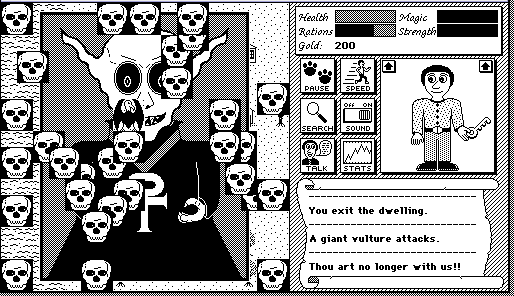
Death gives you an image of what I presume is the Evil Overlord.
     
Before I forget, I need to thank reader Rick S. for helping me with the files. This was ages ago, back in April 2016, and I'm not even sure if he's still reading. I still can't get any sound out of any game I play in the emulator, but I watched some video online and sound doesn't seem to be a big part of the game.

I look forward to seeing how this one develops. It's definitely the best RPG for the Mac so far. [Edit: I meant exclusively, of course.]

****

About to get started on Eye of the Beholder II. Any opinions on creating a new team vs. importing my old one?

Monday, January 1, 2018

Game 275: SpurguX (1987)

I played version 2, but like version 1, it had a 1987 release date.
        
SpurguX
Finland
Independently developed and published
Released in 1987 for DOS and Unix
Date Started: 28 December 2017
Date Ended: 29 December 2017
Total hours: 4
Difficulty: Moderate-Hard (3.5/5)
Final Rating: 15
Ranking at Time of Posting: 34/276 (12%)
    
A friend once sent me a copy of a first-person role-playing game set on the streets of Detroit. You played a homeless person, and the goal was just to find some food and a warm place to sleep for the night. You could explore buildings, walk realistic streets, talk to NPCs, and the like, all while trying to avoid gang members and security guards. It was a great idea, but it was written by social workers to make a point, not game developers, and gameplay suffered accordingly. You couldn't grab a stiletto and level up by killing those gang members, then solve your homelessness problem by looting their corpses and pawning their guns. There might have been some other issues, too.

SpurguX attempts a similar plotline, though more comically. You play a drunkard (my understanding is that spurgu is a slang term meaning the equivalent of "wino") on a quest for a special bottle of cognac, "accompanied only by a great thirst." The "levels" are neighborhoods of the city, and the "anti-hero" must contend with policemen, pickpockets, bouncers, proselytizing priests, dogs, and yuppies with a variety of realistic weapons like chains, batons, and switchblades. He has to keep himself fed during this process, and more important has to keep his blood alcohol concentration high lest he die from a hangover. I didn't plan it this way, but how great is it that a hangover is the central foe in a game for which I'm publishing the review on January 1?
     
Arriving in the game. What does the iin suffix attached to the game's name signify?
       
This is all done with roguelike conventions, including permadeath. The author, Petri Niska, was clearly familiar with Hack (link to my review) and kept many of the former roguelike's commands even when they didn't make sense in translation. The "e" key is used for "eat," for instance, and not "s" for sÿo.

(Aside: A Finnish commenter recently offered that he had learned English so well from entertainment media, including RPGs, that he prefers it to his native language. This shamed me a bit, because before launching SpurguX, I honestly couldn't have offered a single Finnish word. It occurred to me that I've probably never heard anyone speak it. I watched a YouTube video of a native speaker and it never would have occurred to me that this was a language spoken in Europe. If anything, it sounded Asian to my (admittedly untrained) ears. This led me down a rabbit hole of research into languages and language trees. I now know that Finnish is one of a small number of non-Indo-European languages spoken in Europe, belonging instead to the Uralic family. Cousins are Hungarian and Estonian. I wondered why a language with such a non-Latin root would be written with a Latin alphabet, and it turns out that nobody really bothered to write down the language until about the 16th century, so there was never a "Uralic" alphabet.)

Character creation consists only of a name. Every character starts clad only in overalls, at Level 1, with no money (markka), 10 strength/hit points, and a 0.2 BAC in promille (per thousand), which would translated to 0.02% as we do in the U.S. If that's enough to stave off a Finnish hangover, I should have gone to college there.

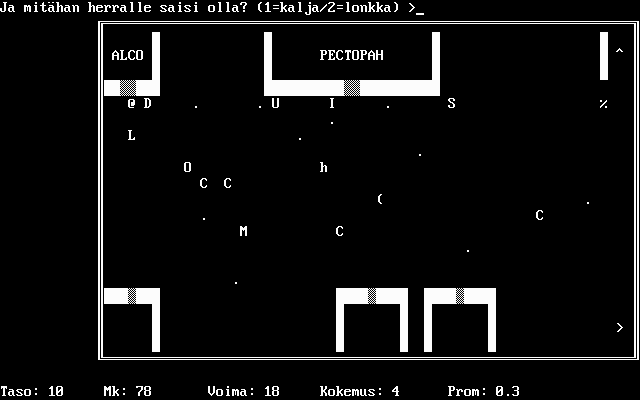
Every screen in SpurguX looks basically the same: a wide-open city block with two buildings in the north and three to the south. You arrive on the west side and find a stairway down on the east side. In between are any number of people and objects.

Some of those objects are points, represented by periods. There are a number equal to the level number you're on, and you have to collect them all before hitting the stairs. That's usually not a problem except that you're trying to conserve movement (to keep the BAC from going down too much) at the same time.
         
I purchase alcohol at a liquor store on a screen that also has a restaurant and a subway station. Numerous characters and 10 points stand between me and my goal in the opposite corner.
     
The people are the most interesting part of the game. Many of them are clearly meant as a social commentary on, I guess, Finnish cities of the 1980s, although they could really apply to just about any city. Some of them are offensive today; some would have been offensive even in 1987. I suppose that was the point. Among the characters you encounter are:

  • Kake, a fellow drunk who asks you for beer. If you say no, he kicks you in the groin, causing the loss of a hit point, and then immediately asks again your next move. You can stave him off by just drinking all your available beer. I'm guessing the name comes from the muscled, leather-clad comic character created by Tom of Finland, known for his homoerotic art. I don't know if he has a particular fondness for beer in the comics.
      
If this guy walks up and wants a bottle of beer, I grant that perhaps you should just give him the bottle of beer.

       
  • Old Women, who you can kill in one hit for easy money, but doing so draws the attention of the screen's . . .
  • Policemen. You can fight them (usually a losing proposition) or flee. If there's a police station on the screen, it generates more. If you want to avoid them and still kill innocents, you have to do it near the exit.
  • Point-Eaters, which jump around the screen and steal your points. You have to chase them down and hit them to get them to drop them. They're not unlike leprechauns in NetHack.
  • Gay Men (although I think the term, hinttari, might be more pejorative). They follow you around the screen hugging you. Killing them (which it's easy to do accidentally) draws no ire from the police.
  • Black Men (again, I wonder if the term, neekeriä, isn't a bit more offensive before translation). I'm happy to say that they do not perfunctorily attack you. If you attack them (at least some of the time), it turns out he's a jiu-jitsu-neekeri and you're in trouble. Policemen do react if you kill them, but they have money.
  • Recruits. They just run up and attack. When they do, the game says something that Google translates as "the swollen recruit rocks in the dirt" (hyytynyt alokas mätkii sinua turpaan). (And all the people who keep e-mailing me about DeepL being "better" than Google translate: it doesn't let you manually select your source language, and most of the time its automatic detection is wrong.) I'm curious what the historical context is here for overly-aggressive military recruits. 
      
A yokel attacks me while a gay man hugs me.
     
  • Escapees. They appear on any screen that has a jail and immediately run up and attack. You can loot stilettos from them.
  • Skinheads (which are called that--no Finnish term), who run up and attack with an "simian rage." (But why?) If you kill them, they generally drop "hints" which are read when you step on them. Things like "cash is king," "a hangover is the disease of the disease," and "if you drink, do not drive." See, the developer had some social conscience.
  • Punks. They attack in packs of four with a leader. Fortunately, although there are 5 symbols for the gang, you only need to worry about the leader. When killed, he drops a chain.
  • Yokels (that's what Google gives for juntti, anyway), who run up and attack you with hoes.
  • Teekkari, which I gather is a technology student at a university. He runs up and sells you a copy of Äpy magazine, which you can't refuse and takes a decent chunk of your cash. I gather that Äpy is like The Onion of Finland, but I otherwise don't know the context of this joke.
  • Pickpockets, who steal your money and disappear.
  • Yuppies. They run up to you and "bluster" (uhota), but this is harmless. Police don't seem to care if you kill them.
  • Sven-Olaf, a guy who runs up and, like gay men, hugs you. Unlike other gay men, he automatically gives you HIV. If you have the money, you can buy a cure in the pharmacy. I have no idea what the cultural or historical context is with that one. Googling "Sven-Olaf" didn't help.
       
I feel compelled to emphasize that you cannot catch HIV from a hug. Maybe that wasn't clear in 1987.
      
  • Hippies. They attack you with drug needles that cause you to hallucinate. I'm not sure the author really understands drugs.
  • Priests. They run up and lecture you on the evils of alcohol. Like yuppies, they do no harm except the annoyance of acknowledging their proselytizing every turn. 
  • Social Workers. They attack you for some reason, but if you kill them, you get chased by the cops. It's no-win. I hated them the most.
     
Something about the social worker "shaking me into shame"? I don't know.
     
  • Prostitutes. They run up to you and try to sell you sex for $50. If you refuse, they just ask you again the next round, continuing to follow and pester you until you leave the level. If you say yes, you're out of commission for several rounds, and any nearby enemies get free attacks.

Other straight enemies include dogs, gorillas, and snakes. They typically die in one or two blows and aren't much of a concern unless you have low health. The help file lists gypsies, politicians, and bootleggers among the other encounters that I never experienced. There are object-based threats, too, including rotten apples and piles of feces that you can slip on.
   
The game's various enemies and objects.
       
Successfully negotiating these encounters gives you experience points (1 per kill, generally, though sometimes you don't get any). Your hit point maximum increases during this process, quite rapidly, though it appears to be more of a function of dungeon level than experience. I couldn't quite work out the formula. I think maybe the dungeon level affects the maximum and the experience level affects the rate of recharge. Either way, that's all the game offers as "character development."

There is a small selection of inventory items, each slotted to a different inventory space, so you can only have one of each. You need food to restore hit points and alcohol to keep your BAC up. The only weapons seem to be stilettos, batons, and chains, though you can throw a bunch of other items. You find "Camel-Boots" (this is in English), often on soldiers, but I don't know what the context is.
        
The "I" key brings up the in-game inventory list on the left.
      
The buildings include markets, liquor stores, restaurants, pawn shops, police stations and jails, metro stations, graveyards, and pharmacies. The market is called "Isku," after a Finnish chain, but it's always closed; I'm not sure if that's supposed to be a joke. One thing that I think is a joke is the word "PECTOPAH" representing restaurants. There's no such word, but the Russian word for "restaurant," which would be rendered as restoran in the Latin alphabet, looks like it says "pectopah" when seen in Cyrillic. Then again, maybe the confusion is so ubiquitous that they're actually called that in Finland.

Of the game's challenges, staying drunk is probably the hardest. You lose 0.1 BAC every 100 moves, and if it reaches 0.0, you only have about 30 moves before you die. You sometimes get lucky by finding liquor on the ground, but most of the time you have to save up money and buy it at an Alco. Regular beer restores 0.1 or 0.2 and what I'm guessing are "hip flasks" (lonkkaa) restore 0.3. Keeping your cash reserves high can be difficult with pickpockets, technology students, and bouncers (who sometimes guard the stairways down) constantly relieving you of funds. I frequently had to pawn stuff at the divari, which I'm still not sure how to directly translate, to pay for booze.
      
Arriving on Level 33. I've got to pick up 33 points and contend with a snake (S), Sven-Olaf (A), a hippie (I), and a yuppie (J). The jail will periodically release escapees. I can't attack that old lady (M) if I don't want to have to fight four policemen (C), plus the police station will generate more.
     
Levels get harder as you go down, spawning more encounters and requiring you to pick up more points, which can be insanely impossible if a "point-eater" is bouncing around. The coveted bottle of cognac is found on random level after 50. Dear reader, did I brave permadeath through multiple games and legitimately make my way to that 'nyak? Of course not. SpurguX is an amusing romp but not interesting enough to sustain dozens of hours of gameplay. It lacks the extensive, detailed equipment lists, magic systems, and combat tactics of other roguelikes. I wasn't about to treat it with the same intensity as Nethack.

I'm not going to spend a lot of time talking about the objectionable content. It's not like I feel that it's okay for a game to feature overly-affectionate homosexuals who transmit AIDS with a hug, or to encourage murdering wandering "Negroes" or old women for their money. But it's hard to get too upset when the whole thing is abstracted at the ASCII level, the author was a juvenile, the game wasn't commercially released, and there might be layers of commentary that I don't understand given the location and the era. I certainly don't mind hearing about such things in the comments.

When you finally find the bottle, the game tells you Korkkaat konjakkipullon! Aave hakkaa sinua!, which Google Translate renders as "Uncork the bottle of cognac! The ghost will blow you!," which I suspect means something closer to "the spirit will blow you away!" Other than that, you don't get a special winning screen or anything. You just get another bottle of cognac on every level after that.

I grab the bottle of cognac


If you really want to see the GIMLET on this, check the spreadsheet. I would have been loathe to leave a blank line in there. Trying to rate the game fundamentally misses its point, which is to make fun of society 30 years ago in a country that I'll probably never get to visit. Onneksi olkoon to Hr. Niska: I probably learned more from SpurguX than any game so far.