Tuesday, March 7, 2017

Game 245: Les Templiers d'Orven (1986)

   
Les Templiers d'Orven
France
Loriciels (developer and publisher)
Released in 1986 for the Amstrad CPC
Date Started: 25 February 2017
Date Ended: 26 February 2017
Total Hours: 5
Difficulty: Hard (4/5)
Final Rating: 25
Ranking at Time of Posting: 104/248 (42%)

It's gotten to the point that French games give me anxiety. I managed to limp through Mandragore, but just barely. Fer & Flamme was just baffling. I've got a reboot of Tera: La Cité des Crânes coming up, even though I didn't understand it very well the first time and have little hope of understanding it this time given that French players can't even figure the damned thing out

In the middle of this comes Les Templiers d'Orven ("the Templars of Orven"), a game I'd never heard of, published by Loriciels, the same company behind Tera. The idea of three incomprehensible games in a row was filling me with dread. Imagine my sigh of relief, then, when I fired up Templiers and found it completely understandable. Very derivative, a little boring, and oddly difficult, yes, but at least not alien. Even the lack of a manual hasn't really hurt me.
     
Combat actions scroll past in a clearly Wizardry-inspired interface.
   
Clearly based on Wizardry, Templiers involves a party of up to 7 characters who venture into a series of dungeons from a central temple governed by a high priest. I guess the idea is that the party--the Templars of the title--are running missions for their boss. The wireframe dungeons comprise four scenarios of three levels each, for a total of 12 dungeon levels. In between expeditions, the characters retreat to a menu town with a temple, an inn, and an equipment shop.

Although it looks, feels, and plays like Wizardry, there are some key differences, particularly in character creation. Each character has six personal attributes--intelligence, constitution, observation, mysticism, agility, and skill--as well as two derived attributes: vitality (health) and concentration (spell points). They also occupy one of four classes: templars, warriors, guides, and scribes. You choose none of these things directly during character creation. Instead, after giving a name to your character, you distribute 30 training points among 8 skills: combat, meditation, long bows, dungeons, parchments (parchemins, which probably has a slightly more nuanced translation), sorcery, lance, and influence. These skills, in turn, affect your attributes and set your affinity for each class. The "dungeons" skill seems like something akin to rogue/ranger skills like pathfinding and trap detection.
     
Creating a character by adjusting the training statistics in the lower-right, which has consequences for the attributes in the upper-left.
    
Characters who invest in a combination of martial and magic skills score high in the "templar" category, while those who concentrate solely on fighting skills will probably end up highest in "warrior." An all-magic character is likely to be a "scribe," and a high "dungeons" skill puts the character solidly in "guide" territory. You also set your origin--city, village, temple, or "vagabond"--which has subtle effects.

A fifth class, "zombie," seems reserved for enemies that you somehow brainwash to your side.
    
At the armory. Some of these things won't be affordable for a long time.
   
Each character starts with a pool of gold to buy weapons and armor (most can only afford a weapon at the beginning). A set of paper dolls, seen only in the temple, change depending on your equipped items. That's cool.
     
Late in this session, the main menu shows my characters with their weapons, armor, and shields.
    
After that, there's nothing to do but hit one of the dungeon levels. Every time you leave the temple, you choose from among four scenarios: The Ultimate Dungeon, The Citadel of Madonas, The Caverns of Xand, and The Guardians of Knowledge. Their difficulty seems to scale roughly in that order.
    
Choosing from among the four scenarios.
    
The dungeons, alas, are pretty bland. I explored The Ultimate Dungeon and poked around the other three scenarios, and I never found any special encounters. Graphically, they pretty much look the same, too. The Caverns have irregular doorways, as if in a cave, but that's it. The enemies differ a little, from a classic D&D bestiary in The Ultimate Dungeon to figures from Greek mythology in The Caverns of Xand.
     
The three levels of The Ultimate Dungeon.
    
There thus isn't much to do in dungeons but wander around and fight. Combat is entirely Wizardry-derived. Upon facing each enemy, each character has options to attack, defend, use an item, shoot a missile weapon, cast a spell, do nothing, or flee. All characters can attack, regardless of rank. Once these options are set for each character, they execute, along with the enemies', in an initiative order.

I've found combats pretty hard, even on Level 1. Enemies routinely hit for more than half of a character's hit points, and they rarely miss. The enemy AI is predictable and merciless, focusing on the lead character until he's dead and then moving on to the next one. Facing more than a couple of enemies in one party, at least at Level 1, is a near-death sentence. You have to retreat frequently to the town to rest and heal. In this, the game is again like Wizardry.
    
I was able to defeat this little dragon. Note my "zombie soldier."
    
Outside of combat, characters can cast spells, use items, or use an interesting mark/recall system to save a waypoint and then "guide" the party automatically back to the stairs or, once you've re-entered the dungeon, back to the waypoint. It fails and you get lost quite often.

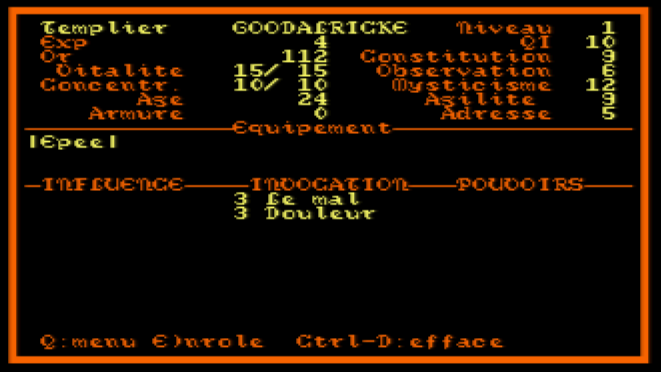
Spells work a bit differently from Wizardry. Spellcasting characters--those who invested points in meditation, parchemin, or influence--have three types of magic: influence, invocation, and abilities. Under each of those headings are listed several "spells" such as "Le Mal," "Douleur," "Vitesse," and "Vitalite," along with a number of castings that you have for that spell. Lacking documentation, I've had to experiment. "Douleur" (pain) is a mass-damage spell that affects one enemy party, and "Vitalite" is a healing spell, for instance. Casting them depletes the number of castings but not the "concentration" score, so I'm not sure what that's for.
     
This character can cast 3 "Le Mals" and 3 "Douleurs."
    
I had a much easier time once I realized that the "Effroi" spell (fear) lowers enemy morale to the point that they might offer to join your party as "zombies." Enemies typically have much better armor class than the party members, so putting one in the front slot can give the "real" party relief for a few combats while enemies whiff their attacks at him.
   
Damian demoralizes and enlists a soldier.
   
The temple serves as "home base," much like the top of the dungeon does in the typical RPG. The high priest is supposed to level you, but leveling is slow in this game. You need around 650 experience points to go from Level 1 to Level 2, for instance, and the typical Level 1 combat might only deliver 5. Equipment upgrades, from money found after combat, are similarly slow, with each character getting only a handful of gold pieces for a successful fight. It was 4 hours after their initial purchases that my party members could buy shields for 150 gold pieces each.
   
So, you're saying this is going to take a while.
   
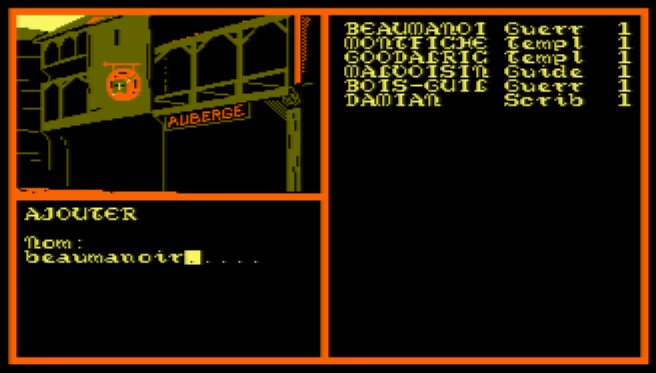
It took me a while to figure out how to rest and heal. You have to remove each character from the party and add them back in. This requires typing each character's name as you add them. You also have to type the character's name when examining him. I began to wish I'd given everyone single-letter names.
    
Returning characters to the party from rest requires typing everyone's full  name--which the game doesn't even show.
    
Templiers is notable for what it lacks. I haven't found a single fixed encounter, message on the dungeon walls, quest, or quest item. Enemies don't seem to leave any items after combat, just gold. There are no treasures or chests in the dungeon rooms. Navigation puzzles and traps are few.
           
Random notes:
   
  • If you walk into a wall, the game says, "Plaf!"
  • Notes online suggest that parties who die in the dungeon might return as enemies for the next party.
         
"Sorcerers, demons, and undead welcome you among them" is the full-party death message.
          
  • One of the options in the inn is called "(C)offres." Choosing it just brings up the message "Vide!" (empty). I have no idea what's going on there.
  • The dungeon levels have several inaccessible areas that in a normal game would suggest secret doors, but walking into every wall produces no results. If there are other ways to find secret doors, perhaps discussed in the manual, I don't know them.
  • Fleeing has not worked for me once. 
  • There does not seem to be any way to trade gold from one person to another.
  • There is no mechanism for raising dead characters--they disappear from the game when you return to town. Perhaps later there are resurrection spells you can cast in-dungeon; I didn't get that far.
  • The only sound in the game consists of beeps when you run into a wall.
     
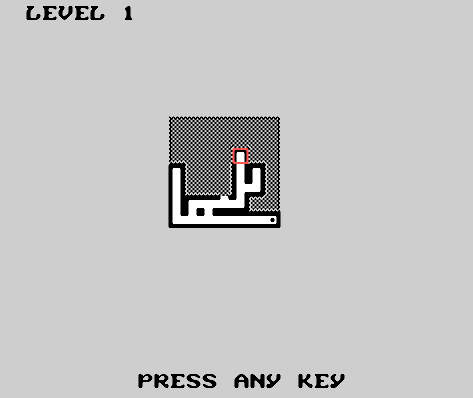
Level 2 of the Ultimate Dungeon brought an area of traps and a few one-way walls but no other special features. Level 3 was about the same, although it had a door leading to a corridor of darkness. When I reached the end, it teleported me back to Level 1.

I'm not sure about the issue of fixed combats. No square seems to inevitably offer a combat, but a number of squares have a tendency. For instance, there's a square in Level 1 on which a guard usually appears. Sometimes you have to enter the square and turn a couple of times. Sometimes he just never shows up at all. There's a similar square with a dragon on Level 1, and with other monsters on the lower levels. If combats were inevitable, I never would have mapped all three levels. It was only by reloading and squeaking past such squares that I managed to make complete maps.
    
This square on Level 3 generally has some combination of sorcerers, knights,and dragons. I'm nowhere near able to take on these foes.
    
In about 5 hours of gameplay, with lots of reloading, I only managed to amass around 250 experience points--less than half needed for Level 2. I touched every square on the three levels of The Ultimate Dungeon and didn't find any messages or anything that seemed like a quest reward, although it's possible that these exist and depend on defeating the quasi-fixed combats. When I return to the high priest in the temple, he says something like, "You haven't accomplished anything," suggesting that there must be some kind of quest. On the other hand, it's possible that it's his "you can't level up yet" message, and there truly is no quest in the game--that the four dungeons offer different maps and monsters, but no real purpose or endgame other than (very rarely) leveling up. It's further possible that the manual would give some more clues about this, if anyone can turn it up.
     
The back of the box suggests there are things to "résolvent" (solve), but whether this is just advertising hyperbole or something I didn't discover remains a mystery.
     
I opened the files in a text editor and scanned them for messages that might indicate some kind of quest--or anything other than dumb exploration and combat--but I didn't find anything.

The existence of a second disk was a little puzzling. The game calls for it for a split second during startup and then never again. Curious, I checked the catalogue on the disk, and it has an entirely different game called Duel Master: Blood Valley (1987), an action game based on a couple of Fighting Fantasy gamebooks, published by the UK's Imagitec. I can only imagine it was crammed onto the disk by whoever ripped this particular copy of Les Templiers d'Orven, but at the same time I can't imagine what files Orven is accessing on this second disk.
     
Where did this come from?!
     
Absent any further intelligence or documentation, I'm going to assume that the game has no quests and it's something like a Temple of Apshai approach--you can explore several dungeons from a central hub, but with no real purpose--crossed with a Wizardry interface. As such, it earns 19 in a GIMLET, with the best scores in economy (4), equipment (3), and magic and combat (3). A good character creation process is rendered inconsequential without much to do with the characters and very slow character development (2). The interface is fine, but wireframe graphics were pretty passé by 1987. A lack of NPCs and quests hurts the game. If I get any information that suggests the game has a raison d'être beyond random combat, I'll re-open it.

At least I basically understood what I was doing. Let's see, in contrast, how I do in a re-match with Loriciels' other 1986 offering: Tera: City of Skulls.

Saturday, March 4, 2017

Lucid Martian Dreams

    
No one had quite what I needed on the power issue, so I had to look up spoilers. What I had interpreted as power arcing from tower to tower was in fact a bunch of loose cables flapping in the wind. It took me a while to figure out how to repair them. I ultimately had to use a pair of pliers on a spool of cable, and then use the cable on the disconnected wires. There was at least a half hour of bumbling about before I got the sequence right and was able to do it without killing myself. After I was electrocuted the first time, I wasted a bunch of time trying to psychically manipulate the cable with berries before I realized I had a pair of rubber gloves.
   
"I am a lineman for the fossae..."
     
I confirmed the power was restored to the planet by opening some doors and extending some bridges that had previously been inert. Next, I figured I should probably figure out how to flood the canals. The map showed three power stations at the north pole. The first was close, so I walked to it.
There was a power tower there, but it was covered with vines. I had been waiting for an excuse to use a bunch of weedkiller I was carrying. Only it didn't do anything. I realized I probably needed to use it in conjunction with a sprayer, which I hadn't bothered to pick up. I knew there was one back at one of the landing sites.

I walked back to Olympus and checked out the teleport tube transport system. It was simple enough. Northwest goes to Elysium, northeast to Olympus, southwest to Hellas, and southeast to an area outside Argyre (which remains locked).
    
This should cut down on some of the walking.
    
I figured I'd walk to the landing sites from Hellas, but I found a sprayer in a building there, saving me the trouble. While I was there, I extended the bridge to the other side of the city (half the buildings are on one side and half on the other), explored, and encountered my first Dream Machine, which looks like a dragon's head. It seemed to be broken.
    
The dude standing north of me doesn't really stand out very well.
   
I nearly walked out of Hellas without noticing that there was a man in one of the buildings. My color-blindness has trouble with the congestion of icons--or perhaps it's a problem for you, too. Anyway, he was an actuary named Marcus. He had been kicked out of Olympus for being "tainted" by the Dream Machine, but he seemed sane enough. He told me what I already knew: that most of the humans were trapped in the dream world while the Martians at Elysium took their bodies. He also told me that if I entered the dream world, simply talking to myself would wake me up.
    
This would suck. You'd never bring yourself to throw anything away again.
    
He also suggested that I talk with the Dream Machine by eating one of the berries. I think they're green. Eating them let me "communicate" with the machine, which indicated I would need to put a chunk of radium in the power bin behind it.

I knew where there was radium: in Marie Curie's house in Olympus. I returned there via transport tube and picked it up, injuring and irradiating myself in the process. It turned out I needed to use a pair of tongs and a lead case--both in Curie's house--to handle and transport the radium chip.

Upon return, the chip did nothing. However, the machine had said it needed an "unusually large chunk" of radium, not a chip. 
   
I guess that was predictable.
   
I didn't know where to find more radium, so I returned to my previous quest to restore the canals. I revisited the power tower with the weed problem and used my Round-Up to kill it. That worked, but it didn't seem to make the station operational. The control panel at the station said something about lenses not working.
    
Why would a plant-based species even have a defoliant?
    
I walked to the other two stations shown on the map. At the first one, I found a broken lens. The second had a broken tracking motor. I brought both back to Olympus, asked around, and got Edison to repair the motor. Admiral Peary recommended that I ask Tiffany--of stained glass fame--to repair the lens. Problem is, Tiffany is possessed by a Martian who lacks that skill. The dialogue option didn't even produce a response.
   
    
Okay, clearly I needed to free the humans trapped in the dream world first. The only other Dream Machine I knew about was in Olympus. The door guard, Legrande Couillard, wanted me to find his lost brother, who had been prospecting in the Olympus mines. I correctly guessed that said mines were under Mons Olympus, surrounded by canals but accessible from a "dungeon" beneath the city.
    
Rockworms are animated like the silver serpents in Ultima VI.
    
The caves were full of monsters, including long creatures called "rockworms" that did severe damage and poisoning to my party. As I explored, I found Legrande's dying brother, who bade me take his Masonic ring to Legrande. There were also a few radium chips and--eureka!--two large chunks of radium. Thankfully, I still had the tongs and lead box. I also found a "heat ray" gun that's powered by radium chips.
    
I feel like there are one too many words there.
    
The monsters killed me before I could exit the cave, but I resurrected back at the module. I sucked up the experience point loss.

Legrande was devastated by his brother's death, but he kept his promise and opened the door to the Dream Machine. Inside, I found a "headset," but the machine was smashed. Between Legrande and Edison, I got the idea that I could repair it by finding a control panel beneath the city. That didn't take long, and Edison patched it up for use with the machine. After spending a while futilely trying to get the Olympus Dream Machine to work, I realized that it really was smashed beyond repair, and the game intended that I use the radium, headset, and control panel back in Hellas.

Even then, it took me forever to figure out how to get the control panel to work. The first difficulty was getting the panel on the console. USE didn't work and neither did MOVE. It turned out I needed to DROP it there. That's not a huge deal except that it's not the way that most inventory interactions work. Anyway, even in place, the game simply told me that "the panel is not installed." I had to look up a spoiler to find out that I needed to use a wrench on it to fasten it into place. That's not very intuitive.
     
I guess I was supposed to extrapolate from "insure the connections are firm."
     
The game is like this in general. More than an RPG, Martian Dreams is a game of inventory puzzles, and it's not consistent in the ways that the inventory is manipulated. To use pliers or a wrench, you USE them and then point to the thing you want to use them on. But to use tongs, you equip them and then MOVE the item as normal. To open a chest, you USE it, but to open a backpack you LOOK at it. To repair the conveyor belt, I simply had to USE the new belt on the rollers, but to repair the console, I had to DROP the new panel on the console and then USE a wrench.
    
That was a little arcane.
    
Some more bumbling before the Dream Machine worked. I had to use the headset on it and then put the chunk of radium in the hopper. Then the Avatar had to stand (or sit) in the right place while someone else operated the controls.

After a cut scene, the Avatar awoke in the dream world with no equipment. I was in a small area with five obelisks. It turned out that each obelisk took me to a particular dream or nightmare, where I had to solve a puzzle.
    
In the obelisk world.
     
The first one took me to George Washington Carver. He was in a dream where he was trying to live a Martian's life cycle, starting from a seed. He explained that Martians start as seeds, which grow into plants, which produce pods. The pods are cut open with a "ritual knife" and the adult Martian emerges with the memories of his forebears contained in the soil that he grew in. Carver kept attempting to replicate the process, but cave worms kept eating the pods. He instructed me to plant some defensive pods, water them, and hold off the worms while he experienced the life cycle. I followed his instructions and his dream ended; he appeared in the "outer" part of the Dream World. I awoke in the Dream Machine after he told me that he'd leave the dream world when everyone else could.
    
The Avatar becomes a horticulturalist.
     
Obelisk #2 brought me to Vladimir Lenin. He was standing in an area with piles of rubles insisting that he had to evenly distribute the wealth among 25 people. I picked up all the rubles but there were 253, plus a gem. I re-entered dialogue and explained the problem, and Lenin said that the remainder would be taken for "the state." I had to DROP 25 piles of 10 rubles to solve the "puzzle" before Lenin expressed his satisfaction and took the 3 remaining rubles plus the gem as an agent of the state. The dialogue was a little heavy-handed about this. Yes, we get it: Russian communism was corrupt.
    
This game came out the same year the Soviet Union fell. Coincidence?
    
Obelisk #3 took me to a room with a book on bullfighting and a red rug. Soon, I came upon a scene of a literal bull in a china shop--specifically, a minotaur rampaging through Tiffany's. After some trial and error, I solved the puzzle by using the rug to lure the bull through the door and then trapping him outside. Mr. Tiffany awoke from his nightmare.
    
"Bullfighting at Tiffany's" would be a good name for a sequel.
     
Obelisk #4 was the hardest. It took me to a series of pathways in which I kept getting "dizzy" and the directions would change. I might have to press the NORTH button to go south and the WEST button to go east for a while. Then it would change and I'd have to press EAST to go south and SOUTH to go west, and so forth. The level was riddled with "dream stuff" which, when used, turned into useful objects like weapons and a spray bottle. A vial of green paint found in the level filled the spray bottle.
    
H.G. Wells must not have been a fan of M.C. Escher.
     
The level culminated in a meeting with H.G. Wells, who insisted he was surrounded by invisible Martians. Sure enough, after I talked with him, footprints appeared everywhere. I had to spray the Martians with green paint and then try to kill them with the weapons I'd managed to find. But there were a lot of them, and they kept killing me (causing me to wake up) before I could kill them. Eventually, I realized the secret to use some telekinesis berries to acquire "dream stuff" from otherwise inaccessible locations. Those batches of stuff turned into an elephant gun and ammo, which allowed me to kill the Martians much quicker. H.G. Wells woke up.
    
Spraypainting and killing invisible Martians.
    
The fifth obelisk took me not to a human dream but the collective dream of about half a dozen Martians hanging out in a grove. This was the first time I saw a Martian character portrait. They mostly told me what I already knew: that Raxachk had destroyed their race with a plague; that the Martians in Elysium had possessed human bodies over the Hellas Martians' objections; and that I would need to help the Martians by growing new bodies so that they'd leave the humans'. They also told me of one of their kind named Kaxishek, who was researching "a new type of body that would be immune to the effects of the plague." He had a laboratory at the north pole.
   
Tell me something I don't know, alien.
   
Between the dialogues in the dream world and Elysium, I think I have enough information to find the materials necessary to grow a Martian. I'll explore that next time.
    
A Martian gives me the location of some seeds.
   
Other notes:

  • I ran out of bullets ages ago. I suppose I should find time to trade some Oxium at the trading post, but my characters have been doing okay with melee weapons. 
  • In Hellas, there was a big gong and a gong hammer. I tried it out. Nothing happened.
   
We'll be right back with more...stuff.
    
  • The green berries don't seem to let you talk to very many pieces of equipment. I tried several.
    
The power tower has nothing to say.
    
  • The developers continue to waste opportunities with NPCs. George Washington Carver did have a response to PEANUTS, but Lenin had nothing for STALIN, TROTSKY, MARX, TSAR, or RUSSIA. Tiffany didn't respond to GLASS or BREAKFAST. H.G. Wells had nothing to say about ELOI, MORLOCK, TIME, or MOREAU.
    
He wrote the book this year, so there's no excuse.
    
I'm warming up to the game a little. The puzzles in the dream world were fun, and I like the way they referenced the characteristics of the real-world NPCs. But this is beginning to feel a lot more like an adventure game than an RPG, and the inventory inconsistencies are irksome. I'm hoping I'm at least somewhat close to the end.

Time so far: 22 hours
Reload count:


Thursday, March 2, 2017

Game 244: Wizard's Lair (1986) and Two Sequels

Perhaps the blandest title screen we've ever seen.

Wizard's Lair
United States
Rainbow Software (developer and publisher)
Released in 1986 for TI-99/4A
Date Started: 20 February 2017
Date Ended: 21 February 2017
Total Hours: 7
Difficulty: Hard (4/5)
Final Rating: 13
Ranking at Time of Posting: 18/242 (7%)
   
Checking out what was hot for the TI-99 in 1986 is like checking out what the poor kids got for Christmas. It just depresses you. If you had a C64 that year, you got to play The Bard's Tale II, Might & Magic, Phantasie II, Roadwar 2000, and Starflight. If you had a TI-99--with an extended BASIC cartridge--you got to play Wizard's Lair. Since it was one of only about five RPGs ever released for that platform, you probably cherished it with all your being. We'll hear from one such player shortly.

The game is essentially the TI-99's answer to Dungeons of Daggorath. It features similar commands, a similar main quest, and similar real-time gameplay and combat, but it lacks the audio and approach to health that make Daggorath so memorable. In some ways, Wizard's Lair is actually harder than Daggorath since you can't save the game and there's a time limit. (And I can't circumvent that approach in 2017 because the Classic99 emulator that I use does not offer save states.) But gameplay never rises quite to the level of frenzy and terror that Daggorath achieved.
    
A typical Wizard's Lair scenario. I'm on Level 3 of the dungeon with 7 constitution, 0 strength, and 3 luck. I'm wielding a sword and wearing leather armor, and facing a wee little ogre. Once I kill him, I'll be able to pick up the potion in this square and whatever treasure lies in the square ahead.
     
The concept is simple: an evil wizard has taken over the dungeons of Weymoor Castle, and you're there to destroy him. He waits for you on Level 4. You have to spend the previous 3 levels acquiring the inventory necessary to defeat him, while fighting off his minions.

It barely qualifies as an RPG. There's no character creation--you just start in the middle of a randomly-generated dungeon level. The character has three attributes: constitution, strength, and luck. Constitution is the same thing as hit points; it starts at 10 and can grow slightly between levels. Strength and luck both start at 2 and can never go higher than 4. They are weakened by traps and some monster attacks and strengthened by magic items that you find.

You start with a stick and no armor. (The game can't seem to make up its mind whether the armor slot is actual armor or a shield. The manual refers to it as a shield, but then you can find items called "plate armor" that go in that slot.) Each dungeon level is randomly generated (it takes about 5 minutes with the CPU at normal speed) and seeded with monsters and treasure. You immediately start exploring the first level, picking up spells, potions, weapon upgrades, and armor upgrades--anything you can find. As you do, you get attacked by creatures like elves, dwarves, ogres, and demons, all rendered as tiny little sprites that would be laughable if they didn't do so much damage.
    
An adorable little demon attacks me.
    
Luck plays a huge role in the game. If you start in the corridors of Level 1 with several monsters around and no weapons, that's the end of that game. If you're lucky, you'll find a leather shield and a dagger in the starting area, making it far more likely that you'll survive the initial batch of monsters. The order that you come across things makes a big difference. Monster } healing potion } monster } vanishing spell } monster works fine. Monster } healing potion } monster } monster } vanishing spell is tough to survive, and monster } monster } monster } healing potion } vanishing spell means you'll probably die before you get to the treasures.

You navigate with single-letter commands like (P)ick up, (M)ove, (L)eft, (R)ight, (U)se, and (A)ttack. Most of these commands have to be followed by ENTER. Attacking is a notable exception; you just hold it down. Whether you're waiting for the screen to refresh after a step or waiting for it to execute your last action, the game is excruciatingly slow. It tends to miss some of your keystrokes. A modern player can't solve this by cranking the emulation speed, for reasons I'll describe below.
    
"DM" brings up a level map. Note the timer.
     
I learned early not to try to conserve magic items. Those 10 hit points go fast. Late on Level 3, you want to start selectively saving things for the wizard, but until then, you use whatever you have--fireballs, death spells, vanishing spells, disarm spells--on the next monster you see, unless it's a simple one.
    
Monster variability also makes a big difference in the game. Level 1 predictably has easy monsters--mostly faeries, dwarves, and elves. Level 4 can have those same easy monsters. It can also have demons and trolls, too--it's all the luck of the draw.

As you kill monsters, you gain experience, and you also find gold, silver, lead, and diamonds to increase your "treasure" score. I don't think that either statistic matters except for the final score. More experienced characters don't seem to do better in combat, for instance. Far more important are the weapons, shields, and magic items, all of which can be trapped in ways that deplete any of your attributes. (A "disarm" spell can forestall these traps.) If your strength gets to 0, there's a chance each combat round that your weapon or armor will be destroyed.
     
Using a "Disarm" spell on a chest.
    
Adding a twist to all of the above is something not usually found in an RPG: time limits. Each level "times out" after somewhere between 3 and 5 minutes, and no matter what you're doing, you get sent to the next level. Fortunately, your hit points are reset and increased slightly during this process. You can force a move to the next level at any time with the "N" key, and sometimes it's the best option. But even if you use your maximum time on each level, no single game takes more than about 16 minutes.

The time limit means, unfortunately, you can't just crank the CPU speed in the emulator. The Classic99 emulator that I use only supports three speeds: normal, "CPU Overdrive," and "System Maximum." "Overdrive" seems to be around 5 times the normal speed--useful for when the random dungeon is being created, but if you leave it on when you start playing, it turns your 3-minute level clock to a 35-second one. Even with the enhanced movement speed, you can't get much done in that time.
   
I pick up a treasure in the hallway.
    
The time limit and lack of save states created a difficult situation for a CRPG addict trying to document the game. Stopping to take a screenshot in the middle of battle, for instance, almost guaranteed losing that battle. You won't see a lot of screenshots here from Levels 3 and 4, because by the time I made it there, I was trying to win the game and didn't want to risk leaving the emulator. If I'd noticed the "Pause When Window Inactive" option sooner, it would have made my life a lot easier.

My first 4 or 5 characters all died on Level 1, and I assumed I simply wouldn't be able to win the game in a reasonable time frame. But for the sake of an enthusiastic commenter, I decided to settle in and give it the full 6 hours. Before long, I was routinely making it to Level 2 before I died, and then to Level 3. I tried alternating strategies, such as immediately zipping to Level 3 and hoping to find good weapons and armor before I got attacked, followed by an exhaustive exploration of each level (or as much as my time limit allowed) before proceeding down. Neither seems to me the "better" strategy--it all comes down to what equipment you find.
    
Death on Level 3.
    
The Wizard, as I mentioned, is on Level 4. He has the same goofy icon as everything else. He has a ton of hit points, but he's the only enemy in the game that doesn't regenerate when you leave his square. He's also the only enemy you can just blow past without defeating in combat first. These two factors allow you to adopt hit and run tactics against him. If you could only reach him without running into a bunch of monsters first, you could probably defeat him with just a decent weapon and a couple of healing potions. Again, it's all the luck of the random generation. You could zip down to Level 4, find a magic sword in the first room, two healing potions in an adjacent corridor, and the wizard a little further along.
     
On this trip to Level 4, my equipment is good but my attributes have been drained.
    
I was just crossing the 6-hour mark when I finally beat him, perhaps my 5th time encountering him. I had 3 healing potions, plate mail, and an axe. Killing him took me about 20 hits in 3 groups (gulping healing potions in between) plus a "fireball" spell. The screen below is all I got for a reward.
      
     
Wizard's Lair was created by New York-based Rainbow Software. This and its sequel seem to be the only games produced by the company (a minor UK developer of the same name confuses search results). Neither I nor Adamantyr (below) have been able to find a name behind the company. Its business address is a residence in Brooklyn that has been sold several times since the game was published. Perhaps the most notable thing about the titles is the unique style of the cover art from the manuals. The interiors, alas, lack any production values.

[Edit: About a month after this entry posted, I was contacted by a Robert Pellegrino, the author of this game and owner of Rainbow Software. He says he programmed a number of games for the TI-99, Commodore 64, and Commodore 128, sold mostly as shareware or published in Loadstar. I'm glad we were able to put an author to these titles!]
    
An interesting cover graphic distinguishes an otherwise bland manual.
     
The very same year as Wizard's Lair, the company came out with Wizard's Revenge. Although it has a continuing backstory--the wizard has reconstituted himself and now moved to Bleylock Castle--it's really more of a remake than a sequel. The graphics are slightly better. Hit points now count down from 100 instead of 10, and strength and agility now start at 25. There are now 5 levels, and the level timers are gone. I would think that these various factors would create an easier game, but I didn't get far enough into it to verify. Half a dozen hours on the first game was enough.
     
On the one hand, they actually drew a separate graphic for each enemy in this one. On the other hand, that's supposed to be a troll?
     
As I mentioned above, if you had a TI-99 in the era, and you liked RPGs, you probably cherished Wizard's Lair. Such was the case with frequent CRPG Addict commenter Adamantyr--perhaps the only reader I have who's commented at least once per year of this blog's existence. A vintage computer programmer, Adamantyr remembered Wizard's Lair fondly from his youth--the first game he bought with his own money, he says--and decided to make a fan sequel for the TI-99 in TI Extended BASIC. It's called Wizard's Doom.

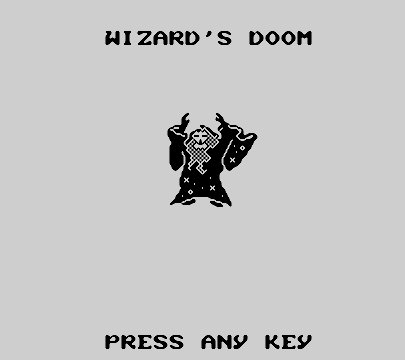
An image on the title screen? Blasphemy!
    
Wizard's Doom is a decent game on its own, but it compares particularly well to its two predecessors. Adamantyr compensated for many of the titles' weaknesses while adding a lot more RPG features. Yet it is still clearly derived from Wizard's Lair. In other words, he successfully walks a fine line between paying homage to Rainbow Software and showing them up.

Character creation offers a choice between warrior, magic user, and adventurer classes. Wisdom is added to the attributes as an arbiter of magic power and trap disarming. Instead of just picking up individual spells, the character now has a spellbook to which spell scrolls can be inscribed. There are more items to find and equip--including potions, rings, gemstones, and both armor and shields--and an identification system. An expanded pack can hold 15 items instead of just 6.
    
An expanded equipment list and a better font are just two of many improvements in Wizard's Doom.
   
Pairs of keys cycle through available items and spells, and all commands execute immediately--no need for the ENTER key. He took the time to develop a unique monster portrait for each creature rather than just using the same troll-looking thing over and over, but he still made them tiny. Drawing is still quite slow--I'm not sure that was avoidable on the equipment--but since there are no level timers, you can happily play this one in "overdrive" with no ill effects. There are 6 levels to Wizard's Doom, and apparently you have to suss out a particular way to defeat the wizard.
   
My character is about to die at the claws of a tiny beast.
   
I haven't made it that far, but overall I suspect Wizard's Doom is easier than the other games--you can save, for instance. I made it to Level 3 on my first try and wasn't really playing hard-core even then. I'm determined to win it, but if you're still reading this text, then I wasn't able to do so in time for this entry to be published.
    
The map also looks nicer.
    
Adamantyr's dedication goes beyond creating a game in the same style. He also duplicated the manual right down to naming Rainbow Software as the developer and stamping its Brooklyn address on the back. He wrote a backstory--the wizard has now shown up in Maldred Castle--that could easily have been written by the original authors.

Because I rarely get to talk from this perspective, it's worth reading about the development process on Adamantyr's blog. If anyone is interested in trying the game, you can download it from the Atari Age forums. You'll need a TI-99 emulator with an Extended BASIC cartridge.

As for the original Wizard's Lair, you can't expect much from a GIMLET, not when it starts out with 0s in NPC interaction and economy and barely rises above 1 in areas like the game world, character creation and development, combat, and graphics and interface. It totaled at 13. I gave it 2s in equipment and quests and was generous with a 4 in "gameplay." That last category--which encompasses things like linearity, replayability, length, and difficulty--really comes down to self-awareness. Does the developer understand what kind of game he's created, and does he tailor the scope, length, and difficulty accordingly? Does it deliver what it promises? How is the ratio between breadth and depth? Wizard's Lair, for all its faults as a traditional RPG, at least knows what it's about and provided one session's worth of challenging gameplay.