Xyphus
Robert "Skip" Waller and Dave Albert (developers); Penguin Software (publisher)
Robert "Skip" Waller and Dave Albert (developers); Penguin Software (publisher)
Released 1984 for Apple II; 1985 for Commodore 64 and Macintosh
Date Started: 2 February 2016
Date Ended: 8 February 2016
Date Ended: 8 February 2016
Total Hours: 20
Difficulty: Moderate-Hard (3.5/5)
Final Rating: 23
Ranking at Time of Posting: 73/207 (35%)
Winning Xyphus in two postings took a lot of effort, but I didn't want to linger on this one.
As covered in my first post, the game is organized into six "scenarios," each with its own map and selection of items and foes. All of them except the last begin with the party in one fortress and end with the party in another fortress on the opposite side of the map. In between, the party usually has to find a particular item or kill a particular creature or both. The party also has generic side missions to slay as many foes as possible, find useful magic items, find useful spells, and replace Xiphoid amulets, which shatter after you've cast enough spells. Each scenario took me about 3 hours.
 |
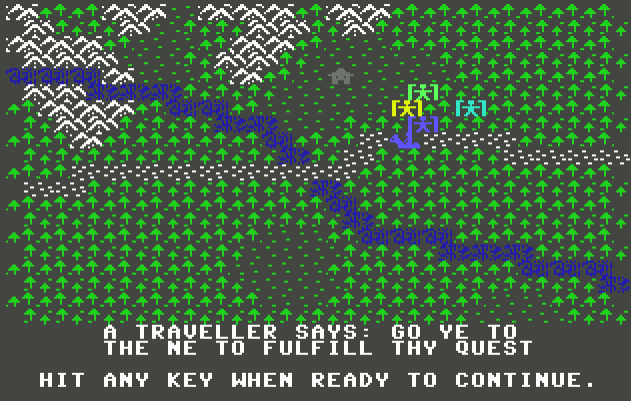
| A title card lays out the key elements for Scenario 5. |
 |
| And I solve the quest. |
I started leveling up on the second map--it requires you to visit one of the towns after accumulating about 1,500 experience points--but leveling isn't rapid. On the last map, I was only Level 5. Leveling conveys extra hit points and allows you to do an extra point of damage in combat.
On each map, there was a wide range of monster difficulty. Some of them were only damageable by magic weapons, and a small number were only damageable by spells. At least one creature, a vampire, I couldn't damage no matter what I did; I suspect the key to slaying him was in a weapon in the middle of a lake that I was never able to figure out how to get. Fortunately, I was able to sneak past him to finish my mission.
 |
| Three of my characters keep the vampire occupied while the fourth goes past him to get the quest item. |
An awful lot of creatures are capable of inflicting poison, and most of my spellcasting went into curing spells.
Overall, gameplay is quite hard. Even using save states and reloading liberally, I found myself in a number of perilous situations. Someone playing the game more honestly would have to take a lot of care to stay near garrisons and lure enemies one-by-one.
I wouldn't have been able to stomach the amount of time necessary to do this one for real. Even save-scumming and using "warp" mode in the VICE emulator, the extremely slow hexagonal movement continually tried my patience. The movement system is this game's most egregious mistake, combining four mechanics that would have been annoying enough on their own: hexes instead of rectangles, the necessity to move each party member in turn, an unpredictable order of movement among characters (since some get more moves than others), and the need to coax the party through tight terrain. If you've played Ultima IV and can remember how annoying it was to move the party through dungeon rooms, one character at a time, with some characters getting more moves than others, just imagine playing that for an entire game and a weird keyboard cluster.
 |
| Mincing through these corridors, one character at a time, in an unpredictable order, was nearly intolerable. |
Xyphus piles on to this horrible design mistake by including invisible barriers all over the maps. Testing for passages in invisible barriers is annoying enough when you only have to worry about one character's movement at a time. By the time I reached the final scenario--a large, twisty dungeon with many passages one-character wide, and many blocked by invisible walls--I wanted to throw my laptop out the window. The ability to set an active character would have made a world of difference. It still wouldn't have been a great game, but it at least would have been tolerable.
 |
| Running into absolutely nothing to my west. |
The emulator introduced a lot of bugs, too. For a while, it crashed every time I moved west. I had to alternate between northwest and southwest. Then it started crashing every time I tried to change weapons. Generally, saving the game properly in-game (i.e., not a save state) and restarting the emulator cleared up these issues, so I assume they weren't the game's fault.
The final scenario moved the party underground and commanded us to slay Xyphus. As I explored the dungeon, I found a couple of messages indicating I would need the Heart of Xyphus and a Crystal Key. I found the heart in the lower-left corner, guarded by demons, and the key in the upper-left, guarded by a dragon. Only an elf could pick up the heart and only a dwarf could pick up the key; the game had warned me at the beginning that I would need at least one of these.

Xyphus was in the lower-right corner, blocked by two doors. I was able to get through the first door with the key (since there's no "unlock" mechanic, the game had me wield the key like a weapon "attack" the door with the key). For a while, I couldn't get through the second door with either the key or the heart, and I started writing up this posting as a "final rating" without the "won!" Then, I thought to try all of the other weapons in my inventory, and it turns out that I just needed to attack it with a Xiphoid amulet.
 |
| The game very nearly ended here. |
There was a final battle with three demon guards--my two fighters took care of them with "demon lances" that only work on demons.

Xyphus himself was immobile in the southeast corner. He was capable of killing my characters in a single blow, so I had to reload a couple of times, but he died in a single hit from his own heart.
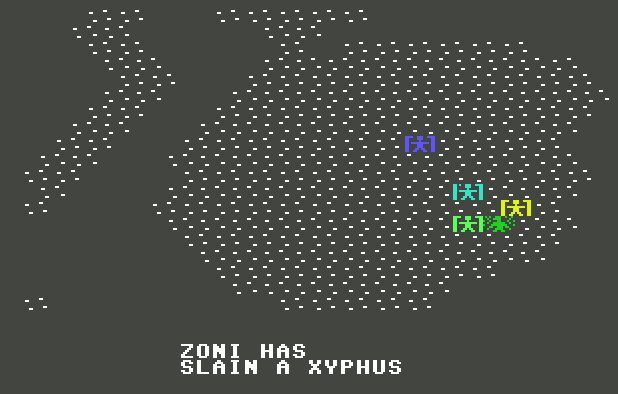 |
| I'm not really sure how I'm wielding a heart as a weapon. No matter what, it feels a bit cruel. |
After this, the game unforgivably forced me to walk back to the garrison in the middle of the dungeon, where I was "rewarded" with an image of a castle, crown, and treasure chest with no accompanying text. I guess this is the game's way of saying that I got the kingdom that was promised.
GIMLET:
- 3 points for the game world. The framing story is pretty good, and the game ties into it with the title cards between scenarios. Not much of it is represented in actual gameplay, though.
 |
| The Macintosh version has a really nice world map. |
- 2 points for character creation and development. Creation is just name, race, and class, and development isn't frequent enough to be truly rewarding.
 |
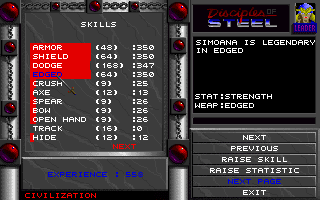
| "Character development." |
- 1 point for NPC interaction, which I allot to the witches who show up on some screens and give you clues. This is generous. Those are more like found messages than NPCs.
- 3 points for encounters and foes. The monsters are mostly D&D boilerplate, but they are well-described in the manual and do have a variety of strengths and weaknesses you have to figure out. There are no other puzzles in the game, unfortunately, and no way to grind characters because all the enemies are fixed.
- 3 points for magic and combat. Fairly primitive, with most of the tactics associated with how many monsters you engage at a time, not how you engage them. A selection of spells whose uses you have to determine through experimentation makes things interesting, but for the most part, you're afraid to cast too many spells because you don't want to shatter your Xiphod amulets since each spelllcaster can only carry one at a time.

- 2 points for equipment--a small selection of weapons to switch between and an incrementally-improved suit of armor.
 |
| Finding items like this was always fun. |
- 3 points for economy. I never had enough to buy all the spells.
- 3 points for a main quest and some optional encounters and items that could be considered quasi-side-quests.
 |
| A title card gives me the quest for the last scenario. |
- 2 points for graphics, sound, and interface. The graphics and sound are primitive but adequate, but nothing excuses the movement interface.
- 1 point for gameplay. Xyphus is mostly linear, non-replayable, a bit too hard, and a bit too long.
That gives us a final score of 23. I'm going to resist the temptation to take off more points for the interface since I have a special category for that.
Xyphus was part of Penguin Software's growing catalogue of RPGs in the early 1980s; others included Expedition Amazon and Sword of Kadash. Each of these titles tries to do something different with the RPG experience--generally making it worse in the process, I should add, but at least they try.
 |
| "Featuring." Yes, that's the word I would have used. |
I haven't been able to track down authors Robert "Skip" Waller or Dave Albert or find full bios on them, so I'm about to do some raw speculating. I'll come back and correct this if I get better information later. We've seen previously that it was Penguin's modus operandi to publish games developed by independent creators, but we've also seen them credit the independent creator along with their own staff, who presumably did some polishing to the final product. For instance, the title screen of Expedition Amazon credits the game to Willard Phillips, Greg Malone, and David Shapiro. From my own discussions with Phillips, it turns out that he wrote most of the game himself and Malone and Shapiro got the credits for additional programming and graphics. They never worked together and Phillips never even met his "co-authors."
Since Albert has a producer credit on Penguin's previous The Quest (1983), I'm going to guess that he was on Penguin's staff. I suspect that the original version of Xyphus was created independently by Waller, but after it was submitted to Penguin, Albert did enough polishing on the final version that he got co-credit.
Whatever the case, I can't find any evidence that Waller worked on anything else in the gaming world, whereas Albert went on to a long and distinguished
career, with credits on games by Origin, Interplay, and Electronic Arts
among others. I'm sure Albert was behind the detailed and evocative monster descriptions in the Xyphus manual. I don't know whether he already had a relationship with Origin at the time, but I suspect he was inspired by the quality of Ultima III's text, and it thus makes sense that Origin tapped him to write The Book of Wisdom for Ultima IV (1985). We've crossed Albert's path several times already: he was on the design team for Autoduel (1985) and served as a producer for various editions of Ultima (1986), Wasteland (1988), Sentinel Worlds I: Future Magic (1988), The Bard's Tale III (1988), Fountain of Dreams (1990), and Escape from Hell (1990). His RPG credentials dry up after that.
It would be fun to track down Waller and confirm my take on the events, as well as my suspicion that he was heavily influenced by Ultima III, but the most likely candidate I could find died in 2010.
Finally, I should note that Wikipedia claims that Xyphus was the first RPG released on the Macintosh. I suppose it's possible, but MobyGames shows four other Mac releases in 1985: Rogue, The Temple of Apshai Trilogy, Ultima II, and Wizardry, and it's hard to tell the specific months in which they appeared.
And that finishes 1984! (If you're wondering what happened to Zyll, I played it for a while, and while I thought it was an interesting adventure game with some decent ideas, it lacked the character development of an RPG. It is closer to Zork than Beyond Zork.) We'll have a transition posting before moving on to 1985.