Saturday, February 9, 2013

Chaos Strikes Back: Lessons in Maneuverability

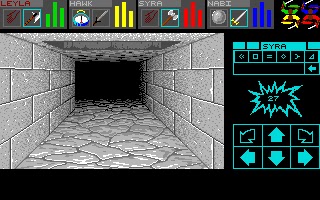
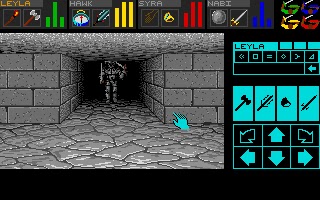
Demon dogs assailed me on my most recent level. They drop food when they die.

In my last outing, I talked about how I liked the integrated combat and movement system of Chaos Strikes Back and many other games. By allowing you to retreat, strafe, and flank your opponents, such games add options for victory that depend less on the attributes of the characters and more on the agility and intelligence of the player. This often allows even low-level characters to win impossible combats.

This particular engine allowed three particular combat tactics in Dungeon Master:

  • Lead the enemy to a set of stairs. Go up or down (he doesn't follow). Regroup, heal, prepare spells. Go back to the enemy, let loose with spells and attacks, retreat along the stairs again before he can retaliate.

 
  • Dance around the enemy. Take advantage of the fact that it takes the enemy a couple of seconds to turn and move to flank him, get behind him, and pummel him with attacks. Jump out of the way before he can return the attacks.

Yes, I know I'd be more effective at this if I learned to use "strafe" properly. I get too confused between strafing and turning in the moment and invariably walk into a wall.

  • Lead your enemy to a portcullis. Wait until he's under it, activate the switch, and fight him while the door repeatedly slams on his head.

We can debate endlessly about which of these tactics is an "exploit," which are cheating, and which are legitimate. I maintain that the game is essentially unwinnable without at least the second one, as was Bloodwych, and I don't see any purpose to the game's real-time engine if you're not meant to do it to some degree. The first and third are unarguably a little lamer, but if they're exploits, FTL didn't do much to discourage them. They also come with their costs in time (and, consequently, hunger and thirst) an boredom. I don't mind resorting to them when I don't see any other way.

As I mentioned, though, Chaos Strikes Back screws with you on these tried and true tactics. As I closed my second-to-last posting, I was using the stair trick on a group of salamander demons on the "Diabolical Demon Director" level, but they wouldn't stop coming. Little did I know I was regenerating them every time I went up the stairs.

I want you to look at this small map of the area as I describe what happened next and its consequent effects on my maneuverability.


The stairs I was coming up are just to the west of E. Every time you go up and down these stairs, salamander demons generate in an area north of C and D, debris monsters generate in an area south of A, and black flames generate around H. The northern corridor between E and G is essentially impassable because of the black flames--it takes my party a long time to kill them with "Disrupt" spells, and one of them continually regenerates at H--so while things are actively attacking you, your only real choice is the southern corridor past A and B. The pit between B and C only opens when you step on C, and it closes when you step on it again. I think pits also open south of A when you step on C, but I can't see them.

When I beat the area for the first time, I did this: waited until the salamander demon was south of B. Ran past him and the debris monsters to C. Waited until the salamander demon was standing on top of the pit between B and C and then stepped on C. Both he and the debris monsters dropped down to the level below. Very satisfying.

Later, I happened to fall down to that level myself. I found the remnants of the debris monsters along with a bunch of items and dragon steaks that indicated a dragon had been there and was killed. I'm not sure how that happened. Maybe I dropped the debris monsters on top of him, and it was enough to kill him. Either way, it was a great boon. Unfortunately, amidst all of this, I neglected to save.

When I reloaded, I did something different: I took a flask that was in a niche on the wall above A. That opened a pit at A that dropped me down to the dragon. I mapped this area, didn't defeat the dragon before leaving via a staircase, and stupidly saved the game. From then on, every time I returned to this area, there was a big difference: the pit at A prevented any maneuverability around the level. I couldn't do the pit trick or anything. I had to defeat both the debris monsters and the salamander demons face-to-face, and it took quite a while.

That single square makes an enormous difference in maneuverability, just like a single empty square in a sliding puzzle allows you to solve it. The developers knew this, of course, and introduced this trap to screw with the player.

To take another example, let's look at the level below, containing the dragon. It's him you can see me fighting in one of the GIFs above. It's a small level.


If I want to do my flanking trick to dart around and behind the dragon, where can I do it on this limited level? The chamber to the west is impossible because of the pit. That leaves only the four-square chamber around F. That would be fine, except F sits on top of a pit that opens after you've crossed it half a dozen times. The developers knew this was the only place on the level that you could do that combat trick, and they deliberately programmed a bomb into the process. (In case you're wondering, no, you can't do either the door or stair trick here. D and E are pressure plates that open the doors, but they close behind you permanently, and you can't open them again if you come back down the stairs.)

I ultimately solved these problems, of course. With the dragon, I found another access point to the area through a secret door, and was ultimately able to use the stair trick on him. (It took forever as it was, so if there was a "non-exploitative" way to do it, I'd love to hear it.) In the case of the pit, I found an obscure button nearby that closed it. But I sure swore a lot at the game during the last few days.

Killing the dragon with the stair trick and poison clouds

Among other treats to this same level was a ridiculously long series of corridors that led to a dead end. To be fair, a message on the wall at the beginning did read "Dead End," but it was still horribly annoying to have to search every wall for secret doors. Getting into the area took a "solid key," so it's hard to believe there wasn't more to find, but all I found was a party of death knights. I killed them with repeated fireballs as I backed down the long corridors.

This level was a bit ridiculous.

In a comment that she ROT13ed, Amy gave me a series of tips on how to navigate this area, and I fear I succumbed to studying them. I would have figured out the monster-on-the-pressure plate on my own, I think (It was a clue when I stepped on it and nothing happened). Luring a debris monster on it caused a pit to close and allow me access to another area.

A debris monster helps me out by slithering onto a pressure plate.

But I probably never would have figured out that the way to close an invisible pit just beyond--a pit that drops you into a room full of poison in which you almost immediately die--was to cast "open" on a grate, thus allowing a salamander-demon that was hiding out behind it to move off a switch that was keeping the invisible pit open.

The next puzzle I was happy to figure out on my own. There was a pressure plate next to a message reading "Value in exchange for valuables." I saved the game and tried several items on it before I hit the right combination of coins and magic items to cause a secret wall to open and reveal not only all of the items I had donated, but a "Cross Key" as well, which opened a nearby door.

You'd be bored to tears if I tried to recount all the keyholes, triggers, teleporters, stairways, pits, and other navigational puzzles I've mapped on these levels, but I have to confess that in doing so, I've abandoned all pretense of minimal saves. I try different things, and if I don't like the result, I fireball myself to death and try something else.

Unfortunately, I've reached a point at which I'm stuck. I know there's more to explore on the level mapped above, but I can't seem to get past a pit to the northeast (I can approach it from the north via a staircase from the level above, or from the south, but I can't get east of it.) There's a keyhole on this level next to a message reading "PAIN" that I don't have the key to open. There's a "Skeleton Key" hole on the level above, but I don't have the skeleton key.

I can always go back to the Junction of the Ways and take a different path, but my understanding is that there's corbum ore to find on every path, so I don't want to leave this one until I've found it. Can anyone confirm whether I'm right or wrong about that?


Thursday, February 7, 2013

Game 86: Dungeon of Death (1979)

This is the best you get for a main screen.

Every few weeks, Irene has some kind of computer glitch that causes me to run Malwarebytes on her laptop and clean off a dozen viruses, unwanted toolbars, and other bits of malware. Meanwhile, I'm downloading .rar files from suspicious-looking Eastern European web sites, and I manage to stay clean. I have no idea what she clicks on.

It was deep in the recesses of one of these sites that I managed to find a copy of Dungeon of Death, the second of two games released solely for the Commodore PET. MobyGames said that it was a version of DND, and they're right. Specifically, it's an inferior version. It's not any mystery why this platform doesn't cause a lot of hearts to glow with nostalgia.

The history of DND is a bit confusing, and there's a lot of conflicting information floating about the web. The best I can piece together from various sites, Barton's Dungeons and Desktops, and my own experience playing the games is as follows:

The original dnd (called The Game of Dungeons on its title screen) was programmed for the PLATO mainframe at the University of Illinois at Urbana-Champaign back in 1975 by a team of students led by Gary Whisenhunt and Ray Wood. I reviewed it almost a year ago. As one of the first handful of CRPGs, it was reasonably advanced for its time. At some point, Purdue University student Daniel Lawrence was exposed to it, took the game's code, added his own innovations, and reprogrammed it for the TOPS-10 operating system on the DEC mainframe at Purdue. After he graduated, Lawrence saw commercial potential in the game and reprogrammed it as Telengard (1982; also available for the PET). But by then, dozens of variants had been floating around and traded as freeware. A version called DND showed up for DOS in 1984, another called Caverns of Zoarre in 1984, and Heathkit DND in 1985 (I reviewed them all in one early posting). There's a bunch more listed on a site called "The Unofficial DND Home Page," but be careful: much of the history given on this page is suspect (for one thing, they have Dungeon of Death as a 1982 game).

Analogous screenshots from the original PLATO dnd (top), Dungeon of Death (second), Telengard (third), and Heathkit DND (bottom)

Today, it's tough to see what made this line of games so popular, but the simple fact is that at the time, there wasn't much else available. We've seen how primitive games like Beneath Apple Manor, Dungeon Campaign, and Dungeon could be. The DND line, by contrast, featured:

  • Characters with multiple attributes, including experience and levels
  • Randomly-placed treasures and encounters within a randomly-generated dungeons
  • A selection of spells
  • Fun random non-combat encounters, such as chests, pits, teleporters, altars, fountains, and thrones

It would take some time before other games--Wizardry, the Ultima series, Rogue--caught up to this level of sophistication. Until they did, DND was the best example anyone had of Dungeons & Dragons-style attributes, combats, and treasure, and it makes sense that the game was so thoroughly copied and traded.  

Dungeon of Death is one of the earliest dnd variants, developed independently by C. Gordon Walton after he had a chance to play the PLATO dnd. It is also thus one of the few extant games in the dnd line that didn't come from a Daniel Lawrence version.

The objective of Dungeon of Death is to descend to the twelfth level of a dungeon and recover the Holy Grail from the lair of Smaug the Dragon (sigh). As you travel, you find random piles of gold, potions, chests, and of course random encounters with the game's monsters, which include vampires, dragons, rust monsters, balrogs, rock trolls, black wizards, "evil men," ringwraiths, demons, and Death himself.

Facing a rock troll with no sword but some other advantages.

Combat consists of  choosing to fight, evade, cast a spell, drop all your gold and run, or surrender. If you fight or cast a spell, the game simply informs you whether you won or lost; you don't see the underlying calculations or rolls. Losing doesn't necessarily mean dying, although it usually leaves you fairly close to death. When you "win," you generally take no loss of hit points (labeled "power").

Chester staggers about blind, with no sword. He will not last much longer.
 
The port illustrates the limitations of the Commodore PET platform. It's hard to imagine an uglier and cruder version of the game. As you can see, the "map" on which you move the characters is miniscule, and the "graphics" are hardly deserving of the term. (There is no sound.) In contrast to some of the variants that randomly generated their dungeons, Dungeon of Death uses a fixed dungeon layout. The encounters are random as you move around the dungeon--indeed, you can just go back and forth between two squares and keep finding monsters and gold--but to progress, you need to find a notch in the outer wall that leads to a set of stairs.

Chester contemplates going to Level 3 (stairs in the notch to the south).

The version I was able to find also has fixed character attributes. You always start the game as an elf and always have the same strength, agility, and wisdom scores. The manual, however, shows different characters with different scores, so I don't really know how these are set or altered.

Oddly, the early encounters (at least in the version I downloaded) are also fixed. No matter which way you step from the beginning, you find 38 gold. On your second step, you always find 65 more gold and encounter a vampire. The third step always brings another 57 gold an an "evil man." Only after that does some level of randomness appear.

Encountering a chest.

Other things about the game seem buggy. "Evade" hardly ever works. My gold level rolled over on me a couple of times to 0, and with one character froze at 13,974, never increasing no matter how much I found.

There are some small innovations with the encounters and combats. For instance:

  • Chests can be trapped with explosions, blindness, or curses, or can contain shields, armor, magic maces (why maces in particular, I don't know), cubes of power, or lucky rings.
  • Found potions include the usual poison and strength, but also an "astral form" potion that strips you of your items (including weapons) but greatly increases your spell power; a "spell storing" potion that gives you unlimited maximum magic spells; and a "polymorph" potion that changes you into a different character.
  • Monsters have some special attacks, strengths, and weaknesses. Particularly annoying are Rust Monsters, which destroy your armor and weapons.
  • Monsters have various resistances to different spells. The manual includes a table that gives the figures. Vampires are vulnerable to "fireball" but resist "sleep"; Rock Trolls are easily "charmed." Unfortunately, you start out with only three spells and only gain them back when you go up and down stairs, so you have to be very conservative with them.

About to Dispel Death.

After I played the game for a few hours, a pattern became clear. You encounter the same monsters on every level, but they get harder (they "level up") as you descend. The monsters don't really seem to vary in difficulty by type; a balrog is the same as an "evil man." At the outset of the game, you have a slight advantage over monsters on Level 1, and if you can find a suit of armor, a magic mace, or some other bonus, you'll reliably win against them every time. To succeed at higher levels, you need either more bonuses or higher character levels. Repeat all the way down to Level 12 and the Holy Grail. You need to save spells for Rust Monsters or they'll destroy your sword and armor.

Unfortunately, it would take unimaginable hours playing to get all the way down to that level. After more than 70 combats at an average of 10 experience points each, I still hadn't made character level 2 when I decided to give up. I would have liked to win it--and to be perhaps the only player online to have done so--but I didn't want to invest the hours.


Dungeon of Death was published by Instant Software of Peterborough, New Hampshire, which is about as close to the middle of nowhere as you can get. The developers are given on MobyGames as C. Gordon Walton and John Polasek, but the name "Wayne Green" appears in the manual. Instant Software is credited with only one other game--1978's Santa Paravia and Fiumaccio, a strategy game that you really have to read to understand. In a comment below, Walton says that he was inspired by the PLATO Game of Dungeons (dnd) but didn't have the source code to work from, so he ended up programming it from scratch for this platform.

C. Gordon Walton achieved legitimate fame in gaming circles in the following decades. As an Electronic Arts and Bioware executive, he appears on the credits of 21 games after Dungeon of Death, including Ultima IX, Star Wars: Galaxies, Mass Effect, and Star Wars: The Old Republic. His entry on Wikipedia indicates that "he played his first computer game in 1977 on the PLATO system," which essentially solves the mystery: I'd bet the rest of my hair that that game was dnd. I've been trying to contact him to verify, but no luck yet.


I am not in any way sad to be finishing the last of the two Commodore PET games. Based on my experience with it, I don't understand how Commodore remained viable in the age of the Apple II. But I'm glad I played it: there's hardly any information online about Dungeon of Death, and I like when my blog can fill in gaps like this.

Later edit: It's hard to tell because Blogger mangled the user name, but developer Gordon Walton commented below. I made some edits based on his comments.

*****

Further reading: Posts on the entire DND line: The Dungeon (aka "pedit5," 1975); The Game of Dungeons (aka "dnd," 1975); Telengard (1982); Caverns of Zoarre (1984); DND (1984); and the Heathkit DND (1985). For a discussion of Lawrence and plagiarism, see this account by one of The Game of Dungeons's original authors.

Tuesday, February 5, 2013

Chaos Strikes Back: A Spot of Violence

Plotting my attack against a little spellcasting Jawa around the corner.

Games that seamlessly integrate regular gameplay and combat have a special place in my heart, and it was one of the things I enjoyed about Dungeon Master.

Most CRPGs treat combat as a separate "event," leading you to a special combat screen in which you have far more limited movement than in the regular gameplay screen. You can only get out of the combat screen by winning, dying, or fleeing--and winning is obviously the only satisfying outcome.

Such games have to introduce combat very carefully. If they make the monsters too difficult too soon, it can be very discouraging to players. With games that treat combat and gameplay as unique elements, it's easy to construct a combat scenario in which players cannot win at their current levels or even at all. See, for example, the early troll battle in Pool of Radiance, or the (optional) battle with demon lords at the end of Might & Magic II, or the battle against the Mulmaster Beholder Corps (sans Dust of Disappearance) in Curse of the Azure Bonds.

But games that don't treat combat separately from gameplay feature a very different dynamic. In such games, you can retreat without "fleeing," take some time to heal, hide and sneak, use obstacles to obstruct enemies, flank them, lead them into traps, and (in some games) find allies to help. These games make combats enormously tactical, though in a different way than, say, the Gold Box series. They also allow for more challenging encounters at earlier levels.

There aren't many of them. The Elder Scrolls series, Might & Magic VI-VIII, the Ultima series after VI, and the two Dungeon Master games are the best examples that I've played. With time, effort, luck, and skill, there's virtually no creature that you cannot defeat at any level in these games. Higher levels make things easier, of course, but a Level 1 party in Might & Magic VII can kill the dragon in the opening area as long as they keep running and time their bow shots in between the dragon attacks. In Skyrim, you have a ton of options for defeating any enemy, including running, hiding, and using sneak attacks; summoning monsters; retreating into areas they can't access and wearing them down with bows or spells; enlisting NPCs; leading them to other monsters (leading an elder dragon to the Karthspire Camp was some of the most fun I had in the game); and using a well-placed FUS RO DAH to send them flying off a cliff.

Killing the Emerald Isle dragon in Might & Magic VII took a lot of patience, but rewarded you with a nice artifact early in the game.

Dungeon Master and Chaos Strikes Back don't have a ton of options, but they still feature this dynamic. As I was closing the last posting, I defeated four "death knights" by luring them one-by-one into a looping corridor, darting in and out of their attack range while landing blows of my own, and using the door-closing trick to damage them as we fought. If they knocked my health down too much, I could always flee to a remote part of the level and heal up. I used similar tactics to defeat a dragon on a lower level.

Flanking the dragon and striking from the rear.

Unfortunately, knowing these things are possible tends to slow down the gameplay. When I encountered an impossible (or near-impossible) combat in Might & Magic, I'd annotate the location on the map, go explore somewhere else, and return later. In Dungeon Master, because I knew I could defeat those death knights or giant spiders if I just find the right combination of skills, I'd keep at it until I did--even if it took hours.

But as one might expect, Chaos Strikes Back has to screw with you on the normal conventions of this style of combat. Here are some ways:

  • Locking you in confined areas with a large number of enemies, limiting movement and flight options. The game in fact starts this way.
  • Including enemies that continually respawn (often in response to walking over an unavoidable square), so you can never actually "clear" them.
  • Fiddling with the magic; through the KU area I've been exploring, spells bounce back at me or otherwise don't do what I expect from them.
  • Having enemies spawn in the only return path from a dead-end corridor.
  • Including nigh-unkillable enemies.

Okay, to be honest, I'm not 100% sure on that last point. But shortly after my last posting, I ran into a little Jawa thing that I remembered from Dungeon Master. I remember it being tough, but not impossibly tough. I did well over 600 damage to it before it finally killed all of my characters with spells. If it's not invincible, I'm not sure what the issue is. I had to abandon the area for later.

Jawas aren't supposed to be able to use the Force.

Shortly after my last posting, I discovered that I was even more hopelessly lost than I had thought. The teleporter leading to "the junction of the ways" had already gotten me lost enough, but even after that, in the midst of mapping the level of the junction, I found corridors that twisted back on areas I'd already mapped, meaning either the game doesn't respect the Laws of Mapping, or I screwed something up, or I was unknowingly teleported at some point. I hate not knowing what level I'm on. Instead of a neat set of maps, I have a whole mess of fragments. I suppose some of the staircases or pits might be dropping me or elevating me more than one level at a time, which throws another huge wrench into things.

The rest of this level--whatever it was--featured an area full of mummies. As one of the first creatures you encounter in Dungeon Master, they're not very tough, but they seemed endless. After what felt like an eternity of hacking and fireballs, I cleared them.

It looks like I've blasted open the door to a nightclub.
 
On the level below that, I killed a dragon. The damned thing must have had 3,000 hit points. It took me almost 45 minutes of dodging around him to kill him. When he died, he left a bunch of dragon steaks and some armor pieces to replace the ones I had to toss after Amy clued me in that they were cursed. He also had a "solid key."

I'm thinking this dragon level might be the lowest level because there were no pits nor down staircases. I also think it might join up with an area I mapped in a previous game (a common teleport field goes to the same place). I tentatively merged the two areas on my map (below), but I also could be way off.


I left the area via the teleportation field, which returned me to the "junction of the ways." I didn't think I was done exploring KU (I thought there was a hunk of corbum ore in each one), so I returned and found myself in an entirely different place than the first time, which I guess validates my idea that some weird teleportation thing is happening even after I leave the junction. The new area eventually connected to the area I was familiar with, via two small levels of ant warriors and giant spiders, most of whom I defeated by using the trick of darting downstairs, attacking, and darting back up.


A few levels up, and I found the sign for the "Diabolical Demon Director" that I've heard so much about. I found myself assailed by some salamander-demon things, and I kept using the downstairs/upstairs trick to defeat them while taking minimal damage. Little did I know that going up and down the stairs was simply causing more of them to spawn (thanks for the hint, Amy). So when I next fire up the game, I have to find some other way to defeat them.


Some other random  notes:

  • I realized a combat strategy that was probably obvious to everyone but me. Only the two characters facing the enemy can engage in melee combat, so if you don't have any ranged weapons or spell points, two characters are always standing around doing nothing. But you can make use of them by spinning around in the middle of combat and having them attack to your rear. You can't see the enemy while you're doing this, but the attacks do connect.

Fighting worms behind me.

  • On the dragon level, the game reminded me of one of the things I loved about Dungeon Master: the barely-visible button. This turned out to open up a pretty key area, full of magic items.


  • There were a bunch of wooden doors I couldn't figure out how to pass before I remembered that you can just destroy them.


  • There are hidden pits in the game: floors that look perfectly normal, but when you step on them, you go screaming to the next level. That's just evil.
  • I think one of my characters gained a fighter level early in this gameplay, but otherwise no one's really been increasing, no matter how many battles I fight, spells I cast, or potions I make. I'm "expert" in everything.
  • So far, I haven't had much of a problem with food, but I'm starting to get a little worried about water. Aside from a fountain near the starting area, I haven't found any.

Navi's food and water levels are a little low for my preferences.

  • On a higher level, I found a scroll that reads "fighters charge." It doesn't appear I can "use" it in any way, and I'm not sure what it was trying to tell me.

Gameplay sessions with Chaos Strikes Back are really exhausting. Expect numerous interlocutory postings (like yesterday's) before I finish.


Monday, February 4, 2013

Game 85: Dungeon (1979)

How far title screens have come in 10 years.

 
Dungeon
United States
Independently developed; published in CURSOR, a tape-based magazine
Released in 1979 for Commodore PET
Date Started: 13 February 2013
Date Ended: 10 October 2020
Total Hours: 5
Difficulty: Moderate (3/5)
Final Rating: 6
Ranking at Game #382: 3/382 (1%)
     
Over the past couple of months, we've taken a look at a couple of pre-Rogue roguelikes for the Apple II: Beneath Apple Manor and Dungeon Campaign, both from 1978. I was lucky enough that both developers commented on my postings for those games, and in both the gameplay and the comments, we get a picture of the earliest emergence of commercial RPGs. Both of these Apple II games were inspired by a very simple maze-crawler called Dragon Maze, but flavored with the programmers' own enthusiasm for Dungeons & Dragons.

Similar developers were at work on other platforms, and one of the earliest and crudest offerings is Dungeon (1979) for the Commodore PET. Released in 1977, the PET is the earliest Commodore model that can truly be called a "PC" (the previous KIM-1 was just a board). I never owned one; my first PC purchase was the TRS-80 in 1982, followed by the Commodore VIC-20 in 1984. (Yes, by then the C64 was already out. I was always chronically behind the times in my computer purchases. My only Mac-owning period was from 1992-1997, right in the middle of Apple's decline and before its big resurgence.)

The Commodore PET 2001. Note the tiny keyboard and built-in tape drive. Later models would have floppy disk drives.

According to MobyGames, the PET supported nine CRPGs before its demise, including three of the Dunjonquest entries (which would later be gathered into the Temple of Apshai trilogy), a variant of StarQuest: Rescue at Rigel (which I deemed a non-CRPG), a variant of Telengard, a variant of Wizard's Castle, and a game called Dragon's Eye that was also available on the Apple II and Atari 8-bit. There are, however, two CRPGs only available for the PET: Dungeon and Dungeon of Death, both released in 1979.

Dungeon was distributed via an electronic (tape-based) magazine called CURSOR, published by The Code Works, that ran from 1978 to 1982. Each "issue" came with a few electronic articles and a selection of programs. If the original distribution came with any kind of back story, it's been lost to time, but the subtitle of the game--"Search for Gold in the Ancient Ruins"--tells you just about all you need to know.

Dungeon is not terribly dissimilar to Bob Clardy's Dungeon Campaign, and like the Apple II games I played in December and January, it really is on the cusp of anything we can properly call a CRPG. When you begin the game, it takes 60 seconds to build a random maze and populates it with monsters and gold. The confines of the maze reveal themselves square-by-square as you travel through them (directional movement, which includes diagonals, are your only major inputs to the game). The player has only three attributes: hit points, experience, and gold.

This is an interesting homage. Was the developer aware of Zork, which had been around noncommercially since 1977 but which wouldn't be released commercially until 1980, or was he like the Zork team inspired by Jack Vance's Dying Earth series?

As you move through the dungeon, you encounter monsters annotated by their number of hit points (e.g., "a snake with 30 hit points"). If you move your PC (represented by a black dot) on top of the enemy, the game automatically makes random combat rolls and tells you the outcome, which might be the death of either party or a loss of hit points, or an offer from the enemy to depart for half your gold. If you defeat the enemy, you gain his hit points in "experience," and your own hit points increase. (The only other games I can think of in which you gain hit points for killing enemies are Akalabeth and Ultima I.)


Monsters I've encountered include grues, dragons, snakes, spiders, and nuibuses (no idea). They're not the only danger, though: you lose one hit point for every three movement steps, so you can't dally. The monsters seem to get progressively more difficult as the character increases in levels, so every victory means an increased chance you'll die next time.


Upon your death, the game reveals the entirety of the dungeon, which really isn't that big. The detached areas would seem to suggest there are secret doors or teleporters, but I haven't been able to find any in my explorations. In fact, a couple of times, I've gotten stuck in small areas (like the one at the top center of the screen shot below) with no way to progress.


I don't know if there's a way to win the game. I checked out a few YouTube videos of gameplay (examples here and here; I would have made one, but it would have been redundant), and none of the players "won." They just eventually died. The after-death maps don't seem to show any obvious exits (the "Gs" are gold symbols and everything else is a monster.) I'm going to assume the goal is just to survive as long as you can.

Dungeon is credited to Brian Sawyer, an employee of The Code Works. He appears on four other games published in the same way--via CURSOR tapes--including a skiing simulator, a firefighting simulator, and an action game called Joust. I tried to track him down but his name is very common and I didn't really get anywhere. MobyGames has 100 other games attributed to The Code Works, none of them CRPGs. I don't know if Dungeon left much of a legacy, but at least one site I reviewed sees some similarities between it and Sword of Fargoal (1982).

For me, this exercise was primarily valuable for learning the VICE emulator, which includes applications for the PET, the VIC-20, and the Commodore 64. I want to check out Dungeon of Death next because it's supposed to be a variant of either the PLATO dnd or Daniel Lawrence's DND. I have managed to find a manual, and it actually abbreviates the game "DND" (for--I'm not kidding--"Dungeon of Death"). Alas, I have not been able to find a download of the actual game. It doesn't seem to have any videos on YouTube or screenshots on MobyGames, both of which are signs that it was lost to the ages.

What interests me about the three pre-Rogue quasi-roguelikes I've tried recently (Beneath Apple Manor, Dungeon Campaign, and Dungeon) is that they're significantly less sophisticated than the PLATO games developed several years prior. As I noted in my reviews of The Dungeon/pedit5 and The Game of Dungeons/dnd, both from 1975, these are reasonably advanced games, with multiple attributes, character levels, inventories, and complex random encounters. Oubliette from 1977 had multiple characters. The first commercial games from 1978 and 1979 pale in comparison to what a bunch of kids were able to accomplish under the radar, in between classes, for their friends. This says a lot about both the technology of the times and what motivates people to develop truly excellent programs.
 
A "winning" screen.
       
Edit from 10 October 2020: As comments covered, the game does have a "winning" condition: collecting all the gold on the level. At that point, the entire level is drawn and the player is asked if he wants to play again. Achieving this means crossing through the wall space between disconnected areas, which sometimes works if you hold down SHIFT while moving in the appropriate direction. I revisited the game and won it while comparing it to Catacombs (1981) for the ZX81.

Saturday, February 2, 2013

Chaos Strikes Back: Better Equipped

Leyla tries to decide among all the weapons suddenly available to her.

I was hit last month with a heavy load of work that kept me from investing too much time in games, and when I finally got out of the pile, I felt I was a little too exhausted to head right back into Chaos Strikes Back. Thus, I tried a number of alternatives:

  • I made a final attempt on Dragons of Flame, but I still couldn't get the controls to work right.
  • I tried to download an Amiga emulator for the first time to try both Heroes of the Lance and Dragons of Flame, but I kept getting some error message about ROMs that I didn't have the patience to solve.
  • I tried Girlfriend Construction Set and actually wrote an entire posting about it before I realized I didn't want to pollute my blog with a posting about a crude, juvenile non-CRPG.
  • I strove to get further in NetHack but kept dying.
  • Seeing that it was intended for novices, I downloaded Tangled Tales and started writing an entry about it.

About this time, I realized I was putting far more effort into avoiding Chaos Strikes Back than I would if I simply played it. So I reluctantly fired it up and found I was in a better mood to play it than I had been last month. I still don't really love the game, but it's possible that it and I might reach some kind of accord.

I decided I hadn't gotten so far in my previous outing that it would be a horrible idea to start over. The events of my first journey had left me hopelessly lost on an unknown level, and multiple commenters were telling me that I'd missed a host of things in the first level. (For the record, since I made everyone self-conscious about spoilers, telling me about stuff after I've already passed it isn't a spoiler. It's my choice if I want to turn around and go back.)

I was about to call "liar" on the anonymous commenter who told me there were more secret doors in the starting area, but after circling the room a few times, I found there was one that opened when I shoved a torch into a wall sconce. It led to a corridor that ended in a quickly appearing-and-disappearing pit, and a message on the wall helpfully told me to "Run and Jump." I spent a while poring over the game documentation before coming to the conclusion that there is, in fact, no way to "jump" in the game (please tell me if I'm wrong); I suspect the sign just means to book it down the hall. There's a pressure plate just in front of the pit that closes it for a micro-second, at which point you can cross if you really haul it.

Knowing that torch sconces do something is valuable intelligence for later.

On the other side, I was assailed by these flying eyeball things (I really wish the game had named the damned monsters), but I was able to take them out fairly easily with melee attacks and fireballs. I was surprised to find a stairway up. I had assumed I was starting on the top level of the dungeon and had to work my way down. [Later edit: This had been spoiled for me, but I had forgotten.] This means the game's opening act makes even less sense. The stairs just end in a closed, locked door, so I must have to approach from another direction later.

I like the scratches and dents in the door, as if someone's been beating at it to get through.

Beyond this was the "Supplies for the Quick" area that Petrus had talked about. A sword gleamed ahead of me in an alcove, but I suspected that the moment I entered the room, something would happen to make it live up to its "quick" name, and I was right. I managed to grab the sword and nothing else before a pit opened up below me and dropped me screaming to the next level.

Moments before I have to run for my life.

My rules prevent reloading except in cases of full-party death, but wouldn't you know my party rather lost the will to live after that. The pathetic losers couldn't even be troubled to avoid pits. In a few minutes, I had another shot at the room. After another few bouts of falling and suicide, I got the hang of it. Basically, after you enter the room, you have time to grab one thing before running for one of the exits, at which point the pits stop opening, but you can re-enter the room as many times as you need to. My inept flailing about (I keep confusing the strafe keys for the turn keys) didn't help, but it did accidentally lead me to a secret area that I wouldn't have otherwise found if I had turned (like I had intended) instead of moving to the left.

My map of the opening area. The yellow indicates something still left to explore: there were a bunch of keyholes on the first level that I wasted keys on and couldn't figure out what they did.

When I finally got out of there, I had a host of items I had missed the first time, including a Staff of Irra, a mace, a Vorpal Blade, an axe, a waterskin, a "Claw Bow," a "Staff of Claws," a "Stormring," a bunch of food, and a couple of potions. As I've mentioned repeatedly, although I can tell the special uses of these items from the menu options that appear when I equip them, I have no idea which of them perform best in combat.

Mapping around the rest of the areas accessible from the start, it soon became clear that everything funneled me to a single square on a level below the starting area, labeled "To the junction of the ways." Ultimately, I had to step into a teleporter in this square, taking myself to an unknown level in relation to the opening one.

What I had taken in the first game for a square that always faces me in one direction was actually a square with four adjacent one-way doors. Each of them faces a corridor with an alcove and a symbol representing, I assume, the four different classes. I don't know which one is best to explore first, but since the corridor closed behind me, I could only choose one. Remembering the difficulty I had with the armored fellows last time, I went the opposite direction (south), which the game informs me is KU. I assume this is the way of the fighter, since the alcove in front of me held a sword called "Biter."

I hope it's not called that because it bites.

The corridor ended in a dead-end with a shield on the ground, but I soon found a secret door to the south. As I passed through it, I heard a familiar and infuriating sound: the chortle of a "giggler," an enemy so annoying I put him on my list. Fortunately, I had some fireball spells ready and loosed them at him. When he died, I looted an onyx key and a second Stormring from his corpse.

I'm not pleased to discover I'll be facing these little bastards again.

The level beyond featured a few interesting encounters. I entered an area with a message on the wall that said "NO FIREBALLS." I wasn't sure why, but beyond a series of grates was a room full of those sword-wielding armored guys stuck in alcoves. They wouldn't leave the alcoves in response to my presence, but if I cast fireballs at them, the fireballs would fly back in my face--as did every other spell I tried, plus throwing items. The fighters did leave the alcoves if I walked up to them.

Moments after lightning-bolting myself.

Also in the room was an axe called "Executioner" in a niche on the wall. Taking it released the fighters and closed the grate out of the room.This was a turn of events I could survive for exactly three seconds. Since I was capable of lasting against any one of them in melee combat for only slightly longer, I either had to find a creative way to kill them or abandon the area for later.

It took a long time, but I ultimately killed them with the old trick (used extensively in Bloodwych) of leading them down a looping corridor and poking at them from behind and the sides, then darting away. It was worth it. They had fantastic armor, and I got what at least looks to be a cool axe.

Leyla dressed up in her enemy's armor.

As I wrap up for now, here are two questions that I won't mind spoilers to:

1. Are there any places in which a pit is the only way from one level to another (or to a section of another)? I'm not sure if I should painstakingly note and number all of them, trying to fall down each one in case it leads to a secret area.

2. I've found a couple of magic weapons that have special attacks, but I've been reluctant to use them because I don't want them to disappear if they run out of charges. So I guess this is a two-part question: a) do they even have charges, or will the sword called "Storm" cast lightning forever; and b) if they do, and they do run out of charges, does the weapon disappear, or does it just cease to work as a magic item?

The torch-sconce-secret-door thing has made me paranoid about every little mark on the wall...

What is it? How do I manipulate it?! WHAT DOES IT WANT FROM ME????!!!

...but otherwise I feel like I'm settling into the game's groove, now that I have the proper time to devote to it. It's largely a matter of being methodical, testing different routes and options, and not being afraid to commit suicide and reload if I want to try something different.