Ultima Underworld: The Stygian Abyss
United States
Blue Sky Productions (developer); Origin Systems (publisher)
Released in 1992 for DOS; 1993 for FM Towns and PC-98; 1997 for PlayStation
Date Started: 15 February 2018
Date Ended: 24 March 2018
Total Hours: 33
Difficulty: Easy-Moderate (2.5/5)
Final Rating:62
Ranking at time of posting: 287/290 (99%)
Rakning at Game #576: 571/576 (99%)
Rakning at Game #576: 571/576 (99%)
Ultima Underworld is in many ways a typical Origin game: groundbreaking, innovative, well-produced, addictive, enormously fun to play--and at the same time a bit disappointing in what they did and didn't do with the story. This simply has no business being an Ultima title, and the protagonist has no business being the Avatar. Fusing the game with their hallmark series may have ensured sales, but it creates a confused continuity and subtracts from what otherwise might have been a compelling story designed specifically for this game. It also blunts any sense of role-playing: if you're supposed to be the Avatar, you can't very well run around choosing the "evil" options.
If they were going to insist on making it an Ultima game, they should have gone all-in. Make it clear that the three-part key is the same one the
Avatar originally carried into the Abyss. Replace the ankh shrines with Ultima IV's altars. Replace Cabirus, Almric, Garamon, and Tyball with people we've heard of--Ultima IV, V, and VI had plenty of possibilities. Make it clear that the chamber in
which the Slasher was trapped was the old Codex chamber, and make the player answer questions to get in. Toss in a gargoyle NPC or two. Blame the fall of the colony on one of the factions finding Mondain's skull, which the Avatar
had last cast into the lava. Instead, they did everything to make it seem like the game was an apocryphal part of the Ultima universe.
I don't know what to think about the story that was told. The cluebook gives an entire history of Tyball and Garamon (reprinted here), and it makes the backstory much clearer than what was presented in the game: the brothers accidentally released the Slasher of Veils while researching interplanar travel. They created the Chamber of Virtue, imbuing it with "virtuous energies" to trap and weaken it until they could find a way to send it home. In the meantime, the Slasher corrupted Tyball and led him to arrange for Garamon's murder. To get into the Chamber of Virtue and free the demon, Tyball needed to find someone of great virtue and sacrifice her to "shatter the virtue of the chamber"; hence, he kidnapped the baron's daughter.
Aside from not making a lot of sense and reflecting extremely outdated views on virginity equaling virtue, the story has a feeling of being written after the game, to explain the elements within it, rather than vice versa. For instance, consider this paragraph, which seems like a clumsy way of explaining why Garamon's bones were somehow found in a random part of the lower level instead of in the chamber.
I don't know what to think about the story that was told. The cluebook gives an entire history of Tyball and Garamon (reprinted here), and it makes the backstory much clearer than what was presented in the game: the brothers accidentally released the Slasher of Veils while researching interplanar travel. They created the Chamber of Virtue, imbuing it with "virtuous energies" to trap and weaken it until they could find a way to send it home. In the meantime, the Slasher corrupted Tyball and led him to arrange for Garamon's murder. To get into the Chamber of Virtue and free the demon, Tyball needed to find someone of great virtue and sacrifice her to "shatter the virtue of the chamber"; hence, he kidnapped the baron's daughter.
Aside from not making a lot of sense and reflecting extremely outdated views on virginity equaling virtue, the story has a feeling of being written after the game, to explain the elements within it, rather than vice versa. For instance, consider this paragraph, which seems like a clumsy way of explaining why Garamon's bones were somehow found in a random part of the lower level instead of in the chamber.
Dying, Garamon was still not without great power. Yet if Britannia were to survive, he could not afford to use his power to defend himself. Instead, he cast a mighty spell which, despite Tyball's best efforts, drew closed the door to the Chamber of Virtue. The demon was bound in place, but Garamon was not. His act of sacrifice made him virtuous enough to leave the Chamber of Virtue, and so he did by magic; but he died immediately thereafter, and his remains were lost on the lowest level of the Abyss.
Whether this supposition is true or not, I don't think this overall backstory is discoverable within the game itself. Sure, there are scraps of it here and there, and it's possible that the developers meant it to be something of a mystery, but I just feel it was poor story-telling--and, again, not well-integrated into the backstory of the Abyss presented in the game materials, let alone the rest of Ultima canon.
Beyond that, and a couple of bugs, it's hard to think of a negative thing to say about it. Even the things that don't work have a spark of a good idea, and you can see how they might work. For instance, the "bartering" system is a bit under-developed and unrewarding, but it's not a bad idea on the surface. Of the three major character builds--fighter, mage, and explorer/ranger/rogue--the last one seems mostly untenable, and yet it's a valiant effort.
There are a lot of "firsts" in Ultima Underworld and even more "seconds"--meaning some other game technically did it first, but probably not as well, and even if it did, it's not coming to mind right now. My list, on which I invite you to expand or correct, includes:
- First RPG with the ability to look and move up and down
- First continuous movement in a 3D RPG.
- First 3D RPG that doesn't use straight lines and right angles for all the dungeon walls and has complex textures. Without that last bit, Alien Fires: 2199 A.D. (1987) is technically first.
- First 3D RPG in which each corridor and room is uniquely designed with wall details, ground details, and furniture instead of just repeating textures.
- First RPG with a realistic dungeon ecosystem
- First 3D RPG with realistic item interactions, such as using a fishing pole to catch fish, making torches out of wood and oil, using a torch to light a candle.
- First RPG to allow direct bartering of goods without the need for intermediate currency (although that's possible, of course).
- First game with an automap of this level of detail, on which you can make your own annotations.
There are a lot of other areas in which it isn't first but still rare: full sentences for PC dialogue, for instance. A fully-voiced introduction. Contextual music. Flowing water. A realistic item identification and repair system. Dynamic lighting levels depending on the source.
Add to all of these things an overall approach that isn't offered here for the first time, but perhaps for the first fully-realized time: the ability to explore and solve puzzles from multiple perspectives. Take something as simple as opening a door. I'm hard-pressed to think of a game from even the last 10 years that takes as realistic (and yet still challenging) an approach as Ultima Underworld, where you can pick it, smash it (including with spells), cast an "Open" spell on it, or find the key. Just as in the real world, some doors are sturdier than others or harder to pick than others. Once opened, you can even close and lock them behind you. Meanwhile, in Fallout 4, 23 years later, just to preserve the integrity of their little lockpicking mini-game, I can't even nuke a door open.
Because of the multiple approaches it offers, I have an almost insurmountable desire to replay the game as a mage. Part is the reason is for penance: I didn't even test 80% of the game's spells. Some of them would have made life a lot easier; for instance, "Fly" would have cut an enormous amount of navigation time out of Levels 7 and 8. "Resist Fire" would have come in handy against all those elementals. Why did I keep casting In Lor once I was capable of Vas In Lor? I was almost always saving my mana for "Heal," "Create Food," and (later in the game) "Gate Travel" that I didn't experiment with many fun-sounding combat options like "Ally," "Paralyze," "Summon," and "Confusion."
Such a replay would be a challenge because although I know the main quest steps, I didn't record, and I barely remember, where I found each rune. I'd have to take a nonlinear approach to exploration, avoiding combats I can't win, re-assessing my capabilities with each new rune.
It might be equally fun to try a stealth game: hardly fighting anyone, trying to sneak in and out of areas, reaching the endgame at a low level. (Are there any required fights other than the Chaos Knight?) I guess it depends on how well the "Sneak" skill works at high levels. Or to play as a fighter again but go for more of a "barbarian" build: high "Attack" and "Defense" but no weapons and armor; maximize "Unarmed," "Acrobat," and maybe "Swim." Or to try a ranged fighter.
Of course, I won't get to all of these. That's why I have you. Please tell me your experiences with these alternate character types. If you don't have any, get the game and give it a try. These comments will stay open indefinitely. Don't be afraid to set the game to "easy" mode if you choose a challenging character.
Here are some other miscellaneous notes:
- I played a tinker, but never once did I repair my own weapons and armor. Early in the game, my skill wasn't high enough; late in the game, they stopped degrading very fast. Also, I only ever found like two anvils.
- Apparently, the wisp on Level 4 is supposed to talk (I don't know why he wouldn't for me) and provide the rune sequence for "Armageddon." Why are those wisps always up to such mischief?
- Casting "Armageddon" actually does destroy the Slasher of Veils, but it also wipes out every other creature in the dungeon, causes the stairways to collapse, and destroys your entire inventory, including the rune bag.
- If you go back up to Level 1 after rescuing the princess, nobody acknowledges you at the door.
- It appears that the only "undocumented" spells are discoverable within the game. You can't just string together logical sequences of runes to find new ones.
- Something pointed out in the reviews that I didn't notice: you can keep clicking "next page" on the automap after Level 8, and use the blank pages just to write random notes.
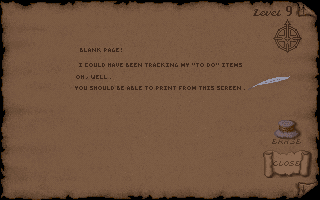 |
| I don't generally buy the idea that consoles have "dumbed down" games, but it's probably true that the reason you can't do this in modern games is because of console compatibility. |
- The record for a speedrun of the game seems to be 17 minutes and 25 seconds. Look at that guy go. He doesn't hesitate for a second. I don't know my way around my own bedroom as well as he knows that dungeon. At one point, he drops the moonstone while in mid-air, knowing that it will land where he wants it to be when he casts "Gate" later.
- But there is a bit of an exploit: he has piles of ash that seem to be able to shoot fireballs and other spells. I guess there's a bug in the game by which turning a wand into a pile of ash keeps its abilities but prevents it from every running out and "breaking." I guess I'm glad I didn't know that. The game was easy enough.
Now, I don't want to jinx it, but having revised my opinion on the game's combat system (as per the last entry), it's entirely possible that Ultima Underworld might unseat Ultima V for the top spot. I'm not going to engineer it that way, but I'll bet it's at least close. It's thus with some excitement that I begin the GIMLET:
1. Game World. As per my concerns at the top of this entry, the backstory and in-game story may offer more detail than the typical RPG of the time, but they're still a bit clumsy, unsatisfying, and uncomfortably seated within Ultima canon. What little lore we got on the Abyss and the collapse of the colony was appreciated, but I still wish there were more. More in the game's favor, the world feels like a realistic environment. Days pass at a sensible rate. The dungeon is logically structured, has clear sources of food and water, and feels like a real place. The game experience is almost better if you ignore everything presented in the backstory and just piece together the scraps of information the game provides as you find them. Score: 6.
2. Character Creation and Development. The "classes" don't matter so much as the more basic "builds," but it's still a good system. The different choices create quite different approaches to playing the game. There's admirable flexibility in character creation, the skill system is mostly well-realized (minus some useless skills), and leveling is more rewarding than any previous Ultima title. My major quibble in this area is the artificially-low level cap. Score: 6.
3. NPCs. Fantastic. I love the importance of dialogue, the dialogue options, the fun use of classic "monsters" as NPCs. There could have been more dialogue options, or starker distinctions to accommodate different role-playing styles, but it's early in the era. I like that NPCs are vital to understanding the quest and game lore, but you still have some options, such as joining (or not) the knights. The barter system needed some work but was still fun and original. Score: 7.
 |
| Dialogue options are: 1) what I need to accomplish the quest; 2) unnecessarily cruel; and 3) a lie that will just prolong things. Some of the other conversations are better. |
4. Encounters and Foes. The game has a small but effective menagerie, well described in the game manual, with an interesting set of strengths, weaknesses, special attacks, and special defenses. I like that some "enemies" are on the edge and can be tipped (or not) into hostility depending on your actions, and that expectations are inverted by making goblins, trolls, and lizardmen friendly. The game is full of non-combat encounters that aren't designated as such (i.e., no text box pops up with a menu of options) but that still call upon your creativity, knowledge, and skill. Score: 6.
5. Magic and Combat. Literally, there isn't much to combat--just a choice of weapons and attack types. But as I discussed last time, in any game where combat is integrated into the main exploration engine, anything possible in that engine becomes a combat tactic. If combat was a little harder, it would have made more sense to explore those various options. More than any game so far, however, you can truly "role-play" combat here, including avoiding it entirely.
I feel like a fraud even commenting on magic. I like the variety of spells, and that so many can be used to solve puzzles and explore rather than just engage in combat. Having to find the runes adds a fun twist. Score: 5.
6. Equipment. Also better here than any previous Ultima title. I always like when you have plenty of item "slots," so you're constantly getting upgraded. The variety of items is fantastic, accommodating just about any play style or set of skills. I didn't mind the wear-and-tear system, nor the identification system, and in both cases I appreciated that there were multiple approaches. I liked that so many items (poles, spikes, fishing poles, lockpicks, torches) could be duplicated by spells, or not, depending on your preference. The encumbrance system altered between challenging and annoying but at least wasn't annoying full-time. Lots of magic items. Lots of things to read. Lots of worthless items, but in the game for atmosphere. Lots of ways for items to interact with each other. My only real complaint is that I don't like fully deterministic games in which items are never varied nor vary locations. Score: 7.
7. Economy. A lot of dungeon crawlers eschew an economy. This one not only offers one but also makes it somewhat realistic by allowing direct bartering rather than passing everything through a standard currency. Beyond that, however, the economy isn't very good. There's not enough interesting to buy, and thus hardly any reason to sell. I do like that the dwarven smith and the seer who identifies things provide a "money sink" if you don't have those skills--if only it didn't take so long to get to them when you need them. Score: 5.
8. Quests. Decent main quest, although it could have been clearer, and a handful of side quests along the way that add flavor and role-playing. No options or alternate endings for the main quest. Score: 5.
9. Graphics, Sound, and Interface. The graphics are state-of-the-art for the time, though obviously a bit blocky today. To allow continuous movement and views from multiple angles, they had to take an acceptable step back in some detail. I found the sounds adequate but not outstanding. The voice acting at the beginning of the game was just awful. The interface, on the other hand, couldn't have been better. The game supports intuitive, redundant use of both mouse and keyboard, and I didn't have to think about either after the first 10 minutes. The automap is the best we've seen so far. Score: 7.
10. Gameplay. Easily the best category. It's as non-linear as a multi-level dungeon game can get (although a central staircase with quicker access to earlier levels would have been appreciated), even in monster difficulty. The lowest levels still have plenty of rats, rotworms, and mongbats. The experiences of different character builds make it very replayable. It was perhaps just a tad too easy in combat, at least for a fighter-type character, but the puzzle difficulty was decent and the game lasted just a perfect amount of time. At no point did I say, "I'm ready for this to be over," but neither did it leave me wanting more. Score: 8.
That gives us a final score of . . . drum roll . . . 62. Ah, well. Not technically enough to unseat Ultima V (69), Ultima VI (68), or even Pool of Radiance (65). On the other hand I rated the "newest" of those games 4 years ago, and 62 is within the margin of error for how my rating approach may have evolved. I wouldn't fret too much about it. It's at least made the average for its year, as of now, the highest yearly average we've seen so far. Perhaps more telling, Ultima Underworld is one of only two games--the other is Ultima VI--in which every score is at least a 5. It could have done a few things a little better, but it didn't do anything truly bad.
My opinion is hardly original. Ultima Underworld makes the "Best X games" list, even today, for every category that it qualifies for. In its day, Dragon magazine called it "the best dungeon game we've ever played," particularly praising its auto-mapping, controls, and simulation of a real environment. Having cheapened their rating system by awarding 5/5 for just about anything, they gave Underworld 6 stars on a 5-star scale. PC-Spiele gave it 100%; Pelit 98%; Play Time 95%; Power Play 94%. ACE, PC Joker, ASM, PC Format, and PC Review UK were all above 90%. The only truly negative review seems to have come from a Swedish magazine called Svenska Hemdatornytt, which gave it 66%. I have't been able to get hold of that particular review.
The July 1992 Computer Gaming World, as was its tradition by the early 1990s, pairs Scorpia's "distinctive and often controversial perspective" with a review by Allen Greenberg. Greenberg's review isn't negative, exactly, but he seems to like the game more for what it portends than how it plays. Half his problem is declaring that the game "is best controlled using the mouse" and then spending several paragraphs explaining why the mouse doesn't work very well. If he'd used the WASD cluster to move like 90% of players, he'd have nothing to complain about. He praises the game as a "significant step" towards quasi-virtual reality and simulated environments but doesn't seem to have had much fun with the "murky and dim" graphics and "minimal" sound effects. He praises the automap but complains that you can't send it to the printer. A couple of complaints are just mystifying ("certain doorways that appear to be within reach remain frustratingly unapproachable"). Overall, though, he rates the game "an enjoyable challenge with a unique game-playing engine."
Scorpia's review is similarly mixed. With her historical perspective, she fully understands the major leap forward that the game represents, and it was fun to see that she had to spend an entire paragraph explaining what "continuous movement" actually means, because players wouldn't have encountered it before. She sees right through the less-useful skills like "Search" and "Appraise." She says the automap is the best she's ever seen but also complains that you can't print it (honestly, name one game in which you could). Her summary is that "the meticulous construction of a real-world dungeon environment is outstanding" and that the game represents "the dungeon trek of the future."
For "RPG of the Year" in 1992, it was up against Eye of the Beholder II, Might and Magic III, Planet's Edge, and Ultima VII, and it took the prize. It lost overall "Game of the Year" to Sid Meier's Civilization.
To listen to the developers, Ultima Underworld was almost never published. You'll recall that it wasn't an in-house Origin product, but rather the brainchild of former Origin employee Paul Neurath, now running his own company in Salem, New Hampshire. Neurath's own account says that the project started off with enthusiastic support from Richard Garriott, but that otherwise Origin hardly communicated with Blue Sky during development. Two consecutive producers assigned to work with Blue Sky quit, and there were rumors that Origin was going to cancel the game, a horrifying prospect to Neurath as he had personally fronted most of the development costs. Fortunately, things changed when Blue Sky requested, and received, Warren Spector as their third producer. Spector took a much greater interest in the title, communicated regularly, and shepherded the project to completion. Even then, success wasn't assured. Although the game sold half a million copies, it took a while--and word-of-mouth from excited gamers--to build momentum. That it was released only a month before Ultima VII probably didn't help.
Thanks to the ultimate sales total, Origin commissioned Ultima Underworld II: Labyrinth of Worlds (1993), which fits more solidly in the Ultima canon, featuring Lord British and the usual Ultima NPCs, and occurring between the two parts of Ultima VII. By then, Blue Sky had merged with Lerner Research to form Looking Glass Studios, and the company continued to specialize in 3D games like the System Shock series, Terra Nova: Strike Force Centauri, and the Thief series. To some degree, of course, Ultima Underworld's influence is seen in nearly every first-person, continuous-movement title, including The Elder Scrolls and Deus Ex and even non-RPGs like Half-Life. Arkane Studios' Arx Fatalis (2002) was originally intended as Ultima Underworld III (Electronic Arts rejected it).
Looking Glass Studios closed in 2000, its employees scattering to companies like Ion Storm, Westwood, Valve, and Arkane. Paul Neurath formed Floodgate Entertainment in 2000 and co-developed Neverwinter Nights: Shadows of Undrentide (2003, with BioWare) and Dark Messiah of Might and Magic (2006, with Arkane). Floodgate closed in 2014, and Neurath almost immediately formed OtherSide Entertainment. Their first project? Underworld Ascendant. It achieved its $800,000 Kickstarter goal in 2015 and has an official license from Electronic Arts (albeit only for the Underworld setting, not the totality of Ultima canon). The graphics look very nice, but the project seems to have exceeded its anticipated delivery by a non-trivial margin.
 |
| Late in the game, I replaced my black longsword of Great Accuracy with a jeweled longsword of Unsurpassed Damage. It seemed to kill the enemies faster. |
7. Economy. A lot of dungeon crawlers eschew an economy. This one not only offers one but also makes it somewhat realistic by allowing direct bartering rather than passing everything through a standard currency. Beyond that, however, the economy isn't very good. There's not enough interesting to buy, and thus hardly any reason to sell. I do like that the dwarven smith and the seer who identifies things provide a "money sink" if you don't have those skills--if only it didn't take so long to get to them when you need them. Score: 5.
 |
| All the treasure found on the lower levels is wasted. |
8. Quests. Decent main quest, although it could have been clearer, and a handful of side quests along the way that add flavor and role-playing. No options or alternate endings for the main quest. Score: 5.
9. Graphics, Sound, and Interface. The graphics are state-of-the-art for the time, though obviously a bit blocky today. To allow continuous movement and views from multiple angles, they had to take an acceptable step back in some detail. I found the sounds adequate but not outstanding. The voice acting at the beginning of the game was just awful. The interface, on the other hand, couldn't have been better. The game supports intuitive, redundant use of both mouse and keyboard, and I didn't have to think about either after the first 10 minutes. The automap is the best we've seen so far. Score: 7.
 |
| This is what the dungeon looks like if you set the textures to "low detail." |
10. Gameplay. Easily the best category. It's as non-linear as a multi-level dungeon game can get (although a central staircase with quicker access to earlier levels would have been appreciated), even in monster difficulty. The lowest levels still have plenty of rats, rotworms, and mongbats. The experiences of different character builds make it very replayable. It was perhaps just a tad too easy in combat, at least for a fighter-type character, but the puzzle difficulty was decent and the game lasted just a perfect amount of time. At no point did I say, "I'm ready for this to be over," but neither did it leave me wanting more. Score: 8.
That gives us a final score of . . . drum roll . . . 62. Ah, well. Not technically enough to unseat Ultima V (69), Ultima VI (68), or even Pool of Radiance (65). On the other hand I rated the "newest" of those games 4 years ago, and 62 is within the margin of error for how my rating approach may have evolved. I wouldn't fret too much about it. It's at least made the average for its year, as of now, the highest yearly average we've seen so far. Perhaps more telling, Ultima Underworld is one of only two games--the other is Ultima VI--in which every score is at least a 5. It could have done a few things a little better, but it didn't do anything truly bad.
 |
| Organizing those three enemies in that screenshot must have taken forever. |
My opinion is hardly original. Ultima Underworld makes the "Best X games" list, even today, for every category that it qualifies for. In its day, Dragon magazine called it "the best dungeon game we've ever played," particularly praising its auto-mapping, controls, and simulation of a real environment. Having cheapened their rating system by awarding 5/5 for just about anything, they gave Underworld 6 stars on a 5-star scale. PC-Spiele gave it 100%; Pelit 98%; Play Time 95%; Power Play 94%. ACE, PC Joker, ASM, PC Format, and PC Review UK were all above 90%. The only truly negative review seems to have come from a Swedish magazine called Svenska Hemdatornytt, which gave it 66%. I have't been able to get hold of that particular review.
The July 1992 Computer Gaming World, as was its tradition by the early 1990s, pairs Scorpia's "distinctive and often controversial perspective" with a review by Allen Greenberg. Greenberg's review isn't negative, exactly, but he seems to like the game more for what it portends than how it plays. Half his problem is declaring that the game "is best controlled using the mouse" and then spending several paragraphs explaining why the mouse doesn't work very well. If he'd used the WASD cluster to move like 90% of players, he'd have nothing to complain about. He praises the game as a "significant step" towards quasi-virtual reality and simulated environments but doesn't seem to have had much fun with the "murky and dim" graphics and "minimal" sound effects. He praises the automap but complains that you can't send it to the printer. A couple of complaints are just mystifying ("certain doorways that appear to be within reach remain frustratingly unapproachable"). Overall, though, he rates the game "an enjoyable challenge with a unique game-playing engine."
Scorpia's review is similarly mixed. With her historical perspective, she fully understands the major leap forward that the game represents, and it was fun to see that she had to spend an entire paragraph explaining what "continuous movement" actually means, because players wouldn't have encountered it before. She sees right through the less-useful skills like "Search" and "Appraise." She says the automap is the best she's ever seen but also complains that you can't print it (honestly, name one game in which you could). Her summary is that "the meticulous construction of a real-world dungeon environment is outstanding" and that the game represents "the dungeon trek of the future."
For "RPG of the Year" in 1992, it was up against Eye of the Beholder II, Might and Magic III, Planet's Edge, and Ultima VII, and it took the prize. It lost overall "Game of the Year" to Sid Meier's Civilization.
 |
| I just thought this was a fun shot of a goblin getting hit in the face. |
To listen to the developers, Ultima Underworld was almost never published. You'll recall that it wasn't an in-house Origin product, but rather the brainchild of former Origin employee Paul Neurath, now running his own company in Salem, New Hampshire. Neurath's own account says that the project started off with enthusiastic support from Richard Garriott, but that otherwise Origin hardly communicated with Blue Sky during development. Two consecutive producers assigned to work with Blue Sky quit, and there were rumors that Origin was going to cancel the game, a horrifying prospect to Neurath as he had personally fronted most of the development costs. Fortunately, things changed when Blue Sky requested, and received, Warren Spector as their third producer. Spector took a much greater interest in the title, communicated regularly, and shepherded the project to completion. Even then, success wasn't assured. Although the game sold half a million copies, it took a while--and word-of-mouth from excited gamers--to build momentum. That it was released only a month before Ultima VII probably didn't help.
Thanks to the ultimate sales total, Origin commissioned Ultima Underworld II: Labyrinth of Worlds (1993), which fits more solidly in the Ultima canon, featuring Lord British and the usual Ultima NPCs, and occurring between the two parts of Ultima VII. By then, Blue Sky had merged with Lerner Research to form Looking Glass Studios, and the company continued to specialize in 3D games like the System Shock series, Terra Nova: Strike Force Centauri, and the Thief series. To some degree, of course, Ultima Underworld's influence is seen in nearly every first-person, continuous-movement title, including The Elder Scrolls and Deus Ex and even non-RPGs like Half-Life. Arkane Studios' Arx Fatalis (2002) was originally intended as Ultima Underworld III (Electronic Arts rejected it).
Looking Glass Studios closed in 2000, its employees scattering to companies like Ion Storm, Westwood, Valve, and Arkane. Paul Neurath formed Floodgate Entertainment in 2000 and co-developed Neverwinter Nights: Shadows of Undrentide (2003, with BioWare) and Dark Messiah of Might and Magic (2006, with Arkane). Floodgate closed in 2014, and Neurath almost immediately formed OtherSide Entertainment. Their first project? Underworld Ascendant. It achieved its $800,000 Kickstarter goal in 2015 and has an official license from Electronic Arts (albeit only for the Underworld setting, not the totality of Ultima canon). The graphics look very nice, but the project seems to have exceeded its anticipated delivery by a non-trivial margin.
In talking about this game's development and legacy, I could publish an article six times this length, but those articles have been published, and are out there, so I leave you to them. I'm grateful to have such a fun and fascinating start to 1992. How do you possibly follow that? Adventure Gamers, are we ready for Quest for Glory 3 yet?
****
****
For further reading:
My reviews of the entire Ultima series:
- Akalabeth: World of Doom (1980)
- Ultima (1981)
- Ultima II: Revenge of the Enchantress (1982)
- Exodus: Ultima III (1983)
- Ultima IV: Quest of the Avatar (1985)
- Ultima V: Warriors of Destiny (1988)
- Ultima VI: The False Prophet (1990)
- Worlds of Ultima: The Savage Empire (1990)
- Martian Dreams (1991)
- Ultima VII: The Black Gate (1992)
- Ultima Underworld II: Labyrinth of Worlds (1993)
- Ultima VII: Part Two - Serpent Isle (1993)
Also:
- "The Digital Antiquarian" articles on the making of this game.
- The Elder Scrolls: Arena (1994), a game clearly inspired by this one.
05/06/2026