Robin Hood: Prince of Thieves
United States
Sculptured Software, Inc. and B.I.T.S., Ltd. (developers); Virgin Games (publisher)
Released 1991 for NES, 1993 for Game Boy
Date Started: 1 June 2022
Date Ended: 5 June 2022
Total Hours: 5
Difficulty: Moderate -Hard (3.5/5)
Final Rating: 23
Ranking at Time of Posting: 194/460 (42%)
Robin Hood: Prince of Thieves (1991), starring Kevin Costner (who, unlike some other Robin Hoods, does not speak with an English accent), may be one of the dumbest adaptations of the legend, but it will always have a special place in my heart. In the summer of 1991, I was attending AIT training for the Army Reserves in Fort Gordon, Georgia. As someone who bristles at even minor constraints, I found Army training difficult--hopefully the closest I will ever come to being in jail. AIT was easier than basic, partly because we had weekends free, and as soon as the drill sergeant announced "Dismissed!" on Friday evening, I jumped in a cab and headed for the local movie theater in Augusta. I spent weekend after weekend that summer watching mostly the same movies over and over again: Terminator 2, The Naked Gun 2½, Backdraft, The Rocketeer, Doc Hollywood, Regarding Henry, The Doctor, and Robin Hood. I probably haven't seen it since then, but I think I could still rewrite the screenplay from memory.
This video game tie-in is a rare (for the era) NES title created by a U.S. developer:
Sculptured Software, based in Salt Lake City. Founded in 1984, the
company specialized in action, sports, and racing games for 1980s
microcomputers. At the end of the decade, they pivoted to console development and
never looked back. They had no experience with RPGs except for handling
the Commodore 64 port of Microillusions' Faery Tale Adventure in 1988, but they smartly hired Mike Breault (Pool of Radiance) to help design the game. Originally titled The Legend of Robin Hood, it was slated for a 1990 release through Mastertronic's Acadia Software label. (This prototype version can be found online and on YouTube.) Publication was held up by Mastertronic's merger with Virgin Games, by which point the forthcoming film had been announced. Virgin licensed the new name from Morgan Creek Productions and mandated changes to the game's plot and graphics to better fit the film. The result is an odd half-adaptation that both needs the film to explain some of its plot developments but diverges from the film in numerous places.
As you may know if you've read much about Robin Hood, the reality of any historical character of that name is hotly debated. Most of the historical references date from the reigns of Edward I (1272-1307) and Edward II (1307-1327), although there are some that go back to the 1260s. The earliest fictional ballads have him active during the reign of an unnumbered "Edward," which could be as late as 1377. (Edward IV reigned from 1461-1470, but by then historical ballads of Robin Hood had already appeared.) Ballads and stories start to appear in complete form in the late fifteenth century. From the earliest, the Sheriff of Nottingham is the primary antagonist. Other characters, like Friar Tuck and Maid Marian, are added to the legend as the years pass.
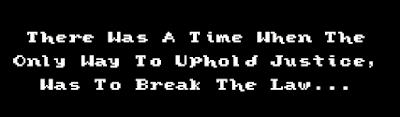 |
That time is called "pretty much all of human history up to the Enlightenment."
|
In 1598, playwright Anthony Munday, a contemporary of Shakespeare, wrote two plays that rolled the dates of Robin Hood's life back to the reign of Richard the Lionheart (1189-1199), and specifically his 1190-1194 absence on the Third Crusade and subsequent captivity. It is Munday who makes Robin a dispossessed nobleman, specifically the Earl of Huntingdon. In 1795, an English historian named Joseph Ritson assembled a volume of all the Robin Hood stories and ballads he could find. In a preface, without much evidence, he argued that Robin Hood was born Robert Fitzooth in the village of Locksley in Nottinghamshire and that he had "some sort of pretension" to the earldom of Huntingdon. Based on Ritson's account, the character appeared in Sir Walter Scott's Ivanhoe (1818) as "Robin of Locksley."
 |
An axe doesn't seem like the right torture instrument for this situation.
|
The game follows the movie's curious choice to accept the Third Crusade setting (specifically, 1194) but to eliminate the character of King John. We are made to believe that the Sheriff of Nottingham himself has his eyes on the English throne, as if such a thing were remotely possible. The fractured development of the game is evident in the backstory, in which you, as Robin Hood, "were fighting in the Crusades when your friend Peter Dubois was captured and imprisoned for stealing bread." You try to free him by taking the blame yourself only to find yourself in prison beside him. This is a silly misinterpretation of the opening scenes of the film, in which Robin and Peter are prisoners of war, and Peter is accused of stealing bread from another prisoner. Anyway, the game begins in the "Arab prisons," in a cell where Robin watches his friend being tortured by a man with an axe. A sword lies temptingly on a nearby hearth, and your first task of the game is to snatch it and whack the guard, who dies in one hit. Peter, looking like a fuzzy Rod Stewart, proclaims that he is "free at last!" and joins the party. Searching the guard reveals the key to the cell.
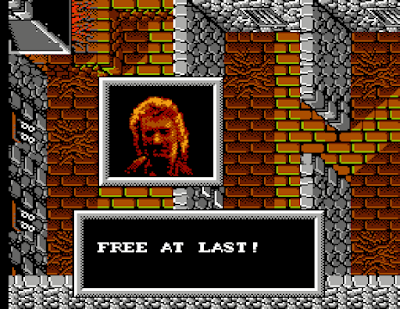 |
Thank God Almighty.
|
The game uses an axonometric perspective with (aside from the portraits) acceptable graphics. It transcends its hydlike roots by offering a fairly complex set of commands accessible with the START button, including "Talk," "Look," "Take," "Search," and "Player." The latter brings up a character and inventory screen with an Ultima VI-esque paper doll for equipping weapons, helmets, armor, leggings, and boots. (Regrettably, only some of these are ever used.) Maneuvering around this screen, pretending the pad is a mouse and the "A" button is a mouse button, is a little annoying, but as good as could be accomplished with a controller. Robin starts at Level 1 with no experience, 100 hit points, and no gold. Everything you carry adds to your encumbrance and decreases agility.
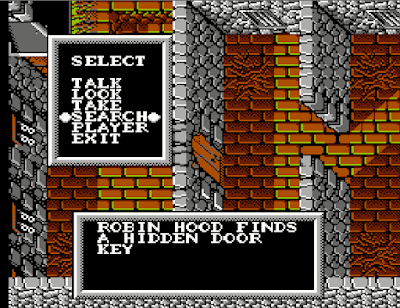 |
The game's menu.
|
Azeem is chained in the next cell. You have your first role-playing choice when you choose to free him, but you can't win if you don't. (Azeem was created for the film, although perhaps based on a character from the Robin of Sherwood TV series named Nasir. In an original draft, Azeem was "Aslan.") He tells you of a secret exit beyond another door, and a hidden key to that door.
 |
This doesn't look much like Morgan Freeman.
|
Opening the door puts you face-to-face with another guard, which instigates the game's dueling system. Many enemies are fought on the main screen with a simple slash of a sword, but some boss fights take place on a side-view screen in which you can move back and forth, attack, duck, and jump. Obstacles like tables and bridges offer both advantages and disadvantages. While I appreciate the complexities of the system, I found that if I just faced the enemy and kept pressing "attack," he'd walk into my sword often enough for me to win.
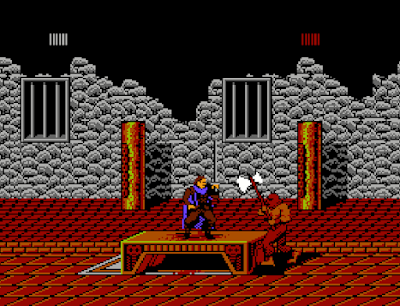 |
The "duel" screen.
|
I played long enough to note that the sound effects were adequate, then turned the sound off. Like most Nintendo games of the era, it features constant music that you can neither mute (independently of the sound) or diminish. If I had been a father during this era, I would have banned the console for this alone.
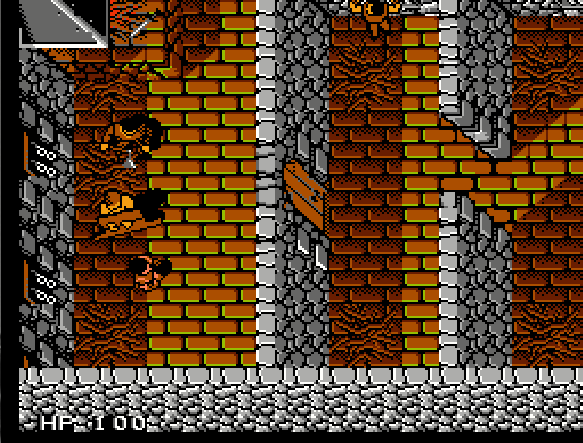
Escaping the dungeons puts you in a maze of catacombs. Most of the game takes place in mazes like this. Monsters (here, Saracen guards) spawn continually, but never more than three or four on the screen at a time. (The game's use of relentless spawning recalls the developer's previous experiences with Faery Tale Adventure.) If you're aligned appropriately, attack with the right timing, and don't let any creep up behind you, you can inevitably kill them before they can get to you, although sometimes it takes several hits. When they die, enemies explode in a satisfying (if slightly unrealistic) display of blood and bones. They occasionally leave corpses on the screen, which is always a sign that you can search them for some item or another.
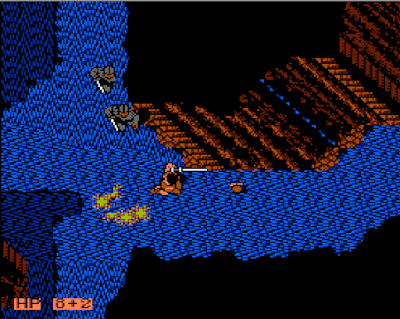 |
Two enemies approach from the north as a third one finishes exploding from my blade. Nearby, someone has dropped an apple.
|
When your dexterity fails, enemies strike their blows, and you lose hit points. These are easily replenished with food, bandages (which comically look like Band-Aids), and potions frequently dropped by enemies or found in the corners of the mazes. I mostly found I was so overloaded with these items that I could use them as soon as I found them.
Occasionally, at scripted moments, the game takes you into a mass combat in which all characters in the party appear on the screen at the same time, fighting larger masses of foes. You control one character while the others roam around, attacking on their own. It's the only time where allies fight and lose hit points, but they can't permanently die.
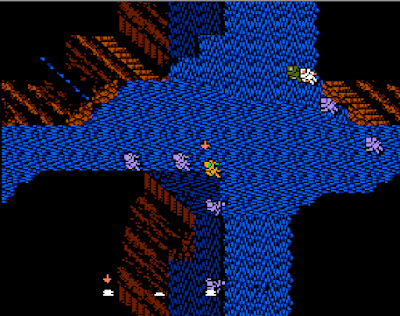 |
Mass combat at the exit. The white, red, and green(?) figures are allies; the blue(?) ones are enemies.
|
No matter what type of combat you're fighting--regular, dueling, or mass--combat is relatively easy. The difficulty with this game comes from the accumulation of small mistakes. There's no way to save your progress. After you die, you can hit "continue" to start over again at the beginning of the level, but only twice. For a game that doesn't allow saving, its overall length is a bit unsupportable. I suppose I occasionally had five free hours as a kid, but it's pretty rare today. Thank the gods for emulators with save states.
 |
When your third life is lost.
|
After you kill about 20 enemies in the mass combat, Peter dies a scripted death. Title cards relate how Robin and Azeem spent 10 months finding their way back to England. Action picks up again in a forest "near Hadrian's Wall," which I am obliged to note is nowhere near Locksley or Nottingham. An old man relates the situation.
 |
Apparently, in this game, the enemy's name is "Sheriff Nottingham."
|
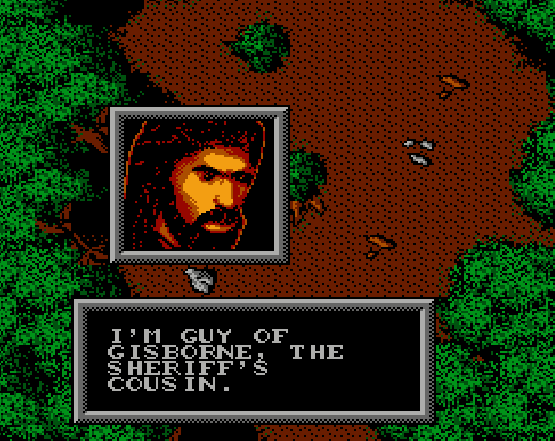
The game from here is extremely linear, with almost painfully small areas to explore and quests that resolve in minutes. At Hadrian's Wall, which has maybe six screens, you find a few items, including your first bow, and rescue Little John's son from Sir Guy of Gisbourne in a mass combat (Guy escapes at the end). The portrait of Guy looks more like the Sheriff from the film (Alan Rickman), and later the portrait of the Sheriff looks like the film's Guy (Michael Wincott).
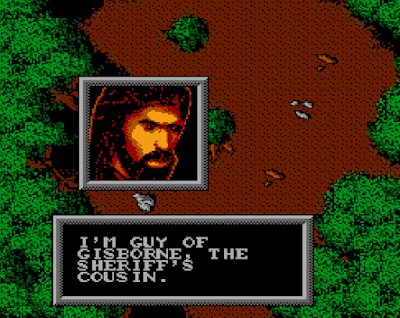 |
You look more like the Sheriff.
|
A quick transition forest leads to Castle Locksley. Robin promises Azeem hospitality but is dismayed to find that the castle has been sacked and ruined, his father crucified above the entry door. The castle is swarming with, I don't know, wild dogs or wolves or something. Bats and rats are also a problem. In a side-chamber, you find Duncan, Robin's old servant, who has been blinded. He joins the party (you can equip him, and he will actually fight) and gives Robin his father's medallion. A title card relates that the trio bury Robin's father.
 |
Well, this is gruesome.
|
Moving west, you reach Maid Marian's Castle. I had to look up a hint to find that wearing the Locksley medallion is the only way to convince the guard to let you in. You can find chainmail and some potions in the castle, but no combats. Eventually, you meet Marian and give her Peter's ring. (She doesn't attack Robin in armor as in the film.) She suggests that you go hide in Sherwood forest. The Sheriff's men raid the castle after the conversation, and you must fight your way free. Some of the men have crossbows for the first time, which adds a challenge to combat. You get a saddle from Marian and have to "use" it next to a horse to make your getaway.
 |
How is this remotely possible? Where is John? Where is the Great Council? How were the chancery and exchequer persuaded to go along with this?
|
There is now one of two horse riding sequences in which you flee through the forest ahead of the Sheriff's men. You have to jump at vital moments to avoid obstacles, not unlike the similar minigame in Hillsfar (1989). The problem here is that mistiming a jump results in a death. I can imagine that back in the day, many players who skillfully avoided death in combat met their demise on the other side of a rock. It must have been infuriating.
 |
I know I'm colorblind, but are these rocks blue?
|
I have no idea what kind of animal was attacking me as I explored Sherwood Forest. Giant rats, maybe. The forest maze brings you to a bridge, where you're challenged by Little John. This brings you to the second duel screen of the game. There's a similar scene in the movie, of course, but both combatants fight with staves in the film, while here, Robin has whatever you've equipped him with. Robin's sword has a much longer reach than Little John's staff, so the battle is fairly easy. Upon your victory, Little John joins the party, bringing a staff that spins continuously when you hold
down the "A" button, which makes you effectively immune to any enemy
that relies on a melee attack.
 |
Isn't that just like a commoner? Brings a stick to a sword fight.
|
You're automatically taken to Sherwood forest, where several Merry Men are busy chopping down trees and planning a camp. From this point, every time you leave Sherwood, you end up going directly to your next quest. This means you can't backtrack to any previous areas, which has some unfortunate consequences if you fail to pick up a crucial item.
Time with your new friends is interrupted by the arrival of a man who begs you to rescue his fiancée from the evil baron who has kidnapped her. This is the part where the game starts to diverge from the film a bit. There's a small forest area
that you have to conquer before you get to the castle.
 |
This is what Robin Hood looks like, by the way.
|
The baron's castle is the most colorful and detailed map of the game, and it features more of the crossbow enemies. There were lots of bits of furniture that I would have liked to search, but the constant spawning of enemies ruins the fun of exploration. The baron is getting married in a chapel on the first floor, but you have to fight your way up to the second floor to find a letter from the baron to the Sheriff of Nottingham, admitting that the bride has been kidnapped. There's a mass combat on the second floor rendered almost too simple with the bow. The baron capitulates after a duel.
 |
Finding a crucial piece of evidence.
|
Returning to Sherwood, Robin finds a new quest: wild boars destroying the fields of nearby villagers. You fight through a small forest map with a few wild boars before encountering the chief boar in a small hut with a skeleton. The staff makes the boar fight trivial; he just keeps advancing into the spinning staff and getting knocked back. Searching the skeleton--which looks just like those in Ultima VII--produces Locksley Armor, a Locksley Bow, and a bag of gold. Who was this guy? The Locksley Bow fires a burst of three arrows at a time, which is a marginal improvement over hitting the "A" button three times rapidly.
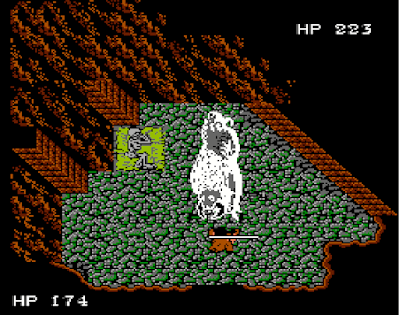 |
Just like in the movie.
|
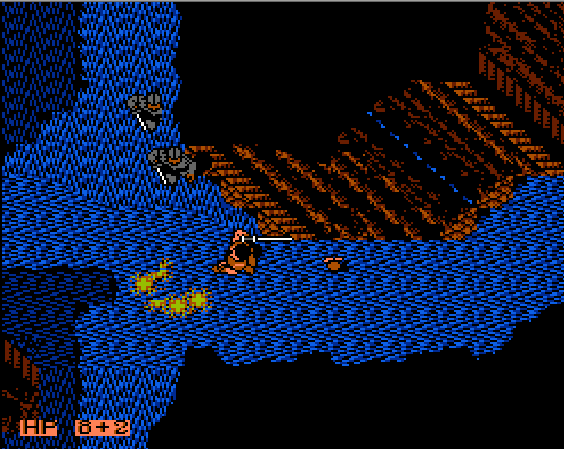
You return to Sherwood and find that the Merry Men have been hard at work building tree huts. One of them tells you that a fellow has gone missing in the woods. In a forest map bisected by a river, you find him dead by a well. A letter from Mortianna, the Sheriff's witch (unnamed in the film, I think) says "Let this be a warning." To the east, you find a length of rope that lets you down the well.
 |
Why are you chopping down a tree that has a hut in it?
|
The well takes you to a series of caverns where you fight rats, snakes, and bats. The caverns lead to a dungeon where Little John claims he can smell druids. Among a few chambers, you find notes with a credit list for the game and a warning that the Sheriff is targeting villagers who help Robin Hood (who hasn't really done any banditry yet!). Mortianna confronts you at the end of the small dungeon and says that she protects the Sheriff and a giant skeleton, which you cannot beat, protects her. The skeleton is indeed immune to normal weapons, leaving you no choice but to return to the well, the outer forest, and ultimately Sherwood.
 |
This must have been a deleted scene.
|
Back home, you hear that Marian wants to meet with you and is at a chapel to the south. You fight through animals and guards in a small forest area. Once you arrive at the chapel, Marian gives you a special Druid's Dagger and warns that the Sheriff is raising an army.
In Sherwood, an ally informs you that the Sheriff's tax carts will soon be rolling through. It turns out to be a trap set by Guy of Gisbourne, who taunts you with the fact that he killed your father. You defeat him in a duel and recover the Locksley Sword. Friar Tuck, accompanying the wagons, joins the party. The Merry Men loot the wagons and their taxes.
 |
Guy lies dead next to the Locksley Sword.
|
Sherwood now has wooden walkways connecting the tree huts. Marian meets you there but only coldly announces she's taking Duncan back with her to her castle. Meanwhile, an ally tells you that the Merry Men need a weapons master, and a nearby hermit fits the bill.
Another forest segment, curiously bereft of enemies, follows. At the end, you meet a hermit who agrees to join you if you defeat him in combat. Another duel follows. The weapons master jumps and somersaults around a lot, but he's otherwise no harder than the typical enemy. He agrees to go back to the camp for 200 gold. You do accumulate gold in this game--I had 550 at this point--and there are only a couple of places to spend it. This is the only necessary one. Coming so quickly on the heels of the wagon robbery, there's no way you wouldn't have enough gold.
Next crisis: A flu has spread through the camp. Friar Tuck knows of a pond with magical healing waters. Strange creatures live in the pond. The "strange creatures" turn out to be giant frogs that hurl some kind of magic bolt at you. To get the water, you need to have picked up a flask in the weapons master's hut. I thought I had, but it wasn't there when I got to the pond. I had to look up how to hex edit one into my inventory.
 |
Maybe "giant frogs" is the wrong call.
|
Bringing a flask of the water back to camp heals the people. The next objective is to stop an evil baron, looting his way through the countryside. You fight through a forest map to reach the village, where a mass combat ensues. Victory allows you to confront the baron, who turns out to be the same evil baron from the interrupted wedding. He challenges Robin to a duel, which goes predictably.
Duncan is waiting when you return to Sherwood, reporting that Marian has been kidnapped by the Sheriff, who intends to marry her. At the same time, a bunch of Celts invade the camp. Another mass combat takes place, and even if you "win," the Celts overrun the camp and force you to regroup in the forest, learning there that some Merry Men were taken captive. If you return to camp, you find it on fire, with an ally bearing news that the Sheriff plans to hang the captured outlaws. One of the huts has a "disguise" in it.
There's another forest, followed by another horse segment, before the party reaches the Sheriff's castle. NPCs in the area talk about the upcoming marriage and hanging. You have to don the disguise to avoid a bunch of needless mass battles.
 |
Except you don't.
|
It took me a while to figure out what to do in this area. There's no way to get up on the gallows platform to rescue the hostages, and guards just turn you away from the castle gates. You have to attack the guard, it turns out, which prompts a mass battle. Afterwards, you can enter the castle.
You explore the castle, fight a bunch of guards, fight a couple of mass battles, and eventually meet Mortianna and her skeleton again. This time, you can kill it with the Druid's Dagger. Mortianna just explodes with a "nooo!" once her skeleton dies.
Beyond her is the Sheriff, who quotes a little dialogue from the film before attacking in a duel. As usual, the strategy of standing still and swinging away carries the day.
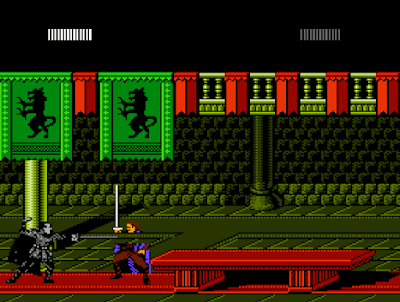 |
The final battle.
|
Once the Sheriff dies, a final cinematic shows Robin and Marian getting married.
 |
"Marry Robin of Locksley to Marian Dubois" would make things less ambiguous.
|
King Richard shows up to give away the bride but otherwise doesn't thank Robin for keeping his throne secure. There's a final, hilarious animation that shows Robin leaning in for a kiss, which clearly disgusts Marian.
 |
"I can't bear to look at that mullet."
|
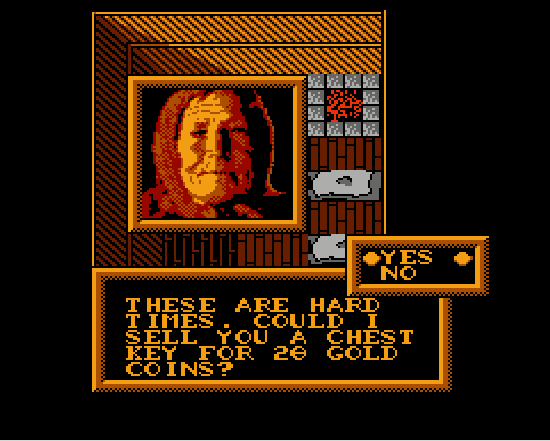
Overall, the game is pretty bad. Everywhere, there are signs of cut content. There are never any helms or boots to put on those portions of the character portraits, for instance. The manual mentions shields, which never appear. You find more chest keys than chests, and there are only two places to spend the gold you accumulate--one on a scripted event, and one on a useless chest key. It hardly makes sense to give party members experience levels and hit points, since they only act in mass combats and can't actually die even there. Individual combats are too easy, but expecting the player to last over five hours with no saves and only three lives is a bit too much.
 |
The only place you can voluntarily spend money.
|
It doesn't even work very well as a movie companion. There's no character to any of the characters. Each of the party members--Azeem, Duncan, Friar Tuck, and Little John--has only a few lines after they join the party. Neither the Sheriff of Nottingham nor Maid Marian are present enough in the game to feel that they're the protagonist's great love and great nemesis, respectively. Will Scarlett is absent entirely.
But where it fails most is as a Robin Hood game. To me, Robin Hood has two defining qualities: he's a master archer, and he gives to the poor. Any Robin Hood game ought to have an archery minigame or otherwise a complex archery mechanic (and indeed the prototype seems to have one) and a method of distributing gold to peasants, perhaps for information, perhaps for other character boosts.
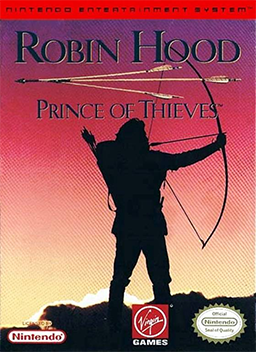 |
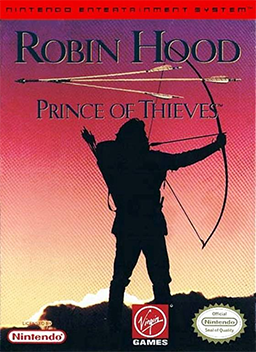
For a game that doesn't have much to do with archery, it features prominently on the box.
|
The worst of it is that if MobyGames is to be believed, there isn't a single Robin Hood RPG after this one. I'd love to see an open world game using these characters. It would be just like a medieval Far Cry. Robin comes home from the Crusades (or escapes from prison) to find Prince John oppressing the populace. Nottinghamshire is divided into several zones, each ruled by a lieutenant, including Guy of Gisbourne and the Sheriff. Robin completes a variety of missions to rob from the rich and give to the poor, with mechanics favoring stealth. Giving gold to the poor rewards the player with information about wagons to rob and castles to loot. Once John's position has been weakened enough by the Merry Men, the showdown commences. The whole thing writes itself.
 |
A mid-game character sheet.
|
There are a couple of things that I like about the game and wouldn't mind seeing in more NES titles. First, while Robin doesn't have any attributes, he does get stronger and faster (as well as hardier) as he levels up. Too many NES RPGs and quasi-RPGs offer only increases to maximum health as a reward for leveling. Second, the more complex commands and character sheet work well mechanically. They just aren't used very well by the content of this particular game. I give it a 23 on the GIMLET, with the best score (4) in "Graphics, Sound, and Interface" and the worst (1) in "Economy" and "Gameplay." It's far too linear, too long for a game that doesn't allow saves, and not replayable.
****
Sorry for the week off, everyone. I had a personal emergency. I played this very early in the month but only had time to write it up now. I'll get back on track this week and get started on the next Werdna entry.


008.bmp)
001.bmp)
003.bmp)
005.bmp)
007.bmp)
011.bmp)
017.bmp)
027.bmp)
046.bmp)
030.bmp)
051.bmp)
048.bmp)
060.bmp)
062.bmp)
066.bmp)
070.bmp)
074.bmp)
081.bmp)
082.bmp)
083.bmp)