Showing posts sorted by date for query Four Crystals of Trazere. Sort by relevance Show all posts

Tuesday, November 28, 2023

Game 499: Worlds of Legend: Son of the Empire (1993)

It was war last time, too.
       
Worlds of Legend: Son of the Empire
AKA Son of the Empire: Legend Worlds 1: This Time Its [sic] War! 
United Kingdom
Mindscape (developer and publisher)
Released 1993 for Amiga and DOS
Date Started: 19 November 2023 
     
Mindscape is one of my least favorite developers from this period. I say that with some sadness, because their games are always innovative. They just have a way of dragging on, getting too hard, and wearing me out. This is true of both the Anthony Crowther line (Captive, Knightmare, Liberation: Captive II) and the Anthony Taglione line represented in Bloodwych (1989), Legend (1992), and this game, meant to be the first in a line of Words of Legend titles.
 
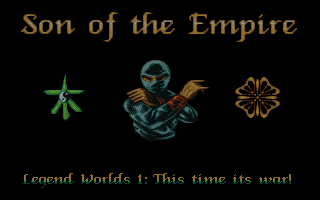
(A quick note on the name: Both the game box and the manual give the title as Worlds of Legend: Son of the Empire, but the title screen, as you see, has the subtitle and main title reversed. My policy in such situations is to go with whichever title is most common among the three sources.)
      
This screen comes up while the game is loading.
       
Both Bloodwych and Legend are among the small percentage of games that I couldn't bring myself to finish. With both, I have occasionally toyed with the idea of trying again. Bloodwych was a superior Dungeon Master clone that featured a rare mechanism for cooperative two-person gameplay. Legend was an isometric game with a fascinating magic system. Both impressed me before, ultimately, exhausting me. I thus start this game in a pessimistic mood.
   
Bloodwych concerned the efforts of one or two parties to save the land of Trazere from the evil Zendick, a wizard who had seized control from the ruling council, called the Bloodwych. Legend--called The Four Crystals of Trazere in the U.S. release--has a party save the land of Trazere from the sorcerer king, Necrix. At the end of the game, the characters establish the Bloodwych, demonstrating that Legend is a prequel to Bloodwych
     
Even in a tavern, the barbarian doesn't put on a shirt and the assassin doesn't take off his mask.
       
Worlds of Legend lies somewhere in between, a sequel to a prequel. (Apropos of nothing, I was reminded the other day that the film The Scorpion King 4 is a sequel to a sequel to a prequel to a prequel to a sequel to a remake.) It adopts most of the mechanics of Legend, including the use of four defined characters: a barbarian, a runemaster, a troubadour, and an assassin. In Legend, these classes had been presented as coming from the north, south, west, and east, respectively. As the game begins, the victorious party is enjoying a drink in the "remote village of Brodfird" when a black-clad figure darkens the door. He brings a letter from the assassin's homeland, the Empire of the Moon. The assassin PC is apparently the son of the Emperor, who has just been assassinated. The letter comes from the emperor's sister and the PC's aunt, Sushiana. She begs the PC to return home to investigate. "I think that Ti-Mann MoChun is somehow connected," she writes; this is apparently the old emperor's sorcerer and aide.
         
Using an assassin to run an errand.
      
My party had actually consisted of four female PCs, named after New Orleans jazz musicians. You can import them into the game or create new characters. I have never seen a greater variance between imported and created characters in a sequel. The imported characters retain their levels (in my case, Level 7), attributes, gold, spells, runes, reagents, and inventories from Legend, and their hit points double. [Ed. All of this is true except for the inventories. You lose your inventory and get a basic set of starting gear. I wasn't paying attention.] New characters start at Level 1 with virtually nothing.
    
Either way, the party must consist of a berserker, a troubadour, an assassin, and a runemaster, each of which is restricted to specific weapons, armor, other items, and abilities. New characters have attributes (strength, intelligence, speed, dexterity, constitution, luck) fixed; the only things to change are names and sexes. You can also alter starting attributes by clicking on one of four buttons to indicate that the character is particularly attuned to earth, fire, air, water, or some combination of these. Each one raises some scores and lowers others; clicking on all of them results in the same statistics as if you had clicked on none of them.
     
Creating a new party.
       
The game begins at Sushiana's house in the city of Imperia, where she is happy that her nephew brought three friends to help. She suggests that the way to save the Empire is to bring her the four shards of the Eternal Amulet, which she can then reforge. In addition, Sushiana offers three services: the ability to rename characters, the ability to change their appearance ("reclothe"), and selling troubadour songs. I remember that "reclothing" was vital to my ability to actually discern my party members in the chaos of Legend's combat. As for learning songs, that's done in taverns in Legend, but the manual explains that taverns aren't as popular in the Empire. I still wonder why, given what's at stake, Sushiana won't teach us the songs for free.
      
The two lines of smoke from the incense in this scene are animated, as is the flag outside.
      
In the rest of Imperia, you can buy horses or "enter vaults." This last option has you threatened by Ti-Mann MoChun before you enter a two-level dungeon whose purpose, I can only imagine, is to get non-imported characters up to speed.
          
I guess there's no chance you were wrongfully accused, then.
         
The core of the gameplay takes place on these isometric planes that make up dungeon rooms. They look identical to those in Legend; as far as I can tell, nothing has changed in the interface or combat mechanics. You select an active character by clicking on his icon in the lower-left. You then select one of the commands on the bottom row or one of the icons in the lower-right to get the character to push something, take something, look at something, open something, shut something, use the character-specific tactic, use an item in the left hand, attack with the weapon in the right hand, or cast a spell. The fist (or whatever it is) causes the other party members to rally around the active character.
    
These combinations of commands are used for both combat and puzzle-solving, and the thing that I have difficulty remembering is that when targeting an enemy or object, you have to click the square at his base, not at the enemy or object directly. For instance, in the very first dungeon room, there's a notice posted to one of the pillars. Clicking on "Look" and then clicking on the notice directly causes nothing to happen; you have to click on "Look" and then the base square of the pillar to which the notice is attached.
    
The first dungeon room.
       
Combat is a chaotic free-for-all in which your party members act on their own except when given specific instructions. In my reviews of Legend, I made comparisons with the real-time-with-pause systems of Darklands and the Infinity Engine games (e.g., Baldur's Gate). But there are numerous problems with the system as implemented here, including an inability to see anything about your foes, even their names, so you have no idea which ones to prioritize. Pathfinding is also horrible, rendered worse by extremely crowded rooms, so it's hard to target a specific enemy unless you happen to be standing next to him already. 
    
With multiple foes on screen, I have difficulty telling enemies from characters.
     
The game is saved somewhat by its creative spell system, which I am going to have to re-learn. You mix spells by combining two types of runes: "director" runes and "effecter" runes. The latter specify what happens (e.g., healing, damage, teleportation) and the former specifies how the spell is cast (e.g., surrounding the caster, forward from the caster, as a missile that can go anywhere). Mixing a spell that uses "Surround-Healing" will heal all the people in the immediate area of the caster. "Target-Damage" is like a magic missile that streaks towards its target. But the particularly neat thing is that you can string together combinations of directors and effectors to create some spectacular effects, such as a targeted missile that itself spawns numerous missiles that fly in all directions, or a sequence that simultaneously casts every buffing spell on the party. In Legend, I admired these options but wasn't very good with them, and I ultimately quit playing when I simply couldn't survive any more combats no matter what tactics I used.
   
A new runemaster starts with only three runes--"Missile," "Damage," and "Healing"--which eases a new player into the system.  
     
A runemaster starts with various spells pre-mixed.
       
I'm not a fan of the interface. It essentially requires the mouse. There are keyboard backups for some actions, but they're relatively unintuitive. For instance, F1-F4 select the active character, which is fine, but F5-F10 control the actions at the bottom instead of more obvious selections like "L" for "Look" and "O" for "Open." The "ESC" key, which I'm always reaching for by accident, causes the party to engage in "flight" mode. "Pause" is mapped, for some reason, to the negative sign on the numberpad (and has no on-screen button, unlike most commands). There are no keyboard commands at all for two things that you want to do often: attacking and viewing the automap.
 
There are some passable sound effects--sword clangs, mostly--but you can't turn off music independently of sound, something that's basically unforgivable by 1993, so I'll be playing this one silent.
    
I played around in the dungeon for a while, reminding myself of the game's conventions. A sign at the entrance warned me that "fierce beasts" were roaming the halls of the imperial citadel. Decorations and furniture use Asian themes, such as taijitu (yin-yang symbols), little mini pagodas, and Buddha statues. You have to search every object in every room because any of them could contain treasures, including gold, weapon and armor upgrades, scrolls, potions, and keys necessary to progress in the dungeon. 
   
Each character has an inventory of 16 items, to include weapons, armor, boots, helms, and gloves. I remember that the equipment system was a good aspect of Legend and almost every few rooms, I got some kind of upgrade.
        
My early-game runemaster, carrying the bones of his slain companion.
       
I got frustrated with this game, though, when I lost one of my characters in the third combat despite healing him a couple of times. Given how much trouble I had with the predecessor, I'm tempted to use an imported party here, except that it feels like the imported party comes with far too many advantages, and I don't understand how the game could possibly be balanced. On the other hand, perhaps a little imbalance in my favor is what I'm looking for. I'm curious to hear the experiences of anyone who's played the game before I make a final decision.
   
Time so far: 1 hour
 

Wednesday, April 14, 2021

1992/1993

      
It's been over three years since I've done one of these yearly transitions, which you'd think would be proof positive that I'm "losing ground"--unable to cover a year's worth of games in a year's worth of blogging. While this is almost certainly true, I've accidentally confounded the issue by making so much of my playing recursive. In the same three years that I covered 46 games from 1992, I also covered 77 games from earlier than 1992, not even counting the BRIEFs. 
   
As I review 1992, it's worth recalling something I said about the then-forthcoming year at the end of 1991:
   
If 1991 was a disappointing year, 1992 promises to be the absolute opposite. I'm practically giddy at the list before me. Every franchise had a release this year. We get the final D&D Gold Box title (aside from the Unlimited Adventures construction set) with The Dark Queen of Krynn. The Ishar series begins. The Realms of Arkania series begins. We get the second Interplay Lord of the Rings title. We get the third Magic Candle title. We get a Might and Magic, a Wizardry, a Quest for Glory, and two Ultimas! And in between these surefire hits are a ton of titles that I feel like I've heard good things about, among them Amberstar, Black Crypt, Darklands, Four Crystals of Trazere, and Spelljammer: Pirates of Realmspace. Surely, one of these games is destined to unseat Ultima V at the top of the list.
    
My feelings at the end of the year are more tempered. I found a lot of the titles listed above disappointing. The Dark Queen of Krynn, Quest for Glory III, Crusaders of the Dark Savant, and Ultima VII performed as expected. Only Amberstar and Darklands really exceeded my expectations. In the same entry, I wrote that to start the year:
 
I've chosen Ultima Underworld. It's a groundbreaking game that makes us feel that we've stepped into a new era, but parts of it haven't aged well, and I thus doubt it will be the highest-rated game of a very competitive year.
   
I was wrong: Ultima Underworld ended up with the top rating for the year. So in many ways, 1992 was all downhill, more the last vestige of a previous era than the beginning of a new one. 
     
Ultima Underworld was the first game to make it feel like you were exploring a real place. Unfortunately, it was the only game of the year to do that.
       
And yet we saw the glimmerings of a new future in 1992. Ultima Underworld is the most significant example technologically, with its continuous movement in a truly three-dimensional space. But there were other positive developments, none appearing here for the first time but all appearing more frequently than in previous years. These include:
   
  • More freedom. "Open world" was this year's default. Ultima Underworld, Darklands, Crusaders of the Dark Savant, Star Control II, Ultima VII, Ragnarok, Amberstar, The Magic Candle III, Realms of Arkania, Legends of Valor, Challenge of the Five Realms, Ishar, Lords of Time, and Planet's Edge were among the games with open worlds. It's easier to count the ones that constrained movement than those that allowed for freedom.
     
There were things I didn't like about Realms of Arkania, but the open world wasn't one of them.
     
  • More interesting encounters and side quests. These days, plentiful side quests are the norm in CRPGs. They've even become the norm in action-adventure games. But before 1992, a lot of franchises didn't really understand the concept. You had a mission, and your only "quest" was to get strong enough to complete that mission. This is the first year in which side-quests became the norm.
           
One of the complex encounters of Darklands.
        
  • More interesting endings. For a game to culminate in a simple combat with the evil wizard is by now so 1980s. It was startling to see it again in Clouds of Xeen. 1992 gave us rituals (Ultima VII, Ultima Underworld, The Magic Candle III), epic encounters that change the rules (Darklands, Realms of Arkania, Ragnarok), and other non-traditional choices. Again, not for the first time, but for the first time usually.
  • More plot complexity. This is the first year that the average game made us pay attention to what was going on. Even Dungeon Master derivatives like Black Crypt and Abandoned Places introduced a certain level of plot complexity not found in predecessors. 
        
Black Crypt tried to provide an actual story with its Dungeon Master gameplay.
      
The year did have the highest average GIMLET rating, at 36. This means that for the first time, the average game crossed my "recommended" threshold. That's nice to finally see. The question is, which one deserves the reward?
     
Game of the Year: Ultima Underworld
   
Yeah, sorry about the lack of suspense, but there's no way to even pretend on this one. Ultima Underworld changed all the rules. From the moment it appeared, every developer working with tiles and static views knew that it would have to shape up or ship out. (I'm not suggesting that tiles are always hopelessly obsolete, or that good games can't be made with them. They represent one technique, and you can still make excellent games with that technique the same way you can still make excellent black and white films. It will just never be the norm again.) But as I noted in my entry, the game doesn't just win because of its technological innovations. Although it could have rested on those laurels, instead the developers offered a fantastic experience on multiple fronts, including a realistic dungeon ecosystem, memorable NPCs and NPC dialogue, interesting quest stages and puzzles, and strong system for combat, magic, and inventory. And yes, I will defend what I just said about combat; anyone who describes it as "simple hack and slash" is not thinking hard enough about all the possibilities inherent in a game that uses the same mechanics and interface for combat as it does for exploration.
    
My only complaint about Ultima Underworld is that it's an Ultima game. It has no business being set on Britannia or involving the Avatar, and if there's one thing that I can't stand about ORIGIN, it's how they've come to insist that the Avatar is involved in everything. ORIGIN should have had the confidence to let their motto--"We Create Worlds"--stand on its own without implicitly adding "and then shoehorn the Avatar into them."
   
I am not insensitive to the fact that four of fourteen "Games of the Year" are Ultima games, and I looked for any reason to make it not so, but there's no helping it. If it's any consolation, Ultima Underworld isn't really an Ultima game. It wasn't developed by ORIGIN and the setting on Britannia is so obviously a late edition that the Ultima part is just so much marketing.
    
Game of the Year: Second Place
     
Considering "Game of the Year" for 1992 is like trying to name the greatest American composer. Of course it's Duke Ellington. But ask me to name the second greatest composer, and I'm lost. There are at least 30 names that seem equally worthy--Cole Porter, George Gershwin, Hoagy Carmichael, Richard Rodgers, John Philip Sousa, Scott Joplin, Aaron Copland, Philip Glass, John Williams, Danny Elfman, and John Cage are those that spring to mind without my even having to really think about it--for different reasons. 
    
1992 is similarly full of worthy runners up that would make it an extremely difficult contest if not for Underworld. Not all of them got high ratings, but remember that "Game of the Year" is about more than ratings; it's about the trends that the game helped establish or solidify. With that criteria in mind, here are a bunch of titles that I find almost equally worthy:
   
  • Amberstar: Probably the best example of the "Disassembulet of Yendor" approach that we've seen. By modern standards, the game didn't do anything great, but it's rare in not having done anything bad. Together with Challenge of the Five Realms, it also pioneers the "create-a-main-character-and-enlist-NPCs" approach that we need a better name for.
  • Challenge of the Five Realms: Spellbound in the World of Nhagardia: Although the lowest-rated of the nominees, Challenge established a template in the way it handled exploration, sub-quests and side-quests, and NPC interaction (and enlistment) that anticipates later, better titles.  
     
Challenge of the Five Realms had 10 NPC slots.
        
  • Darklands: A fantastic blend of Pirates-like simulation, random encounters, and real-time-with-pause combat in an RPG setting. 
  • Legends of Valour: Unlike Underworld, it didn't give sufficient attention to core RPG elements. Otherwise, it has many of the strengths of Underworld and some of its own. The way it treats survival, factions, and the exploration of a living city will become open-world standards.

Valour's world needed a little work, but the concept was good.
          
  • Ragnarok: For me, the apex of the roguelike sub-genre, at least so far. It shows that a roguelike game can be a good commercial game. I guess I can't claim that it had a lot of influence, though.
  • Star Control II: The Ur-Quan Masters: The game needed to work on its RPG elements, but the title is notable as one of the earliest series to start as something other than an RPG and then become one, something we'll later see in everything from Assassin's Creed to Grand Theft Auto. It also has one of the best game worlds of the era.
            
Star Control II: tactical ship-to-ship combat in an RPG world.
      
  • Ultima VII: The Black Gate: Even if Ultima Underworld didn't exist, the series would be a strong contender for GOTY with this entry, although I didn't love it as much as some people do.
  • Wizardry: Crusaders of the Dark Savant. If Ultima Underworld was the herald of a new era, Crusaders is the zenith of an old one. Its approach to character development, combat, and magic have never been better in the first-person, tile-based genre.
      
A few potentially-worthy titles, including The Dark Queen of Krynn, Quest for Glory III: Wages of War (I still think about how inviting that inn/tavern looked), and Might and Magic: Clouds of Xeen are off the list simply because I already gave the prize to predecessors that were better games. But they all rank high in objective quality.
 
I suppose that in the end, I'm mostly torn between Darklands and Legends of Valour simply for the originality of their approaches, but I could honestly be persuaded on almost all of these. What interests me more is the sheer number of titles that I felt at least some urge to put on the list--not because they had any honest chance of winning but because they did something interesting enough that I know I'm going to be thinking about them for a long time. These include Defender of Boston: The Rock Island Mystery (I think that game may have honestly messed me up a little), Spellcraft: Aspects of Valor (despite my failure to finish), The Legacy, UnReal World, and even SpellJammer: Pirates of Realmspace.

Superlatives and other notes:

Games have been getting longer but slightly better.
        
  • I covered 46 games for the year, winning 43 (I left Legend, Spellcraft, and Shadowlands unfinished). That's a completion rate of 93%. (One game remains open.) I rejected only 2 games and marked 2 as "not playable." Three others are waiting for a BRIEF that will cover all three. Around 10 games that were originally on the list got deleted (their original sources having repudiated their RPG definitions), merged, or shunted to other years.
  • Strategic Simulations, Inc. was the real factory of the era. They published 6 games. MicroProse was second, with three.
  • The highest rated games were Ultima Underworld (62), Wizardry: Crusaders of the Dark Savant (60), Darklands (56), The Dark Queen of Krynn (52), Star Control II (51), Treasures of the Savage Frontier (51), and Ultima VII: The Black Gate (50).
  • Crusaders of the Dark Savant took the longest, at 108 hours. Average time to finish was 28 hours.
  • On the GIMLET, I didn't give a single 9 or 10, just lots of 8s. Only two games got two 8s: Ragnarok (equipment and gameplay) and Darklands (economy and gameplay).
  • The most erratic games (highest standard deviations in GIMLET scores) were Star Control II and Challenge of the Five Realms. Both games did a few things very well and a few things very badly. The most stable games, in contrast, were Sword Quest 1: The Search, and Shape Shifter, which did almost everything uniformly badly. 
  • There was no "bad game with a good category" this year. Anything I rated low was low across the board. 
  • I didn't rate any game harder than "hard." 
  • The average completion time for a completed game was 29 hours, lower than the average of 34 in 1991, although that number is heavily influenced by Fate: Gates of Dawn.
    
Looking Ahead
   
1993 offers 74 games--more than any other year until 2012--on the preliminary list. I have played only a few of them: Ultima Underworld II, Might and Magic: Darkside of Xeen, Quest for Glory IV, Ultima VII, Part Two: The Serpent Isle, and Warlords II. I don't remember much about most of the ones I have played. I've heard great things about a lot of the ones that I haven't played, including Angband, Betrayal at Krondor, and Dark Sun: Shattered Lands.
      
1993 not only has the highest number of RPGs (until 2012), but it's also the first year that offers more games I won't play than ones that I will.
        
1993 is also a milestone for offering, for the first time, more games with an "N" on the playlist than those with a "Y." Consoles have a lot to do with it, of course: there are 39 Nintendo exclusives (SNES and NES), 8 Sega exclusives, 12 TurboGrafx exclusives, and 4 handheld exclusives. There continue to be a lot of games for Japanese PCs that never received an English translation. Korea enters the market for the first time with two DOS games that I'm hoping will eventually be translated. Taiwan offered its first title in 1990 and offers three more in 1993. Again, it would be nice to eventually attempt some of these.
   
There are a lot of sequels on the 1993 list, but I can't really say I'm looking forward to many of them. While not remembering much about them, my recollections are that Ultima VII, Part Two and Ultima Underworld II have the great engines of their predecessors but are too long and bloated. Abandoned Places wasn't that great a game to begin with. Neither was Bandor, Ishar, Ormus Saga, Stone Mist, Sword Quest, or Ultizurk. I know the reputations of Eye of the Beholder III and Dungeon Master II.
 
But I still have the next NetHack entry, Ambermoon, and Quest for Glory IV to look forward to. We'll have to see about the rest. In general, I expect my enjoyment of 1993 to be carried more by brand new titles than new entries in venerable series.
 
SSI will offer five RPGs this year. The only other publisher with more than two is Sierra, which unexpectedly comes charging in with four--the biggest RPG year for the company. Germany and the United Kingdom will remain heavily represented among companies, and we'll see our first RPGs from Hungary and Austria.

The elephant in the room is the plan I announced over a year ago, on my tenth anniversary, to allow myself to move forward in the timeline without necessarily completing a year. When the time came to do that, I chickened out. It just felt wrong. Now that I stand on the cusp of a year that seems destined to take me at least three years to cover, I feel conflicted. All things being equal, I'd rather just continue with my original chronological plan. But every year that passes brings a slight probability of my own death or incapacitation, the end of blogging as a medium, the loss of reader interest, and the collapse of civilization.

I guess my inclination is to delay making a decision until I clean up the backlog. I still have 42 pre-1992 games to cover, many of which are destined for a BRIEF or a single entry. When I've caught up on those and have only present and future games to play, I'll assess what kind of progress I'm making and consider allowing some forward movement. This will naturally take a while, but a journey of a thousand games begins with the next entry. On to 1993!

Saturday, May 26, 2018

Legend: Summary and Rating

           
Legend
United Kingdom
Mindscape (developer and publisher)
Released 1992 for Amiga, Atari ST, and DOS
Published in the United States as The Four Crystals of Trazere
Date Started: 7 April 2018
Date Ended: 21 May 2018 
Total Hours: 33
Difficulty: Hard (4/5)
Final Rating: 37
Ranking at time of posting: 221/290 (76%)

I really struggled over whether to quit this one. On the one hand, it was getting a little better. On the other, it was simply exhausting. Combats in Kilijan's Dark Tower became difficult enough that each one was a nail-biting fight to the death, requiring all my best tactics and spells, and even then I had to reload half of them. Most RPGs give you maybe 10 throw-away battles punctuated by the occasional significant battle. In Legend, none of the battles are throw-aways. A random encounter in a corridor you just cleared can absolutely destroy you, with enemies pouring in from all sides, a new one arriving to replace every one you've slain. I swear, some battles go on long enough that the game decides to generate a new random battle while you're still fighting the old one.

My inventory got so overloaded during the third level of the Dark Tower that I decided to make the journey back to the main map, with all of the random combats in between, to sell the excess goods, donate money at temples to restore luck, and level up. I did all of these things, then couldn't force myself to re-enter the tower and wind all the way back up. I sat on it for a couple of days. Finally, I decided I'd quit if someone else online had documented the endgame.
               
As far as I made it: the stairs going up to Level 4 of the Dark Tower.
            
My, has someone. Starting in November 2011, a YouTube member named Dzyu played the game over 102 videos, ending in May 2013. His videos were invaluable in documenting the endgame. (Another worthy LP series was started in June 2015 by FSSZilla, but as of her 83rd video in November 2017, she hadn't won.)

The Dark Tower turns out to be five levels. At the top, the player defeats Kilijan (who is immune to "Disrupt" and "Paralyze") and gets his magic staff, either keeping it or turning it in to the Ancient for a reward. Somewhere in the Dark Tower, the player finds a skull key that opens up Levels 3 and 4 of Fagranc. Once you clear those, you have to visit taverns to hear of the discovery of a "power gem" in the sewers of Balenhalm by some "ratmen." Balenhalm is a single large level.

Next up are two levels of Moonhenge in the northeast corner of the map. It provides the keys necessary to explore Levels 5 and 6 of Fagranc, which in turn provides the items necessary for the two levels of the Unshrine (which jumps around the map), where the party contends with Tetrahagael, the Chaos Lord. This is apparently an exceedingly difficult battle, as the Chaos Lord has magical protections (which you have to dispel), immunities, and very high hit point total. The Chaos Lord has the key necessary for the eighth and final level of Fagranc.

While exploring the dungeons, the party members also find the titular four crystals of Trazere, each of which boosts the defenses of one of the towers on the overland map. Between dungeons, the party has to reconquer cities seized by the enemy and provide gold to boost staffing at the towers.
      
This is the kind of statement that would make a robot's brain explode on the original Star Trek.
       
After delivering the fourth crystal, the party discovers that King Necrix himself is responsible for the evil taking hold in the land. ("Necrix" always sounded like a suspicious name.) The party must assault the king's fortress, fight up three levels, and slay him at the top. It took Dzyu over half a dozen attempts. Watching this part of the video gives you a sense of the complete chaos that is combat in this game. Even watching instead of playing, I can't tell what's happening most of the time. Spells are exploding all over the place, characters die in seconds. It's so crazy that in the fight where he finally kills the king, he doesn't even realize it for a few seconds.
          
A typical shot from the final battle.
            
Even after killing the king, Dzyu has enough trouble with the chaos beasts that he runs into an adjacent room hoping for better terrain, and in the midst of combat accidentally reads a sign--and unwittingly concludes the game. (To his credit, he recorded a final video in which he completed the combat before reading the sign.) He's clearly let down by the lack of denouement after so many hours ("I think I would have preferred at least some artwork"), but he remarks that he should have expected it given the sparsity of story throughout the game.
             
The winning screen.
        
The sign, of course, confirms Legend as a prequel to Bloodwych, the idea being that the Bloodwych now take over in the place of Necrix, reign peacefully for a while, and are then usurped by Zendick in the first game.
           
Dzyu's late-game spellbook.
       
Throughout the videos, Dzyu clearly enjoys the game for its spells. A late game screenshot shows his current recipe list, which I make out as:

1. "Missile-Disrupt-Disrupt-Disrupt-Damage-Damage-Damage." An all-purpose "blast the hell out of a targeted enemy" spell. "Disrupt" is more powerful than "Damage" but some enemies are immune to it, so I'm sure the goal here was to have a spell that would devastate anyone.

2. "Surround-Damage-Damage-Damage-Missile-Damage-Damage-Damage-Surround-Damage-Damage-Damage-Missile-Damage-Damage-Damage." This one is similar to my "fill the room with fire" spell, but jacked up to the maximum possibility.

3. "Heal-Heal-Heal-Continuous-Heal-Heal-Heal." The best I can figure, this immediately triple-heals the caster, then creates a square of healing magic in the room that other characters can walk or teleport into.

4. "Missile-Surround-Vivify-Heal-Heal." This allows the caster to resurrect any dead characters in a 9-square radius and then immediately heal them a bit.

5. "Regenerate." His only single-rune spell lets the caster regenerate quickly.

6. "Missile-Teleport-Speed." Allows the caster to send one of his colleagues to another place in the room and simultaneously give him extra attacks.

7. "Teleport-Regenerate-Speed-Antimagic-Surround-Teleport-Regenerate-Speed-Mystic Weapon-Antimagic." A kind of holistic pre-combat spell that gives each character the most important buffs and allows him to place himself anywhere in the room at the beginning of combat.

8. "Missile-Forward-Missile-Teleport." No idea. I'm guessing this was a solution to his last puzzle somehow. He doesn't have any of these mixed, which bolsters my hypothesis.

9 & 10. "Missile-Paralyze" and "Missile-Dispel." Both quick spells to affect a single target.

Analyzing some of the videos, "Teleport" is the real workhorse, and it makes sense that "Cloud" objects (rings, potions, wands, helms), which cast the spell, are vital to the party's success. They're the key to placing characters in strategic positions at the outset of combat, and to ensuring that the assassin is well-placed to use his backstabbing abilities. The spell also gets wounded characters out of combat and to healing squares.

My GIMLET combines both my experiences and what I observed in Dzyu's videos.

1. Game World. Neither the game world nor the story is well fleshed out, consisting primarily of allusions rather than real descriptions and sensible bits of lore. The game's "twist"--Necrix being the evil lord behind the invasion--doesn't really make any sense. Why didn't he undermine the "good" armies? Why did he send the party to Fagranc? It's too bad, because the connections to Bloodwych would be more meaningful if the story in either game made more sense. Score: 3.

2. Character Creation and Development. There are limited options during creation, and I feel that the number of levels achievable during the game (about 12) is a little low given the difficulty of combats. You have no choices while leveling up--you just get a random selection of stat upgrades. On the plus side, each of the four characters plays a pretty stark role. You can't just treat them all like fighters. You have to carefully equip and position them in ways that call on the strengths of their classes. I also like that the four classes--berserker, troubadour, assassin, and runemaster--are just a bit different than the standard fantasy RPG roster. Score: 4.
             
A late-game troubadour, from Dzyu's LP.
         
3. NPC Interaction. I'll give a point for a few people in the various towns, but really those are more part of the "encounters" or "economy" than true NPCs. Score: 1.

4. Encounters and Foes. As a somewhat non-visual person, it particularly annoys me when games don't name their monsters or use color to distinguish types or difficulty, and this game does both. The monsters in the game are a varied selection of humanoids and beasts, some of which do physical damage only, some of which are capable of magic, some of which have magical immunities and protections. I suspect it becomes important to note which is which, and I don't like having to fill notebooks with things like "bluish guy that looks like a minotaur--can self-teleport." 

The other aspect to "encounters" is the puzzles. I ran hot and cold, as I do with almost any game that features these sorts of mechanical puzzles (cf. DarkSpyre, Chaos Strikes Back). I thought some were too difficult and others offered the right level of challenge. They seem to get pretty crazy towards the endgame. Score: 4, but those who like puzzle-oriented games might boost this to a 6 or 7.

5. Magic and Combat. The magic system is obviously the highlight of the game, offering potentially thousands of creative combinations. I would love to have this type of spell system, maybe with a few more effects, coupled with a proper tactical combat system--either turn-based like the Gold Box games, or real-time-with-pause, like the Infinity Engine games.

The combat system actually offered in Legend has too few tactical options for non-spellcasters, is too chaotic and confusing, in too tightly-confined territories, with poor pathfinding and AI. It undermines most of the positives of the magic system. Score: 5.

6. Equipment. A positive that I probably didn't focus enough time on. Each character gets a variety of weapons, shields, armor, helms, gloves, boots, amulets, rings, wands, potions, and special items like the troubadour's various instruments. Upgrades are fairly regular. For regular weapons and armor, you can easily see their effects on your various statistics. For magic items, you have to experiment and study the effects (or take them to the Ancient for identification), but the totality of the items allows all characters to wield some magic and thus increases combat tactics. I also like that the available items in shops changed throughout the game, and that the treasures were randomized rather than fixed. Score: 6.

7. Economy. Another strong point. Between equipment, leveling, runes, reagents, donating at temples for "luck," and fortifying towers, money remains relevant until the end of the game. Score: 6.

8. Quests. There's a main quest with multiple stages, but I don't think there are "side quests." One of the stages, at least, gives you a single choice, but in general you're on a linear rail throughout the game. Score: 3.
           
You have to love "I shall kill you all myself . . . Guards!"
          
9. Graphics, Sound, and Interface. I rather like the oblique-angle graphics and the various dungeon scenes they create, and I didn't have any problems with the interface, which offers redundant mouse and keyboard options--with the exception of targeting (sometimes). Sound, on the other hand, is only serviceable, consisting of the "ding-ding-ding" of weapons while the same troubadour tune drones endlessly in the background. Score: 4.

10. Gameplay. Here's where it all falls apart by hitting every element of the Unholy Quartet: too linear, too hard, not replayable, and above all, too long. I'll give a point in this category in recognition of the outdoor map, which allows relatively free exploration between the dungeons. Score: 1.

That gives us a final score of 37, just above my "recommend to check out" threshold, but not quite all the way to "good."

Anthony Taglione, responsible for both this and Bloodwych, is clearly a talented programmer with some good ideas. Both games started with a popular base (Dungeon Master in the case of Bloodwych) but brought their own innovations. Neither Bloodwych's cooperative multiplayer nor Legend's magic system have anything quite like it among their predecessors. But both games commit the fatal sin of not knowing when to quit. Neither 1989 nor 1992 was ready for 100-hour games; the hardware and software of the time simply didn't support enough content. Even today, I regard a game that requires 100 hours with a jaundiced eye, although I have no trouble with games that allow for that length. I trust you can see the difference.

Of course, even given any memory- and space-based limitations, this small series is still pretty paltry when it comes to actual story. And both games reward dozens of hours of gameplay with a single screen of text at the endgame. I would have shared Mr. Dzyu's expectation for at least some artwork, particularly since Legend featured an animated introduction.

Computer Gaming World overlooked this one, but Dragon got to it and gave them an uncharacteristically-low 3/5 stars, calling it a "decent effort" with an original magic system but "limited character creation," confusing combat, and an unintuitive interface. European reviews mostly ran in the 80s and 90s (though the German Play Time gave it a 56). Unfortunately, I can't quote any of them because the site I use to find full-text magazines from the period is down. Given the light standards of journalistic integrity that we've seen in most European Amiga magazines, it's hard to imagine that many (if any) of them made it to the end before reviewing the game, and I feel that the interminable length and abrupt conclusion are key parts of the game.

We aren't done with the world of Trazere. 1993 will bring Worlds of Legend: Son of the Empire. Judging by the screenshots and game description, it is simply Legend with different maps, featuring a quasi-East Asian theme. In 1994, we'll face Hexx: Heresy of the Wizard, which appears to be an updated variant of Bloodwych. Those will be our last experiences with Mr. Taglione, as the other offerings from both him and co-designer Peter Owen-James are action and adventure titles (1993's Bram Stoker's Dracula, 1997's Alpha Storm).

We'll clean up a couple of 1988 offerings before getting to the next 1992 game, starting (maybe) with Seven Little Horrors, a bizarre German game from Motelsoft. I'm having trouble with the interface and have written to the publisher for help. If I can't figure it out in time for an entry, we'll move on to the easy-but-bland Talisman, a roguelike for the Atari 800.

*****

I was really looking forward to trying the first version of the long-running UnReal World. Released in 1992, version 1.00b is completely unrecognizable to a player of later versions, with a vastly different interface, different rules, and a high-fantasy setting (rather than real-world Finland). But I can't get it to run. I can run the character creation program and the world setup program, but the main program offers four options, each tied to a function key, and none of them activate. I've verified that the function keys work in DOSBox with other programs. If I can't get 1.00b to run, I have to wait until 1994 for the next major release.

Thursday, April 12, 2018

Game 288: Legend (1992)

       
Legend
United Kingdom
Mindscape (developer and publisher)
Released 1992 for Amiga, Atari ST, and DOS
Published in the United States as The Four Crystals of Trazere
Date Started: 7 April 2018
 
If there's one major thing that you can credit British RPGs of the late 1980s and early 1990s, it's their experimentation with different perspectives. While most U.S. games remained stubbornly divided between iconographic, top-down, and first-person perspectives, British games (at least, those not based on Dungeon Master)  played with side-view and what we might call "studio" perspectives: those where the screen seems to be framing a scene from a play (Moonstone, Galdregon's Domain, Heavy on the Magick). More important, the U.K. was ahead of the curve on axonometric perspectives, which would eventually comprise a solid chunk of all RPGs. In the U.S., only a small percentage of games so far have used this perspective, perhaps most famously in Faery Tale Adventure (1986) and Ultima VI (1990) and its two spin-offs, and in these cases the perspectives are barely offset from top-down. Axonometric examples from the U.K. include Lords of Chaos (1990), Heimdall (1991), and HeroQuest (1991).
       
A group of four characters explores a dungeon from an axonometric angle.
          
(What I'm calling "axonometric" is usually given as "isometric," but every time I use it we have to have a long discussion about whether it's technically isometric, which means the X, Y, and Z axes have been equally shortened to achieve a 3-D effect, or just axonometric, which can involve any number of perspective angles. In the case of Legend, if it's not actually isometric, it's damned close.)

HeroQuest and Legend both seem ultimately inspired by the action-adventure Cadaver (1990), which featured the same perspective, the same-shaped game area, the same sorts of controls and indicators in the periphery. When I reviewed HeroQuest, I remember remarking that the graphics were quite good, but the limited gameplay didn't give you anything to do with the interesting items you see, and the combat was just laughable. In Legend, both elements are improved, though they still have a long way to go. 
           
Cadaver (1990) seems to be the source of the interface for both HeroQuest (1991) and Legend.
          
Legend was written by Anthony Taglione and is set in the same universe as Taglione's previous Bloodwych (1989). It was marketed in the U.S. as The Four Crystals of Trazere, which is how my list had it until I started playing and found more available copies and documentation under its original name. Graphics are by Peter Owen-James, who also did Bloodwych and Anthony Crowther's Captive (1990). He seems to specialize in gaunt, hollow-cheeked protagonists who look more desperate than heroic.

The brief setup is that some ancient evil is reaching into the world of Trazere and turning its residents into vicious monsters. Four characters--a berserker, a runemaster, a troubadour, and an assassin--assemble to investigate and put a stop to it.
          
The brief backstory is covered in about half a dozen screens.
         
In character creation, you have to go with these four classes. You can choose a name and sex and broadly adjust ability scores by assigning various elemental icons to the character. For instance, "Earth" boosts strength, constitution, and armor class and reduces intelligence, speed, and dexterity while "Air" does the opposite. I went with an all-female party. Each character comes with a starting selection of weapons and armor and a little gold.
         
Creating a new berserker.
        
Gameplay begins on an overland map from which you can direct the party to various towns and castles and such. Other parties and armies roam the map at the same time, their sigils indicating their power levels, and the manual suggests you can fight them in something called "banner encounters," but I didn't try that in the first session. The manual hinted that the dungeon of Treihadwyl (similar to the "Treidwyl" of Bloodwych) was intended as a starting dungeon, and that was the closest city, so I went there.
          
This reminds me of the overland maps in Moonstone (1991) or Dragon Lord (1990).
        
The city has a "menu town" on top of the dungeon, with options to visit the blacksmith, tavern, artificer, and adventurer's guild. There's not much to do at these locations when you first begin, so I immediately headed for the dungeon.
        
Not much to do here until I earn more money.
         
I am mortified at how long it took me to get out of the first room. To start, I had trouble interpreting the elements in the periphery of the actual gameplay area, in the center of the screen. The central area, surrounded by a black void, is the area where the gameplay actually takes place. The items in the corners are controls and indicators. In the northwest, we have buttons that bring up the automap (the dragon) and character inventory. In the northeast are the directional indicator and a chicken that unkindly flaps its wings when the party is fleeing. The southeast shows available actions (based on equipped items) for the active character.
        
The characters arrive in the first room.
        
Finally, the southwest is where you can select your active character from among the four. The stacks of skulls next to them depict their health levels.

I realized from the manual that you select the characters in the southwest, but I didn't realize they were the same characters milling about the center of the screen. I thought they were starting outside the room and would have to open the first door to enter it. In other words, I didn't realize they were controls instead of the actual people. I spent a good 10 minutes trying to figure out how to open that door before I realized that by selecting them, I was simply choosing which figure in the center of the screen was active.

The core of gameplay in Legend is exploring these dungeon rooms and finding the keys, or solving the puzzles, necessary to open doors and access further rooms. The placement of keys imposes a certain linearity on room exploration, but the two dungeon levels in Treihadwyl weren't all that big anyway. The game tells you explicitly what type of key is needed to unlock each door, and you simply have to search items until you find them. Just about any piece of furniture--chests, clocks, desks, tables, weapon racks--can hold treasures, including items. There's no difficulty in opening and looting them--no hidden items, no locks, no traps.
        
My assassin finds a key in a clock.
       
The harder part is the occasional puzzles. They have something of a Dungeon Master quality, with which of course Taglione was intimately familiar. Most of the usable objects are levers or buttons, but they often have non-obvious effects, sometimes in other rooms. Some examples below.
     
This was a tough one. The lever in the middle changed what the lever on the left did--either cause the pillar in the northwest to rotate or belch fire. I had to hit both of the runes with fire to lower the spikes in the northeast, which allowed me to push buttons on those pillars, which did something in a different room, I think.

I had to find a key to open this door to pull the lever behind it to do something in another room that would then allow me to enter this room from the west side.

The troubadour prepares to push a lever that will teleport the runemaster to the inaccessible western area. There, she'll be able to loot the large chest, then pull the lever to return. The plaque in front of the assassin said "send a friend" as a hint.
          
Aside from my confusion on the interface, one of the reasons that I couldn't get out of the first room was that it took me a while to understand the puzzle. Each of the two northern corners had a rune, and I finally had to break down and read the manual thoroughly to realize that the runes correspond to the game's magic system. (Between the puzzles and use of runes, there is some similarity here to 1990's DarkSpyre.) The sigel rune (looks like an "s") is associated with damage and the nȳd rune (looks like an "x") is associated with healing. The game wanted me to cast the appropriate spells on these rune tiles to open the east and west doors.

Thus, I had to explore the spell system right away. It's interesting. You create spells as pairs of runes, the first specifying the "direction" and the second specifying the "effect." Directions include forward (the tile in front of the character), surround (the 8 tiles surrounding the character), missile (wherever the caster aims), and "continuous" which applies to a subset of spells. Effects are damage, healing, paralysis, antimagic, dispelling, charming, speed, teleport, regeneration, resurrection, death, and "make weapon," the last a kind of odd-one out.
         
Mixing spells in the spell interface. This reminds me a bit of Dragon Lord (1990).
      
Both directions and effects require reagents, of which the runemaster begins with a large stock. The game is explicit about what reagents are required for what spells. You select the direction and appropriate reagent, then the path and the appropriate reagent, then mix them together. Once you've done this once, the spell appears on a recipe list and you can mix new ones with just the click of a button.
           
Now that I've mixed a couple of spells, I can just go to this screen to mix them again.
          
My understanding is that it's possible to mix extremely complex spells by combining multiple effect runes--for instance, a targeted spell that dispels the enemy's magic protection and then paralyzes him. But the runemaster only starts with the runes necessary for healing and damage, so that will have to wait until later.

Once I figured out how to mix targeted spells for healing and damage, I was able to cast them at the runes in the corners and open the doors.
       
The door opens after I blast the rune with a healing spell.
       
The next major issue is combat, of course. Any room you enter for the first time might contain a swarm of foes, but they can also respawn randomly in rooms you've already visited. I have no idea what the enemies are; the game identifies them nowhere in the interface. By appearance so far, they've included things like goblins, kobolds, orcs, wizards, and beholders. But there's no way to get their names or a sense of how powerful they are.

Combat is a chaotic free-for-all that does a decent job anticipating the Infinity Engine. You have to click on each character and activate their weapons to prompt them to engage the enemies. Enemies puff away as they die, but a lot of them seem to have some kind of teleport ability which looks the same. You can't select a specific enemy or otherwise do much to guide the character in combat. Sometimes they seem to go for the closest enemy; other times, they take the most roundabout route to the farthest enemy and insist on attacking from his least-accessible side. Of course, they get hung up on obstacles easily, and certain rooms are designed to make it almost impossible for more than one character to engage the enemy at a time.
         
A few seconds of combat. This is only a little faster than in the actual game.
         
A good solution in the latter case is to flee to a previous room where there's more space to spread out--enemies always follow--but you run a couple of risks. Characters are supposed to stop fleeing when you hit the "rally" button (or ENTER) but sometimes they don't, and you may end up in a worse room than where you started. Moreover, every time you transition screens, there's a chance that enemies will respawn, which means you might find yourself fighting both the original foes plus respawning ones from one or two rooms.

Often, enemies fixate on the first character they see, and if it happens to be one of the weaker ones (i.e., the runemaster or assassin), they can pound away his hit points mercilessly in a few seconds. But it's extremely hard--impossible, really--to coerce your characters into any kind of formation. Success at combat boils down to luck and, unfortunately, a lot of reloads.
       
The party battles some beholders and other monsters in a fairly limited-movement area.
       
You have just a few tactics. Each character has a special ability. The berserker can go into "berserker rage" and do some extra damage. The assassin can "hide in shadows" and theoretically backstab enemies, but good luck actually navigating him around in the chaos of combat. The troubadour can play a song. He only starts with "March of the Bold Ones," a weak regeneration spell that doesn't help much in combat but ensures that you can fully heal after combat before moving on.

Chief among the tactics, theoretically, is the runemaster's ability to cast spells. In the chaos of combat, with everyone moving every which way in real-time, it's almost impossible to successfully target either a healing or damage spell, but you can pause combat at any time and take your time studying the landscape. Without the pause option, I would have given up the game in its early hours, because it takes me at least a few seconds to identify who my party members are. If they're differentiated by color, I can't tell it except for the assassin. I have to study the figures carefully to look at their clothes or weapons, which is hard when they're in the middle of combat and running around the map.
         
This happened too often.
      
You can't activate new actions, switch characters, or do anything else while paused, but you can click on the screen to target a previously-initiated action. Again, it feels a lot like an early version of Infinity Engine combat, except that the Infinity Engine has more tactics and allows you to do a lot more while paused. Those extra options make quite a bit of difference. On the other hand, I'm new to this game, and it's possible that combats will feel more tactical as I acquire more items and powers. I've found area-effect items and scrolls, but I don't see how you keep your own party out of the area of effect. The game would be so much easier if you could just direct one character from room to room, but everyone has to go at once.

There's a huge imbalance in combat power, and thus earned experience. The berserker is killing machine who is rarely in danger of death, does about 10 times the damage of the weaker characters, and earns more experience than the rest of the party combined. This, of course, may change as I get more proficient with spells. I could also deliberately keep her out of combat by not clicking on his weapon, but for the first dungeon, at least, I really need her.

Thus, I blundered and reloaded through the two dungeon levels beneath the city. There were fairly regular equipment upgrades in the chests; this post is getting long so I'll talk more about equipment next time. I returned to the city once to see if I could level up, but only the berserker could.
          
Intelligence doesn't really do much for the berserker.
        
The first level had 15 rooms, and I've found 13 so far on Level 2. But there are corridor screens in between "rooms," and while not as complex, they often have their own items and combats. The total number of screens per level is around 30-35.
           
An automap helps.
         
Unfortunately, I'm stuck on Level 2. There's a room where I have to shut off a series of obstacles along a narrow path. Another room has a series of buttons behind locked doors, and I need four ornate keys to open the doors and push the buttons. I've found two. The fourth is, I'm sure, is beyond the door in the screenshot below.
            
The characters wait for inspiration to strike.
             
The floor runes are clearly the key to this puzzle. But you can't cast spells across the void, so I can't hit the five on the detached platform. I can only hit the one in the far southwest corner, but all that does is to cause a fireball to come belching out of one of the northern pillars. Nothing in the other rooms seems to affect anything here. I am thus stuck and will try to find a hint online if no one has any for me here.

The game certainly isn't the same old thing. I'll give it that. And I kind of look forward to seeing what happens outside with the "banner encounters." But I don't know if I'll be able to come to an accord with this combat system, and I thus hope there aren't too many of these dungeons to explore.

Time so far: 4 hours