Showing posts sorted by date for query Elvira - Mistress of the Dark. Sort by relevance Show all posts

Thursday, June 20, 2019

Game 333: Waxworks (1992)

The box CamelCases the second "W" but the title screen doesn't. There's a similar issue with whether the company is called HorrorSoft or Horror Soft.
           
Waxworks
United Kingdom
HorrorSoft (developer); Accolade (publisher)
Released in 1992 for Amiga and DOS
Date Started: 11 June 2019
         
Waxworks is the fourth major title from HorrorSoft, after . . . A Personal Nightmare (1989), Elvira: Mistress of the Dark (1990), and Elvira II: The Jaws of Cerberus (1991). (It is also the last; the company would re-brand itself AdventureSoft in 1993 and from then on publish essentially nothing but Simon the Sorcerer entries. That annoys me a little bit. I mean, "AdventureSoft" is too generic a name to be taken up by a company that just publishes one series. They should have called themselves "SimonSoft" and left "AdventureSoft" for a developer with a more diverse catalog.) I think I could make a case for the game not really being an RPG, but part of me is curious to see how the developer does without Elvira as the game's centerpiece. I never really cared for the character, which I'm sure dragged down my enjoyment of the two previous titles.
          
Like the Elvira games, Waxworks is fundamentally an adventure game that does offer RPG-style character development, combat, and inventory. The interface is slightly redesigned from Elvira II. (The engine is called AGOS, a graphical version of an open-source engine designed for MUDs called AberMUD.) The system of health to individual body parts has been dropped, as has the useless beating heart. The compass is moved from the lower-right to the left, and character stats are on the bottom rather than between the two main windows. A control panel of icons in the upper-left lets you check inventory, manipulate objects, ready weapon, and attack.
        
I bought the GOG version and was confused for a while until I looked it up and discovered that the game came with two manuals, one of which GOG doesn't offer. The second, The Curse of the Twins, explains the backstory in 13 pages of text by Richard Moran, who also wrote the manual to Star Control II.
         
The backstory casts the unnamed protagonist as a twin whose brother Alex disappeared when they were teenagers. They had been exploring an old mine. The siblings lived in the seaside town of Vista Forge, where their rich, eccentric Uncle Boris built a wax museum in his creepy mansion. Now an adult, the main character has returned to Vista Forge to attend Boris's funeral. All kinds of mysterious signs, portents, and disasters accompany the trip, including the collapse of Boris's grave, and disappearance of his coffin when a sinkhole opens beneath the cemetery. During the chaos of this event, the protagonist thinks he briefly sees Alex in the mine tunnels that run under the cemetery.
         
The hallways of Uncle Boris's waxworks.
         
The protagonist remembers a tale that Uncle Boris once told, about a family ancestor who caught a witch named Ixona stealing one of his chickens. In retaliation, he chopped off her hand, for which Ixona cursed the family: "In every generation in which your family bears twins, one shall belong to Beelzebub." The curse nearly immediately came true, when one twin son of the family became Vlad IV of Walachia, or Vlad the Impaler, who lived up to his name by tracking down and impaling the witch. Generations later, other twins in the family included Torquemada, the Marquis de Sade, and a female witch burned at the stake in Salem. [Having lived in Salem, I am obliged to point out with indignation that no accused witches were burned in Salem; they were all hung, except for one who was crushed under rocks. Also, they were all innocent.] It was these very individuals that Uncle Boris chose to populate his waxworks. Determined to lift the curse, Boris also funded a dig at Vlad's castle in Walachia and recovered a crystal ball from the impaled corpse of Ixona. 

The character enters the tunnels and returns to the location where Alex disappeared, finding evidence that someone has been living in the tunnels, eating bats and fish. The next day, at the reading of the will, the character inherits Boris's estate. A letter left by Boris indicates that Boris knew Alex was still alive, and possessed by evil, and that the character can save him by using the waxworks to travel back in time and undo the curse.
         
Uncle Boris's creepy, disembodied head speaks to me from beyond the grave.
        
The game begins at the door to the mansion, with Boris's butler inviting the character in. The butler gives the protagonist (whom I guess I'll describe in the first person from now on) a crystal ball in which I see Boris's face. He tells me that I must use the waxworks exhibits to enter the worlds of the previous twins and kill them, "destroying the power that feeds the curse." I then find myself in front of an Egyptian exhibit. The Egyptian siblings technically predate the curse, but one of them was evil, which gave Ixona the idea in the first place.
         
Death is only the beginning.
       
I move throughout the mansion. Given the backstory, I expect to find exhibits depicting the Spanish Inquisition, the Salem Witch Trials, Dracula, and perhaps even the persecution and assassination of Jean-Paul Marat as performed by the inmates of the asylum of Charenton under the direction of the Marquis de Sade. But I guess those were just examples. What I see instead are:
        
  • A mine being overrun by a mutant plant
           
Did that happen in this town? If so, the authorities sure hushed it up.
         
  • Jack the Ripper approaching one of his victims with a knife
         
You're not even stabbed yet, woman! Don't swoon--run!
         
  • A bunch of zombies lumbering through a graveyard
              
I'm not sure this event was "historical."
            
There are other closed curtains throughout the museum. I'm not sure if they'll later be opened and reveal other exhibits.

I wonder if I'm supposed to take these on in a particular order, but the game has me covered there. It turns out I can talk to Boris by clicking on the crystal ball. He tells me that no, it doesn't matter what order I choose--all of the scenes need to be "cleansed." I realize later that talking to him has cost me "psy" points, so I'd better save it for when I'm really stuck.
          
 . . . except that I'll be Level 1 for the first one and like Level 20 when I go to the last one.
          
I decide to go in chronological order, although I'm not entirely sure where the graveyard fits into it. My best guess is that the order is Egypt - Graveyard - Jack the Ripper - Mine. Thus, I head back to the Egyptian exhibit and choose "Enter."

A couple of flashes of light later, and I'm in a pyramid. A nearby room shows someone labeled "pyramid designer" stabbed in the back, his body hunched over a table. A piece of papyrus underneath the corpse has an image of Anubis and a set of nine hieroglyphics.
           
Some kind of puzzle already.
         
The room is full of baskets, jugs, pitchers, and other objects, and it turns out that, just as in Elvira II, you can pick up just about everything. Unlike Elvira II, there's no spell system here that's going to make use of all these items, so there's probably no point in loading up my inventory. I do it anyway, mostly because I want to see if the 16 items the window holds are all I get, or whether it scrolls. It turns out that it scrolls. At this point, I realize that I can't figure out how to drop things. Clicking and dragging them back to the environment doesn't help. The manual says that "Drop" is supposed to be an object action when I click on an object, but it never appears. I hope there's no limit to my inventory, then. I walk out of the room with a scarab beetle brooch (found in a chest), a dagger, a lamp, a bowl, a beaker, a stylus and ink block, two pieces of papyrus, three baskets, six jugs, a jar of oil, and a mat.
         
The scene in the first room. Most of this stuff will end up in my inventory.
      
Returning to the hallways, I start wondering if I'm going to have to map. I decide to try following the right corridor first, and if I get lost or confused, then I'll map.
       
I turn a corner and meet a pyramid guard with a sword. Combat hasn't really changed since Elvira II, either. You hit the sword icon to activate your readied weapon, then click in the screen itself to indicate what part of the enemy you want to target. The guard defeats me three times in a row.
          
And here's where we learn that Horror Soft did not skimp on its customary gruesome death screens.
          
Finally, on the fourth time, I manage to kill him--with no hit points lost. That suggests that luck is going to play a big role in combat. From this one battle, my level increases to 2. I also get the guard's sword.
         
                 
As I walk, I realize I'm getting 1 experience point for every square I've never stepped in before. I soon go to Level 3. This is accompanied by an increase in maximum hit points.
        
Continuing down the hall, I meet another guard, who also slays me two times in a row. I finally kill him on my third try. I hit him about five times for every time he hits me, and I do hundreds of points of damage to him. These guys are tanks. I begin to wonder if I was really supposed to level up in one of the easier scenarios first.
         
At this moment, let's pause to note that the graphics are quite nice. Many are animated, which isn't coming through in these static shots. But the only sound effects I've experienced in the game are the swishes and thuds of weapons connecting in combat. There's music, but it's loud and relentless and I turned it off.
         
This guy was a little easier. He looks easier.
      
After picking up some piles of sand, I meet a new enemy: a priest with a dagger. He dies a lot easier than the guards. At the end of a corridor, at a statue, I find a tuning fork in a pot. But it isn't long before yet another guard kills me. I reload, kill him, step a few paces past him, and find a little pond. There, a crocodile kills me while I'm trying to fill a jug with water. Man, this game is rough.
           
         
Reloading, I walk a few paces past the crocodile, then meet an Egyptian guy with a spear:
           
            
The problem is that hit points don't seem to regenerate automatically as you move. It occurs to me that Uncle Boris might be able to help. I contact him and, sure enough, using the bits of papyrus and pen that I picked up, he creates three healing scrolls. Each one seems to heal 10 hit points. They don't really help: the spear guy destroys me in two stabs.

I start paying attention to the statistics, and when I finally kill the bastard, I'm convinced the game is just making things up. When you strike someone, the box in the lower-left corner tells how many hit points of damage you've done. There were times that I hit the guy for over 200 points in multiple blows and he didn't die. When I did finally kill him, it was after maybe 80 points of damage.

I come to a treasure room! Too bad that's not why I'm here. Five pots, a weight, two cat statues, a golden calf statue, and a tile all join my overflowing inventory.
            
In a real RPG, there would be lots of cool stuff in a room like this.
         
I soon come up against a thick glass panel. Nothing will smash it. This sounds like a job for the tuning fork! After 15 minutes of rummaging through my stuff, I find it--somehow I accidentally put it into a basket. I use it and the glass shatters and collapses.

A few paces on, two blades come out of the ceiling and kill me.
        
        
Okay, it turns out that the blades are the result of a trap, indicated by the presence of a very thin piece of string stretching across the corridor. I'll have to watch for those in the future.

I finally make it to a set of stairs upward, where I'm confronted by a puzzle: a pentagram with the number 0 at each point, plus four numbers (1, 3, 4, 6, 7) at each intersection of lines. Clicking on any of the 0s causes them to cycle through numbers 1 through 9, but it also starts an hourglass timer at the bottom. If I run out of time, as I did the first attempt (before I realized the hourglass was even running):
             
The mechanism by which this happened is unclear to me.
         
My guess is that it's like a magic square: each line has to add up to the same number, with no number being used more than once, including the ones in the middle. That means I have to make do with 2, 5, 8, 9, and 0 at the points of the pentagram. It doesn't take me long, though, to realize that isn't going to work. The best I can do with no repeating numbers is make the totals come out to 16, 17, 18, 19, and 20.

So I focus on just getting them to add up to the same thing period. I spend some time messing with it in Excel and I finally come up with the answer, but I'm unsatisfied with my method. I know there's a way to do it algebraically, and I just couldn't figure it out. Solving math puzzles via trial-and-error never seems right. Anyway, I go up to Level 6.
             
Caught it just as the door was opening.
        
A few steps down the corridor and:
              
How did I end up barefoot, exactly?
         
I think I'll leave it there. So far, it seems like a brisk game, but much like Elvira II, the RPG elements are unsatisfying. The deaths are kind of funny, but I wouldn't be laughing if I prized myself on low reload count.

Time so far: 3 hours

Saturday, October 21, 2017

Might and Magic III: Summary and Rating

I'm not sure there's anywhere in the game that you encounter a dude of this description. I wonder if it's supposed to be Sheltem.
      
Might and Magic III: Isles of Terra
United States
New World (developer and publisher)
Released in 1991 for DOS; 1992 for Amiga, FM Towns, and PC-98; 1993 for Macintosh, SEGA CD, and TurboGrafx CD; 1995 for SNES
Date Started: 27 August 2017
Date Ended: 12 October 2017
Total Hours: 68
Difficulty: Easy (2/5)
Final Rating: 52
Ranking at Time of Posting: 248/265 (94%)

Might and Magic III is a good entry in a superior lineage. It moves the game from "Wizardry done better" (which characterized the first two titles) to its own category, with an engine that is still turn-based but seems somehow action-oriented. In doing so, it preserves most of the best parts of the earlier games, including an open world, nonlinear gameplay, a hidden-but-interesting plot, and copious special encounters and side quests. There are many absurd moments in the game, but never a boring moment.

It does, unfortunately, introduce a couple of problems. The 1990s start to present an issue that is going to remain relevant all the way through the modern era: as the level of graphical detail of a game increases, we expect an equal increase in the level of content detail, and it becomes jarring when it doesn't appear.
      
Are we supposed to be envisioning hundreds of residents milling about this town square? It's hard to force yourself use your imagination to fill in the details when the water is animated and the ground tiles are cut into irregular rectangles.
      
When I say "content detail," I'm talking about the realism of the world and the way the character interacts with it. Maybe "realism" is the better term overall. I'm making this up as I go along, so forgive me if this theory isn't 100% polished, but I think it generally works, and it explains some of the problems people have with modern AAA titles like Skyrim. When developers were only capable of showing us wireframe graphics, we understood that everything was an abstraction. We didn't complain about lack of realistic layouts or an absence of obvious NPCs because we understood that we were meant to fill in those details with our minds the same way we fill in the very walls of the dungeon. But as graphics improve to show us individual bricks, we start to question the plausibility of the dungeon's very existence, how lighting and sanitation work, and so forth. This is part of the reason that Ultima Underworld will be such a breakthrough in 1992, presenting for the first time a dungeon as a (semi-) realistic ecosystem.

No one makes fun of the food systems of games like Ultima where you have an enormous feedbag with thousands of meals that deplete at a regular basis, but we do make fun of a game like Skyrim, where you can stop combat to ingest 30 cabbages. Once you get to the point that a game can graphically depict individual cabbages, you expect it to treat them like real cabbages. (In fact, let's call this whole thing my "Cabbage Theory.") Abstract hit points? No problem. But you build an engine in which you can graphically make "headshots," to the point where the arrow remains sticking out of the enemy's head? You'd better believe that I expect it to cause more damage than a torso shot. NPCs are little white icons that run around the screen? Sure, I can imagine that they only represent a fraction of who's supposed to live in this town. But when you get to the point where I can see and talk to every NPC in voiced dialogue and they all have individual homes in the city, I'm going to start to question why the capital of the entire country only has 20 people living in it.
       
Walking across an ocean that feels nothing like an ocean towards mountains that feel nothing like mountains.
      
Note that we don't seem to care the other way. Roguelikes often offer absurd content detail in the way that individual objects react with living things (and each other) but only the most abstract graphics. Thus, my theory is that you want your game to remain at or above the line in the graph below. If it is, players aren't drawn out of the game by its lack of "realism." If not, the resulting dissonance will probably damage the game for some players and completely break it for others.
        
       
Thus we return to Might and Magic III, where the added detail in graphics and sound raise issues that you'd rather not think about. Why, for instance, can I see all the monsters in each city but not the residents who presumably inhabit them? Terra seems hauntingly empty of people, aside from a handful of NPCs you encounter behind desks plus the people who staff the stores. When the statues in Castle Dragontooth talk about armies of thousands clashing in the northern islands, you can't help but laugh. Individual enemies are as tall as mountains; you could fit maybe six of them on the island that the stories say held 6,000.

Look at the world size. You can walk from the top row to the bottom row in 10.5 game hours and in the process pass from icy tundra to parched desert. (And this isn't an artificial world like VARN or CRON.) The 16 x 16 standard for Might and Magic's game maps is far too small for this more detailed world. The developers took pains to try to give each map its own character and backstory, but you really can't make "Serpent's Wood" or "Enchanted Meadow" all that memorable when they consist of only 8 tiles each.
       
"Do you remember the Crystal Mountains of Might and Magic III?" -- No one.
      
Because of these issues, it's all the more disappointing that the game doesn't take itself seriously in terms of story and quest. Most of the limited NPC dialogue and quest paths that you receive are nonsensical at best and outright comedic at worst. Take the three kings, each wanting the Ultimate Power Orbs to conquer the others. You could have made a truly compelling plot out of this, with the "good" king envisioning a land of order and harmony, the "evil" king pushing for a world in which individual strength and will are paramount, and the "neutral" king looking for balance. Instead, each one is a ranting caricature of his alignment, and you end up siding with any of them only to move the plot forward, with essentially no consequences.

This lack of seriousness was present in Might and Magic II as well, and I guess it's just something we have to live with from this developer. My more important criticism of Might and Magic III is that the game went backwards in its magic and combat systems. I missed fighting battles against dozens of enemies. I missed carefully plotting battles against tough foes that would go for a dozen rounds or more. I missed launching powerful spells against wave after wave of enemies, and adventures in which I had to cast every last healing spell to keep the party on its feet. In Might and Magic III, the average offensive spell so under-performs physical attacks that you really have no reason to cast them. The developers had to make some enemies immune to physical attacks just to justify having a mage class. Mass damage spells are hardly necessary because the screen won't accommodate more than three enemies at a time--less for larger enemies against whom you'd really need those spells. Most of the spells in the game are the same as in its predecessor, when it perhaps needed a new approach to magic to go with its new engine.
      
There isn't a single enemy in this game that "Sun Ray" doesn't feel like overkill against.
      
I didn't like other aspects of combat, including the fact that all characters are in melee range and that archery--absolutely deadly in the hands of the right character in I and II--is relegated here to a "bonus" you get against approaching foes. After the first quarter of the game, it's mostly a waste of time.

Combat overall is too easy. Most foes are temporary annoyances to be brushed aside rather than true obstacles requiring just the right tactics. All the teleportation spells contribute to this lack of difficulty. If you get into a tough scrape, you just need to drop a "Lloyd's Beacon" and "Town Portal" to safety. The game isn't so big that it can easily justify these spells. Their absence, plus perhaps some nerfing of the fountains, plus perhaps an inability to save in dungeons, would have made more balanced gameplay.
     
As I often do, I've spent more time complaining about a good game than talking about its strengths. The paradox here is that a game must offer a certain level of complexity before you can complain about it in detail. Of course, the good points outweigh the bad. Might and Magic III kicks things to the next level in graphics, sound, and mechanics; it feels like a true 1990s game instead of a remnant from the 1980s like so many of its contemporaries. It's enormously addictive. I had to force myself to stop and write. The sense of character development is absolutely constant, the interface so intuitive that you could play in your sleep. It's the type of game for which you find yourself saying "just 10 more minutes" over and over again until suddenly it's 04:00 on a weeknight.
     
Nonetheless, I think the GIMLET is going to disappoint some fans. It will rank high, probably in my top 20, but I suspect it will rank a little lower than its predecessors, which in their more primitive graphics and sound offered better combat and more challenging overall games.

1. Game World. A strength that may seem like a weakness if you're not paying attention. Might and Magic III not only tells its own story but clarifies what was happening in the previous two titles. The manual's backstory and lore are well-written and complement the gameplay well, and I loved the "Corak's notes" feature that offered a little background on every map, outdoor and indoor. The party's cluelessness as to their ultimate goal is part of the charm of the series, so I won't dock any points for that. The game world could have been a little more responsive to the player's actions, but beyond that I don't have a lot of complaints. Score: 6.

2. Character Creation and Development. Someone unversed in Might and Magic could be forgiven for thinking that it draws directly from Dungeons and Dragons. During character creation, after all, you get a list of D&D-style races and classes, as well as a list of suspiciously similar attributes. But in character development, the series offers much more rapid and continual development than the typical RPG. A character might start with a might of 15 and end the game with 75. Nearly every dungeon provides a couple of character levels. The skills, while still binary (except for thievery), offer an additional means of development that most RPGs of the time didn't feature.
      
In fact, it's a little too much. I don't think I've ever complained about too much character growth before, but Might and Magic III skirts that edge if any game does. As I played, I routinely delayed training (after the first few hours) because it just didn't matter. If the developers had made Level 100 a distant maximum (instead of the actual Level 200) and essentially halved the game's experience point rewards, it would have resulted in better balance. Casses, races, and alignments still don't matter in any role-playing sense. Score: 4.
       
My ninja's final character sheet.
      
3. NPC Interaction. As with many first-person titles, what you get in Might and Magic is not so much "NPCs" as "encounters during which someone talks." Most of the NPCs are goofy, one-note characters who offer no role-playing options or dialogue choices. You don't even really learn much about the game world from them, with a couple of exceptions. I do like the NPCs who can join the party, but they're not really necessary and if I played the game again, I'd do without them. Score: 3.
   
4. Encounter and foes. Might and Magic offers a satisfying bestiary, with associated strengths, weaknesses, special attacks, and special defenses. Its frequent non-combat encounters with quasi-NPCs, statues, fountains, talking heads, and so forth are a highlight of the game. The riddles and puzzles are a little easy, but at least they're not frustrating. I would dock points for offering a "closed" system--you can kill every enemy in the game and have nothing left to fight--except that it ultimately doesn't hurt character development. Score: 5.
      
I should have done more with the Arena.
     
5. Magic and Combat. Discussed extensively above. A good system, but not a great one. Combat is a little too easy, magic a bit unbalanced. Offensive spells tend to fall into two categories: those so under-powered that it's a waste of time to use them and those that level with the caster and thus cost so much that you can only cast 5 or 6 before having to rest again. At least combat isn't tedious, though: even the toughest battle is over in well under a minute. Score: 4.

6. Equipment. Both a strength and a weakness. I loved all of the different types of equipment and potential slots; every treasure chest seemed to bring an upgrade for one or two characters. The "breakage" system is a little annoying but one of the only consequences to a character getting knocked unconscious. I wasn't as in love with the random generation of item materials and enchantments, and I would have liked to see some unique "artifact" weapons and armor.
       
Things got a little formulaic by the end.
     
Although they exist, I barely explored the use of magic items. You can find items that duplicate almost every spell, along with other items that recharge them, but I mostly just sold them to save inventory space. If combats had been harder, I'd probably have made more use out of them. I also didn't really explore the "Enchant" spell, which adds an effect to unenchanted items, because it doesn't work with the game's better materials. Score: 6.

7. Economy. Useful but badly balanced. After the first few hours, you don't have to worry about money except in a general sense, as you watch training costs grow and wonder where the "tipping point" will be. After your initial purchases, you really don't need money for items. You spend it on spells, training, healing, and training, and it would be nice if the whole system were both more challenging and not closed. I offer a slight bonus for the interest-earning bank accounts and the "money sink" fountain. Score: 5.
       
There's not much logic to it, but it ensures that every gold piece is worth something.
      
8. Quests. The game's primary strength. "Side quests" have still not crept into the average developer's lexicon in 1991, not even with Might and Magic showing how it's done since 1986. Might and Magic III excels at them. Even the main quest has a couple of choices--though more would be welcome--including that final optional area. Score: 6.
      
My mage's final accomplishments. What are those two blank spots and what could I have improved on?
      
9. Graphics, Sound, and Interface. I thought the monster graphics could have used a bit more realism, but they're certainly an upgrade from II. I was less enamored with the overall graphical quality than with the creative use of graphics as part of the interface. Consider how the character portraits change to match their conditions (diseased, curse, drunk, in love), the use of colored gems to depict the character's relative hit point total, the way the gargoyle waves to signal a secret or the bat opens and closes its mouth to show that enemies are near. In melee combat, you can tell how much damage you inflict from the size of the blood splatter that appears when you hit (and none appears at all when you miss). Lots of games have good graphics, but Might and Magic III is one of the few of this era to start incorporating true graphical feedback; to make graphics a key part of the interface rather than just something nice to look at.

Sound is sparse but effective and realistic where used; honestly, no game is going to do great in this category until we start hearing more ambient sounds. The interface is one of the best I've encountered, aside from casting spells, where it would have been nice to have a shortcut or a "favorites" list or something. Score: 7.
       
The well-detailed and animated shop images will continue for the rest of the series.
     
10. Gameplay. As you know, I use this category for considerations like linearity, pacing, difficulty, and replayability. It definitely gets points in the first two categories. I'm generally happy if the number of hours doesn't far exceed the final GIMLET, and here Might and Magic III does fairly well. I personally played it longer than was warranted, spending a lot of time experimenting and dithering around; it's easily winnable in 40-50 hours. And even though I didn't do much with it, the nonlinearity was welcome. On the other hand, balance issues made it a tad too easy (as did the ability to save everywhere), and it's hard to think of it as "replayable" except perhaps for a particular challenge. Score: 6.

This gives us a final score of 52, right about where I suspected it would fall. It ends up at the #19 spot and falls below both Might and Magic I (60) and II (58). Those who would give more weight to graphics and who prefer fast action combat to tactical combat will probably invert those scores across the three games. It is the fourth-highest rated game of 1991, and again I don't dispute the order. There are things I like better about the Might and Magic series than the Gold Box series, but when it comes down to the final assessment, I prefer the relatively more serious nature of Pools of Darkness and Death Knights of Krynn, the more tactical combat, and the greater challenge that they offer.

If I could play it again, I'd try something more challenging. Perhaps only four characters, or perhaps a party of nothing but knights, forcing me to make better use of special items with magic effects. I'd like to hear from someone who gave that a shot. I resisted the temptation to try a speedrun, mostly because I saw that it had already been done a few times. One guy did it in about 5 minutes, but he used cheat codes at the teleporter to get an Ultimate Power Orb and a ton of gold early in the game. A more honest one took about half an hour. He did what I would have done: got a little money early in the game, put it in the bank to earn interest for about 10 years, collected it, and donated so much to the fountain in Fountain Head that he was able to take characters to Level 150 all at once. He then bought the necessary teleport and damage spells and a ton of might potions for smashing doors and getting the pyramid key card, visited the central pyramid for the teleportation box, and used it to zip to each dungeon to collect orbs and hologram cards.

I did spend some time trying to raise my high score, fighting about 10 arena battles and donating a few million to the experience fountain before returning to the endgame. I went from 1.1 billion points to 1.2 billion.
      
I'm sure much higher scores are possible.
      
Computer Gaming World featured Might and Magic III on the cover of the May 1991 issue, and a review by Johnny L. Wilson is all positive, focusing primarily on graphical details. It was a nominee for "Game of the Year" in the magazine's November 1992 issue, which makes no sense, but lost out to Ultima Underworld, which is hard to dispute. If it had been evaluated in its actual year, it's hard to see how it wouldn't have beaten Elvira: Mistress of the Dark (which itself was being evaluated a year too late, as it's a 1990 game). Dragon gave it 5/5, which for once I understand, but again I have to comment how a magazine dedicated primarily to tabletop role-playing never seems to focus on actual role-playing mechanics in its reviews of computer games. It's always about graphics, sound, music, interface . . . anything but combat rolls and attributes.
    
The copywriters fell down on this one. Is the title called Power and Magic? I don't think so.
     
Even Amiga magazines rated it well. Percentages range from 81% (Amiga Joker) to 93% (Amiga Action). To the extent that these reviews have complaints, it's primarily about frequency and speed of disk access on the Amiga specifically. I almost always find something that bothers me in an Amiga Action review, but here they were actually quite fair and thorough, calling it the "best role-playing adventure available on the Amiga."

In a 2012 RPG Codex interview, John Van Caneghem recalled that his team went "all out" on III, eager to meet expectations of gamers primed on two excellent predecessors. He notes that it was the "smallest seller" of all the titles, probably because many fans of the series hadn't upgraded to the 1990s platforms, but the best reviewed and highest-awarded.

To the best of my recollection, Might and Magic IV and V uses an update of the same engine, but perhaps with a better story? I honestly don't remember anything about it. It will unfortunately be the end of 1992 before I get to explore the pair, but the prospect of playing them is almost enough to get me through the rest of 1991. Before then, we'll be looking at another New World production: Planet's Edge (1992), which has a completely different interface but shows art director Louis Johnson's influence in the cut scene graphics. The title also shares several of the same programmers; I know virtually nothing about it but look forward to it.

For now, we have 13 more titles to finish in the interminable 1991. I want to do it by this blog's 8th anniversary in February.


Sunday, July 5, 2015

Elvira II: Won!* (with Final Rating)

I don't like the sound of that last bit.

Elvira II: The Jaws of Cerberus
Horror Soft (developer); Accolade (publisher)
Released 1991 for DOS; 1992 for Amiga, Commodore 64, and Atari ST
Date Started: 20 June 2015
Date Ended:
04 July 2015
Total Hours: 21
Reload Count: 44 (mostly from trying alternate solutions to puzzles, not death)
Difficulty: Moderate-Hard (3.5/5)
Final Rating: 34
Ranking as of Game #349: 238/349 (68%)

If nothing else, Elvira II helped me clarify why I'm a CRPG addict and not an adventure game addict. Although I value puzzles in RPGs--the occasional riddle, mystery, inventory puzzle, or navigation puzzle--I don't like games that are all puzzles. I don't always want to have a puzzle on the board, waiting to be solved. Rather, I want my puzzles to be punctuations after moderately-long periods of dungeon crawling and tactical combat. This probably explains why I'm not a huge fan of Dungeon Master-style games, where unsolved puzzles tend to rack up pretty fast.

As I wrapped up last time, I was preparing to navigate out of 6 levels of catacombs so I could grab some items of makeup and then navigate back through 6 levels of catacombs and fool the evil sorcerer into thinking I was his apprentice. As I had done with the mad scientist's assistant, I studied the picture that looked like a wizard's apprentice and dressed up in the appropriate garb, hat, and facial hair.

This was fun the first time.
        
Fortunately, it occurred to me to take all the makeup items back with me, in case I'd made a mistake, because I did. I forgot the fake nose. If I hadn't brought everything, I would have had to trek up and back again, and that probably would have killed my interest in finishing the game. (Later, though, when it became clear that I missed some fish bones needed for a "buoyancy" spell, I did have to trek down four levels again.) As it was, they were pretty annoying. Frequent traps pop up in your path, so you can't get into a rhythm where you're constantly moving forward, because this happens:

     
Instead, you have to pause after every step to make sure there isn't a trap ahead, and if there is, you have to click on it and "avoid" it.

      
Anyway, fooling the wizard just made him go away, allowing me to proceed into the small chamber beyond, where I found Elvira!

          
Or, at least, I thought so. The visage of Elvira turned into an acid-spitting demon. Once I dealt with it, I recovered the Indian's war lance.

It turned out that each of the three major areas--the "stages"--culminated in an encounter with "Elvira," followed by the recovery of one of the Indian's magic items. The first two times you find Elvira, she turns out to be a fake and you have to battle the creature that's taken her visage. The third time, it's the real Elvira, and after that until the end of the game, she appears in your inventory(!).


The caverns of Stage 1 were as large as the catacombs, but only four levels. They were crawling with giant mosquitoes, ants, grubs, and other vermin, but I clearly was supposed to have visited this area first, because I was way overpowered for them. Most of them died in a single blow with combat set to "berserk" mode. Occasionally, they poisoned me, but red mushrooms in the area were capable of creating the "antidote" spell.

The encounters in the dungeon were punctuated by rooms full of crystals and mushrooms that I could use to make helpful combat and healing spells. I ended up using hardly any of them because I had already conquered the place where I would have needed them most--the catacombs in Stage 3.

At the apex of the level was a giant spider and spider web. The spider was unkillable, I think, but I was able to evade him by trapping him behind an elevator door. In his web, I found a version of Elvira that turned into a hideous wasp-woman and the Indian's magic tomahawk.

Okay, enough of that.

Clearing the area meant finding a key to the elevator, and I had to look up a spoiler for that one. It wasn't obvious to me that a couple of pixels on an image of a dead man wrapped in a spider's web held a necessary item, or that I would need to use the "Telekinesis" spell to obtain it rather than simply cutting it out of the web. There are quite a lot of puzzles in the game that are like this.

Do you see anything obvious to try to take?

During my explorations of Stage 1, I maxed in level (10) and experience (9999). Even though I took multiple passes through the catacombs, I still think it was a bit too easy to hit the cap well before the end of the game.

Fighting a giant worm. Note all the crystals and mushrooms in my inventory.

With Stages 1 and 3 clear, I had to return to the haunted house at Stage 2 and figure out what I hadn't finished there. It turned out I had to bring Frankenstein's monster to life by casting "Summon Storm" on the house's roof and letting it strike a copper rod I inserted in a barely-visible slot. Again, I was relying on a walkthrough at this point.

The storm brought the monster to life, but what ensued was the most annoying puzzle of the game. Basically, you have to do two things with the monster: remove his headband, scalp, and brain, and get him away from the door that he's blocking when you first find him. This means that you have to animate him long enough to get him to walk a few steps from the door, but then stop him (by pulling out his brain wires) before he has a chance to kill you. The timing is hard to get right, and if you don't realize there's a door behind him in the first place, it's easy to put yourself in a "walking dead" scenario by taking his brain before he's moved away from the door.

Disassembling the monster.

Behind the door was, in my case, the real Elvira, along with the Indian's magic bag.

I don't suppose I could just leave her here?

I took all of the magic items to the Indian and he, one by one, in a series of identical animations, infused them with magic power.

You'd think a man of such ability could find a better job than janitor.

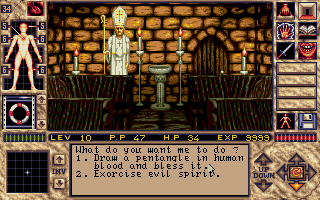
I now had all the items I needed for the summoning and binding ritual to kill Cerberus, described at length in one of the library's books, but I needed a holy man to draw the pentagram, and that meant resurrecting the dead cleric. Fortunately, now that I was at Level 10, I could mix the "resurrect" spell. I'm sure the ingredients were among the library's many tomes, but I just tried various mixtures of likely-sounding items (brain, heart, spleen, holy book, holy water, etc.,) until I got it right.

Trying various items to mix the "Resurrect" spell. Note Elvira sitting there in my inventory (second from the left). Could I have used her to mix a spell?

With the cleric revived (no word on how a clearly-Catholic priest felt about being resurrected via arcane arts), he took my chalice full of blood (I honestly can't remember where I got it) and went off to the parking lot to draw a pentagram. At this point, relying on the instructions in the book and a little help from the walkthrough, I completed the ritual necessary to kill Cerberus: light a series of 10 candles around the pentagram, use the magic bag to summon the beast, cast "Bind Demon" at him, throw the Indian's spear at his head, and hack his heart with the tomahawk. It took me a few tries to get it right because he kept killing me while I was trying to find necessary items in my inventory.

You'd think he could just do #2, but he just says "I don't perform that mumbo jumbo sort of religion."

The endgame animations were pretty good, and it's worth watching the video below of the entire sequence. Note the constant music. I played the game with sounds turned off on my computer; how long would you have been able to last with music like this playing incessantly?


Like the first game, this one ends with Elvira beckoning you to your ribald reward.

I'm not sure I like the look of that dagger.

I hope that the folks at The Adventure Gamer get to this one eventually, because I'm curious what they'd say about it from an adventure game perspective. I thought that some of the puzzles were rather obscure and illogical, and that there was too much screwing around trying to make sure you had the right inventory items in each situation. Add to this a number of "walking dead" situations (avoided in my case by breaking my rules and looking at spoilers), and I'm not sure it performs well as an adventure game.

On the other side, the role-playing aspects were under-developed. You do get notably stronger with each level-up, but the dungeons are long and boring and the combats bereft of anything you might call "tactics," so for me the role-playing elements were somewhat unwelcome. They mostly just padded the time.

It might score higher in a GIMLET than the first one just because it has more elements, but I can't honestly say I enjoyed it more. Let's see.

  • 6 points for the game world. This is one category that's notably better than its predecessor. It makes good use of horror movie tropes and characters by having the sets literally come to life. Elvira felt more like a standard fantasy game in Elvira's clothes; this one felt closer to a horror RPG.
  • 3 points for character creation and development. Definitely better than the first. You get noticeably stronger as the game progresses and you gain experience and level up. I like that you get experience for a variety of actions and puzzle-solving, not just combat. But there are no meaningful character choices throughout the game; even the initial selection of "profession" is staggeringly unimportant.
  • 5 points for NPC interaction. Between Elvira, the Indian, Frankenstein, and the sorcerer, there are a handful of NPCs with dialogue options, some of them even involving a small amount of role-playing (e.g., whether to insult the Indian by asking for "fire water").

Elvira's interpolations were usually unwelcome.

  • 5 points for encounters and foes. A variety of monsters undone by a lack of true strengths and weaknesses, plus puzzles that tended on the too-tough side. Balancing this were some occasional puzzles different than anything I've seen in a CRPG or adventure game. I like the use of spells as puzzle-solving tools.
  • 4 points for magic and combat. The combat system is arguably worse than the first game, but either way it's just a click-fest. I did like aspects of the magic system, such as being able to create "Fireballs" from a combustible material. This would be a fun dynamic in an open-world game where items replenish. Here, because there were so many "walking dead" scenarios, I was reluctant to fully exploit the magic system. I could have gone the entire game without running out of "Herbal Healing," for instance, but there was only a single item available to cast "Telekinesis." Good thing I didn't waste it.

Killing a giant mosquito, like everything else, is just rapid clicking.

  • 3 points for equipment--a handful of weapons and armor. The game gives you no clues as to the damage or protective value of the items you wield and wear.
  • 0 points for no economy.
  • 2 points for the main quest, which offers only one outcome and no player choices.

Tossing a spear at Cerberus to win the game.

  • 3 points for graphics, sound, and interface. The graphics are lovely, but the relentless music is unbearable and makes it impossible to enjoy the other sound effects. And I can't excuse the all-mouse interface. If a game is going to feature long series of mazes, I want to be able to move through them with the arrow keys.

A well-rendered giant spider chomps me to pieces.

  • 3 points for gameplay. I like the non-linearity during the central acts, but I'd say it's just a little too hard and quite a bit too long.

That gives us a final rating of 34, a little higher than Elvira but not enough to cross into "recommended" territory. Elvira II is definitely a better RPG than Elvira, but being a "better RPG" doesn't count for much if you're still not a good RPG.


I've run out of ways to make fun of Dragon giving everything 5 out of 5 stars, but they did it again here. You'd think a magazine focused on role-playing would recognize that Elvira II had some definite weaknesses in this area, but instead they offered a review that could have doubled as an advertisement: "From the opening screens, you'll be on the edge of your seat trying to rescue the beloved Elvira. This is a 'must' purchase."

Scorpia offered a more sober look in the March 1992 Computer Gaming World. Her primary problems are the "walking dead" scenarios: she was unable to complete the game because she'd used a crucifix needed to ward off a vampire in a spell; even if she could have gotten past this, she also used the matches needed to light the candles on a "Fireball" spell (which I also did; thankfully, I had VK to warn me). She also mentions the Frankenstein one. The entire second half of her review, in fact, is taken up with complaints about this specific issue, and I can see why. I was also happy to see that she complained about the music. On the other hand, she goes on for a while about a lack of save slots, which baffles me a bit. The game allows 48 different save slots in an era where the default is usually one. I only used 6 slots, but I grant you I tend to be overly conservative about this.

I'll tell you this: I wish there were more horror-themed RPGs. To that end, I'm going to be happy to give the Horror Soft/Accolade team another chance with Waxworks, coming up in 1992. Judging by the screen shots, it uses the same engine as Elvira II, but perhaps it improves elements of the gameplay. Either way, the setting looks pretty cool.

That will, alas, be Horror Soft's last game. The company renamed itself Adventure Soft in 1992 and produced the Simon the Sorcerer series but never tried again with an RPG. Of the three primary developers on Elvira II--Alan Bridgman, Michael Woodroffe, and Simon Woodroffe--only Simon Woodroffe seems to be active today, with some 2010s credits on action games produced by Sega. Michael Woodroffe last shows up as managing director of Call of Cthulhu: Dark Corners of the Earth (2005), and Alan Bridgman last contributed to Simon the Sorcerer 3D (2002).

My acquaintance with the Mistress of the Dark was brief, but I can't say that breaks me up. It's time to finally get serious about Antares.

****

Further reading: My series of posts on Elvira: Mistress of The Dark from early 2014. YouTube user Lemm has a 3 hour and 20 minute LP that takes the game from beginning to end, and as a bonus you can check out Javier Juan Castro Sanchez's compilation of all of the game's death scenes.