Showing posts sorted by date for query Disciples of Steel. Sort by relevance Show all posts

Friday, August 29, 2025

Daemonsgate: Sic Semper Tyrannis

 
I would think that should be C.D.R. or W.J.D.
        
It was really tough getting back into Daemonsgate after (unintentionally) not playing it for a couple of weeks. The disorientation started as soon as I loaded the game. I had ended the last entry saying that I couldn't get past some guards and couldn't find the Laughing Heretic. When I loaded it up this time, I was standing in the Laughing Heretic. I don't remember how I worked it out.
    
So, to remind us all of the plot: An army of demons has come boiling out of the southern nation of Elsopea and has surrounded the free city of Tormis. The captain of the guard of Tormis (my lead character, Gustavus) was charged with sneaking out of the city and finding his way to the city of Atteia, where it is rumored that an Elsopean refugee has arrived. The thinking is apparently that this refugee might know something about the source of the demon horde and how to stop them.
   
Upon arriving in the city, we learned that the refugee, Alathon, is a "guest" of the city's dictator, Hellast. Searching for allies, we learned of a faction called the Warriors of Light. To find his group, we were instructed to go to the Laughing Heretic and say "Incontinence" to the owner, because that's a word that every innkeeper wants to hear.
          
BONK! "Ha! That never gets old!"
         
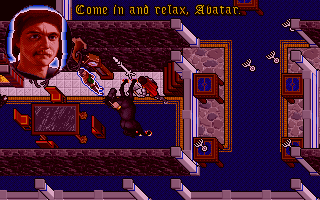
The innkeeper, a hooded man named Erina, told us to walk through an illusory wall in the inn's northwest corner. There was a guy standing on the other side, and he confirmed that Alathon was being held captive in "Hellast's private quarters." But before I could enter the dialogue screen, a guard, identifying himself as a member of the sacrepolitz, arrived to arrest us. He knocked us out with smoke (this was narrated in text form, along with the screen at the top of this entry), and we woke up in jail with most of our inventory items, including weapons, missing.
      
That's an interesting mix of languages.
           
Fortunately, there were some thieves' tools on one of the beds in the cell, so we were soon out of the cell and creeping through the complex. This was the first of many situations this session in which I was trying to avoid getting into a fight. It's not too hard. Combat is triggered by some combination of the enemy's proximity and his facing direction, so as long as the party moves far enough away, or behind him, we're usually all set. Walls and furniture can conceal enemies, though, so there's no perfect method.
           
But who left the tools?
       
There were dozens of other cells in the prison, mostly empty, and the ones that weren't had generic NPCs. I will now go into one of several diatribes that I imagine will occupy most of the text in this entry. There's nothing wrong with generic NPCs if they're in generic places. Whether I'm playing Ultima IV or Skyrim, when a guy standing by a town's gate with a pike turns out to be a generic guard, I have nothing to complain about. I don't expect everyone milling around the town square to be unique. When a guy is in a prison cell, on the other hand, there should be a reason for it. Otherwise, what's the point of NPCs? Ultima established the rules here: If you find a druid hanging out in the middle of a dark forest, or a mage at the bottom of a dungeon, or a bard locked behind six consecutive doors, they all turn out to be interesting (sometimes vital) NPCs with something to explain their presence.
            
Then you have games like Morrowind, which I otherwise love, where you encounter an orc in the middle of a Daedric ruin, and he has nothing to say except generic orc stuff. When you're exploring a remote or unusual place and you realize, "By Grabthar's hammer! There's someone else here!," he ought to have a story. I'm not saying he has to spill it; he can be secretive, or cagey, or even hostile. But he shouldn't be generic. This is not a mistake that the Infinity Engine games ever made—nor, for that matter, Oblivion or Skyrim, but that nonsense is all over the place in Starfield, so Bethesda clearly hasn't learned its lesson.
        
Just a reminder of what combat looks like.
         
We found our items in an office in the northwest corner and had to maddeningly pick them up one by one (the game offers no other option) and redistribute them among party members. I had to fight two battles on the way out. I got past the first one but had to flee from the second (which fortunately removes the enemy from the screen). When I got back to the Laughing Heretic, the leader of the Warriors of Light was gone, and I never heard another word about the organization.
        
I don't know who that guy was, but he just watched us pick up our things.
      
I then set about trying to find the entrance to Hellast's palace, which took a while. The city is realistically large, but realism isn't a virtue when you're exploring a top-down city with a limited view window and no map. It's worse than Disciples of Steel, which had a similar problem. There are multiple nested sets of walls, lots of generic buildings that you can't even enter, narrow alleyways, and places where it's easy to trap yourself without realizing there's only one entrance or exit. More important, and related to the issue I discussed above, you run into all kinds of interesting-sounding locations—embassies, moneylenders, banks, guilds, a city council chambers, a courthouse, city archives—and yet none of them have anything interesting happening or anyone interesting to talk with. The author worked awfully hard to create a large world and then populate it with mostly nothing, excepting the few NPCs and locations that propel you to the next quest.
     
You wouldn't know it to look inside.
        
I got attacked frequently as I walked around and almost always lost a party member in the subsequent battle. I suppose I could roll with that, but I've been reloading instead, since the game doesn't seem to offer copious NPC replacements nor any method of resurrection. ("If the character is dead," the manual helpfully explains, "it is assumed that the rest of the group dump his or her body in a ditch.") Eventually, I was fed up.
   
I returned to the Laughing Heretic and spent about two months there. I had the party spend 18 hours a day practicing their skills and 6 hours resting. Most of them started with specialties in one-handed edged weapons, but a couple of them didn't have that, so as soon as Gustavus reached "Master" rank, I had him train the others. This is because so far, the only weapons I found that can be enchanted are one-handed edged weapons. Eventually, I got everyone to "Master" in that plus some ancillary skills like Cyless's "Scouting" and "Survival," although I don't know how important either are. I had some characters reach "Master" level in skills like "Throwing" and "Brawling" just because I needed something for them to do while other characters caught up. 
     
 I just want to know how Gustavus managed to practice "Leadership" in a hotel room.
         
I got Arion to "Master" in both "Herb Lore" and "Elemental Lore" and then began to explore the magic system. The game offers three forms of magic: herbalism, elementalism, and daemonology. None of them allow you to cast traditional spells in battle. Herbalism is about making potions, and I only explored it long enough to realize I didn't have enough reagents. Elementalism allows the mage to enchant weapons with various effects. Daemonology, which none of my characters have, also allows for enchanting weapons, but also amulets, which can be broken in combat to release the demon.
    
If you spend 6 hours on elementalism, you get to choose the elemental bound to the weapon. First, you choose the type: light, darkness, air, earth, fire, or water. Then you choose the level: minor, small, weak, average, powerful, and gargantuan. The manual doesn't bother to tell the player what earth enchantments do. Water increases the chance of corroding the opponent's armor. Air weapons "reduce the chance that [the] weapon has of being fumbled," which has not been a problem so far. Darkness weapons inflict both regular damage and fatigue damage. Light weapons are effective against undead, which I have yet to face. Fire weapons simply increase damage. 
     
The elementalism screen.
      
The only mechanic that I actually trusted to be implemented was fire, so I had Arion enchant the two Adamantine Swords with gargantuan fire elementals. I tried to enchant the "Enchanting Sword," but the game just said that Arion didn't possess anything that could be enchanted. Once enchanted, the Adamantine Swords became "Elemental Blades"; you have to examine them to see the specific type of enchantment. 
      
I feel bad for the fire elemental.
      
In terms of skill development, it's possible that I'm done for the game. "Master" is the highest level you can get, and you can only get it by doing stuff in camp (reading, practicing, or learning from a master). It doesn't increase during combat. It was very artificial for me to do it all at once like this, but it was going to be artificial no matter what. In a game with no time limit, why not do it all at once at the beginning? Still, this is about the dozenth British game that fundamentally misunderstands how character development is supposed to work in an RPG. Frankly, only Anthony Crowther (Captive) and Anthony Taglione (Bloodwych, Legend) have gotten it correct.
       
After all of this skill-building, combat did become noticeably easier, although I still had to be careful to remove characters from the fracas once their hit points got too low.
   
I finally found the entrance to Hellast's palace and had to fight several parties of guards on the way in. Hellast was in a chamber in the southwest. "May I ask what you interlopers are doing?" he demanded before calling his guards. The resulting battle was relatively easy.
      
This session is just full of 1989 references.
       
From his corpse, we looted a letter that suggested a larger conspiracy, with Hellast promised a reward by the minions of someone named "Alkat." The note was signed by "Warmaster Edric."
    
Alathon was imprisoned in a pentagram in the next cell. "We cannot stay here and talk," he said. "Meet me in Joruli Point, and I will explain all." Then he disappeared. I should note that the game called him "Alathon" on one screen and then "Dorovan" on the next. This is notable because the back of the box gives the subtitle of the game as Dorovan's Key.
      
Could I just meet you at the bar down the street?
      
We fought our way out of the palace, rested for the night at the Laughing Heretic, and then left the city. The game map shows Joruli Point on an island quite far to the north. The city of Trade Town was just across a channel, and I figured there would be some kind of transport there. But before heading up the coast, I returned to Tormis to sell looted equipment and buy more Adamantine Swords so that all of the characters could have Elemental Blades. I ended up having to buy several more than I needed, because apparently there's about a 20% chance, even at "Master" level, that the mage screws up and breaks the sword while trying to imprison a gargantuan fire elemental in it. This left me without much money. I bought some food and a little bit of armor, but I had to save most armor upgrades, as well as reagents for potions, for later.
 
A couple of miles to the north or south would have been less effort.
             
We left Tormis and headed north. I had to go pretty far east to ford a river, and I mis-guessed the distance to the coast on the other side, resulting in my running into the far northern Wall before reaching the coast. I had to return to the southwest to find Trade Town. There, I learned from an innkeeper named Ari that there are three towns near the Wall, collectively called the Campps: Hajak, Rowche, and Slime. Hajak is the unofficial capital of the area, ruled by an unofficial king named Svien McDoogal, who keeps a fragile peace between the Clans. The game is best when it's building lore like this, but so far it's done a poor job integrating that lore into meaningful gameplay.
      
Again, the comparison to A Song of Ice and Fire is uncanny.
      
I also learned that there's no transport to Joruli Point from Trade Town; instead, I have to go to Dryleaf to the south.  
   
I poked around Trade Town a little. As usual, it was far larger than it needed to be and had intriguing-sounding buildings (the headquarters for the Northern Rangers, the gaol) turned out to have nothing interesting but a few things to loot.  
       
Miscellaneous notes:
     
  • Among things that don't seem to have actually been implemented is equipment damage. If you look at any piece of armor, for instance, it tells you that it's in "good condition." You can buy an armorer's kit, ostensibly to repair armor. But there's no mechanism (unless I'm missing something) to do so.
  • And while we're on that subject, a "fletcher's kit" is also something that you can find or buy, but there is again no way to invoke it.
        
Aron's current skill levels.
        
  • There are two skills that Arion has, "Meditation" and "Magic Sense," that the manual doesn't even mention. 
  • I trained everyone in "Missile Weapons" and gave everyone a bow, but arrows cost so much money (1 gold piece each) that it might be a while before I avail myself of the skill. It's also a pain to swap melee and missile weapons in combat. 
  • When you pay for lodgings at an inn, an inventory item called "Lodgings" appears in your backpack. It disappears when you camp at an inn. It's kind of an awkward way to do things, but I suppose you can regard the physical item as the room key or something. 
  • The game crashes frequently when exiting dialogue screens. 
  • If I place the characters under computer control in combat, Anvil flees every time.
  • It took me a while to realize that when you want to buy something in a shop, you're not interacting with the NPC at the counter; you're interacting with the shop itself. Thus, you can access the "Buy/Sell" menu even when no NPC is visible.
  • The combat icons are primitive and pixelated, but the author did take the time to program blood spurting from the little icons when they die. I'll try to capture it next time.
    
The resting and practicing turned this session into a lot of gameplay hours but without a lot of plot progress. Hopefully, now that I've made the investment, things will happen faster.
    
Time so far: 14 hours 

Saturday, April 13, 2024

Game 511: The Red Crystal (1993)

    
The Red Crystal
United States
Wild Card Software (developer); Quantum Quality Productions (publisher)
Released 1993 for DOS
Date Started: 11 April 2024
     
I like to start every new game as unbiased as possible, so I try to avoid learning anything about it from external sources. There have been times that my reactions to universally-adored games have been negative, and there have been times that the opposite has occurred. I feel that either scenario is more likely to happen if I go into the game with a blank slate.
    
I did that with The Red Crystal, but a few hours into it, when I allowed myself to look at the game's Wikipedia summary and saw that Computer Gaming World had rated it the 22nd worst game ever made, I thought, "Yep, that tracks." CGW has been monstrously wrong before--that same list includes Disciples of Steel!--but when I saw that Crystal's chief designer had come from Paragon Software--which never really understood RPGs--and had previously been a lead programmer for MegaTraveller 1: The Zhodani Conspiracy (1990), it was all the explanation I needed.
     
You know this guy is evil because he wears a skull on his belt.
     
That designer is Charles Griffith. In addition to MegaTraveller, he programmed some of Paragon's Marvel titles, such as The Punisher (1990) and X-Men II (1991). He was briefly at MicroProse, which bought Paragon, but then seems to have staked out on his own. I suspect that Wild Card Software was his own label. (The company's name comes up briefly in the title screen sequence but is not found on any of the game's documentation.) His publisher, QQP, was a well-known maker of wargames, and according to CGW, they should have stuck to that category. Griffith's LinkedIn profile proudly mentions his time at Paragon/MicroProse and his later work for Acclaim and Stargate Interactive, but it skips over Wild Card and Crystal, which is probably another bad sign.
           
He must be a Targaryen.
       
The game takes place in the empire of Blackmoore, which consists of seven kingdoms which peacefully coexisted for 3000 years. Then some troublemaker named Lexor came out of nowhere, raised an army of the dead, and conquered the empire. He gave each of the seven kingdom's castles to one of his chief lieutenants ("the seven worst tyrants the world has ever known") and tasked them with guarding the Seven Secrets of Life. (Most sites give The Seven Secrets of Life as a subtitle. It appears on the box cover but not anywhere in the manual or title screen, and my policy is always two out of three.) Your goal is, of course, to retrieve them and use them somehow to destroy Lexor. Involved in some nebulous way are red crystals, which have weird magical properties, including foresight and telepathy.
    
Character creation begins by choosing a portrait from a number of cartoonish options that would look perfect in a comic book game, although they don't seem to have been adapted from X-Men II. I am grateful that they offered some helmeted options in case you just want to imagine your own character under the helmet. You can also choose a crest from among six options: a chalice, an eye, a mouth with a wagging tongue that looks a little disgusting, a skull, a fist, and a lightning bolt.
     
Some of the character portraits. The two women look like the same woman from different angles.
        
You then enter a name and choose from five classes: barbarian, knight, lord, sorcerer, and thief. Barbarians are supposed to be all physical offense, knights slightly less so. Lords are supposed to be wealthy, so they can bribe their way out of more combats, but I wonder how well this really works in reality (see below). Same goes for the supposed stealth and trap-defying abilities of thieves. Sorcerers are masters of magic, so they start weak but get stronger as they master their powers.
   
The game's attributes are strength, intelligence (for spells), ability (to disarm traps and such), armor, damage, resistance (to spells), stamina (hit points), and zetos (money). The manual tells you nothing about what the maximums are, so you have to reroll a lot to feel it out for each potential character. I tried a lot of rolls and came up with the following chart:
        
     
"Armor" and "Damage" are odd because they have initial values, but these are changed by the weapons and armor you later equip. Most games make innate damage a function of strength and innate armor as a function of dexterity or what this game calls "ability."
   
This was a pretty solid set of statistics given the maximums above.
     
The game begins on an outdoor map that seems to depict a desert environment. A smaller-scale map to the right (by default, unless you have a companion) shows the entire kingdom, including the seven castles and various towns. The character icon is represented by a sword. NPCs move around the map at the same time, but I find they never have anything interesting to say. Merchants never offer to sell anything and bounty hunters are never looking for you, so they don't engage in combat. It's really a wasted mechanic.
       
I'm so glad we had this encounter.
      
In most RPGs, you head for the town to buy some equipment before you start seriously adventuring, but here that's not possible because you begin with so little cash. (I'm not sure if I can bring myself to use the word "zetos.") So you might as well go right to one of the seven castles. However, for later reference, towns have weapon and armor shops, oracles who provide crystals and healing, wizards who sell spells and potions, wandering NPCs as useless as the ones in the outdoor map, NPCs in houses who sometimes give side quests, and courthouses where you can literally buy the town and I guess start collecting its tax revenue. 
      
Exploring the wasteland, I come upon a castle and its town.
       
The seven castles are all near towns. When you enter, you get a qualitative assessment of how tough the enemies are going to be in the castle compared to your current level. 
       
I guess this one shouldn't be too hard.
     
As you explore the castles, you run into enemies--bestial, undead, humanoid, and other. There are only 15 monsters in the game, but they can exist at different power levels depending on what castle they're in. I think their color has something to do with it. You can try to avoid them, but they tend to swarm you, and it's better to just deal with them even though they (somewhat slowly) respawn.
       
The death screen. I don't understand: how did Lexor's guards fail in my mission?
        
Combat is the game's big failing. Aspects of it probably sounded good to someone. You're taken to a separate "arena" screen for each combat. You and the enemy can run around the screen or stand still and swing at each other. There are theoretically nine types of attacks that you can choose from: three low, three medium, three high. Each enemy is particularly susceptible to one of the nine types of attacks, so you have to experiment a bit to figure out which one applies to that enemy. When you land on it, the difference is obvious. Your attacks go from 1-2 damage per hit to 5-10 or more. Then you have to annotate or remember the best setting for each enemy.
       
Fighting an "orb," which is a beholder with hair. I clearly need to adjust my attack.
        
This all sounds okay, but two more important principles govern combat:
    
  • Even if you have your attacks set to the idea setting, you can't just stand next to an enemy swinging away. You'll die after a couple of combats, if not the first.
  • Your reach is always greater than the enemy's. (This might not be true with daggers, which I haven't tried.) None of the enemies have missile weapons. Even spellcasters have to get up close to you.
   
In practice, these factors create a combat system in which you wait for the enemy to approach, swing a couple of times as he gets close, then run away before he can hit you. Then you find a new position and do it again. It's tedious and exhausting. One level was enough for me, and I've got dozens of them. Some enemies have over 100 hit points and only take 3 or 4 per hit at best.
  
With a little practice, it's not hard to avoid all enemy attacks. Since you can't afford to stand still and get hit by any enemy, there's functionally no difference between the easy ones and the hard ones except how long combat will take.  
       
That's more like it.
       
Every encounter with an enemy gives you a chance to bribe before you fight. The manual suggests that this is the lord's primary way of dealing with enemies. I don't know how this works. Maybe you get experience for successful bribes. I'm not sure how you get the money to bribe in the first place if you don't fight, but maybe there's a way to do it by running around, collecting treasures from chests until you have enough to buy a town, then bribing off that town's income. Or multiple towns. It would be a unique approach to gameplay if it were possible, but I can't think it would be all that exciting.
   
I leveled up a couple of times as I killed enemies. The experience point statistic is hidden, but it clearly exists. Levels increase maximum stamina and, according to the manual, accuracy.
        
Only in CRPGs does getting struck by lightning leave you stronger. Maybe the armor acts like a Faraday Cage.
        
As I explored the castles, I found additional items to use and wear, including armor, gauntlets, boots, potions, and food. Potions are color-coded, and the manual has nothing to say about them. Food restores stamina. Some slain enemies deliver money. I also found a couple of things that sound like quest items, including "Hunwell's Skull" and a "Lost Crown."
    
Finding a chest in the dungeon. Chests are often empty.
       
Castles have multiple levels with lots of stairways up and down and hidden doors. I had hoped to find the first Secret of Life for this entry, but I started over once (when I realized I'd rolled lousy statistics for the first character) and the castles are large. They have multiple levels, and the game doesn't remember the map once you've left a level, so it's very hard to systematically explore without going in loops. Then, it turns out that some encounters on higher levels are with multiple enemies at once, which makes the entire game less like a CRPG and more like a game of Pac-Man where you spend the entire thing running around trying to avoid getting touched by your foes.
        
It would be nice if they'd given me a bigger screen.
       
The game does have one innovation I haven't covered and probably can't: cooperative multiplayer. Supposedly, you could get a friend to dial in via modem and join the quest, with the second player taking up the spaces on the right hand side of the screen. I haven't been able to figure out how to replicate that--and I couldn't do much with it even if I did--but it is something that few other games of the era were offering. If only it was offered in the service of a game with better combat mechanics.
     
Time so far: 3 hours
 
****
     
I've made an update to the last entry for Tygus Horx based on some information I got from the author. I still couldn't finish the game, but from his notes, we know what the ending should have looked like.
 

Wednesday, October 18, 2023

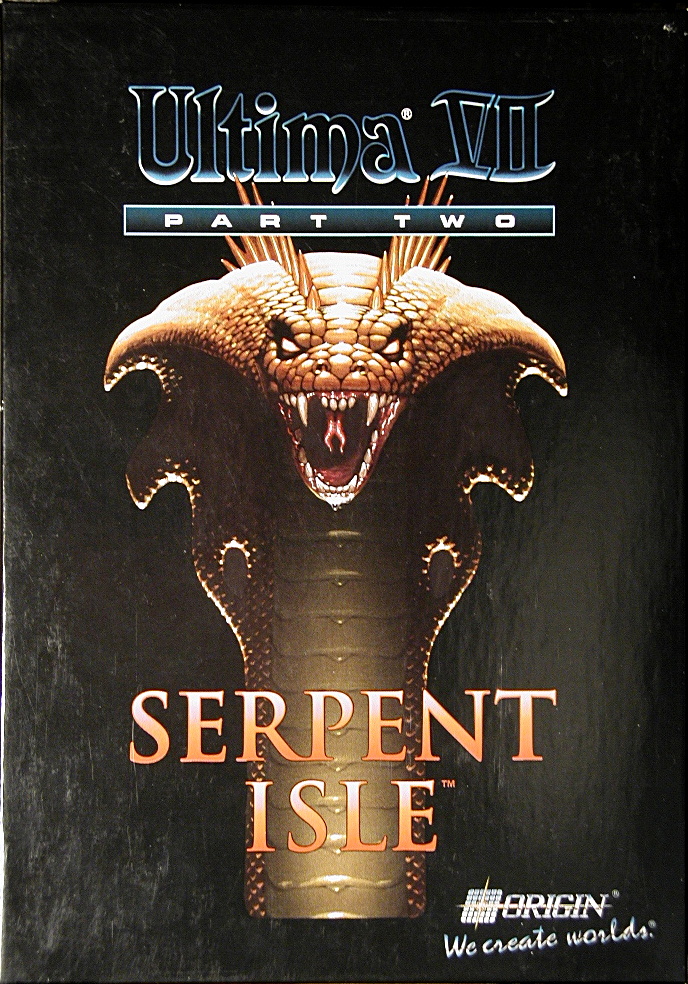
Ultima VII: Part Two - Serpent Isle: Summary and Rating


Ultima VII: Part Two - Serpent Isle
With The Silver Seed expansion
United States
ORIGIN Systems, Inc. (developer and publisher)
Released 1993 for DOS
Date Started: 29 January 2023
Date Ended: 3 October 2023
Total Hours: 112
Difficulty: Easy-Moderate (2.5/5)
Final Rating: 43
Ranking at Time of Posting: 443/508 (87%)
         
Summary:
    
Serpent Isle takes the engine from Ultima VII: Part One - The Black Gate (with a few upgrades) and tells a long, full story worthy of its own game number. The Avatar and his three stalwart companions (Iolo, Shamino, and Dupre) travel from Britannia to the Serpent Isle, chasing former Fellowship leader Batlin, who has ostensibly gone to enact the next stage of the Guardian's plot to destroy Britannia. As a secondary quest, the party hopes to find the fate of Iolo's wife, Gwenno. They arrive to find a land of former Britannian malcontents who have built cities on the foundations of an older race that worshiped Order, Chaos, and Balance. In the end, the party destroys Batlin but unleashes forces that essentially wipe out the people of the island. The Avatar manages to restore Balance for the few remaining citizens, but at the cost of Dupre's life and the Avatar's own abduction into the next Ultima title.
    
The plot is long and complex, with abrupt, nonsensical, and inept developments balancing the relatively competent backstory and world-building. Like The Black Gate, the mechanics are weak in classic RPG elements. Combat remains more random than tactical; spells are mostly unnecessary; character development is an afterthought. Inventory and lever puzzles adopt far greater prominence than in previous Ultima games. The oblique-angle interface remains fantastic for exploration and character actions, less so for combat, even less so for inventory management. 

The narrative is relatively linear, and most of the game world is blocked off until you hit various plot points. And it just drags on forever. I enjoyed the beginning but was so exhausted by the end that I grew actively angry at each NPC, door, and puzzle.
         
****
    
The Ultima series continues to innovate. Past entries gave us the first CRPG mini-games, the first dialogue keywords, the first recruitable NPCs, the first map included in the game box, the first ability to play musical instruments within a game, and lots of other superlatives. Here, we have the first 100-hour CRPG plot. You understand, I trust, how that's different from the first 100-hour game. A game can take a long time to win but be primarily about mapping (Crusaders of the Dark Savant), or grinding (Disciples of Steel), or both (Fate: Gates of Dawn), or dying and reloading (NetHack, The Return of Werdna). It can exceed 100 hours because it offers a thousand side quests (The Elder Scrolls) or because the game simply has no single ending (MMOs).
   
But it's rare to find single storylines that cross into three-digit hours. Even today, main quests can usually be wrapped up in considerably shorter time. More important, modern games offer features that weren't available in 1993, such as quest logs, summaries of completed quests, dialogue notes, and quest items that you cannot discard. Long plots tend to be divided into digestible chapters or regular points of return to a central resting place.
   
Thus, when I say that Serpent Isle is "too long," I don't mean necessarily that it's too long a game (although, let's face it, it is) but that it's too long of a plot, and more precisely that it's too long of a continuous, unrelenting plot in which the player must keep track of hundreds of things said by hundreds of NPCs as well as dozens of quest items, lest he literally lock himself out of continuing. That I only had to use the cheat menu a couple of times is something of a miracle.
      
I just like this shot.
    
If I'd liked the plot, I might have minded less, but I just didn't. I liked the plot of The Black Gate. The Fellowship was a sinister organization seeking to usurp everything I'd built, and I enjoyed discovering their hidden motives. In Serpent Isle, the part I liked best was trying to track down the items lost in the teleportation storm. The rest of the plot just didn't hang together well. The history makes no sense (e.g., the rise, peak, and disappearance of the "Ophidian" culture in less than a century). The motives of the Guardian and Batlin are nonsensical. The plot twists are abrupt, and the NPCs don't have enough of a reaction to them; for instance, no one in the party reacts to Dupre's cremation, and the world's NPCs are awfully ho-hum about the deaths of 90% of the citizens. The Imbalance (i.e., teleportation storms) is handled inconsistently. I have to give some praise to the depth of the backstory and the development of the Ophidian virtue system, but I couldn't bring myself to care about it. That's the, what, sixth system of virtues that the Ultima series has introduced? At some point, you have to say enough.
      
Commenters have offered conflicting opinions on whether the central problem with the game is that the developers had too much time or too little, were under too much pressure from their new Electronic Arts masters or given too much leash. (Jimmy Maher has an excellent pair of articles on this period in Origin's history, as it was subsumed by its larger partner.) I think a more obvious explanation for the difference between The Serpent Isle and The Black Gate is that the team lost their writer. Raymond Benson, who had done such a great job with the plotting and dialogue in The Black Gate, only worked on Serpent Isle for a couple months before he left Origin to go write Return of the Phantom (1993) for MicroProse. (These facts are attested in a 2013 Ultima Codex interview with Benson.) Replacing him was . . . well, it's not clear. Unlike The Black Gate, Serpent Isle doesn't have a "lead writer" credit. It does have a "Writing Team," but I don't think anyone on it is a professional writer. It's made up of career Origin employees whose talents are in coding, not dialogue.
       
This part never made any sense.
     
The team was led by Bill Armintrout, who according to MobyGames credits was occupying the director's chair for the first time. In another Ultima Codex interview, Armintrout indicates that his big break wasn't a sign of confidence from Origin or EA management, but rather a consequence of three project leads quitting the company at the same time. He describes a one-hour briefing in which he had to learn "what an Ultima was." The interview indicates that Richard Garriott was occupied with Pagan while a mostly-inexperienced team worked on Serpent Isle, adapting to changing visions and requirements. In an early draft, the game was going to be pirate-themed.
    
Armintrout's interview also gives some indications of material that was cut from the game. As commenters have already mentioned, originally the Banes of Chaos (occupying the bodies of Dupre, Shamino, and Iolo) were supposed to take over the three cities of Serpent Isle, not just kill everyone. They would have perverted the values and virtues of the towns. The Bane of Wantonness was to have turned the citizens of Monitor into actual leopards, wolves, and bears; Iolo was to have unleashed a plague in Fawn that made everyone ugly; and Shamino was to have become the new MageLord of Moonshade. The Avatar would have had to evict them all from their respective cities before facing them at the Castle of the White Dragon. These bits of lost plot appear in the game in various forms; for instance, there are leopards, wolves, and bears roaming around Monitor, and there are some notes and dialogues in Fawn and Moonshade hinting at the other lost plots. Overall, it sounds like a slightly better story, but it would have also added unnecessary length to the game.
      
A scroll in Fawn references content cut from the game.
     
In contrast to the plot, the Serpent Isle team completely inherited the engine. It has the same strengths and weaknesses of The Black Gate. I mostly like it. No other game was offering an exploration window completely unencumbered by interface elements, and it works great. Single keys call up windows and execute the most important actions. The mouse is used as it should be used, for selection of on-screen objects and positioning them. But we still have the problem with characters needing to be fed and objects getting lost deep in characters' backpacks, including a lot of tiny-but-vital objects like serpents' teeth and keys. Darkness is still too debilitating, and enemies still respawn too quickly when you leave the screen and return.
      
The addition of the "freezing" mechanic didn't do anything for me, either.
       
Combat remains underwhelming. I'm not sure if such is inevitable with the interface or whether it would have been possible to do it better. Character development is also lackluster--a few extra attribute points maybe seven or eight times. Equipment rewards are okay but barely feel like they matter. Spells play a minimal role. Much more attention is given to the game's puzzles, leading a lot of people to comment correctly that for much of its run time, it feels more like an adventure game than an RPG.
       
Moments like this made me want to quit long before the game's end.
      
I would have loved to see the possibilities inherent with this engine if the script had been less tightly plotted and the areas less gated. I think I said as much when I was reviewing The Black Gate. The engine seems tailor-made for an open world game with plenty of side quests and lots of serendipitous discovery. Origin had been planning an Arthurian Legends title using the engine (accounts differ as to whether it was going to be a Worlds of Ultima game); it's too bad it was canceled.

It's worth reading the cluebook for the game, subtitled Balancing the Scales. Frankly, until you get to the "walkthrough" part at the end, it's less a cluebook and more a supplement to the manual. It clarifies the Ophidian backstory and virtue systems, and it offers information that ought to be open to the player, like lists of spells and reagents, exchange rates, and weapon damage. Even the maps hardly offer more spoilers than the typical automap of today's RPGs. It made me wish there was something like a halfway point between a game manual and a cluebook--maybe a "manual supplement" for players who want to delve deeper into a game's lore and mechanics but not actually spoil puzzles and plot developments. 
          
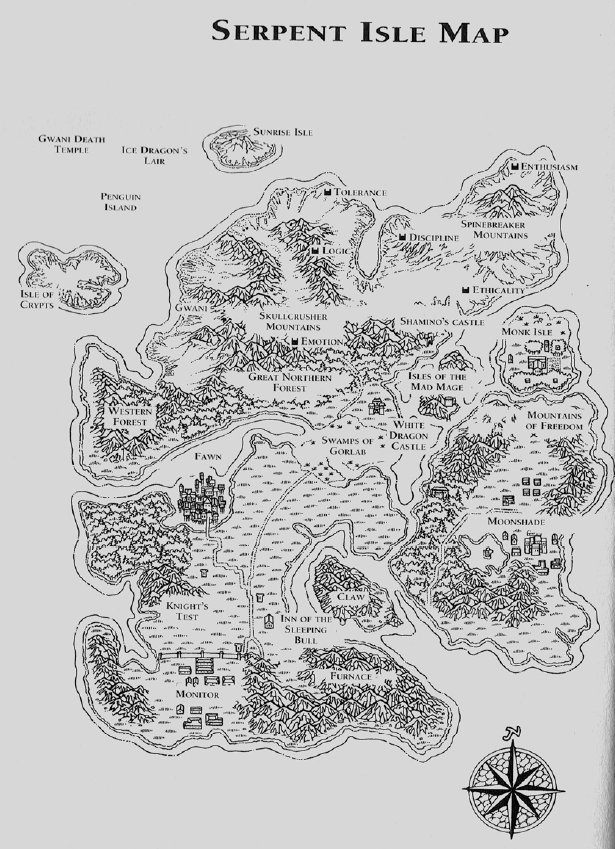
It would have been nice to have a map this clear and accurate throughout the game.
      
Usually when I offer a "summary and rating" as a separate entry, I give multiple paragraphs to each GIMLET category. I just don't feel like doing that here. I already did it for The Black Gate, and any major changes between the two parts of Ultima VII I've already described above. Let's just get this over with:
    
  • 6 points for the game world. It gets all of it for depth and complexity. It doesn't do as well as The Black Gate (8) because I didn't like much of the material that went into that depth and complexity.
  • 3 points for character creation and development. No change from Gate.
        
The party's final statistics.
      
  • 6 points for NPC interaction. I gave it 7 in Gate. The quality of dialogue dropped here, and the classic keywords became more strained. Too much was gated by keyword. You have about the same number of NPCs who will join the party.
  • 5 points for encounters and foes. It gets a little extra for the quality of the puzzles in various parts of the game. Enemies themselves are mostly unmemorable.
  • 3 points for magic and combat. The variables are there, but they're lost in random actions and too much luck. Spells are mostly unnecessary and wasted.
       
The typical cluster@#$% that is this game's approach to combat.
        
  • 5 points for equipment. Finding upgrades remains one of the better parts of the game.
  • 3 points for the economy. Money is needed mostly for spells and not at all in the second half of the game. Having four different currencies adds nothing.
        
The last moment that money has any use.
      
  • 4 points for the quests. There's a main quest, but no alternate ending. There are some side-ish quests and areas. You get a few choices in the order you handle things.
  • 6 points for graphics, sound, and interface. The sound is horribly disappointing, so much that I mostly played it with sound off. The occasional voiced dialogue didn't excite me. I was happy with the graphics and the interface. I'm told the music is very good.
  • 2 points for gameplay. Here's where it suffers most in comparison to The Black Gate. The world is less open. It errs on the side of too easy. It's way, way, way too long, and because of that it's the opposite of "replayable." There are very few games in my chronology for which I'm sure that I'll never, never play them again, but Serpent Isle is one of them.
   
That gives us a final score of 43, the lowest by far that I've ever given to a proper Ultima title, 7 points lower than The Black Gate. I know some people think it's the best Ultima and improves upon its predecessor, so I'm sorry I can't share your opinion.
     
I don't think I've heard of "MCGA Graphics." "Make Computers Great Again?"
         
Just be glad I didn't dislike the game as much as Scorpia. In the July 1993 issue of Computer Gaming--oh, Land of Goshen, when the hell am I finally going to open an issue of this damned magazine and not see an ad for Spear of Destiny on Page 2? I swear it's been there in every issue I've consulted since 2015! It's mocking me with my lack of progress. Sorry. As I was saying, Scorpia didn't care for it much. Choice quotes:
   
  • "Many threads are woven into this tapestry, and at times, it's easy to lose sight of the pattern as a whole."
  • "Inventory is the same nightmare it was in the previous game . . . Try locating a dark item, such as nightshade or black pearl, when it's against a black background."
  • "Once a party member becomes hungry, he whines and moans about it until you stuff something into his face."
        
Amen, sister.
       
  • "Party members . . . cheerfully walk over the most blatant traps, no matter how carefully the Avatar maneuvers."
  • "The whole business of Shamino's background is bogus."
   
Aside from technical issues that I didn't experience, her biggest problem was with the puzzles, and particularly the gated nature of the puzzles. She noted, for instance, how the Avatar can't get into Skullcrusher until he speaks to the Gwani despite solving the puzzle well before then, and how the Hound of Doskar is still needed to lead you to where you already knew you had to go. She didn't like the inconsistencies in whether you could open doors with bashing and explosions or not, and she mentioned many of the plot holes, such as Wilfrid not noticing the corpses of his family members in the same room. I'm not sure what she means by "an amazing programming oversight that allows you to complete the game without performing what is supposed to be a crucial ritual," but it doesn't surprise me. Overall: "Serpent Isle is likely to provide more aggravation than enjoyment for most players."
       
To Deruvia, I guess.
      
We're in the minority, though. Most reviews put it in the 90s. Just a year after it was released, PC gamer rated it #13 (from the top) on a list of the "Top 40 Best Games of All Time." It's the highest-rated RPG on the list, which does not include The Black Gate. (The #1 game is Doom; the next-highest rated RPG is The Elder Scrolls: Arena at #18.) My own readers have shown far more enthusiasm than I've felt. Maybe it will balance out with my loving Ascension. Before then, of course, we'll take a look at Ultima VIII: Pagan, if I ever get to 1994. Chances just got a little better.
 

Monday, November 2, 2020

The Dark Queen of Krynn: Summary and Rating

 
Why does she dress like that? There's no one to see her but Raistlin and a bunch of monsters.
        
The Dark Queen of Krynn
United States
MicroMagic (developer); Strategic Simulations, Inc. (publisher)
Released in 1992 for Amiga, DOS, and Macintosh
Date Started: 21 September 2020
Date Finished: 26 October 2020
Total Hours: 36
Difficulty: Moderate (3/5)
Final Rating: 52
Ranking at Time of Posting: 372/392 (95%)
    
Summary:
 
The final game in the Dungeons and Dragons-licensed Gold Box series (except the Unlimited Adventures construction kit), Dark Queen satisfactorily wraps up the Krynn trilogy. The game uses the same "engine" that has supported a dozen games since Pool of Radiance (1988) with only a couple of minor interface and graphics improvements. The meandering story takes the experienced party from Death Knights of Krynn and brings them to a new continent, Taladas, where they must thwart the machinations of the evil queen Takhisis and her followers. The story is nothing great, but the game manages to offer challenging tactical, turn-based combat even for high-level characters, and without resorting to cheap tricks like wiping the characters' spells. There were times that it got a little long and frustrating, but nothing that a short break wouldn't cure. A good end to a good game series.
    
**********
     
The Gold Box goes out neither with a bang nor a whimper, but with something in between: a solid, well-crafted, challenging entry that nonetheless fails to break any significant ground. It leaves the player looking forward to the next new thing rather than wanting more of the old. While I was generally happy with Dark Queen, I couldn't help but contrast it with Icewind Dale II, the last Infinity Engine game, arguably the best of its series in mechanical terms, which kicked gameplay to a new level at the very time that its creators announced it would be the last game.
    
I am writing this before rating Dark Queen, but I know there's no chance it will unseat Pool of Radiance (1988), the first Gold Box title, as the best of the series. I know that some readers will disagree, but I suspect they are prizing what I consider rather trivial improvements--better graphics, better sound effects, the introduction of paladins and rangers, and the "Fix" command among them. (This game allowed loading from within the game for the first time, something I didn't realize until I read Scorpia's review.) I prioritize quality game content, and to me the series never improved upon what Pool of Radiance offered. Some examples:
    
  • The most meaningful character development. Pool is the only Gold Box game in which characters start at Level 1. They can make it to roughly Level 8, right at the point that they start to feel overpowered. Every level brings awesome new resources to all classes.
  • The most meaningful role-playing choices. Pool is the only Gold Box game in which you can really role-play an evil party, right up to the end where you can join with Tyranthraxus. Every map offers numerous encounters with several role-playing options that fundamentally change the nature of the challenge. Some later games approached this encounter complexity but rarely exceeded it.
          
This early role-playing choice set a standard that the Gold Box series rarely met.
         
  • The most challenging battles. To me, the five most memorable battles in the Gold Box series are: 1) the troll battle in the ruined tavern in Old Phlan; 2) the hobgoblin battle in Sokol Keep; 3) the sequence of three battles against kobolds in the kobold caves; 4) the beholder corps; 5) the final battle of Pools of Darkness. Three of these are in Pool of Radiance. It never gets better than when you have a tight group of adventurers against a mass of mostly-physical enemies, and every asset--every "Cure Light Wounds," every "Hold Person," every "Sleep," every shot of a Wand of Magic Missiles--can make all the difference.
       
These were the days when one "Bless" spell made all the difference.
          
  • The most non-linear plot. The world of Pool of Radiance opened up fast, and you could do most of the quests in almost any order.
  • The most interesting plot. No world-threatening events ever improved upon reclaiming the city of Phlan block by block.
  • The best quest system. Sidle up to the quest board outside City Hall and write 'em down, then later return to the clerk for your reward.
  • The best use of NPCs. As with all the games, there were some named NPCs who would join you, but Pool gave you the only chance to hire mercenaries.
  • Lots of random encounters on the world map. Pools of Darkness was the only other game to do this well.
  • A fixed number of random encounters. Beat enough wandering parties, and you cleared the maps.
  • Best use of the journal. Later games tended to use the journal for just long paragraphs of text. Pool had a few of these, but it tended to use the journal to offer things that you would actually find on paper in the game: maps, notes, scraps.
      
There were definite improvements in some of the later games, but none of them ever solved any of the original engine's most significant issues, including boring environments, little warning about impending encounters, and a horribly broken economy. Even the vaunted "Fix" command isn't much of an improvement when you realize how much it trivialized the resting-and-healing process. In short, the series did not improve in enough ways after Pool of Radiance to make up for what it left behind.
   
Nor did the engine incorporate any of the better elements of its competitors, many of whom were innovating past the Gold Box by the early 1990s. I still haven't encountered a game with you-wouldn't-even-think-of-taking-off-the-headphones sound design, but some of the best titles of the era were at least experimenting with ambient sound and more realistic effects. It would have also been nice to see more in the way of puzzles in the Gold Box--not like Dungeon Master, but more a combination of inventory and logic, like some of those in the later Wizardry games. It would have been nice to see some actual dialogue options with NPCs, and even more encounters with role-playing options, not fewer. Other games were doing these things.
       
I thought I'd play a little longer and at least get my characters leveled up. But I inadvertently found out that they're racist.
    
But one way in which no title has exceeded the Gold Box--and I'm tempted to add "even until today" in this superlative--is in combat. I will never stop loving the series' turn-based tactical battles, even if I like some individual elements better in other games (e.g., the point-based movement system of Wizard's Crown and Disciples of Steel or the sheer number of options in Nethack).
    
Part of the genius behind the Gold Box combat system lies in its faithful adaptation of the very large variety of Dungeons and Dragons spells. We saw how their absence significantly reduced the engine's value in the two Buck Rogers games. But here, again, we see how things don't get much better than Pool of Radiance. Once you acquire "Fireball," nothing else seems awesome again. (Its seventh-level "Delayed Blast" counterpart increases the utility, of course.) The fourth-level "Ice Storm" does less damage in a smaller radius. Even spells that sound like they ought to be awesome, like "Meteor Swarm," turn out to be more of a pain than anything. The Gold Box has a significant problem with the utility of higher-level spells. At the eighth level, I'm supposed to get excited about "Power Word: Blind"?
    
This, then, is one area in which Dark Queen improves upon its earlier counterparts. By making so many enemies immune to various spells, the player has to experiment as he never did before. Desperate for something to deal with the dark wizards, I actually cast "Otto's Irresistible Dance," for gods' sake. And while "Monster Summoning" could have been targeted better, I have to hand it to the developers for including it at all. It wasn't there in Pools of Darkness.
   
I will probably have a longer retrospective on the Gold Box at a later date, so for now let's rate Dark Queen of Krynn. This is where the Gold Box stands right now on my ratings sheet:

Pool of Radiance (65)
Curse of the Azure Bonds (60)
Champions of Krynn (56)
Death Knights of Krynn (54)
Pools of Darkness (52)
Treasures of the Savage Frontier (51)
Secret of the Silver Blades (50)
Gateway to the Savage Frontier (49)
Buck Rogers: Countdown to Doomsday (46)
Buck Rogers: Matrix Cubed (34)
    
In my mind, I was thinking that Dark Queen would fall in between Champions and Death Knights, apparently remembering the latter as being worse than it actually was. There's not a lot of room there. Well, I definitely thought Champions was the best of the Krynn series, and Dark Queen definitely was better than Silver Blades, so that leaves a range of about 50-55 in which I'd expect to see it fall. Let's see.
    
1. Game World. I'm never going to feel all that positively about the Dragonlance universe (it has always sounded like bad fan fiction to me), but the bigger issue is the way the games handle the universe. For the most part, they expect you to know it. This is particularly true of Dark Queen, where neither game book gives you any idea about the history of the world; woe to the player who steps in without playing the previous two Krynn titles. Even within the game, I don't think the story is very well told; the party is always just running to the next thing, the scope of things only becoming clear at the end. (You could design a good plot where these things were true, but Dark Queen doesn't feel like it did it by design.) Too many moments depended on a player with existing experience with Dragonlance gasping with delight or shock at the latest appearance of Tasslehoff or Raistlin or some other character from the novels. I care about them less than I do about Buck Rogers. I don't mean to suggest there's anything wrong with players who do care, of course, and I understand if you want to bump up the score. Score: 4.

2. Character Creation and Development. One way in which the Dragonlance universe arguably does improve over the Forgotten Realms is in character creation and development. There are more character classes and races, and more of them are interesting. I like the way the moons affect spell volume, too. On the other hand, the specific classes and races matter less here than in any previous game, and you don't even have the satisfaction of your knights being recognized as Knights of Solamnia. Character development is also about as rewarding as any Gold Box game. Score: 6.

3. NPC Interaction. The Gold Box has always done a good job of having a character or two join the party, sometimes for a short stay, sometimes long. I generally like what they offer. Other NPCs are sometimes funny, sometimes boring, but you never get any serious dialogue options with them, just long dumps of text. The only two "romances" offered by the series are both bizarre, including the one that appears here. Score: 5.

4. Encounters and Foes. Dark Queen did a better job than any game since Pool of Radiance in offering numerous non-combat encounters that depended on role-playing, logic, or skill. And I will always appreciate the large and varied Dungeons and Dragons menagerie, each monster described in detail by the game manual, and with attendant strengths, weaknesses, and special attacks in-game. This game even introduced a bunch of new ones. There's room to do better, but so far few games have. Score: 7.

5. Magic and Combat. As you saw from my entries, I was continually challenged by the game's combats, but in a fair and satisfying way. I feel like I could use another round to really master some of the new spells introduced this time. (I particularly should have invested more in "Blade Barrier," since practically everyone in my party could have cast it.) If I could name one category in which I most wanted the series to go out strong, this is it. Score: 8.
   
6. Equipment. A bit disappointing. You hardly find anything new in this game that you didn't bring from Death Knights. The equipment system is good, but the actual items seem like an afterthought. Score: 3.
       
Except for the Ring of Free Action, Midsummer has nothing here that she didn't have at the end of Death Knights.
      
7. Economy. All I can say is that at least the last two Krynn games had a money sink. It wasn't completely useless to gather all those gems and jewels and appraise and sell them individually. But on the whole, this category goes out without any game ever reaching the halfway point. Score: 3.

8. Quests. Dark Queen has a meandering main quest as well as a couple of side areas with side quests. Again, we never returned to Pool of Radiance quality, but I could live with it. Score: 4.

9. Graphics, Sound, and Interface. The Gold Box games has always merited about a 6 in this category, and I don't see any reason to change it here. Small graphical, sound, and interface improvements really don't show up much on a 10-point scale. A 6 is about as good as any game is going to get before truly immersive graphics and sound. (I have given a few 7s for ambient effects). The interface couldn't be easier to use, though, with mice, joysticks, and keyboards supported redundantly and completely in themselves if that's what the player wants. Score: 6.

10. Gameplay. In this ill-named category, I look at length, difficulty, linearity, and replayability. Dark Queen has just about the perfect length and difficulty, but it's quite linear and only mildly replayable, mostly to see how different party compositions fare. Score: 6.
    
That gives us a final score of 52, right in the range I expected it, equaling Pools of Darkness but under-performing Death Knights. Even that issue seems to be more one of memory; scanning my Death Knights postings now, I see that I praised it more than I remembered.
        
"Achieve characters up to the 40th level!" That's double what most of my characters ended the game at. I wonder if some players did that much grinding.
         
Wow, did contemporary reviewers not agree with me. Scorpia couldn't have been harder on it. (She reviewed it in September 1992.) While acknowledging some interface improvements, she said, "There is little to like about Dark Queen of Krynn. Playability suffers from a couple of insidious bugs, poor design, and a great deal of gratuitous damage." I didn't experience the first bug she noted: the color of a multi-class character failing to change when he's ready for a level-up. She goes on for three paragraphs about this. I don't understand what the big deal is. You find training facilities often enough that you could just test everyone's ability to level up every time. Not having the color change would be mildly annoying at best. It seemed to bother her most because she actually went through the entire game without even trying to train those characters. I guess the difference between her and me is that I would never trust anything so fickle as color.
     
The other bug had to do with the book not showing up in the right place in Hawkbluff, and fortunately I didn't experience that. I agree it would have been worth a point or two.
    
She had some vitriol for the lighthouse, where you travel up 11 floors only to find the real way forward was in a secret room in the basement. This didn't bother me at all. The trek was hardly a waste of time; it was worth a ton of experience and some interesting encounters besides. Plus, you wouldn't have known the secret door was in the basement without making the trek. She didn't like the new draconians, but I appreciated the challenge they added to combat. (I still hated them, of course, but in a good way.) Finally, she made a good point about the useless economy, but that's been true since the first Gold Box game. Ultimately, she says that Dark Queen is the "nadir of the Gold Box games," which seems a bit harsh. She had played Matrix Cubed earlier that year, after all.
    
The review roundup on MobyGames shows no solace for the fan. The best review (82/100) came from the Swedish Datormagazin. An 80/100 from the German Play Time wasn't far behind, but after that, it drops like a rock, the median sitting at 68. The British Amiga Format gave both it and Treasures of the Savage Frontier 49s in the same issue, with no justification at all.
    
Dollars do the ultimate voting, of course, and Dark Queen was the third-worst selling Gold Box game, at 40,640 copies. (Champions of Krynn, in contrast sold 116,693.) The only ones that sold worse were Treasures of the Savage Frontier and Matrix Cubed, released the same year. According to Jimmy Maher's account, TSR had only extended its contract with SSI on the condition that the latter deprecate the Gold Box after 1992. These sales figures couldn't have helped any argument on SSI's part to keep it around. Unlimited Adventures, the Gold Box-based construction kit, was a kind of coda on the series, a way for fans to keep the adventure alive even if TSR wouldn't.
    
SSI's contract with TSR only lasted until mid-1994, and the developer spent the next 18 months developing or contracting as many Dungeons and Dragons titles, in as many possible formats, as it could possibly manage. The Gold Box may be done, but we still have a lot of titles from the partnership to explore: Dungeon Hack (1993), Eye of the Beholder III (1993), the two Dark Sun titles (1993-1994), Stronghold (1993), Al-Qadim: The Genie's Curse (1994), Menzoberranzan (1994), and three Ravenloft games (1994-1995). Not on my official list is Slayer (1994) for the 3DO. After the last one of these, it's only a year before Interplay starts showing what it can do with the license.
       
I'll look forward to a final turn with Unlimited Adventures, but one of the great things about the Gold Box is that no one can claim that it ended before its time or that it didn't leave enough games behind. If I weren't a CRPG addict facing a list of thousands of games that I'll probably never get a chance to play, I'd be happy to start over again with Pool of Radiance.