Showing posts sorted by date for query Curse of the Azure Bonds. Sort by relevance Show all posts

Monday, January 19, 2026

Star Trail: Road Warriors

In real life, maybe wait a few minutes before concluding that there's "no hunter or predator anywhere."
         
Based on comments from the first entry, I decided to start this game with the new characters I previously rolled. Thus, the next step was to see about my equipment and explore the starting town, Kvirasim, which unintentionally rhymes with the name of my Thorwalian and looks like it rhymes with the name of my warrior, Xamidimura, which the game abbreviates.
   
We start our explorations at the Lovely Meadow tavern, which probably offers more options than any other tavern in RPG history. The player first has to decide where to sit (at the bar—always my preference, at an empty table, or at an occupied table), then what to do there, including ordering food, ordering drinks, buying a round for the house, or performing feats of music or acrobatics for money. Add a little more complexity, and you could make an RPG set entirely within a bar.
      
Just like my first visit to a British pub.
      
I can't say I accomplished much. Talking to the bartender, Gilbert of Norburg, brought us to a full dialogue screen, but he had nothing to say about any of the keywords, and he ended the conversation after three of them. Most NPCs do this, making it all the more annoying that "Salamander Stone" and "Salamanderstones" appear as two separate options. We bought a round of drinks, which earned us some temporary good will but no intelligence. Toliman made back some of the money by doing somersaults or whatever. 
   
As we headed back into the world, I noted that the automap automatically labels commercial establishments, although apparently only if you've gone inside or faced the front door or something. Still, it's a nice feature. The player can write his own labels for other locations, including key NPCs. The detail of the automap meant that I didn't feel compelled to make my own map.
       
A shop labeled by the automap.
      
It was dark when we exited the tavern, and most businesses were closed, but I still made a circuit of the town and tried to enter each building. Some notes:
    
  • Most houses are occupied by generic NPCs who dismiss you with comments like: "Go visit some inns and taverns and leave me alone!" or "Go look somewhere else." What I like is that the images of these NPCs depict them as confronting the party at the front door. The party is just knocking, not barging into their houses. 
  • There were a couple of frames indicating uncompleted houses under construction.
  • A harlot propositioned us randomly. We said no. 
  • Fladim Peterman: "When Elves and Dwarves are fighting, there will be Orcs delightin.'" Sounds prophetic.
        
You're a poet, and you were not aware of this fact.
       
  • Marje from Thorwal: Bring a net when you go into swamps. "You can catch all sorts of things in swamps."
  • There was an inn run by Mariaka Windbreker. I didn't get anything out of her. I was going to stay the night, but the interface suggested that the rest periods were in 24-hour blocks, which would have left me no better than when I started, timewise.
  • Daleone Moringdew, the healer, agreed to treat us, but "it'll cost you more if you still want to be treated at this late hour." Fortunately, we didn't need anything.
  • Asgrim Kollberg: Suggests we hide out from the evil in the mountains.
  • Eida Matjus: "Anyone who's allied with Rondra need fear no Orc in the long run." Rondra is the goddess of battle in Das Schwarze Auge setting.
      
That's quite a difference between the large screen image and the mini-portrait.
     
  • Heralja Olafsen: "The Elven king will come to our aid. But will even his power be sufficient against these Orcs?" 
  • Rumhild Rohalsdottir: Suggests we prepare for bad weather lest we get diseased by it. 
  • Ingram Son of Utzlesch: "It's always better to spend the night in an inn than under the stars." Amen. I haven't been camping for a single night in my adult life and have no interest in doing so.  
    
We had to wait until morning for Jadwina Greenston's general store to open. Each character started the game with a blanket, a waterskin, and two ration packages. Gnomon (dwarf) had a prybar and a hammer. Remembering the "environmental simulation" aspects of the first game, we loaded up with additional rations, waterskins, oil, a key ring, a net, two coils of rope, a rope ladder, a mattock, charcoal, a few torches, a fishing hook, a shovel, a whetstone, writing utensils, and a grappling hook. 
       
Trying to plan for every contingency.
    
If there was an armory in town, I didn't find it. I was a bit disappointed, as I wanted to swap out some of the default weapons to better match the skills I had given each player. But finding no such options, we exited the town, which in this game you do by walking into a signpost.
    
Travel in Blade of Destiny was handled by selecting a destination from a menu, much like Curse of the Azure Bonds. In the sequel, the party moves across the landscape in segments, either by planning a route in advance or by handling it one segment at a time. The manual curiously makes this choice about gender: "Male characters do not need to [plan in advance] because they always insist they know where they're going." I think this is probably just a joke, but in a game that makes distinctions between "warriors" and "she-warriors," you never know. In any event, even though a woman leads my party, I did the stereotypical male thing and chose to do one segment at a time, even though you really don't have any choices: only one road leads out of Kvirasim.
       
Being a man, I simply commence marching.
       
No sooner had I pressed the direction for south than a special encounter came upon me: the sounds of fighting from "somewhere to the left of the road." We chose to investigate, and found a priestess of Rondra beset by five orcs. We had options to intervene (even though she explicitly did not ask for our help) or let her fight alone. We chose the former and soon found ourselves in our first battle.
     
The battle starts well enough.
       
Combat is mostly unchanged since Blade of Destiny. Both games use a turn-based system on a tactical grid, rotated 45 degrees and inclined, a perspective almost unique to British games until Arkania. Characters act in initiative order and can move, guard, attack, cast a spell, and change weapons. One significant improvement between the games is that missile attacks and spells no longer must be targeted along direct lines (which in Blade was impossible if another character stood in between). They work from anywhere.
    
Combat options (from a later battle).
      
I used the occasion to try out a couple of spells, like "Lightning" (which is not the lightning bolt of D&D but rather a blinding spell) and "Iron Rust." But the battle overall went mysteriously horribly. My warrior and Thorwalian, with the highest strength and highest scores in their chosen weapons (which they had equipped) couldn't seem to land an attack to (literally) save their lives. Gnomon the dwarf, meanwhile, did the most damage despite being equipped with an edged weapon (a mace; we'll talk about whether that should be an "edged" weapon later) and not his favored axe. Toliman the elf did respectably with his bow, until an orc decided to make him a target. 
   
Overall, my first battle ended in a full-party death, which is accompanied by a cute poem.
         
That is some nice artwork.
         
On a reload, I decided to see what the computer would do. The game has several different modes of computer-controlled battle. You can put individual party members under the computer's control, deciding as you do so whether they will use magic. You can also have the computer fight the entire battle in front of you, controlling every party member. Finally, you can have the computer engage in a kind of "quick combat" on a summary screen.
       
Options for computer control.
      
The computer prioritized different spells, including "Evil Eye" (turning one of the orcs to my side) and "Fulminctus" (an attack spell). It seemed to have more luck with melee attacks, so I'm not sure what I was doing wrong there. But Gnomon was still killed, a fact I didn't notice until after I had spent a good 20 minutes manually leveling my first two characters' skills. I killed everything and started over.
   
On the third attempt, I used the "computer combat" option, and it delivered a victory with no party members lost, although my warrior was at death's door. The only lesson I can take from that is that in the aggregate, my party should have done well, but my particular tactics just sucked. I'll try to get better. I've used auto-combat occasionally in Gold Box games when the outcome was inevitable, but using it too often feels like abdicating a responsibility. I might as well just let the computer play the whole game. (The issue becomes confusing with games that have scripts, like the Infinity Engine titles, but that's a problem for Future CRPG Addict.)
      
The "computer combat" option.
      
We tended to the priestess after the battle. Some god or supernatural entity spoke through her, noting that we had proved our courage but had little experience. "You would be going to your death," it said, "But we cannot allow this to happen to such upstanding heroes." The spirit then "loaned" some of its experience to us, enough to raise us to Level 3.  
     
Some gold would have been nice, too.
        
It would have been nice to save after the computer-controlled "victory" and then try it a few additional times the long way, but Star Trail follows its predecessor's policy of immediately leveling-up characters who have earned enough experience in the preceding combat. This means if you bollix something during the allocation of skill or spell points (which isn't hard to do when leveling six characters in a row), you either have to suck it up or kill the game and fight the battle again. I didn't feel like going through the leveling process twice, so I sucked it up and accepted the victory. It took me almost an hour to then allocate all the spell and skill points across six characters for two levels each.
      
That seems low, but I'm not going to fight the entire battle again just to get a better roll.
      
We kept marching south after the encounter. I was prompted to camp three times in a row, each time restoring a few hit points and spell points. The morning of the fourth day, we encountered a man laden with all kinds of weapons. His name was Iwain Basiliskslayer. He had a few things to say about elves (they've been driven into the Salamander Stones by orcs) and dwarves (they have little influence on the north), but nothing that explained his load of weapons.
         
I expected more from this encounter, especially given his name.
      
After the encounter, the game said we'd reached the next crossroads. The road continued southwest towards the city of Gashok, but there was a path to the south heading towards a river, which I took. A number of messages popped up indicating that my characters ate and drank; I guess if you don't feed them manually, they'll handle it automatically eventually. I was alarmed to find that our water skins were mostly empty already. I guess maybe I needed more than two each.
  
I played with some of the camp options, which include hunting (Toliman found some water and game) and foraging (Lyra found a few herbs). Lilii Borea treated Xamindimura's wounds. 
      
Isn't that cute?
     
The next day, we continued to follow the river. The game noted that we filled our waterskins, which is a nice touch of realism. Then, we were attacked by a dozen goblins, and I had my second chance at battle. This time, I experimented a bit more with spells. "Acceleratus" turns out to be a nice buffing spell, and "Evil Eye" (charm) works better here than it ever did in a Gold Box game. "Fulminictus," a damaging spell, is so effective that it's hard not to cast it exclusively, though it takes a lot of spell points. Anyway, goblins are a lot easier than orcs, and it wasn't long before I was mopping up the dregs. It felt good to win a battle legitimately. They dropped a bunch of sabres. I didn't lose many hit points, though almost all my magic was gone.
     
Towards the end of the goblin battle.
     
I continued following the river even though the map suggested it was going to dead-end in the mountains, and I might have to trek all the way back. Fortunately, an unmarked western path took us towards the road again.
   
After a few more days of rest—over a week on the road at this point—we came across a bear cub playing in a field. We had options to kill it for food, capture it to sell in town, or leave it alone. I left it alone. I wonder if these little encounters are location-specific or drawn from a random pool.
       
Which of you sociopaths would choose the first two options?
       
Toliman contracted a disease at some point (I didn't notice), but Lyra was able to heal it. Gnomon caught another disease getting his feet wet while crossing a brook, but Lyra was able to heal that, too. By now, I had rested about six nights since the goblin fight, and the characters were still recovering hit points and spell points from that fight. I'd better learn potions, and fast. 
       
A couple of my characters are a bit cuddlier than I would have desired. I guess we'll say that's Toliman and Lilii?
       
I had been hoping to find the so-called "Dwarven Pit" during my explorations; it's still possible it's in those mountains. There was an eastern path I didn't take. But by now, I was anxious just to get to the next town, rest up, and hopefully find some weapons and armor. By taking the river route, I think I missed some towns on the main road. The next big town on the map, at a major crossroads, was Gashok. 
   
A wounded antelope came bounding from the trees and collapsed dead in front of us. Thinking waste not, want not, we gutted it. This put us in battle with three forest lions. I blinded them with "Lightning" and did my best. I got through it, but my warrior fell unconscious and contracted some disease, and my druid suffered significant hit point loss. My spell points, never recovered from the last battle, were almost gone. Xamindimura lost 2 strength points from the disease, which I trust isn't permanent. The next night, Lyra was able to heal the disease (rabies). I hope we threw away that antelope meat.
       
Could armored warriors prevail against lions? Discuss.
       
A few more nights of this, and we finally reached Gashok, where we were "greeted" by a crossbow bolt, fired from an ambush, that halved Toliman's hit points. But overall, I was happy to be on safe ground again.
      
It's almost like we admire the guy who fired it.
     
This session reminded me that traveling between cities in the Arkania series is a frightful undertaking in which all kinds of horrible things can happen, and you'd better be prepared. I think I did all right with my equipment purchases overall, but I needed to bring greater quantities of food and water, and I need to learn about herbs and potions sooner rather than later.
   
Hopefully, someone in this town will know about that Dwarven Pit.
   
Time so far: 6 hours 
     

Tuesday, April 22, 2025

Unlimited Adventures: Trial of Champions (1993)

Another victory screen. This could become addictive.
         
I promised I wasn't finished with Unlimited Adventures. I love that it's always there, that it will always be there, whenever I get the Gold Box yen.
    
This time around, I decided to play one of the earliest adventures listed on the sheet that Abacos sent me, Wraithstar's "Trial of Champions" from April 1993. It's one of eight adventures from that month, and it seemed like it might be just right for my Level 5-6 party (the one that had finished "The Restoration of Gundahab"), as its starting characters are Levels 6-7. As it happened, I found it a bit too hard, and I ended up ducking out for a while to Roy Osborn's "What Are Friends For" (May 1993) for a little while. (This is not to be confused with Roy Orbison's cover of "That's What Friends Are For.")
      
"Ernie Devlin" is either a coincidence or an obscure reference from a 1970s kid.
       
"Friends" starts on a large overland map with the following backstory: "You have just arrived in Smallsville after an arduous journey from the east. The reason that you are here is because you got a strange request from your longtime friend Ernie Devlin." The request had been accompanied by a package with a picture of a wand, a ring, an orb, and a talisman and a note that said to meet Ernie in Yarbor.
   
As we tried to find Yarbor, we visited some menu towns and other locations and got the sense that all was not right with the land. We found a recently-burned town and a dying old woman who told us that the Southern Realm used to be guarded by an organization called The Protectors, but a "new ruling class" came to power, slowly took over, and drove everything to hell. The Protectors vanished. She told us we must stop Owha Tajrkiam and bring The Protectors back.
    
Things are pretty grim in this world.
       
We saved a "young man" from an assailant, and he asked if we'd help him find a Protectors' outpost. We said yes, but for some reason, when he actually joined, he became a young woman named Nacacia, a Level 11/9 thief/ranger. As her level significantly exceeded our own, I began to wonder if I'd chosen the wrong module.  
     
Maybe there was no artwork showing a woman fighting.
       
Eventually, we arrived at what I guess was Yarbor. A dark robed man approached and said, "If you want to see your friend alive, you will bring me the Ring of Power." He pointed his staff at us and we were teleported to a dungeon. As we roamed the caves, we were attacked every few steps by some canonical creatures (margoyles, carrion crawlers, Drow champions) and some created for the module (sand elementals). Fortunately, we could generally rest between encounters, as some of those enemies hit hard.
        
And paralyzed.
       
There was a boss fight with a fire elemental and some efreet. After we defeated them—an authentically challenging battle—we rescued a Protector named Priam, who turned out to be a Level 18 (!) fighter. I later checked the manual, and it turns out that Priam and Nacacia are stock NPCs programmed into the kit. Nacacia was originally in Curse of the Azure Bonds and Priam was in Secret of the Silver Blades.
      
This guy gets around. I guess that's why he's Level 18.
       
Unfortunately, I couldn't find a way out of the dungeon. I searched every square (using the "search" option) and pushed every wall, but I got nothing but battle after battle. That did its job, and after an hour or so, everyone was ready to increase another level. I thought the module had promise, so it was with some reluctance that I quit and sent the characters back to "Trial of Champions."
      
I poke at some walls in vain.
          
"Champions" is a tight, well-written module with one standard-sized town and one standard-sized dungeon. There are only about ten battles in it, but each one really punches. They're all designed to be tactically interesting in their own ways. They were a perfect challenge for my Level 7 party. I had to experiment with a variety of spells, keep up with healing during battle, and make a lot of use of magic items sold in the town.
   
The module begins with the party's arrival at Sedille, to which they have been drawn by promises of fame and wealth in the "Trial of Champions." As they disembark from their ship, they're greeted by the mayor of the town, Rolf, a fun callback to Pool of Radiance. Like his Pool namesake, he leads the party on a brief "tour" into the city, where a festival is underway.
   
The module begins.
     
The town has one shop ("Anjel's Armory"), a trainer, a temple, and an inn. The shop sells all goods, including some high-level mage and cleric spells that provide some much-needed tactical advantages in combat. It also sells healing and buffing potions. Even though the party was reasonably flush from the previous adventure, I had to make some tough choices here. You also need to save 1,000 platinum pieces to buy entry into the trial.
      
Some of the shop's offerings.
      
There are some fun "tavern tales" at the inn. We learned that centuries ago, a powerful sorcerer named Malhavok created the Trial of Champions "using foul magics." Apparently, no one has ever won the trial, but the mayor keeps sending people to their deaths because "it brings this small town much tourist money."
     
The town has the following encounters:
    
  • In an alley near Anjel's armory, a pack of undead (specters, ghouls, and wights) attacks. "Enough mortals have invaded our resting place. You shall trouble us no more!" The battle isn't terribly hard on its own terms, but wights and specters can drain levels, which is kind of the opposite of why you're here.
     
I kept trying to grab a shot of a backstab, but this one, near the end of the battle, is the only one I could get.
      
  • In a large town square, a disfigured man offers information for 10 platinum pieces. He says he used to work for Malhavok and that "the key to passage is the elements of his name."
  • A secret door leads to an abandoned alley with half a dozen margoyles and two black puddings. Black puddings can only be damaged by magic or fire, and the first time we faced them, I ran out of spells before we could kill them, putting us at a stalemate. The second time, I memorized "Magic Missile" instead of "Enlarge" and was able to clear them out. They left a number of magic items.
       
Black puddings are the worst.
       
  • A group of thieves ambushes the party in an alley near the inn. This is the easiest battle of the game.
  • In a town hall, a woman who looks like Sasha from Pool of Radiance sells the party a brass amulet necessary to enter the trial.
  • In the streets approaching the trial, an old man asks us to find the fate of his daughter, Kallithrea. She is another of the stock NPCs who made an appearance in "The Heirs to Skull Crag."
           
I mean, she went in alone, and there are six of us, so maybe we'll do better?
      
As the party gets near the trial, a man steps out of the crowd and says, "follow me." He leads the party to a secret door. Behind it is a group of spellcasters who greet the party with: "Welcome fools! You'll be one less party we have to compete with for the test!"
   
This leads to a battle with two mages, two clerics, and two fighters, all relatively high level—and they all get to go first. The clerics inevitably cast "Hold Person" and the mages inevitably cast "Lightning Bolt." The battle is nearly impossible to survive. It took me about eight tries to defeat them with half my party unconscious or dead. The enemies have some amazing loot, though, including a flail +3, a Girdle of Giant Strength, and a Wand of Ice Storm.
      
What about the female party members?
         
You cannot exit once you've entered the Trial of Champions. The trial itself begins with a modest combat against three earth elementals and some efreet. In the same chamber where we defeated them, we found the ghost of a previous contestant who gave us his long sword +3, though we didn't identify it as such until we were out of here.  
   
We soon found the ghost's (living) companion—Sir Priam again!—who joined the party. His room offered the only safe place to rest on the level. 
 
A northeast room had a battle with about 20 trolls. Gold Box trolls regenerate and will pop back up, fully healed, in the same place that they died, about four rounds after you kill them. Thus, to avoid those regenerations, you either have to kill all the trolls in four rounds or block the places that the early ones died with "Stinking Cloud," "Blade Barrier" (I had a few on scrolls), or your own bodies.
      
These are some particularly ugly trolls.
      
South of Priam's room was a jail guarded by six minotaurs, two dracolisks, a necromancer, and a cleric. They were arranged in a formation perfect for "Fireball," but the dracolisks were capable of stoning us with a gaze, and we had no way to cure that. 
    
Kallithrea was in a cell behind the minotaurs. We unlocked it with a key looted from the trolls, and she joined the party. She's a Level 9 cleric, and her healing helped a lot in the coming battles.
      
Poor woman was so rattled she forgot her own name.
         
Behind a hot door was a fight with a red dragon, salamanders, and efreet, followed immediately (no resting) with a battle with more fire-based creatures. Kallithrea had given us two Rings of Fire Resistance, and between those and "Resist Fire" spells from her and my existing cleric, we were able to do all right.  
     
The perfect formation for my second-favorite spell. I might even be able to get him again on the ricochet.
       
A door leading out of this room had a sign: "A curse upon all who enter the domain of Malhavok. Only the learned shall pass." We had to choose from five letters: Z, T, C, K, and G. The old man's clue from earlier was that "the key to passage is the elements of his name," which we interpreted correctly as the only letter (K) within his name.
        
But in the Latin alphabet, "Malhavok" ends with a "C."
         
Malhavok was waiting on the other side. "I did not create this little game for fools to win," he sneered. "I created it to bring me profit!"
   
The final battle had two groups of enemies far enough apart that they couldn't be affected with mass damage spells. Each group had a combination of fire elementals, fire giants, salamanders, hellhounds, one high-level cleric, and one high-level mage (Malhavok himself for one of the groups). Complicating things, Malhavok couldn't be targeted by spells directly (he must have some form of invisibility); he was capable of "Delayed Blast Fireball"; and he had a very high initiative.  
     
Malhavok goes early and nails us.
       
The spellcasters were naturally a priority, but the elementals, giants, and salamanders were capable of wiping out half a character's hit points with a single attack. In short, it was a deliciously challenging fight, won only through extensive buffing, extensive in-combat healing and dispelling (when a cleric hit us with a lucky "Hold Person"), and the right damage spells in the right locations at the right times. "Haste" probably would have trivialized it, but my mage never took that spell.
     
Half of the final battle's enemies.
      
Malhavok had some solid loot, and a chest nearby had a scroll proclaiming us the winners of the Trial of Champions. Sandar, the old man, was reunited with his daughter. The mayor thanked us and, somewhat redundantly, dubbed us "Champions of Sedille." 
      
It was nice of him to write this out, considering he never expected anyone to win.
       
The party left the module having gained a couple new levels and numerous pieces of new equipment. I want to play the follow-up to "The Restoration of Gundahab" with this party, so I probably won't use them again, lest I over-level myself for that game. Maybe I'll try to find one for evil parties next time.
       
I mean, accepting "only his thanks" should have been a role-playing choice right?
       
"Trial of Champions" was a relatively short but satisfying, challenging adventure. How is it that a fan got it just right, less than two months after the kit's release, when so many major developers of the era got it so wrong?

Monday, March 3, 2025

Unlimited Adventures: More Adventures, Summary, and Rating


Unlimited Adventures
And specifically, "The Heirs to Skull Crag" adventure
United States
MicroMagic, Inc. (developer); Strategic Simulations, Inc. (publisher)
Released 1993 for DOS and Macintosh
Date Started: 31 January 2024
Date Ended: 25 February 2025
Total Hours: 29 (two full adventures, several partial ones)
Difficulty: Moderate (3.0/5), but depends heavily on the adventure
Final Rating: 50
Ranking at time of posting: 516/554 (93%)  
      
Summary:
    
Unlimited Adventures is a creation kit that uses the Gold Box engine, the basis of ten Dungeons & Dragons games and two Buck Rogers games between 1988 and 1992. "The Heirs to Skull Crag" is a short but satisfying adventure that exemplifies the strengths and weaknesses of the creation kit. It casts the party as a group of caravan guards who get caught up in the fate of a fortress whose lord or lady, called the Roadwarden, serves as the protector of trade routes through the Dragonjaw mountains. A cabal of odd enemies has slain the Roadwarden, and her artifact weapons and armor have been scattered among the factions. The party must recover the items while arbitrating a succession feud among the dead Roadwarden's children. There are several side areas and adventures.
   
The module makes excellent use of the variety of enemies allowed by the engine (which is based on the latest commercial version, as seen in 1992's The Dark Queen of Krynn), the tactical combat, the spells, character development, and equipment. Weaknesses are the same as the weaknesses of the Gold Box engine and the Unlimited Adventures kit in general: no interactivity to the environment, a broken economy, and graphics that are all stock art rather than created specifically for this story. It nonetheless stands up well against other Gold Box games.
     
*****
     
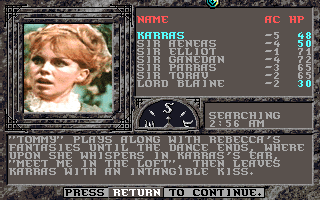
The next adventure I checked out was "Ghost of Greyhawk Manor," by Mike Whyte, apparently created as part of a 1993 Halloween contest on America Online. The plot is that the PC (whichever party member was selected when you hit "Begin Game") is on the trail of a malevolent entity named Malhavok. Years ago, Malhavok tortured and slaughtered the PC's family and burned his village. The PC has traced Malhavok, through similarly destroyed cities and scenes of slaughter, to the town of Greyhawk.
    
Right now. This is the first time I'm hearing that name.
    
I decided to do something different and make the main character a cleric surrounded by five paladins. The game starts everyone at a relatively-high Level 9, to include cleric spells through Level 5 and +2 equipment. I envisioned the cleric, Karras, not as a kind, healing cleric, but rather a wrathful, vengeful one. I decided to see how long I could stay alive while giving all offensive spells to the cleric and relying on the paladins' "Lay on Hands" abilities for healing.
   
As the party enters Greyhawk, they witness an altercation between a local lord, Blaine, and a messenger from the duke, who is upset about Blaine's dalliance with the duke's daughter. In the inn, the party hears about the history of Lord Blaine's family. Fifty years ago, the viscount's daughter went insane and murdered her family, then killed herself. Her spirit still haunts the old manor, protecting a hidden vault of riches that succeeding generations have occasionally tried to find, most of them getting slaughtered by the vengeful spirit. Blaine himself barely made it out alive when he went for the treasure.
        
The party gets the main quest from "Duke Skynyrd."
    
The relationship between this haunting and Malhavok is unclear, but when the party meets the duke (amusingly named Skynyrd), he tells them that Malhavok is at the old estate, looking for the one weapon that can kill him: the sword Blackrazor. Lord Blaine (a Level 7 chaotic good human fighter) and one of his companions, Usurp Toe (a Level 10 lawful evil human fighter) join the party on the way out of town. We're soon attacked by a pack of wolves (I immediately start regretting my lack of "Fireball"), which causes Usurp Toe to run off after our victory.
   
The core of the game takes place in the enormous Greyhawk Manor. The author did a great job making the manor seem like a real place with evocative descriptions of rooms and encounters.
 
As you know, I'm a big fan of "flavor text."
       
He also took the time to create original art for the game, or at least digitize it from photographs.
     
They both look familiar, but I can't quite place them. Are they from Doctor Who?
       
However, it soon became clear that this is not a module in which you want to screw around with unconventional party composition. First, the module calls upon the skills of thieves and magicians; there are locks that need to be picked and doors that need to be "Knocked." Second, enemies are hard. The largely-undead bestiary resists most of the cleric's offensive spells (most of which are fairly useless even against normal enemies; does anyone really ever cast "Cause Blindness" in a Gold Box game?) and attempts to turn them. Many of them drain levels. And you can't easily ride back to town for a quick "Restoration" because the game likes to throw enormous wolf packs at you when you do.
      
We just wanted to get a drink and identify some equipment.
        
Thus, my mind turned to bringing my victorious "Restoration of Gundahab" party into the module. First, I needed something to get them from Level 6 to roughly Level 9. I sorted the list randomly and looked for the first 1993 module with a starting level of between 4 and 8. The first one was "Travelers and Thieves" from May 1993 by a "Turbo007." It creates characters with 40,000 experience points, which was about the average for my party.
   
The adventure does not have a description in the Rose Dragon database, nor does it have a title screen. The opening screen begins: "After your graduation, a group of your friends decides to take a trip to England to sight-see." The visit includes a tour of the ruins of "old town Cambder . . . the birthplace of the youngest king ever to rule England." (The youngest king ever to rule England was Henry VI, born at Windsor Castle in Berkshire. Things are not starting well.) The game uses the "tour" feature to escort us through the ruins, as the tour guide explains that a current archaeological project is underway at the location to "discover the secrets of time travel." The guide leaves the party alone to explore. The air becomes thick. Someone screams for help in the distance. Then . . . nothing. I walked on every square, tested every wall, tried sleeping, etc. Nothing seems to move the story forward. If I go back to the starting square, it just repeats the tour. I looked up a review of the adventure in the Unlimited Adventures newsletter from 2010, and it mentioned the problem but says that the reviewer "got around it." It does not say how. Meanwhile, however, it sounds like the module isn't great: "Nothing made sense."
     
The automap doesn't even show an exit.
      
I went back to the drawing board and selected the next game to match my criteria: "Volcano" from May 1993 by a "Dave C." Unfortunately, the database was wrong: Instead of the Level 5-6 adventure it promised, the adventure starts new characters at 140,000 experience points, or about Level 13 for a fighter.
   
Next up: "Shadow of Moloch" from July 1993 by "Skarsol." It begins on an outdoor map of a pleasant countryside called Lanethorn. We enter a peaceful village where the friendly people smile at us. It's all very suspicious.
    
The game begins on an outdoor map.
        
"Something nags at you," the game says as we leave the town. Before long, we're stopped by a group of armed men who demand to know our business. The leader pretends there's some trouble on the road ahead and suggests we spend the night in his camp. When we refuse, he attacks. The ensuing battle against a bunch of "Bestea knights" and "cult knights" leaves three of us unconscious.
     
I've played enough RPGs to know this won't end well.
      
More guards appear in a mountain pass, where we bluff our way through, then barely survive attacks by ice wolves and cult assassins. On the other side of the mountains is a menu town where the shop sells +2 equipment. 
  
I continue on to a castle on a promontory. A dark, severe-looking man greets me and says that all the priests are "engaged in a prayer convocation" hoping to "bring peace to this troubled land." We can't do anything here. Instead, we enter the village at the base of the castle. It is a full 16 x 8 map with an inn, a shop, a training hall, a tavern, and a temple. But something is clearly wrong. The residents are all fighting with each other. The schoolhouse is empty of children. We're attacked repeatedly by assassins in the street. And when we ask one resident about entering the castle, he returns with a squad of soldiers and tries to kill us.
     
The game has the first use of dialogue options that I've seen with the kit.
       
The problem: there's no way to exit the village. The entry square has no exit, and I've tried every other square and wall. I made some good experience fighting the assassins, and most of my characters leveled up twice, but if I'm going to continue with this module, I'll have to export the characters and start over. It's too bad, because I found this one promising.
      
A typical battle against cult assassins.
     
Thus, a bunch of false starts. I bear neither the kit nor the creators any ill will. They were amateurs attempting a new tool in its first few months of existence. What I'll do when I play the next one is choose one with the best ratings or something. But for now, I'm going to wrap up my current coverage of Unlimited Adventures and give it a rest for at least a few weeks while I make progress on some other games.
     
There is no good way to rate a kit. My usual practice to date has been to rate each game independently if the kit results in a standalone program and to rate them collectively (or based on the demo program) if the player must have the original kit to run the adventure. Obviously, a kit is only as good as the adventures made for it. Since Unlimited Adventures theoretically can accomplish the best of everything previously accomplished with the Gold Box games, a theoretical GIMLET score for it would add up the top score for each category across the series of Gold Box titles. That would be a 68, incidentally, but the highest I ever rated for "economy" was 4, and I think it's possible to create a game with a better one, so let's call it a 70. That means that I think Unlimited Adventures is probably capable of creating a game that rates higher, if only by one point, than any other game I've ever rated. It would tell a story and have encounter and side quest options as interesting as Pool of Radiance or Curse of the Azure Bonds, offer the depth of character classes and character-based role-playing as Champions of Krynn, keep the magic and combat system of any of the titles, and outdo all of them for the economy. Not much could be done about graphics, sound, or interface, which would keep even a perfect Gold Box game from pushing much higher than 70.
    
This is all most Gold Box games needed to immediately gain 3 GIMLET points.
        
But I don't think it's fair to the other games on my list to rate a kit by its hypothetical best product, so I'll give it a rating instead based on "The Heirs to Skull Crag," if for no other purpose than to keep the game from showing up in my list with a row of blank cells:
      
  • 5 points for the game world. I like the small, localized nature of the story. It has a fair amount of lore, but I think the developers could have done a better job setting up the reveal of the final villains. 
  • 6 points for character creation and development. It has all the strengths and weaknesses of the Gold Box engine and the first-edition AD&D system. We're so used to games that offer multiple races, classes, alignments, and meaningful leveling that we sometimes forget what a rarity it was in the early 1990s. 
  • 5 points for NPC Interaction. As with most Gold Box games, this is a weird combination of the people you can actually speak to (who are more "encounters" than "NPCs") and those that join the party. The dialogues, alas, offer little opportunity for choice or role-playing.
  • 6 points for encounters and foes. In terms of description, varieties, and tactics, any game based on D&D was doing monsters better than just about any other game during this period—and most of the exceptions were cribbing from D&D. Between different sorts of physical attacks, spells, effects like poison and paralysis, breaths, and resistances, the player is always having to adjust the strategy. While there are a lot of contextual encounters in the game—both combat and non-combat—there aren't many choices, and very little role-playing. 
     
The Gold Box series doesn't get enough credit for doing this in every module.
       
  • 7 points for magic and combat. I still think the Gold Box engine is one of the best ever designed for tactical combat. This module highlights its strengths superbly, and in general the authors deserve a lot of credit for programming so many spell effects. Most of the weaknesses are weaknesses of the system.
  • 5 points for equipment. You have a lot of equipment slots, plus usable items like potions. I always appreciate how easy it is in a D&D game (Baldur's Gate 3 a notable exception) to compare items. I wouldn't mind some item descriptions and greater randomization, and of course we're a long way off from crafting.
  • 2 points for the economy. It exists. You need money for training and item identification, and there are some magic items to buy. Like with most Gold Box games, which try too hard to stick to D&D rules about wealth and experience, the game is overly generous. The kit is capable of better, though.
  • 4 points for quests. There's a main quest and some side quests and side areas, but few opportunities for choices or role-playing.
  • 5 points for graphics, sound, and interface. We've talked about how, in a weird way, most of the graphics in Gold Box games are symbolic rather than literal, but I still can't bring myself to give it nothing at all. Sound effects, particularly combat sound effects, are sparse but decent. Where the engine really shines is in its controls, which simultaneously allow for intuitive mouse, keyboard, and joystick inputs.
  • 5 points for gameplay. The challenge level is perfect. The length is good, but a little short for everything possible with the engine and characters. There's inherent replayability in any system with so many character choices, but I don't think the plot is replayable. It's fairly linear but does give the player a few choices.
   
That gives us a final score of 50, which puts it right around the quality of the Savage Frontier titles. I agree with this. I think "The Restoration of Gundahab" would rank about the same, the better economy balanced by a slightly more linear and shorter plot.
    
In a November 1993 Computer Gaming World review, Rudy Craft didn't think much of the Gold Box ("sorely lacking"; "far removed . . . from the cutting edge of computer gaming technology"), but he still thought that the program was "the best adventure construction kit available." He points out that, "Origin has not yet released an Ultima Underworld adventure construction kit, nor are they likely to." Apparently, the original release of Unlimited Adventures shipped with bugs and without some crucial documentation, but both problems had been fixed at the time of the review.
 
(As an aside, Craft's description of the game begins with this sentence: "Unlimited Adventures allows the player to design and/or plan an essentially unlimited number of adventures." I have no previous experience with Mr. Craft, but I have to wonder if he's one of the writers who would later insist that "a role-playing game is a game in which you play a role.")
   
The kit sold just over 32,000 copies in its initial run, respectable for a product that was essentially just a repackaging of tools that already existed. I don't imagine expectations were very high; judging by contemporary accounts, SSI was pinning most of its RPG hopes on the subsequent release of Dark Sun: Shattered Lands. I'm not sure why, but the release of the kit marked the end of MicroMagic and was the last commercial release for most of its staff, including founder and lead designer Jason T. Linhart (I attempted to get in touch with Linhart to no avail).
     
My module list grows.
       
The kit accomplished its mission and lived up to its name. A creator/user community popped up immediately and continues to this day. As recent comments pointed out, Unlimited Adventures came out just before the widespread availability of the Internet. Accordingly, the manual simply envisioned players trading modules on floppy disks. But early adopters of the new paradigm took to cyberspace, where they organized an AOL Forum (1993-2001) and shared information on various Usenet groups. Developers and fans uploaded files to university web sites and FTP servers. A Yahoo group ran from 1999 to the late 2010s (Yahoo shut down all groups in 2019). The first web sites were online by 2000, cataloguing the best adventures in perpetuity.
       
The site I've been using lists 648 modules for the PC and 148 for the Macintosh, including around a dozen created in the last two years. Creators soon figured out how to "hack" the kit so that they could include character classes, races, environments, enemies, and equipment in worlds well beyond the Forgotten Realms, including most of the D&D campaign settings, Doom, Star Trek, Star Wars, Middle Earth, Arthurian Britain, and many others.
    
I look forward to sampling some of these as I continue my adventure through time. I obviously can't let myself get too distracted, but I can see inserting an Unlimited Adventure into the occasional streak of 30-point games just so I'll have something to look forward to. I'm taking the kit off my current list, but in no way are we done with it.