
 |
| Hey, EA: the only things I must do are pay taxes and die. |
Sentinel Worlds I: Future Magic
Electronic Arts (1988)
Date Started: 3 July 2011
Date Ended: 15 May 2012
Total Hours: 22
Final Rating: 36
Difficulty: Moderate
Look, I respect all of you and I really value your presence on my blog. Your opinions, views, philosophies, suggestions, and tactics have greatly enhanced my experience playing these games. I hope you all stick around forever. So I hope you don't take it personally when I say that Sentinel Worlds was the dumbest @#$%ing game.
I sensed it the first time I played, and indeed I said something in the first paragraph of my first posting. It has a dumb plot, a dumb interface, a dumb approach to combat, dumb dialogue, dumb exposition, and a final "battle" so dumb it beggars description.
I grant you that on the stupidity scale, Ultima II still beats Sentinel Worlds. But Sentinel Worlds has far less of an excuse: It came six years later, and it had great examples, like Starflight--which Electronic Arts freaking made!--to use for inspiration.
Let's break it down and see if we can figure out why it's so bad, but I feel like Sentinel Worlds might be a rare game that's actually worse than the sum of its parts.
1. Game World. I do give it some credit here. There aren't many science fiction CRPGs, and this one starts with a reasonably good backstory as your crew comes out of cryogenic sleep, far from Earth, to deal with mysterious raiders attacking shipping lanes. You have a clear mission and a mystery to unravel. But the story that is revealed during the course of the game is nonsensical and poorly written. The Sentinels, the spell book, the Key of Thor, the aliens, and Malcolm Trandle seem like plot points tossed in randomly, and none of their stories are fleshed out enough--which is particularly unforgivable, since the game manifestly had a way to offer exposition through the paragraphs book. The world is also quite small, featuring only three planets. Score: 5.
 |
| The world was disappointingly small after Starflight's entire galaxy of planets. |
2. Character Creation and Development. Flawed, but not bad. You allocate points to your attributes during the creation process. There are 20 levels in the game, and only the most serious grinders would make it through all of them. Leveling comes at a good pace, and for the first 10 or 12 levels, it brings solid rewards as you allocate skill points. It collapses towards the end when you run out of useful skills to give points to; the cap of 7 for each skill seems arbitrary. Attributes play a solid role in the game: my medic ended up with the most experience because I gave him 20 dexterity, which allowed him to reload nearly instantaneously. Only charisma seemed to be a useless statistic. The combat skills were vital, but there were a host of other skills of dubious use, including ATV repair, bribery (I only found two characters to bribe in the game), and observation (never figured out what it did). Score: 4.
3. NPC Interaction. This could have been a lot better than it was. At first glance, it seems to anticipate the detailed dialogue screens that Bioware made famous starting in Baldur's Gate, except using the paragraphs book for longer bits of dialogue and exposition. In practice, it didn't work out that way. Each NPC has extremely limited dialogue, and they have an annoying way of cutting you off in the middle of your conversation, requiring you to wander around until enough time has passed that they'll talk to you again. There are no real "choices" in the dialogue, just topics. Finally, there are only about a dozen key NPCs in the game. The game could have been better with a lot more NPCs offering bits of lore and context, perhaps fleshing out the ridiculous Sentinel/Key storyline in more detail. As it is, I'd call it a missed opportunity--although still better than the one-liners offered in many CRPGs of the era. Score: 5.
4. Encounters and Foes. Here are where things begin to go downhill. There are two moments in the game where you have to cripple a raider vessel and board it, the first time to interrogate a raider and the second time to mind-probe him to find out the location of his secret base. These moments were a comparative joy, because they offered the only chance to do something interesting. The entire rest of the game was SPACE to target, ENTER to attack, no matter what the enemy. The monsters were interchangeable dots, some shooting and some attacking with melee weapons, but hardly even worth looking in the lower-right corner to see their names. There are no scripted encounters and no role-playing in the game. My bullet points in this category include "areas respawn at some point after they are cleared." Well, enemies do respawn in this game, constantly, but since areas are never "cleared" it doesn't quite match what I had in mind. Score: 3.
 |
| By the end, I was just channeling skill points into random skills. |
3. NPC Interaction. This could have been a lot better than it was. At first glance, it seems to anticipate the detailed dialogue screens that Bioware made famous starting in Baldur's Gate, except using the paragraphs book for longer bits of dialogue and exposition. In practice, it didn't work out that way. Each NPC has extremely limited dialogue, and they have an annoying way of cutting you off in the middle of your conversation, requiring you to wander around until enough time has passed that they'll talk to you again. There are no real "choices" in the dialogue, just topics. Finally, there are only about a dozen key NPCs in the game. The game could have been better with a lot more NPCs offering bits of lore and context, perhaps fleshing out the ridiculous Sentinel/Key storyline in more detail. As it is, I'd call it a missed opportunity--although still better than the one-liners offered in many CRPGs of the era. Score: 5.
 |
| No. I returned the book to the sentinels. |
4. Encounters and Foes. Here are where things begin to go downhill. There are two moments in the game where you have to cripple a raider vessel and board it, the first time to interrogate a raider and the second time to mind-probe him to find out the location of his secret base. These moments were a comparative joy, because they offered the only chance to do something interesting. The entire rest of the game was SPACE to target, ENTER to attack, no matter what the enemy. The monsters were interchangeable dots, some shooting and some attacking with melee weapons, but hardly even worth looking in the lower-right corner to see their names. There are no scripted encounters and no role-playing in the game. My bullet points in this category include "areas respawn at some point after they are cleared." Well, enemies do respawn in this game, constantly, but since areas are never "cleared" it doesn't quite match what I had in mind. Score: 3.
 |
| If I don't move, little red dots will keep coming down the corridor indefinitely. |
5. Magic and Combat. The game lives up to its name by offering "magic" of a sort, as late in the game your characters get the ability to use their "light" to cast a variety of spells, along with a reserve of "energy." I only used this ability once, to solve the mind-probing quest. The key problem is that in the time it would take to open up the spell list and choose one, your targeted enemy has inevitably been gunned down by one of your other party members.
Even the toughest enemies in this game don't last more than a few hits. With one exception, they're only really dangerous in volume. The times I died, it was because enemies overwhelmed me before my medic could keep up, and I'm not sure the spells would have helped.
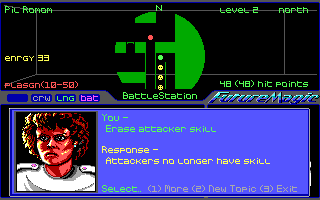 |
| This was a nice idea, but as far as I could tell, it did nothing. |
Neither ship combat or melee combat are tactical in this game. For the most part, the computer does the fighting for you as soon as you see enemies, and the control you have over a single character in melee combat is annoying rather than meaningful. I suppose there are some tactics in how you position yourself in various rooms and hallways, but it's the dullest sort of tactic, and difficult to implement because you don't really know when a new pack of enemies is suddenly going to respawn from behind or to the side of you. All in all, combat in this game was a real chore.
But worse than the slog of regular combat were the couple of times that the game decided to do something original. After slaughtering thousands of interchangeable mooks in the raider base, I'm suddenly faced with a unconquerable former NPC at the end of a corridor, forcing me to result to save-scumming to defeat her. And there is absolutely no excuse for the idiocy of the final "battle" against Malcolm. Score: 3.
6. Equipment. Very basic. The game offers weapons of five types: contact (bludgeoning), edged, projectile, and blaster. Each takes its own kind of ammunition, and you have to watch your ammo stores carefully lest you run out. Early on, it's best to channel each character's skills into one of the weapon types and specialize. You don't find blasters until late in the game, but almost every new map otherwise brings an equipment upgrade, so that wasn't so bad.
There are seven different types of armor. For both weapons and armor, the game makes it clear in the manual which does the most damage and which offers the best protection. You also find a host of other miscellaneous objects for which there seems to be no purpose but to sell them. Since they were the best way to make money late in the game, though, I didn't complain. None of the items are very well-described, there are no special items or "useable" items. Score: 3.
 |
| Those $900 crysprisms really set me back towards the end. I probably should have stuck with projectile weapons. |
7. Economy. This is probably the category that I liked best in the game. You know from my previous postings that I like a) different ways to make money, and b) plenty of things to spend it on. One of my biggest pet peeves is getting to the end of a game and having millions of gold pieces (or dollars) unspent. Sentinel Worlds works well on both of these major criteria. You can make money by running science foundation missions, mining minerals, killing raider ships, and raiding storerooms and armories. You spend it on equipment and ammunition (ammunition for blasters is particularly expensive), ship repairs, and attribute boosts in the Towers of Caldorre. You can only raise your attributes a certain number of times, and you can only carry 8 units of ammunition at a time, so it's theoretically possible that you could run out of reasons to make more money, but I never came anywhere near this point. Score: 7.
8. Quests. The main quest presents a paradox. I praise it for offering something different than "kill the evil wizard" and yet I condemn it for offering something worse. The galling thing is that the elements are there for a fairly decent plot. I enjoyed it at the beginning. You've arrived in a distant system with a mission to track down the source of some mysterious, violent raids. Early on, you're taken about the yacht of the region's trade magnate, who offers some advice. The game then takes a turn towards the mystical by introducing the god-like Sentinels and one of their renegade brethren. This is not a quest that, on the surface, sounds bad, and yet the game manages to bollix it up at every point with horrible writing, weird names and allusions, and inexplicable plot developments. To name a few:
Now, if some of these things were supposed to be mysteries, that's fine. Nothing wrong with a little mystery to create a sense of wonder. But it doesn't feel like they're mysteries; it just feels like bad plotting. There's a serious lesson to be learned in analyzing this game.
Aside from that, the main quest has only one outcome, there are no role-playing opportunities, and there are no side-quests. Score: 2.
9. Graphics, Sound, and Interface. The graphics were more than tolerable. The sound didn't impress me. Lots of things that felt like they should have sound (e.g., going into hyperspace) didn't, and lots of the things that did have sound (e.g., running the ATV) got on my nerves. I should note that each class of weapon makes a different sound, which did help combat a bit because I could tell what I was getting attacked by. It wasn't high-quality sound, but very little in the era is.
I felt the interface was pretty awful, though. The main game screen is far too small, making both ship and melee combat difficult, as either you or your enemy has a good chance of leaving the screen. The character screens were unnaturally cumbersome when it came to viewing and swapping gear. Here's a tip for developers: use a letter like (T)rade to trade equipment rather than a random number like 3. The hybrid top-down/first-person interface in dungeons made me seasick. Score: 3.
10. Gameplay. The game starts off feeling non-linear as you try to find the threads of the main quest, but it turns linear very quickly. As I covered recently, much of the second half of the game consists of extremely tiresome slogs through enormous dungeons, with enemies constantly respawning around you. Even worse, you have to visit the same huge dungeon--the raider base--twice, navigating your way both in and out. I really wanted to strangle the developers during this section. I can't see any reason to replay the game because there would be no variance in plot or order of events. The only things I can really give it credit for are 1) it doesn't take too long, and 2) there are (rare) parts that offer a satisfying challenge. Score: 3.
 |
| Until the end, I took an odd pleasure in mining, even though it was the least lucrative of the money-making options. |
8. Quests. The main quest presents a paradox. I praise it for offering something different than "kill the evil wizard" and yet I condemn it for offering something worse. The galling thing is that the elements are there for a fairly decent plot. I enjoyed it at the beginning. You've arrived in a distant system with a mission to track down the source of some mysterious, violent raids. Early on, you're taken about the yacht of the region's trade magnate, who offers some advice. The game then takes a turn towards the mystical by introducing the god-like Sentinels and one of their renegade brethren. This is not a quest that, on the surface, sounds bad, and yet the game manages to bollix it up at every point with horrible writing, weird names and allusions, and inexplicable plot developments. To name a few:
- What was going on with that Shadar guy? Was he just supposed to be a typical sub-boss? If so, why give him this weird back story about really being named Paul? Why did that other NPC have to be his brother?
- About midway through the game, my crew suddenly encounters aliens. Did we know there were aliens? The manual doesn't say anything about them. Shouldn't that be a huge discovery for mankind?
- Why does Taylor, the NPC from Norjaenn, show up in the raider base trying to kill me? And why is she the toughest foe in the entire game?
- Why is the Key of Thor called that? What is it, really? Why is it even necessary to the plot?
- Why does the spell book talk?
- What are the Sentinels and Malcolm even doing out here?
- What is Malcolm's relationship to the Towers of Caldorre? Are the services there really just illusions? Is the dexterity I gained in the tennis club also an illusion?
- What were the aliens digging for on Caldorre? How did that relate to Malcolm?
- What is Malcolm's issue with Grager? Was the whole probably-an-enemy-of-Grager thing just supposed to be a red herring?
- Should we read anything into the leader of the Sentinels looking like a Native American?
- Why is the Sentinels' place being guarded by aliens?
- How does a godlike alien being come by the name "Malcolm"?
Now, if some of these things were supposed to be mysteries, that's fine. Nothing wrong with a little mystery to create a sense of wonder. But it doesn't feel like they're mysteries; it just feels like bad plotting. There's a serious lesson to be learned in analyzing this game.
Aside from that, the main quest has only one outcome, there are no role-playing opportunities, and there are no side-quests. Score: 2.
9. Graphics, Sound, and Interface. The graphics were more than tolerable. The sound didn't impress me. Lots of things that felt like they should have sound (e.g., going into hyperspace) didn't, and lots of the things that did have sound (e.g., running the ATV) got on my nerves. I should note that each class of weapon makes a different sound, which did help combat a bit because I could tell what I was getting attacked by. It wasn't high-quality sound, but very little in the era is.
 |
| If you don't pay attention to what he's saying, the graphics aren't too bad. |
I felt the interface was pretty awful, though. The main game screen is far too small, making both ship and melee combat difficult, as either you or your enemy has a good chance of leaving the screen. The character screens were unnaturally cumbersome when it came to viewing and swapping gear. Here's a tip for developers: use a letter like (T)rade to trade equipment rather than a random number like 3. The hybrid top-down/first-person interface in dungeons made me seasick. Score: 3.
10. Gameplay. The game starts off feeling non-linear as you try to find the threads of the main quest, but it turns linear very quickly. As I covered recently, much of the second half of the game consists of extremely tiresome slogs through enormous dungeons, with enemies constantly respawning around you. Even worse, you have to visit the same huge dungeon--the raider base--twice, navigating your way both in and out. I really wanted to strangle the developers during this section. I can't see any reason to replay the game because there would be no variance in plot or order of events. The only things I can really give it credit for are 1) it doesn't take too long, and 2) there are (rare) parts that offer a satisfying challenge. Score: 3.
The sum of the individual scores is 38, but we have to talk about some adjustments before we go. First, we're going to deduct a point for the final "battle." That and BattleTech vie for the stupidest endgames I've ever experienced, and I docked BattleTech a point for it, so it would only be fair to do it here. Second, there's the writing. I've rarely encountered such distractingly bad writing in a game. It couldn't have been any worse if Malcolm Trandle had sent a message to the federation that "all your base are belong to us."
Let's take a look at the paragraph in which the Key of Thor offers his exposition on Malcolm and his plots:
At the mention of Malcolm's name, the light from the Key seems to dim, and his response is almost a whisper: "He used to be a Sentinel. No, more than that: he was one of the greatest of them. He led them across the universe, finding and nurturing beings of light on a thousand different worlds. I was one of those beings."
The Key takes a long pause before continuing. "The light within him was once so brilliant that he could have lit up the galaxy. I never knew what happened to him. None of us did. Perhaps power corrupts, or perhaps it is the destiny of every being, given enough aeons, to stray from its path. All I know is that when the Sentinels came to a planet called Earth, Malcolm began to change. Instead of nurturing the people of Earth, he commanded them. Instead of gathering them for meditation and reflection, he gathered them as an army. Before long, he stormed the temple of the Sentinels, stole me, stole the sacred book of magic, and fled to this forsaken corner of the universe, leaving ruin behind him."
Now, if you're thinking that this doesn't sound too bad, thanks! I re-wrote it. Here's what the book actually says:
Why, he is one in whom the light shines with a fierce dark intensity that I have never before seen. He is called Malcolm Trandle and he was once a Sentinel. Surely you must not judge the Sentinels harshly by comparing them to Malcolm, for he left their ways for the ways of evil. The Sentinels are the keepers of the light. They find those in whom the Light shines brightly and they nurture it. Why, they found me many, many aeons ago, on a far distant world where all have my appearance, but where I was the only one in whom the light shone brightly. There was another in whom it shine darkly and he they destroyed.
In Malcolm Trandle the light once shone brightly. Once it shone with a radiance that would illuminate a galaxy. But when the Sentinels took up residence on a planet called Earth by its people. Malcolm began to change. A darkness crept into him and he began to treat the poor primitives who lived on that world as cattle and playthings. Before any of the other Sentinels knew what had transpired, Malcolm had gathered a small army of these pitiful savages and decided that he should be the ruler of the Sentinels. He stole me from the dwelling of Kedro, and he stole the book of spells as well. You see, although the light shines brightly in me, I wield it but slightly. Those around me, however, can wield it far beyond their normal capacity. Malcolm feared Kedro as long as Kedro had me with him. And Malcolm feared the book even more. Ahh, how he feared the book! So he stole us and brought us to this light forsaken corner of the cosmos.
Do I have to explain why this paragraph is horrible? It jumps all over the place. The Key sounds like Rain Main. We have the bit about light shining with a "dark intensity." Oh, and I'm not sure I appreciate the Key's patronizing tone. If the "poor primitives" called the planet "Earth," they must have lived fairly close to the modern era, and yet the Key calls them "pitiful savages." The Key also needs to learn proper comma and hyphen usage and to standardize his capitalization of "light." Now, it might be forgivable if all of these things were just characterizations of the Key, but all of the language in the game is like this. Couldn't EA have just contracted an English major?
In any event, I'm lowering the final score of the game to 36 based on these two factors.
I forgive you if you think I've been a little hard on the game. It does have its charm, as a rare science-fiction CRPG and one that at least attempts something original. One of my frequent commenters, Amy Lunitari, liked it enough to make an astonishing 53-video "let's play" of the game, and I had fun (in some cases, morbid fun) watching some of the videos after I won. She spends a huge chunk of them going through the raider base, and my understanding is that she only recorded them after she had already been through once.
My favorite moment comes at 05:38 in Part 39, when she's wandering down a corridor. There's a red dot just ahead, but she must figure it's one of the standard goons she's been killing for hours. Suddenly, Taylor blasts her lead character to ribbons. You can actually picture Amy sitting there stunned as she says, "What?...Whoa...That's insane." She then spends the rest of the video and much of the next one simply trying to get past Taylor. Watching it is a riot to me because we had the exact same reactions, and we tried the exact same things to get past Taylor before settling upon the exact same solution. Amy's characters are much higher levels than mine, though (how did you get their hit points so high?!), which means I think I had a lot more reloads.
The next game--Star Command--ought to offer an interesting contrast to Sentinel Worlds. Let's get to it.


