

Worlds of Ultima: The Savage Empire
Origin Systems (developer and publisher)
Released 1990 for DOS, 1992 for PC-98, 1993 for Sharp X68000
Date Started: 11 April 2015
I end mostly where I started, thinking that The Savage Empire is a perfectly serviceable little game that makes adequate use of a good game engine but would have been better if the creators hadn't tied it to the legend of the Avatar. Said legend is, of course, already hopelessly muddled, so when we get revelations in this game about the ancient Kotl race and the ability of a moonstone to somehow power an entire civilization, we don't even try to mentally work it into Ultima canon. We just shrug and keep playing.
I couldn't think of any other thematic issues to cover after the "won" posting, so let's get right into the GIMLET.
1. Game World. The Lost World-style setting of Eodon, the various tribes, and the revelations about the lizard-like past civilization are somewhat common fantasy and sci-fi tropes, but they're relatively original among RPGs. In this, the game deserves a lot of credit even if the execution was a little goofy at times. While Empire didn't always make the best use of the Ultima VI engine, it kept the open approach to the game world that the Ultima series has been rightly famous for. Empire arguably does a better job than any previous Ultimas in having the game world respond to the player's actions, with NPC dialogue changing substantially depending on various plot statuses. Score: 6.
2. Character Creation and Development. Probably the worst part of the game. In contrast to the multiple races and sexes offered by Ultima VI, the player has no choice but to play the Avatar as a Great White Hunter. Even worse, the backstory removes any sense of self-identification with the Avatar that previous Ultimas (IV in particular) took great pains to build up. A brief character creation process helps define starting attributes, but there's nothing else. Because the game starts you at Level 5, there is essentially no character development (barring a lot of grinding, which is unnecessary anyway) for either the Avatar or his NPC companions. There are no role-playing opportunities, no karma meter. The game barely qualifies as an RPG in this category. Score: 3.
3. NPC Interaction. Always strong in Origin titles, a little weaker here because so many NPCs say the same things. Basically, every tribe has a chief, a shaman, and one or two other key NPCs, and then about 6-10 interchangeable men and women with the same dialogue. Still, the quality of the dialogue is pretty good, and you learn almost everything of importance about the game world and quest through these discussions.
I like that you have so many party members to choose from--including a Neanderthal, a lizard man, and an automaton--and that they don't cease to be individuals just because they've joined the party; you can still talk with them. Some of them have unique skills, like Triolo's magic, Rafkin's ability to make certain items, and Jimmy's notebook.
Finally, the game gets points for offering the first player-optional romance in the game. (Other games have seen a romance between the PC and some NPC, but always part of the main plot, not something that the player can choose.) There's not much to it: you just say LOVE to Aiela or Tristia, which causes their dialogues to change, and you get a couple of endgame screens. Still, it's always nice to find a "first." Or am I forgetting an earlier game?
I could have done without the unresolved Shamuru/Dokray/Triolo mystery. Score: 7.
4. Encounters and Foes. Getting through the game involves solving a variety of item-based and navigation-based puzzles, none of them terribly hard, most with multiple solutions. While the selection of enemies (giant apes, dinosaurs, sabre-toothed tigers) is original and appropriate to the setting, I never got over the sense that fighting dinosaurs should have been a bigger deal. Like all Origin games, the manual does an excellent job describing each enemy. Score: 6.
5. Magic and Combat. The tribal magic system, with its collection of 9 spells, is thematically creative but tactically underwhelming--particularly since there's only one spellcaster. I didn't find combat particularly strong in Ultima VI, and it gets worse here with poor enemy and NPC AI and a general sense that combat is a minor part of the game. Score: 4.
6. Equipment. The sandbox nature of the game means that there's a ton of stuff lying around with no reason to take any of it, including jars, baskets, pots, tools, extra totems, rocks, sticks, and so forth. I don't mind this. It makes the world seem more real. The selection of armor and weapons is less interesting, particularly since the game doesn't tell you the relative damage of weapons or the relative protection of armor, and since combat isn't hard enough to bother with upgrades anyway. Towards the end of the game, I just equipped my new companions with whatever was most convenient, and they did fine. I didn't care for all the unused equipment slots.
A lot of the items are for solving puzzles, and many of these work together in creative ways. Tar can be collected in a bucket, then applied to strips of cloth (themselves made by putting scissors to whole cloth) to make "tarred cloth," which can then be wrapped around branches (pulled from trees) to make torches or used as a fuse in a bomb. Dropping a tree branch onto an open fire makes charcoal, which can be combined with phosphorous (scraped from crystals) and sulfur (screened from sulfur pits) to make gunpowder. Using a knife on a slain mammal gives you a pelt and some meat. There are a lot of these types of interactions, and they'd be a lot more fun if they were more helpful. Score: 5.
7. Economy. There are plenty of valuables to find in the game, but only a couple of places to spend them, and essentially no reason to spend them in those places, since everything you need can be picked up for free. A very under-developed part of the game. You could argue that it's not necessary for The Savage Empire, but I still like my RPGs to have an economy. Score: 1.
8. Quests. Empire has a multi-staged main quest. It's interesting, but it doesn't offer choices, alternate outcomes, or really anything that qualifies as a "side quest." I did think that the "uniting the tribes" plot was a bit fun, particularly since (just like the map-piece-finding quest in Ultima VI) it offered such a variety of difficulties and lengths to the individual tasks. Score: 4.
9. Graphics, Sound, and Interface. The graphics are well-drawn, but from my colorblind perspective, the palette used by Empire was awful. I couldn't discern a lot of objects, NPCs, and enemies against their backgrounds. The day/night cycle was a constant annoyance. On the other hand, I liked the frequent use of full screen graphics at key parts of the story--there were more of these in Empire than any Ultima game I can recall. There were some fun sound effects but no way to separate sound from the incessant music, so I left it off. (The music, I should add, is good--creative and thematic--but I still didn't want to hear it all the time.)
The interface is generally excellent. Like any good game of this era, it offers the ability to move flexibly between keyboard and mouse, with major commands mapped to a single letter. The ability to designate an "active" character is essentially unique to this game and Ultima VI, and it's just what this type of RPG needs. One drawback to the interface: my characters kept getting stuck on things, and I didn't notice for a long time. This required a lot of effort to reunite the party. Score: 5.
10. Gameplay. Nice and non-linear. Even the major quest stages can be done slightly out of order (e.g., you could reunite most of the tribes before rescuing Aiela). The non-linearity and availability of different NPC companions makes it slightly replayable, though not very. The overall pacing is good--neither too long or too short--but like Ultima VI, it suffers a bit by being too easy. And despite using the same engine, it doesn't offer quite the same "screwing around" possibilities of its parent. Score: 5.
I don't often discuss a game's packaging and manual, even when they're good, but The Savage Empire deserves a couple extra bonus points for going the extra mile. The manual (may the MOCAGH never die) is presented as an adventure magazine written, in part, by the Avatar, Jimmy Malone, and Dr. Rafkin after their adventures in Eodon. It's full of clues hidden in sections like "Letters to the Editor" (one gives a hint about the importance of a fire extinguisher; another discusses bomb-making) and advertisements.
The manual also has one of the best and most obscure Easter eggs I've ever seen. In a (fictional) advertisement for an upcoming Savage Empire film, the cast is given as Richard Corlane, Bryan Swade, and Faith Selburn. You would have to be the most incredible film geek to know that these are the three (fictional) stars listed for a (fictional) Broadway musical called A Day in New York, featured in a single screen in the 1949 Gene Kelly/Frank Sinatra film On the Town.
All in all, fantastic work by Aaron Allston (credited for both the overall game story and the game manual) and worth an extra 2 bonus points for a final score of 48. That's considerably lower than the 68 I gave to Ultima VI, but still in the top 10% of 1990 games, and the third-highest rating I've given in the past year.

I started my series of posts on The Savage Empire praising Origin for re-using a great engine instead of discarding it after a single use. Thus, I was a little surprised and annoyed to find Dennis Owens complaining about the same thing in his March 1991 Computer Gaming World review. "Although once upon a time, Ultima stood for innovation and surprise," he grouses, "[they] seem to have devolved into copies of themselves--all requiring that worlds be explored...monsters be bashed, and objects be found." I mean, Jesus, Dennis--you could reduce all RPGs to such trite phrasing. Ultima hasn't lost its innovation just because the creators re-used one engine. Frankly, if they hadn't, we'd be waiting until Ultima VII for the next game. Would that have been better?
While he does have some positive things to say, his conclusion is mixed: "Compared to any except its own brothers and sisters, The Savage Empire...must be considered dazzling and successful. Compared to its peers, however, the game presents what may be a disturbing view of a possible trend in the Ultima line: caricature."
In her 1993 "survey" of RPGs on the market, Scorpia was a little more positive, concluding that it was "good for filling in the hours while you wait for the next real Ultima," with which I completely agree.
For the next Ultima game, I thought I'd have a choice between Martian Dreams and Ultima Underworld, but I was disappointed to see that Underworld is a 1992 game (really looking forward to that one), so Martian Dreams is definitely the next outing as the Avatar. I know people usually rate that one nigher than The Savage Empire, but the backstory seems a bit stupid to me. Maybe everything else will be better.
****
And that pretty much wraps up 1990! Technically, I still have Operation: Overkill to finish, but that's proving to be a boring slog, not unlike Dragon Sword but without the same ability to cheat. If I do finish it, it will probably be several weeks from now, after playing an hour here and an hour there in between other games. That means we'll be moving on to the 1990/1991 transition posting. I look forward to writing it.
Date Ended: 16 May 2015
Total Hours: 18
Reload Count: 8
Difficulty: Easy (2/5)
Final Rating: 48
Final Rating: 48
Ranking at Time of Posting: 163/185 (88%)
Ranking at Game #458: 420/458 (92%)
I end mostly where I started, thinking that The Savage Empire is a perfectly serviceable little game that makes adequate use of a good game engine but would have been better if the creators hadn't tied it to the legend of the Avatar. Said legend is, of course, already hopelessly muddled, so when we get revelations in this game about the ancient Kotl race and the ability of a moonstone to somehow power an entire civilization, we don't even try to mentally work it into Ultima canon. We just shrug and keep playing.
I couldn't think of any other thematic issues to cover after the "won" posting, so let's get right into the GIMLET.
1. Game World. The Lost World-style setting of Eodon, the various tribes, and the revelations about the lizard-like past civilization are somewhat common fantasy and sci-fi tropes, but they're relatively original among RPGs. In this, the game deserves a lot of credit even if the execution was a little goofy at times. While Empire didn't always make the best use of the Ultima VI engine, it kept the open approach to the game world that the Ultima series has been rightly famous for. Empire arguably does a better job than any previous Ultimas in having the game world respond to the player's actions, with NPC dialogue changing substantially depending on various plot statuses. Score: 6.
 |
| The Avatar prepares to start the endgame on the Hill of the Drum. |
2. Character Creation and Development. Probably the worst part of the game. In contrast to the multiple races and sexes offered by Ultima VI, the player has no choice but to play the Avatar as a Great White Hunter. Even worse, the backstory removes any sense of self-identification with the Avatar that previous Ultimas (IV in particular) took great pains to build up. A brief character creation process helps define starting attributes, but there's nothing else. Because the game starts you at Level 5, there is essentially no character development (barring a lot of grinding, which is unnecessary anyway) for either the Avatar or his NPC companions. There are no role-playing opportunities, no karma meter. The game barely qualifies as an RPG in this category. Score: 3.
 |
| Jimmy becomes the only character other than the Avatar to level up. |
3. NPC Interaction. Always strong in Origin titles, a little weaker here because so many NPCs say the same things. Basically, every tribe has a chief, a shaman, and one or two other key NPCs, and then about 6-10 interchangeable men and women with the same dialogue. Still, the quality of the dialogue is pretty good, and you learn almost everything of importance about the game world and quest through these discussions.
I like that you have so many party members to choose from--including a Neanderthal, a lizard man, and an automaton--and that they don't cease to be individuals just because they've joined the party; you can still talk with them. Some of them have unique skills, like Triolo's magic, Rafkin's ability to make certain items, and Jimmy's notebook.
Finally, the game gets points for offering the first player-optional romance in the game. (Other games have seen a romance between the PC and some NPC, but always part of the main plot, not something that the player can choose.) There's not much to it: you just say LOVE to Aiela or Tristia, which causes their dialogues to change, and you get a couple of endgame screens. Still, it's always nice to find a "first." Or am I forgetting an earlier game?
I could have done without the unresolved Shamuru/Dokray/Triolo mystery. Score: 7.
4. Encounters and Foes. Getting through the game involves solving a variety of item-based and navigation-based puzzles, none of them terribly hard, most with multiple solutions. While the selection of enemies (giant apes, dinosaurs, sabre-toothed tigers) is original and appropriate to the setting, I never got over the sense that fighting dinosaurs should have been a bigger deal. Like all Origin games, the manual does an excellent job describing each enemy. Score: 6.
 |
| Because of course we can't just walk through the waterfall and into the cave, Gideon prepares to block the river by blowing up the boulder next to it. Don't ask. |
5. Magic and Combat. The tribal magic system, with its collection of 9 spells, is thematically creative but tactically underwhelming--particularly since there's only one spellcaster. I didn't find combat particularly strong in Ultima VI, and it gets worse here with poor enemy and NPC AI and a general sense that combat is a minor part of the game. Score: 4.
6. Equipment. The sandbox nature of the game means that there's a ton of stuff lying around with no reason to take any of it, including jars, baskets, pots, tools, extra totems, rocks, sticks, and so forth. I don't mind this. It makes the world seem more real. The selection of armor and weapons is less interesting, particularly since the game doesn't tell you the relative damage of weapons or the relative protection of armor, and since combat isn't hard enough to bother with upgrades anyway. Towards the end of the game, I just equipped my new companions with whatever was most convenient, and they did fine. I didn't care for all the unused equipment slots.
A lot of the items are for solving puzzles, and many of these work together in creative ways. Tar can be collected in a bucket, then applied to strips of cloth (themselves made by putting scissors to whole cloth) to make "tarred cloth," which can then be wrapped around branches (pulled from trees) to make torches or used as a fuse in a bomb. Dropping a tree branch onto an open fire makes charcoal, which can be combined with phosphorous (scraped from crystals) and sulfur (screened from sulfur pits) to make gunpowder. Using a knife on a slain mammal gives you a pelt and some meat. There are a lot of these types of interactions, and they'd be a lot more fun if they were more helpful. Score: 5.
 |
| I think using a knife is the only way to do this. |
7. Economy. There are plenty of valuables to find in the game, but only a couple of places to spend them, and essentially no reason to spend them in those places, since everything you need can be picked up for free. A very under-developed part of the game. You could argue that it's not necessary for The Savage Empire, but I still like my RPGs to have an economy. Score: 1.
8. Quests. Empire has a multi-staged main quest. It's interesting, but it doesn't offer choices, alternate outcomes, or really anything that qualifies as a "side quest." I did think that the "uniting the tribes" plot was a bit fun, particularly since (just like the map-piece-finding quest in Ultima VI) it offered such a variety of difficulties and lengths to the individual tasks. Score: 4.
 |
| I forgot to show the lizard guys last time, so here they are. |
9. Graphics, Sound, and Interface. The graphics are well-drawn, but from my colorblind perspective, the palette used by Empire was awful. I couldn't discern a lot of objects, NPCs, and enemies against their backgrounds. The day/night cycle was a constant annoyance. On the other hand, I liked the frequent use of full screen graphics at key parts of the story--there were more of these in Empire than any Ultima game I can recall. There were some fun sound effects but no way to separate sound from the incessant music, so I left it off. (The music, I should add, is good--creative and thematic--but I still didn't want to hear it all the time.)
 |
| The giant Avatar prepares to trample a company of puny villagers. |
The interface is generally excellent. Like any good game of this era, it offers the ability to move flexibly between keyboard and mouse, with major commands mapped to a single letter. The ability to designate an "active" character is essentially unique to this game and Ultima VI, and it's just what this type of RPG needs. One drawback to the interface: my characters kept getting stuck on things, and I didn't notice for a long time. This required a lot of effort to reunite the party. Score: 5.
10. Gameplay. Nice and non-linear. Even the major quest stages can be done slightly out of order (e.g., you could reunite most of the tribes before rescuing Aiela). The non-linearity and availability of different NPC companions makes it slightly replayable, though not very. The overall pacing is good--neither too long or too short--but like Ultima VI, it suffers a bit by being too easy. And despite using the same engine, it doesn't offer quite the same "screwing around" possibilities of its parent. Score: 5.
I don't often discuss a game's packaging and manual, even when they're good, but The Savage Empire deserves a couple extra bonus points for going the extra mile. The manual (may the MOCAGH never die) is presented as an adventure magazine written, in part, by the Avatar, Jimmy Malone, and Dr. Rafkin after their adventures in Eodon. It's full of clues hidden in sections like "Letters to the Editor" (one gives a hint about the importance of a fire extinguisher; another discusses bomb-making) and advertisements.
 |
| The "pulp manual" is part story, part instruction, part description, and part fun. |
The manual also has one of the best and most obscure Easter eggs I've ever seen. In a (fictional) advertisement for an upcoming Savage Empire film, the cast is given as Richard Corlane, Bryan Swade, and Faith Selburn. You would have to be the most incredible film geek to know that these are the three (fictional) stars listed for a (fictional) Broadway musical called A Day in New York, featured in a single screen in the 1949 Gene Kelly/Frank Sinatra film On the Town.
All in all, fantastic work by Aaron Allston (credited for both the overall game story and the game manual) and worth an extra 2 bonus points for a final score of 48. That's considerably lower than the 68 I gave to Ultima VI, but still in the top 10% of 1990 games, and the third-highest rating I've given in the past year.
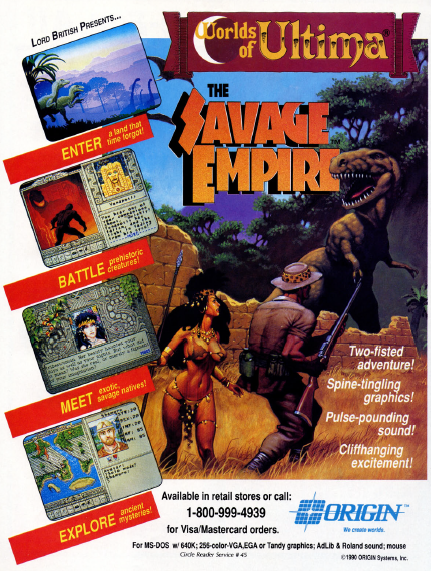
I started my series of posts on The Savage Empire praising Origin for re-using a great engine instead of discarding it after a single use. Thus, I was a little surprised and annoyed to find Dennis Owens complaining about the same thing in his March 1991 Computer Gaming World review. "Although once upon a time, Ultima stood for innovation and surprise," he grouses, "[they] seem to have devolved into copies of themselves--all requiring that worlds be explored...monsters be bashed, and objects be found." I mean, Jesus, Dennis--you could reduce all RPGs to such trite phrasing. Ultima hasn't lost its innovation just because the creators re-used one engine. Frankly, if they hadn't, we'd be waiting until Ultima VII for the next game. Would that have been better?
While he does have some positive things to say, his conclusion is mixed: "Compared to any except its own brothers and sisters, The Savage Empire...must be considered dazzling and successful. Compared to its peers, however, the game presents what may be a disturbing view of a possible trend in the Ultima line: caricature."
In her 1993 "survey" of RPGs on the market, Scorpia was a little more positive, concluding that it was "good for filling in the hours while you wait for the next real Ultima," with which I completely agree.
For the next Ultima game, I thought I'd have a choice between Martian Dreams and Ultima Underworld, but I was disappointed to see that Underworld is a 1992 game (really looking forward to that one), so Martian Dreams is definitely the next outing as the Avatar. I know people usually rate that one nigher than The Savage Empire, but the backstory seems a bit stupid to me. Maybe everything else will be better.
****
And that pretty much wraps up 1990! Technically, I still have Operation: Overkill to finish, but that's proving to be a boring slog, not unlike Dragon Sword but without the same ability to cheat. If I do finish it, it will probably be several weeks from now, after playing an hour here and an hour there in between other games. That means we'll be moving on to the 1990/1991 transition posting. I look forward to writing it.


