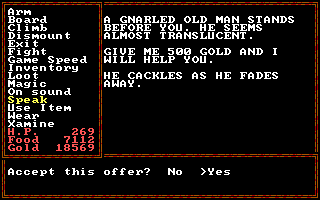
This game has the least effective copy protection of any game I've ever played. You can figure out the answers without even glancing at the manual. Another one said something like: "Which of these creatures lives in a dungeon?" with answers like "1. Cloud Soarer; 2. Wood Nymph; 3. Giant Shark; and 4. Deep Dweller."
Questron II
United StatesWestwood Associates (developer); Strategic Simulations, Inc. (publisher)
Released 1988 for Apple II, Apple II GS, Atari ST, Amiga, and DOS
Date Started: 12 June 2011Date Ended: 18 June 2011
Total Hours: 7
Difficulty: Easy (2.0/5)
Final Rating: 26
Ranking at Time of Posting: 17/59 (29%)
Ranking at Game #453: 233/453 (51%)
I honestly hadn't intended to play Questron II beyond my six hours, and then I found that six hours was almost enough to win (I said I was under six yesterday, but when I tallied it up, it actually came to seven).
Here's the GIMLET:
1. Game World. Well. Questron II gets some points for originality for sending me to another planet, even if that doesn't really make sense. The time-travel angle is also unusual, but again poorly implemented. The world itself is a collection of towns, castles, and terrain features no different from Britannia or Ymros. You do have a lengthy history and lore in the manual, they're just not all that interesting; "stop the evil wizard" had already become a cliche by 1988. And the looting castles and slaughtering guards bit bothers me. Didn't Ultima IV teach us anything? Score: 3.
2. Character Creation and Development. The only real option you have when creating your character is the name. Leveling occurs at fixed intervals and in response to progress on the quest, not slaying monsters or building experience. You have no choices when leveling. You can increase some of your stats in dungeons or by purchasing training in castles, but basically every player ends the game with the same character as every other player. Score: 2.
3. NPC Interaction. No games are really rocking us yet with NPC interaction, but Questron II still feels like a throwback to a few years prior, when NPCs gave a single line of exposition. It's even worse here because most wandering NPCs say something worthless ("Me not like you") as if they were straight out of Ultima II. You do get some plot points from barbers, innkeepers, and publicans, but not enough to really advance the plot--most of the stuff they tell you, you'd figure out anyway. There are no dialogue options, not even when dealing with the main quest NPCs. Score: 2.
 And if you're going to make a Treasure of the Sierra Madre reference, at least put it in some kind of context.
 And if you're going to make a Treasure of the Sierra Madre reference, at least put it in some kind of context.
4. Encounters and Foes. We just came across a game--Pool of Radiance--that advanced the concept of "encounters" light years, and in this game, we might as well still be playing Akalabeth. Despite descriptions in the manual and interesting names, the monsters are utterly unmemorable, and there are no episodes in which you have to make any kind of real decision. Usually I like games that offer random encounters and respawning, but only when there's some point to fighting, and there's no point to fighting in this game: you don't get any experience, and you get more gold from gambling and dungeon exploration. Score: 1.
 This kind of encounter wasn't even fun the very first time.
5. Magic and Combat. Combat consists of hitting "F" over and over, and the magic system offers exactly four spells. I'm seriously contemplating giving this game a 0, but the only game I've done that for is Braminar in which you literally make no decisions in combat. I guess that here, you at least have to pick the best out of four spells. Score: 1.
6. Equipment. We've seen lots of games with limited equipment, but this is the only game I've played in which your available equipment is tied to your character level, which makes no sense even on the surface. The best I can say is that at least you can tell, based on the price, when you're getting an upgrade. If I consider transportation as part of equipment, though, I have to give the game some points for the flying eagle. Score: 3.
 Keeganac's gear at the end. The game's best weapon, as far as I can tell, is the broadsword.
7. Economy. There are quite a lot of things to buy in the game--stat upgrades, healing herbs, weapons and armor, spells, hit points, food, transportation, information. And I like the gambling mini-games; there aren't many games that feature mini-games in this era. But the game unbalances itself with high returns on gambling, making it pointless to accumulate treasure through combat or dungeon exploration. Having tens of thousands of gold pieces likely made the end game much easier for me than the creators intended. Score: 5.
 Gambling is not supposed to absolve you from actually playing the game.
8. Quest. There is one relatively boring main quest but no "side quests." There is only one outcome to the main quest, and no opportunities for role-playing at all. Score: 2.
9. Graphics, Sound, and Inputs. I'm almost scared to rate anything in this category now. The graphics are a nice upgrade from Questron and Legacy of the Ancients, but the sound is still primitive and I mostly kept it off. The keyboard commands were mostly intuitive enough, but there's no excuse, in this era, for disallowing diagonal movement--especially when your enemies can both move and attack you on the diagonal. I'm going to give it an extra point for the automap, probably the game's only innovative feature. Score: 5.
10. Gameplay. Questron II is completely linear. You have to visit each dungeon and castle in a particular order. Towns are an exception, but the game's dozens of towns are essentially interchangeable. Although I admire its quick resolution (again, I think the creators intended more monster grinding and less gambling), the game is a bit too easy. (Among other things, resurrection is immediate and guaranteed upon death.) There would be absolutely no reason to replay it. Score: 2.
The final score of 26 almost seems too high. I think I might revisit my system soon to allow for a "discretionary" category where I can add and subtract points based on particularly well-done (or hated) features. It's time for an updated GIMLET review anyway; the one I keep linking to is from over a year ago and it talks about The Bard's Tale in the intro.
 Note: Nothing this ad says is actually true.
Earlier today, reader Macnol was kind enough to link to the issue of Computer Gaming World in which Questron II was reviewed. The review's last sentence (p. 50) sums up the game perfectly: "Bottom line: Not equal to the original; best for the beginner, not the experienced."
Next up: I couldn't find a working version of the 1988 edition of Rogue Clone (which, by all descriptions, was pretty much a clone of Rogue; who would have guessed?), so it's on to Scavengers of the Mutant World.