|
| Phantasie III sums up the game-playing experience. |
Phantasie III: The Wrath of Nikademus
United States
Strategic Simulations, Inc. (developer and publisher)
Released in 1987 for Apple II, Commodore 64, Atari ST, Amiga; 1988 for DOS, PC-88, PC-98, FM-7, and Sharp X1; 1989 for MSX and Sharp X68000
Date Started: 7 January 2011
Date Finished: 17 January 2011
Total Hours: 20
Difficulty: Moderate (3/5)
Final Rating: 39
Ranking at Time of Posting: 32/39 (82%)
Ranking at Game 453: 375/453 (83%)
I was curiously ambivalent while playing Phantasie III. I won it because I knew that I could. But with the game mechanics, spells, equipment, classes, graphics, gameplay...even the damned villain...identical to Phantasie, it never felt like I was playing anything new or exciting. It is at least a competent game, and not particularly painful, but I don't feel like I missed out on much by playing most of it in front of the TV.
The Phantasie series is the embodiment of the trope that TVTropes calls "Phantasy Spelling": pointlessly altering the normal spelling of words to seem ancient, exotic, or just pretentious. Fortunately, not all series do this or we'd have to contend with Phinal Phantasie. We've seen other examples of this in the blog, including Faery Tale Adventure and Dunjonquest, and we'll see it again with titles such as Wizard Warz, Vampyr: Talisman of Invocation, and Jinyong Qunxia Zhuan. Seriously, people: who are you trying to impress?
I have a lot more readers these days, so I want to make it clear that the GIMLET is supposed to be an objective measure of my own enjoyment of the game. It makes no allowances for the age of the game or the technology level of the times. Oblivion is meant to be compared on the same scale as Akalabeth. Thus, a score of 50 or so in this era would be pretty good, while a score of 75 in the 2000s might be considered quite poor. Before you complain that this isn't fair, keep in mind that my only requirements to get a good score on graphics and sound is that they "aren't painfully bad." A game from this era could have achieved a score in the 80s (though none have, so far) if it combined, say, Starflight's attention to game world and back story, Ultima IV's dialog system, and Might & Magic's variety of quests.
Got it? All right. Let's do this:
1. Game World. Phantasie III feels derivative of a lot of games, not the least of which its own predecessors, in the game world. The continent of Scandor, aside from the different names of towns and such, is indistinguishable from the worlds of Phantasie, Legacy of the Ancients, Shard of Spring, or any number of other titles. In fact, all of the SSI games seem to suffer this certain banality of story and location. And not only is Scandor facing the "same old type of threat," it is literally facing the same threat--Nikademus--as the previous two outings. With three games to build his personality and backstory, you'd think that the player would have a sense of who Nikademus is and what he's all about, but no, all you know (or even need to know, I guess) is that he's evil. Your quest to destroy him is nonetheless pretty clear, and there are sages and such to help you walk through it. And on the plus side, the funeral for Kilmor was a nice tie to both the manual and the previous games, and unlike the original game, your actions have a permanent effect on the world. Score: 4.
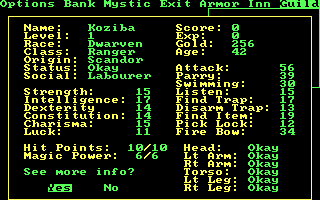
2. Character Creation and Development. Unchanged from Phantasie. The classes are standard, the variety of monster races a nice touch. Except the need for a gnome to enter the Gnome Caverns, your choices have no bearing on the storyline. Development seems a little too rapid at the beginning and far too slow towards the end. It literally took me about four hours of constant monster-bashing to rise from Level 15 to Level 16. But leveling up, with its improvement of skills (a nice touch) and spells is satisfying. Score: 4.
3. NPC Interaction. There aren't many NPCs in the game, and none with whom you can have any kind of dialog. The few vital ones, like Lord Wood and Filmon, help you advance the story but don't give you much opportunity for role-playing. As in the original game, it's neat how you find scrolls that give you contextual information about the world and its dungeons. Score: 4.
4. Encounters and Foes. Again, I could largely just paste my comments for Phantasie here: many monsters but oddly undistinguished except in the strength of their attacks and the damage done by their spells. You have some minor role-playing options in deciding whether to fight, greet (hardly ever worked), threaten (never worked), or beg mercy (who does this?) from your enemies. I do like that there were both random and fixed encounters and enemies respawned; without this, I wouldn't have built up my characters enough to win. Score: 4.
5. Magic and Combat. Battle tactics redeem some of the bad elements of the game. Since you can only rest and heal in towns, you have to take care in every encounter, especially in dungeons. If you think you can just breeze through the battle with orcs, you might take just enough damage to give you trouble when you encounter more serious foes later on. Carefully planning battles is the only way to win, and with its multiple attack, defense, and spell options, the game gives you a lot of planning to do. Do I try to wipe out a host of creatures with SWING or do I target the spellcaster in the back rank with my bow? Should I use Firebolt IV here or save my magic points for tougher battles ahead? I like making these kinds of choices, and Phantasie III is really second only to Wizardry in the tactical nature of its combat. In the original Phantasie, I complained that most of the battles were too easy, rendering these tactics moot, but that's definitely not true in this game. Only the paltry selection of really usable spells, and a banal spellcasting system, keeps this category from getting a really "good" score. Score: 6.

6. Equipment. There is a lot of variety to the weapons, bows, armor, and other items in the game, and the game is very clear about the relative value in terms of protection or damage, which I like. The "distribution" system is a bit cumbersome, and it sucks that you can't use powerful items the moment you find them--you have to return to a town first. There are no item descriptions, no artifacts, and nothing very unique, though. Score: 5.
7. Economy. Big, scrawled letter F. Any game that lets you end with over 4 million gold pieces doesn't understand the value of gold. There are shops in the town, but none sell anything better than what you can pick up outside. Give me things I can buy with these shiny pieces! It's only good at the beginning stages when you're suffering for gold for training, and every salvaged dagger is a step closer to a new level. Score: 2.
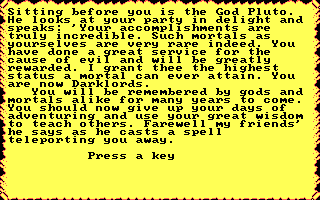
8. Quests. The main quest is a retread of the previous games, and there aren't really any sidequests, aside from a couple of small extra dungeons. The dual-ending of the main quest is rare for a game of this era, but I don't really count it as a "role-playing" decision because you don't make your choice until literally the last minute. Score: 3.
9. Graphics, Sound, Inputs. They're tolerable. The sound features squishes and crunches and got a little better after Phantasie; the graphics (in the PC version) are the same as its predecessor--not painful, but not interesting. Keyboard controls are intuitive enough if a bit cumbersome when assigning battle actions. Score: 3.
10. Gameplay. The game world is so small that it's hard to call the gameplay "non-linear" even if you can literally go anywhere from the beginning. Functionally, the difficulty of monsters and the need to go through certain scripted events makes the game something of a railroad, although as I said there are a few dungeons that you can explore on your own time. Aside from the alternate ending (which you can get by simply reloading), there's no reason to play the game a second time. Heck, there's almost no reason to play again after playing the first game. Score: 4.
The final score of 39 matches the original Phantasie exactly. Although III suffers from being a retread, its tactical combat system, which I probably didn't spend enough time on, makes up those lost points. I'm not sad that there isn't an English Phantasie IV, and that SSI would soon move on to cooler things.
Time to finish up the first NetHack, and then you're all going to forgive me for a brief detour into Pirates!
The Phantasie series is the embodiment of the trope that TVTropes calls "Phantasy Spelling": pointlessly altering the normal spelling of words to seem ancient, exotic, or just pretentious. Fortunately, not all series do this or we'd have to contend with Phinal Phantasie. We've seen other examples of this in the blog, including Faery Tale Adventure and Dunjonquest, and we'll see it again with titles such as Wizard Warz, Vampyr: Talisman of Invocation, and Jinyong Qunxia Zhuan. Seriously, people: who are you trying to impress?
I have a lot more readers these days, so I want to make it clear that the GIMLET is supposed to be an objective measure of my own enjoyment of the game. It makes no allowances for the age of the game or the technology level of the times. Oblivion is meant to be compared on the same scale as Akalabeth. Thus, a score of 50 or so in this era would be pretty good, while a score of 75 in the 2000s might be considered quite poor. Before you complain that this isn't fair, keep in mind that my only requirements to get a good score on graphics and sound is that they "aren't painfully bad." A game from this era could have achieved a score in the 80s (though none have, so far) if it combined, say, Starflight's attention to game world and back story, Ultima IV's dialog system, and Might & Magic's variety of quests.
Got it? All right. Let's do this:
1. Game World. Phantasie III feels derivative of a lot of games, not the least of which its own predecessors, in the game world. The continent of Scandor, aside from the different names of towns and such, is indistinguishable from the worlds of Phantasie, Legacy of the Ancients, Shard of Spring, or any number of other titles. In fact, all of the SSI games seem to suffer this certain banality of story and location. And not only is Scandor facing the "same old type of threat," it is literally facing the same threat--Nikademus--as the previous two outings. With three games to build his personality and backstory, you'd think that the player would have a sense of who Nikademus is and what he's all about, but no, all you know (or even need to know, I guess) is that he's evil. Your quest to destroy him is nonetheless pretty clear, and there are sages and such to help you walk through it. And on the plus side, the funeral for Kilmor was a nice tie to both the manual and the previous games, and unlike the original game, your actions have a permanent effect on the world. Score: 4.
 |
| And I guess the "plane" architecture is semi-cool. |
2. Character Creation and Development. Unchanged from Phantasie. The classes are standard, the variety of monster races a nice touch. Except the need for a gnome to enter the Gnome Caverns, your choices have no bearing on the storyline. Development seems a little too rapid at the beginning and far too slow towards the end. It literally took me about four hours of constant monster-bashing to rise from Level 15 to Level 16. But leveling up, with its improvement of skills (a nice touch) and spells is satisfying. Score: 4.
 |
| Training and increasing skills. |
3. NPC Interaction. There aren't many NPCs in the game, and none with whom you can have any kind of dialog. The few vital ones, like Lord Wood and Filmon, help you advance the story but don't give you much opportunity for role-playing. As in the original game, it's neat how you find scrolls that give you contextual information about the world and its dungeons. Score: 4.
4. Encounters and Foes. Again, I could largely just paste my comments for Phantasie here: many monsters but oddly undistinguished except in the strength of their attacks and the damage done by their spells. You have some minor role-playing options in deciding whether to fight, greet (hardly ever worked), threaten (never worked), or beg mercy (who does this?) from your enemies. I do like that there were both random and fixed encounters and enemies respawned; without this, I wouldn't have built up my characters enough to win. Score: 4.
5. Magic and Combat. Battle tactics redeem some of the bad elements of the game. Since you can only rest and heal in towns, you have to take care in every encounter, especially in dungeons. If you think you can just breeze through the battle with orcs, you might take just enough damage to give you trouble when you encounter more serious foes later on. Carefully planning battles is the only way to win, and with its multiple attack, defense, and spell options, the game gives you a lot of planning to do. Do I try to wipe out a host of creatures with SWING or do I target the spellcaster in the back rank with my bow? Should I use Firebolt IV here or save my magic points for tougher battles ahead? I like making these kinds of choices, and Phantasie III is really second only to Wizardry in the tactical nature of its combat. In the original Phantasie, I complained that most of the battles were too easy, rendering these tactics moot, but that's definitely not true in this game. Only the paltry selection of really usable spells, and a banal spellcasting system, keeps this category from getting a really "good" score. Score: 6.

6. Equipment. There is a lot of variety to the weapons, bows, armor, and other items in the game, and the game is very clear about the relative value in terms of protection or damage, which I like. The "distribution" system is a bit cumbersome, and it sucks that you can't use powerful items the moment you find them--you have to return to a town first. There are no item descriptions, no artifacts, and nothing very unique, though. Score: 5.
7. Economy. Big, scrawled letter F. Any game that lets you end with over 4 million gold pieces doesn't understand the value of gold. There are shops in the town, but none sell anything better than what you can pick up outside. Give me things I can buy with these shiny pieces! It's only good at the beginning stages when you're suffering for gold for training, and every salvaged dagger is a step closer to a new level. Score: 2.
 |
| I hate this. |
8. Quests. The main quest is a retread of the previous games, and there aren't really any sidequests, aside from a couple of small extra dungeons. The dual-ending of the main quest is rare for a game of this era, but I don't really count it as a "role-playing" decision because you don't make your choice until literally the last minute. Score: 3.
9. Graphics, Sound, Inputs. They're tolerable. The sound features squishes and crunches and got a little better after Phantasie; the graphics (in the PC version) are the same as its predecessor--not painful, but not interesting. Keyboard controls are intuitive enough if a bit cumbersome when assigning battle actions. Score: 3.
10. Gameplay. The game world is so small that it's hard to call the gameplay "non-linear" even if you can literally go anywhere from the beginning. Functionally, the difficulty of monsters and the need to go through certain scripted events makes the game something of a railroad, although as I said there are a few dungeons that you can explore on your own time. Aside from the alternate ending (which you can get by simply reloading), there's no reason to play the game a second time. Heck, there's almost no reason to play again after playing the first game. Score: 4.
The final score of 39 matches the original Phantasie exactly. Although III suffers from being a retread, its tactical combat system, which I probably didn't spend enough time on, makes up those lost points. I'm not sad that there isn't an English Phantasie IV, and that SSI would soon move on to cooler things.
Time to finish up the first NetHack, and then you're all going to forgive me for a brief detour into Pirates!