The Realm of Angbar: Elfhelm's Bane
United States
Green Valley Publishing (developer and publisher)
Released in 1986 for
Apple II
Date Started: 6 September 2016
Date Ended: 8 September 2016
Total Hours: 6
Difficulty: Hard (4/5)
Final Rating: 20
Ranking at Time of Posting: 60/227 (26%)
Raking at Game #453: 149/453 (33%)
Elfhelm's Bane is one of those games that has all kinds of
fan pages and
tributes, with 1980s players reminiscing about how awesome it is, perhaps even the "
greatest game ever," and then when you actually play it, it turns out to be an inexcusable red herring of a game that promises far, far more than it delivers.
 |
| The game pays homage to a much better series. |
The author of the game, Mark Peterson, had grandiose plans worthy of the
Alternate Reality series. Elfhelm, the capital of the Realm of Angbar (by the author's own account, changed from the original "Angmar" to avoid possible legal action), was to be the hub of the adventure and would occupy Side 1 of each game disk. From the city, players could visit a number of locales; these additional disks were to be called
Quest of the Dragon's Run,
The Mountain-Lord of Eriath,
Fangwood, and
The Crystal Realm. They never shipped, but that doesn't stop this game from asking for the disks when you try to leave the city at the right location.
The game is all-text and draws clear inspiration from
Eamon, with its central hall branching out to multiple adventures. [
Ed. As per the discussion in the comments, it appears I am wrong about Eamon
being the inspiration. Instead, the author seems to have taken inspiration from early 1980s MUDs.]
But instead of allowing flexible verb/noun inputs,
Elfhelm's Bane condenses its commands to simple keyboard shortcuts: (A)ttack, (C)ast spell, (I)nventory, and so forth. This isn't necessarily unwelcome, except that the one-letter mechanics don't allow for any puzzle-solving or deeper exploration of the game's many rooms. There are plenty of times that you enter an interesting-sounding room--a room that in the typical text adventure would reveal its secrets with a little parser-prodding--and yet there's nothing to do if there isn't a monster to fight or an object to pick up.
 |
| One of many interesting-sounding locations that produces nothing. There isn't even any mechanic by which to interact with the copper image or its jeweled eyes. |
Players can choose between warrior, mage, and priest characters, although since arcane and divine magic aren't distinguished, the priest is basically a warrior/mage. Healing spells are so vital to survival that I can't imagine playing as a pure warrior. Mages and priests get one new spell per level; mages start with the first three but priests only start with one. During character creation, the game rolls randomly for strength, intelligence, constitution, dexterity, and magic ability.
 |
| Starting a new character. |
The player is supposed to be a penniless drifter who has just arrived in Elfhelm. He has a little money but no equipment. You start in the middle of the city with no direction except vague rumors that some evil cult has recently opened a temple somewhere.
The game's lack of depth soon becomes apparent as you start to encounter NPCs--maidens, watchmen, gentlemen, clerks, musicians, artisans, even The Prince and The Emperor if you wander into the palace. There's no way to interact with these NPCs except to "examine" them. No "talk" command. No "give" command. Even worse, many of them attack you for no reason at all, and if you try to defend yourself, you get thrown in jail.
 |
| Almost immediately after starting a new game. |
 |
| This just isn't my lucky day. |
The city is full of twisty streets, and the developer didn't have the decency to maintain consistent distances and direction, meaning mapping it was a bit of a nightmare. I had to toss in a lot of blank squares to account for the fact that there were 4 squares along one street but only 3 along a parallel street.
 |
| The city of Elfhelm's Bane. The extra bit of cobblestone along Cabaret Street meant that I had to insert a blank square for every parallel street. |
Eventually, I found my way to the equipment shop and was able to purchase a suit of armor, a weapon, and a shield. The game keeps all your money in a bank account. If you find gold after fighting an enemy, you can turn it in to the bank for equivalent experience points. A pawn shop--the only place to (H)ock looted equipment and gems--is found at the end of a "seedy" section of streets where you're likely to encounter thugs, muggers, and killers.
 |
| Buying weapons and armor. A "shestoper" turns out to be a type of mace. |
 |
| Selling looted items at the pawn shop. |
Combat is relatively primitive, consisting of three types of attack (regular "attack," a defensive "parry," an attempt to "bash" the enemy off his feet, and a powerful but reckless "smash"), as well as casting spells. There are a couple of problems with combat. First, I don't think that "bash" ever works. Second, I verified with save states that before you even make your selection, the game has already decided if you're going to hit the enemy, whether the enemy is going to hit you in the follow-up, and how much damage the enemy is going to do. Thus, although the selection between the four attack types is supposed to affect your chances of hitting, how much damage you do, and how much damage you receive in return, it only seems to affect the amount of damage you do. There's no reason to ever choose anything but "smash."
 |
| Combat with a "high priest." |
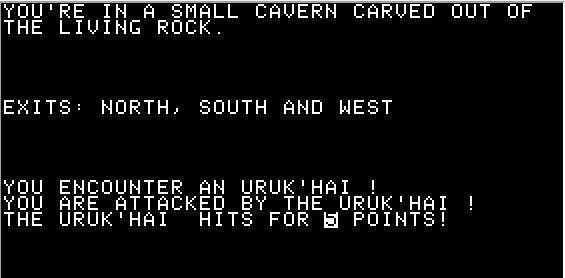
Combat is quite deadly at the beginning of the game and remains difficult throughout, primarily because enemies have a tendency to pile into the same square. You might start facing one mugger, but in round two, an additional thug suddenly appears and you're taking damage from two enemies at once. You try to polish off one of them, but while you're in the middle of it, another one shows up, and another. There were times that I literally couldn't get out of a square because the game replaced enemies as fast as I killed them.
 |
| A green slime attacks me at a "grisly scene." |
 |
| This battle didn't go so well. I don't even know what a "horast" is. |
The seedy alley is a good place for grinding, but it takes about 20-30 successful combats to get enough experience points to rise to Level 2.
 |
| I play vigilante for experience points. |
Even then, you also have to have 3,000 gold pieces in your bank account to train. The needed experience points and gold both rise quickly with the levels, and you basically never have enough money. I had enough experience to train for level 3 several hours before I had enough gold.
 |
| For some reason, you have to return to this fountain to "train." |
Supposedly, weapon skills increase through use, much as in
Eamon, but I never saw it happening with my characters.
 |
| My character sheet at Level 2. The "weapon bonuses" don't seem to be going anywhere. |
Enemies drop equipment, and higher-level enemies drop some pretty good stuff. Scrolls that heal, cure poison, and cure disease (poison and disease are fatal in 10 rounds) supposedly make up for the lack of spells for the warrior class, but there aren't very many of them.
 |
| The filth was not, in the end, very interesting. |
There are several gates out of the city, each prompting you for a new disk. A number of exits are visitable from Side 2 of
Elfhelm's Bane, including a forest and swamp to the west, an "iron castle" across the bay to the south, a "city of the dead" inside the walls, a small park, and the evil temple. An arena seems to have no purpose, and a "clanhouse" remains locked.
 |
| ....England, The Earth, The Solar System, The Milky Way, The Universe. |
Enemies increase in difficulty considerably when you leave the city, and if I hadn't been using save states, I would have reloaded dozens and dozens of times. (You can also get resurrected after death at a cost of half your bank account, but that just ensures you'll never be able to level up.) I explored as much as I could, but as I noted above, you soon realize that none of the interesting-sounding areas are going to deliver anything in the way of puzzles or even quest rewards because the interface doesn't allow it. There are no special items to find and use in other areas, no clues to piece together.
 |
| The inventory screen. The flaming axe +6 was a nice find. It was just sitting outside the arena. |
The only thing interesting that might happen as you explore is that "(F)ind" might reveal a secret exit from whatever room you're in. These secret exits might open up large new areas to explore. It's just too bad there really isn't anything to do or find within these areas. The game supposedly offers keys to unlock a number of locked areas, but I never found any in the 6 hours that I played. [
Ed. According to a commenter, you can find keys by killing officials.]
 |
| I never found a way to get past areas like this. |
After spending 6 hours with it, I'm reasonably convinced that there's no way to "win" the scenario despite what sounds like a main quest to invade the evil temple and plunder it. I mapped the entire temple, but only one square had what seemed to be a fixed encounter--something called a "wormlord"--and there were no special items that seemed there to be retrieved. (Admittedly, I didn't get through the locked doors.) After exploring, fighting, and plundering as much as I could, and finally managing to kill the "wormlord," I returned to the surface and visited the emperor, but there's no way to actually interact with him. Oh, and the emperor attacked me for no reason. Later, I examined the game disks, and I couldn't find anything that suggested dialogue with the emperor or any winning or congratulatory text. Maybe you're just supposed to pat yourself on the back once you defeat the wormlord and imagine a victory parade.
 |
| The dungeon of the evil temple. This is where I think the main plot would happen, if it had one. |
There are other fixed (non-respawning) encounters in the game, with Poseidon and Satan himself, but they don't seem to produce any winning conditions, either.
 |
| Apparently, the publisher's concerns about getting sued didn't extend past the name of the game world. |
To make things even worse, the game punishes you for character development by throwing harder monsters at you (and more of them) the better your statistics are. I noticed this after I grinded a few levels, hoping to defeat Satan. Places I had encountered 1 skeleton before suddenly served up 3 wraiths. To test it further, I hex-edited my save game file. I gave my character 255 in every attribute (up from around an average of 70), 255 hit points (from 70), 99 magic points (from 13), and bonuses of 99 on attack, defense, and different weapon types. Such a herculean character would have mopped the floor in most games, but what happened here was the moment I stepped into a square, enemies began piling into it and didn't stop until I was dead. The enemies were all higher level and hit much harder. For fun, I tried lowering various statistics to try to figure out which one the game was using to scale the monsters, but I wasn't able to identify a specific variable. It seemed to have somehow been considering all of them.
 |
| Seriously?!? |
In short, we have a text RPG with decent mechanics and writing but ultimately no point to either exploration or character development. I'd leave it at that, but there's one more thing that we have to consider.
Mark Peterson seems to have been more famous for a BBS game called
Swords of Chaos (interestingly, the name of one of the higher-end weapons in
Elfhelm's Bane), which is
still available to play today. In a long article on the
Swords of Chaos site, Mark Peterson talks about his game development history. He discusses how, in 1985, he got a job with the Minnesota-based Green Valley Publishing, by Peterson's own admission a purveyor of "cheap software." If the company sounds familiar, it's because we just visited them in my review of
The Adventure: Only the Fittest Shall Survive. The company wasn't just "cheap"; they blatantly plagiarized popular games and re-sold them. We saw in my review how
The Adventure was plagiarized from
Eamon.
As I noted in that review, one of the few things that the unnamed plagiarist had added to
The Adventure was a jail cell with some goofy writing: "Gumby hath no mercy." That same phrase is in the text of
Elfhelm's Bane, supposedly found in a locked cell in the palace dungeon. (I never found it in-game, but I found it through my inspection of the game files.) Thus, either the silly phrase was dropped in to both games at the insistence of some deranged Green Valley executive, or Mr. Peterson is the "author" of
The Adventure as well as
Elfhelm's Bane. Peterson doesn't mention
Eamon or
The Adventure in his account of developing the
Angbar series, which is curious given how much this game owes to the
Eamon lineage. I can easily imagine Peterson being given the task of "adapting"
Eamon as one his first jobs at Green Valley, and getting inspired enough by the project to create his own series. I'd of course like to have Peterson's direct account, but I haven't been able to track him down. I do apologize if I've suggested anything here that turns out not to be true.
 |
| The title of the developer's next game is found in an equipment drop in this game. |
Elfhelm's Bane GIMLETs at 20, almost the same as The Adventure, with 2s in just about everything. By 1986, text games were largely on their way out, and if you're going to develop an all-text series, you really need to improve upon, rather than reduce, what was done with Eamon. This game offers a much bigger world than the typical Eamon adventure but so thoroughly dumbs down the mechanics that there's just no point in playing it. On to the next one.