Tuesday, November 17, 2015

Game 202: Super Dungeon (1979)


Super Dungeon
United States
Programma Software (publisher)
Released 1979 for Apple II
Date Started: 16 November 2015
Date Ended:
17 November 2015
Total Hours: 4
Reload Count: 0
Difficulty: Easy (2/5)
Final Rating: 13
Ranking at Time of Posting: 17/200 (9%)
Ranking at Game #457: 54/457 (12%)
   
A few months ago, a commenter named Keith (AKA, the Golden Age Arcade Historian) did one of those things that I both really want you to do and kind-of don't want you to do: he sent me a list of a bunch of RPGs that aren't on MobyGames or Wikipedia, the two major lists that I used to compose my master game list. When you have a "to do" list of 2,000 items, the last thing you want is for someone to give you 20 more tasks. On the other hand, when you created the list specifically because you want to do those things, you could regard 20 extra items as like a bonus. I go back and forth.

In this case, when he first sent the list, I didn't want to hear about all these additional games, so I wrote back and said I wasn't sure they all met my criteria. I thought that would make him go away. Instead, he personally investigated each game, verified which ones met my criteria, and sent me a new list with annotations. F@%# you, Keith. And, of course, thank you, Keith.

There are only a couple of pre-1984 games on the list, so it won't affect my playlist dramatically. The first one is Programma International's Super Dungeon (1979). All bipolar joking aside, I'm grateful for Keith's list for this entry alone. Even if we're generous about what constitutes an RPG, and even if we include several Dunjonquest variants as separate games, we still only have a dozen commercial RPGs before 1980. The discovery of another one is a major event.

The moment I fired up Super Dungeon, I thought I had stumbled upon a small scandal. I immediately recognized the approach to gameplay, the low-res graphics--in many places, even the literal text--as identical to Level-10's Dragon Fire, a 1981 game that I covered back in 2013 and praised for originality. I was about to revoke all the good things I said about Dragon Fire and expose it as a fraud. After further analysis, it appears they came from the same author: Rodney Nelsen of Thornton, Colorado. Although Nelsen isn't credited with Super Dungeon in-game, he is listed as the author in a 1980 Programma catalog (incorrectly spelling his last name "Nelson").

Moreover, it sounds like Super Dungeon might not even be the first. In the same catalog, the game is described as "a SUPER version of the popular Dungeons and Dragons game." I don't know if they're literally referring to the tabletop D&D or some computer predecessor.
   
The description of a warrior in Super Dungeon (1979)...

...and in Dragon Fire (1981).
  
In general gameplay, both games are nearly identical. In character creation, you specify a name, and the game automatically rolls for starting strength, constitution, speed, and life points. You then choose a character class--warrior, wizard, elf, dwarf, and hobbit ("huntress" was added and "hobbit" removed for Dragon Fire). The choice of class modifies and in some case balances the initial attribute roles; for instance, warriors get an extra 25 life points and elves gain experience faster with lower strength. The various classes also have strengths and weaknesses in terms of what weapons and armor they can use, whether they can safely use secret doors, whether they can open locked doors, and whether they take damage from various traps.

You get a random amount of copper to purchase weapons, armor, healing items, and horses. These aren't "real" inventory items in any sense: you can't equip or drop them after the game starts. Instead, whatever you purchase adds directly to your strength, constitution, life points, armor class, and speed scores. Nonetheless, there are class restrictions on what you can purchase. Wizards can only purchase daggers, for instance, but get an extra 3 strength points to simulate their use of spells in combat.

Purchasing initial equipment.

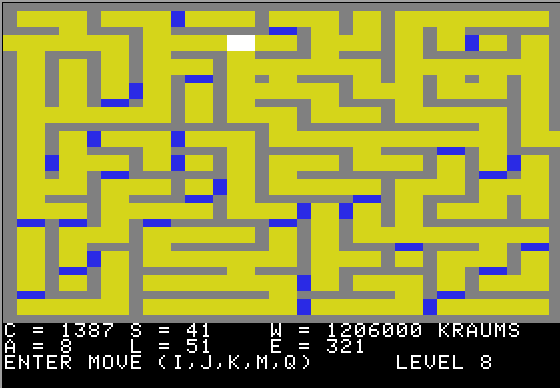
After inventory acquisition, you enter a randomly-generated, lo-res dungeon in which your character is indicated by a brown square. The style of the dungeon, if not the mechanics of exploring it, seems to have been inspired by Programma's previous Dragon Maze (1978). (Dragon Maze is a non-RPG, but it inspired a couple of RPGs, including this one, Dungeon Campaign, and Beneath Apple Manor.) You move via (U)p, (D)own, (L)eft, and (R)ight commands. Secret doors are blue, locked doors white, and regular doors gray [ed: I guess they're 'magenta' or something. My colorblindness strikes again]. Different character types take different injury levels when trying to pass through locked or secret doors.

The dungeon in Super Dungeon.
For comparison, the Dragon Fire dungeon.

Every pass through a door brings you to a room with a monster drawn from the Dungeons & Dragons bestiary, including rust monsters, ghouls, stirges [sic], gnolls, doppelgangers, minotaurs, manticores, and gnomes. Crude graphics represent both the monsters and items that you might win if you defeat them. You see their attributes and decide whether to fight or flee. If you fight, combat is an extremely rote affair. Relative speed determines who goes first, and each attack evaluates the monster's strength and armor class against yours (for monsters, strength is both actual strength and hit points) and determines whether you hit and how much damage you do. Some combats might take upwards of 20 rounds, but spamming the ENTER key gets you through them relatively fast.

I fight a chimera in hopes to win that bit of armor.
     
At the end of combat, you claim the room's treasures, which can include gold, keys to locked and secret doors, magic weapons (necessary for warriors to defeat some enemies), and items that increase your attributes and armor class. Occasionally, you get lucky and find a room with treasure and no combats.

Reward with no risk.

And occasionally, you find a special encounter, such as this room full of coffins that can contain treasure, skeletons, or magic gasses that either increase or decrease attributes.
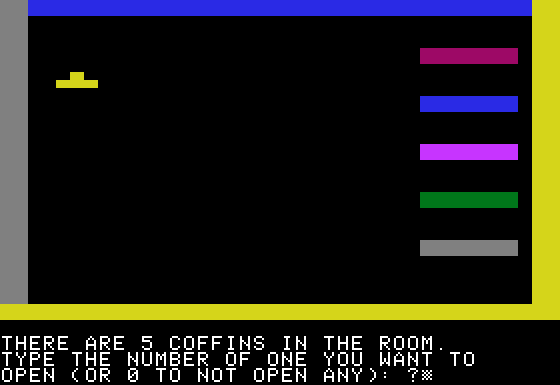
   
As you explore, random events can befall the dungeon and damage your attributes, diminish your gold, and screw up your navigation. These include tremors, random teleportation, "witches' spells," thieves, and pits. Higher levels have wandering monsters, but on the first few levels, you only encounter monsters in the rooms. Occasionally, portals appear to allow you a quick exit from the dungeon.
  
That's not cool.
    
As you advance in dungeon levels, you're given the opportunity to spend your experience directly on improved constitution and life points.


There is some strategy in how you explore. You lose one life point for every step you take, so you don't want to linger too long before heading for the level's exit. But if you hit the exit too soon, you won't have amassed enough experience to handle the more difficult creatures on the next level (or even replenished what you lost on this level). You need to try to find the right balance and make sure you can advance, if only slightly, in constitution and life points. Fortunately, you can retreat to earlier levels if you need to. You can also save and reload the game at any point.

Unfortunately, there doesn't seem to be a lot of point to the game except to accumulate treasure and escape the dungeon whenever you've had enough. At that point, you get a message indicating your overall score, which I suppose you could log for later comparison with yourself and your friends.

The game's "main quest."

If you're cautious, the game isn't too hard. I managed to make it to Level 5 in about 2 hours of playing, without having to reload. Rather than press my luck, I took advantage of a portal and escaped.

I'm not sure what the "gold deposited" bit is about. I never saw anything that would allow me to "deposit" gold.
  
While Dragon Fire is identical to Super Dungeon in mechanics, Nelsen did make a number of advances to the game in the intervening years. In particular, the detailed (and random) descriptions that accompany each Dragon Fire room do not appear here; this was perhaps the most memorable element of the latter game. Dragon Fire has a main quest--a dragon to kill on Level 10 (which is also the name of the publisher. I just got that!)--an adjustable difficulty level, a fast combat option, and a detailed, framing story written by later award-winning science fiction author Steve Rasnic Tem.

A couple of features were lost between the two games. Dragon Fire doesn't have secret or barred doors, removing some of the navigation challenge and decreasing the utility of a couple of character classes. Super Dungeon has monsters that only wizards or warriors with magic weapons can defeat; these are gone in Dragon Fire, again reducing the usefulness of the wizard class. I don't remember special encounters like the coffins in Dragon Fire. Finally, Super Dungeon has an extensive in-game manual, moved to a paper manual for Dragon Fire, likely to accommodate all of the detailed room descriptions in the latter game.
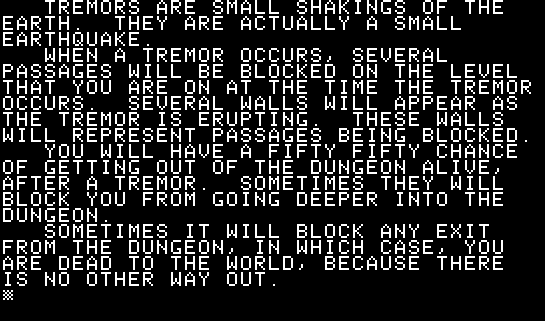
The long in-game manual describes all of its elements in detail.
 
Super Dungeon certainly would have tickled the imagination in 1979, but it doesn't do well on my GIMLET today, earning only 13 points. (Dragon Fire got 18, since it had a back story, quest, and the detailed dungeon descriptions.) It does best (3) in "character creation and development." I like that the choice of class really matters, and I like the way you can spend experience directly on attributes.

Despite the primitiveness of the game, this was always a bit of a thrill.
  
Super Dungeon is a reasonably good representative of the era. If you look at the 1978 and 1979 commercial RPGs, the list is full of titles--Dungeon Campaign, DUNGEON, Dungeon of Death, Dunjonquest-that feature different graphics and mechanics but the same basic approach to gameplay: roll a basic character and explore a random dungeon looking for treasure, enhancing the experience with your own imagination, with the only overt goal to get out of the dungeon richer than when you went in. (Beneath Apple Manor, The Wizard's Castle, and Wilderness Campaign are slightly different in featuring main quests, but none of them are full RPGs.) It wasn't until the success of Akalabeth, first published in 1979 but not widely released until 1980, that an ending started to become the norm in CRPGs.

Super Dungeon seems to be Rodney Nelsen's first game. I'm not sure what led him to enhance and republish it as Dragon Fire (1981), but Programma International was foundering by then, so perhaps the rights had reverted to Nelsen. I'm not sure whether he had anything to do with Level 10's Alkemstone (1981), a maze-running adventure that delivered clues as to the location of a real-world cache and offered a cash prize of $5,000 to the person who could find it. (As far as anyone knows, it's still out there.) He definitely did participate in Kaves of Karkhan (1981), an in-name sequel to Dragon Fire that is best described as a first-person adventure game rather than an RPG. In 2013, I got half a posting written on it before I realized it met none of my criteria. Nelsen also published a first-person shooter called Tharolian Tunnels through Datamost in 1982, and he appears on the design team of several Carmen Sandiego titles in the 1990s. After that, he disappears into the ether, obscured in Internet searches by many others of the same name. I tried finding him to ask about Super Dungeon and Dragon Fire but have not had any luck.

I'm still going through the rest of Keith's list and adding the ones I agree are RPGs to my master list. For the ones that precede 1984, I'll play them soon (I don't want to have three active lists) but not next. Martian Dreams is on hold until next week for reasons I'll explain later, so you'll probably see me slide into Shadow Keep next.

Sunday, November 15, 2015

Antares: Wrap-Up and Final Rating

     
Antares
Nightmare Productions (developer); Bomico (publisher)
Released 1991 for Amiga
Date Started: 7 July 2015
Date Ended:
19 September 2015
Total Hours: 23
Reload Count: 24
Difficulty: Moderate (3/5)
Final Rating: 30
Ranking at Time of Posting: 106/199 (53%)

For most of the summer and early fall, I was thinking that Antares would turn out to be a kind of ongoing source of humor on my blog. The game fell into a kind of tedious rhythm--survivable, but only in small doses--and I saw myself making one Antares posting in between other games, maybe covering one dungeon level per entry or something. Eventually, it would stretch into 2016, and after every post, commenters would wonder why I was still playing the game. But I'd plod on, probably reaching a conclusion around the time that I finished 1991 in general.

But after my unintended hiatus of the past two months, I've changed my mind. Even though it would be fun to be the only one online to document ending of this little German oddity, it's not going to be me. I couldn't even get through another dungeon level. The mechanics of managing light, food, fatigue, and healing are too much for what the game offers in return--a nonsensical, wandering plot and combat involving only the most basic of "tactics." Whatever percentage of the game I experienced during my play, I feel like I hit the highlights.

Messages strewn in the dungeon corridors show the game's Bard's Tale heritage.

Antares clearly draws from The Bard's Tale in its basic approach to exploration and turn-based combat, particularly in the variety of messages on dungeon walls, riddles, and static NPCs. But it joins other German games like The Legend of Faerghail and Dragonflight in offering a selection of gameplay mechanics and elements that are highly original but, unfortunately, not very good. I must both admire the game for deviating from the norm and chastise it by noting that the norm, however ordinary, makes for a better gameplay experience. Some of Antares's original deviations include:

  • No character creation system; instead, the player selects 5 from 12 pre-defined characters, including androids, mutants, and robots, each with different skills in fighting, technical ability, medicine, language, psychics, and cooking.
  • A food system by which a party's "hunger" meter slowly depletes and is restored by cooking ingredients found in shops and combat. The amount restored on the meter depends on the ingredient and the cooking skill of the character.
  • Division of hit points into physical and mental health, with different enemies and different attacks having various effects on both. Different items heal the two types of health, dependent on the character's healing skill.
  • Combat likewise is divided into physical and mental attacks, with the mental attacks sort-of replacing "magic" in a typical RPG, but without nearly as many options.
  • A strange approach to sound: no sound effects, but a track that plays different techno music selections when a party member uses certain found devices like Walkmen.
  • A weird sleep system: each character sleeps independently of the others, while the party is otherwise moving around and even fighting, slowly restoring the fatigue bar.
  • A selection of languages that the characters must translate by finding the appropriate books.
  • Part of the status display tells you what level of monster you're likely to encounter at any given moment.

Some of these don't sound too bad, but the combination of them--fatigue, health, and hunger, primarily--create a frustrating experience in which the player constantly has to juggle these logistics. Such considerations can be done well in RPGs, when made fun or particularly challenging, but here they're just tedious.

Still, we have to recognize a few things that the game does well. The monster portraits and other visuals don't represent the height of artistic achievement, but they are highly creative and very different from what we find in other games. The developers did a good job with dungeon design and wall textures, eschewing the bland repetitiveness of The Bard's Tale and Wizardry and really making each dungeon feel like a different place. I love that you can get hints and observations from your party members as you explore. The inventory system is reasonably well done, requiring some investigation and experimentation to determine what items actually do. I appreciated touches like the storage depot to store excess equipment. And in an era in which the default game seems to allow saving anywhere, any time, I appreciate that Antares offered a greater challenge by refusing to allow saving in dungeons.

One of the game's original monster portraits.
    
To recap the story, my party consisted of the remaining crew of the Auriga, a ship dispatched in 2314 to the Antares system to find out what happened to Earth's first interstellar spaceship, Hope, which had broken contact 34 years earlier. The same thing happened to Auriga that happened to Hope: shot down by an unidentified alien spacestation, with the crew stranded on the planet Kyrion. Among the remnants of the Hope crew--who were mysteriously sterile--I learned that the Antares system is home to three alien races: the Umbeken, the Questonaten, and the Vuronen. The latter are the evil masters of the system. Some mysterious being or force called "Tahun" seems to be influencing things.

As I progressed from the opening area, through the first dungeon, and to the first two cities and their associated dungeons, a mysterious "projection" kept popping up to help guide me along. Eventually, he said I should seek out an Umbeke named Ranishtar in the city of Akrillon. I was in the process of trying to find him when I last blogged.

An NPC offers to sell me information about Ranishtar.

I can fill in some of the rest of the blanks from the document that my commenters so helpfully translated. Ranishtar turns out to be a severe, war-weary Umbeke revolutionary who's also being visited by the mysterious "projection." He tells the party that the Vuronen live in a domed city to the north and suggests they build a bomb to use against the evil aliens. He gives the party a list of ingredients and parts needed for the bomb.

The next few dungeons seem to be full of riddles and puzzles as the party tries to find the parts for the bomb. If I had kept playing, I would have found several characters--including an android and an Umbeke--who would join the party and fill in the last character slot. Another race called the "Lepers" would have made an appearance, as well as a blue dwarf that keeps popping up and offering to sell advanced weapons for absurd amounts of money.

Eventually, the party makes its way to the domed city with the assembled bomb and starts sabotaging key industries and factories. Through a series of dungeons, it becomes clear that the Vuronen are working on a virus to destroy other life forms, and that they are capable of easily cloning and replacing themselves. They encounter the TAHUN, which seems to be a big glowing crystal that psychically impresses people to calmness and obedience. The party briefly falls under its power, but one of the robot characters is immune to the influence and guides the rest of them away (I have no idea what happens if the party doesn't have a robot at this point).

The projektion was up to no good.
    
Somehow, the party gets captured and tossed into something called The Death Zone. There, the helpful "projection" reveals herself as a female Vuroner named Stasia who has been using the party to sow chaos so that she can take power. At the end of the Death Zone is a final confrontation with Stasia. Unfortunately, I didn't see anything in the document that looks like congratulatory or end-game text. [Edit: my commenters found it and translated it! See the comments.]

In a GIMLET, I give the game:

  • 3 points for the game world. I'd like to go higher, as it is original and unusual, but it just doesn't hold together well. Elements of the back story and plot make little sense; major revelations are handled in a banal, deadpan manner; and several plot threads are simply dropped. The storytelling is as blithe and careless as it is original.
  • 3 points for character creation and development. The skills system is a good idea and creates a logistical challenge in party creation, but I don't like selecting pre-designed characters, and there's hardly any satisfaction to leveling. I guess characters get a little stronger, but their skills don't increase and there are no choices during the leveling process. You don't even get a notification that it's happened.
  • 3 points for NPC interaction. Discussion with a variety of NPCs advances the plot of the game, but it's all Bard's Tale-style, with no dialogue choices or role-playing options.
  • 3 points for encounters and foes. The highly-original monster names and pictures become bland when actually faced in combat. There, they devolve into two basic types: physical creatures and mental creatures. Other than monsters, there are a lot of riddles in the game, though translation issues make it difficult for me to judge their quality.
  • 3 points for magic and combat. Again, the division between mental and physical attacks and defenses is original, but it doesn't end up doing much for combat tactics. Overall, combat is even more rote and boring in Antares than in the games that inspired it.
  • 4 points for equipment. The long and varied list of items that you can buy and find make for a challenging puzzle. There aren't nearly enough inventory slots, though.

The halogenlampe lights up the dungeon. I never figured out what the Atari ST was for.

  • 3 points for the economy. You get money for killing enemies and spend it on food, healing items, and other equipment. I never felt particularly rich or poor. Nothing good or bad here, just bland.
  • 2 points for a long, meandering main quest with no side-quests or role-playing options.
  • 4 points for graphic, sound, and interface. The interface is well-explained in in-game documentation, and the graphics are both original and serviceable. The lack of sound--other than occasional techno music tracks that I turned off after a few seconds--is a major liability.
  • 2 points for gameplay. While the challenge is pitched okay, the game is ultimately too linear, too big, and too long.

The game features a fairly useful in-game help system.

The final score is 30, in that uncomfortable zone where I can't quite recommend the game, but if it were still 1991, I'd encourage the developers to try again. Just teenagers when they developed Antares, they definitely showed promise with design and programming. Alas, they didn't take my hypothetical advice. This is the only title from Michael Wyler, Kjell Marc Droz, Olivier Schraner, and their company, Nightmare Productions. Droz wrote to me briefly back in July, but I haven't been able to get him to answer a list of further questions about the game and its development.

With this, another German game has defeated me. I lost Faerghail because of a bug, The Ormus Saga and Dungeons of Avalon because I couldn't figure out how to win, and Antares because I wasn't willing to invest any more time. We'll see soon whether I can break the pattern with Drachen von Laas or Rings of Medusa II.

****

And with that, I'm back! Things have finally quieted down, and I have two more postings in the pipeline, so I hope to maintain a consistent schedule for at least the rest of the year. Finally settled into my new house (regrettably, only a seasonal rental), I plan to take an entire two weeks off in December, focusing on my blog during the day and Fallout 4 at night. Hopefully, by the end of the year I can make up for all the time I missed this fall.

Monday, October 19, 2015

Game 201: Martian Dreams (1991)


It is a truth universally acknowledged that women cannot get enough of Jane Austen. My wife, Irene, is no exception. A number of years ago, she made me sit through an A&E miniseries of Pride and Prejudice, which to the best of my recollection was 176 hours. It consisted primarily of wealthy people sitting around drawing rooms trading quotable barbs. Occasionally, to really liven things up, one or two of them would get up and walk around the perimeter of the room and sit back down again. High drama and scandal came when a man whose estates brought in £10,000 a year considered marrying a woman whose father's estate only brought in £9,500 per year. I remember remarking to Irene at the time that there was no time or place in world history more in need of an alien invasion.

I was thus delighted to see, some years later, that a writer named Seth Grahame-Smith had taken advantage of the novel's public domain status to produce Pride and Prejudice and Zombies. I bought a copy for Irene for Christmas in 2009 or 2010. I didn't expect her to love it, but I also didn't expect her to be offended by it. She flipped through a couple of pages and then threw it away, right in front of me. I learned an important lesson: when you're really invested in a setting and story, you don't want to see it treated frivolously.

I shouldn't have needed to learn this lesson because I had already experienced it myself with the Ultima series. As I've wrote about before, Ultima IV was literally a life-changing game for me. It infused my impressionable and agnostic 12-year-old mind with the equivalent of a secular religion. Moreover, its approach to storytelling made me feel, more than any other game, that it was literally my avatar wandering the fields and caverns of Britannia. When Ultima V opened with a screenshot of "my" desk, complete with computer and soda can, I didn't mind because I realized it was abstract and it pretty much looked like my actual desk anyway. When Ultima VI put a picture of a pole-dancing centaur on "my" wall and decided that "I" was a white male with long hair, it was harder to swallow. At 15, I was already sporting a bald spot. Yet aside from the opening screens, the game still allowed "me" to adventure in the game's fictional world and practice the principles of virtue.

This game's Avatar has an Ultima VI poster on his wall. How does that make any sense?

But when I first encountered the Worlds of Ultima* titles, my reaction was "oh, hell no." Not only did the games codify a particular appearance for the Avatar, they gave him a set backstory and acquaintances. The Avatar was no longer traveling from my living room to Britannia; he was traveling from his house on his peculiar version of Earth--a version of Earth in which reporters still look and talk like 1930s caricatures and--to quote from the current game--"scientists have long suspected that Mars was capable of supporting intelligent life." By Ultima VII, in which the character remains in Britannia at the end of the adventure instead of returning home, the deconstruction is complete. The Avatar is no longer my avatar but just a character of that title.

The game gives me no choice but to play as this guy.

(*This little series can't seem to make up its mind as to whether its title is Worlds of Ultima or Ultima: Worlds of Adventure. It's also unclear whether the series title is supposed to be part of the game's title. My convention is usually to favor the game's title screen but also consult the manual title and the box cover title. In this case, they all conflict, with Ultima: Worlds of Adventure 2: Martian Dreams appearing on the box and Martian Dreams appearing by itself on the manuals and game title screen. Since Martian Dreams by itself is more common than the alternatives, that's what I've used for the official game name.)

Otherwise known as the "only" Ultima: Worlds of Adventure game.

To be clear, I don't object to Origin re-using the Ultima VI engine to tell stories in alternate universes based on early-20th-century pulp magazines (as in the case of The Savage Empire) or on 19th-century science fiction (as in the case of Martian Dreams). I just object to them trying to shoe-horn them into the Ultima universe and making the Avatar the main character. (Could they truly conceive of no other protagonist?) I object to the weird plot developments, retconning, and conflicts that accompany these titles, including moonstones that explode and allow time travel, ancient saurian civilizations on Earth, and a habitable atmosphere on Mars. But like I did with The Savage Empire, having written all the above as a kind of catharsis, I'm going to try to ignore everything I've just said and see if I can enjoy the game on its own merits, particularly because I like the engine and everyone keeps saying that the game is good.

The introductory screens are well-composed.

Like most Origin titles, Martian Dreams benefits from solid production values in the supporting material and in-game introduction. These come together to tell a story that is absurd but sometimes clever. The summary is that the Avatar and his friend from The Savage Empire, Dr. Johann Spector, are contacted by an "odd-looking woman" (there's a hint that she's an alien) who gives them information necessary to travel through time with the Orb of Moons that the Avatar has been carrying since Ultima VI. Following the woman's instructions, they find an abandoned lab in the mountains of Colorado. There, they step through a timegate and find themselves in the same lab in 1895.

Now that we know time travel is possible by moongates, future problems that arise in Britannia ought to be easy to fix. I'm sure the series doesn't simply never reference this again.

The lab is owned by Nikola Tesla. (It's funny to see him appear in this game, 20 years before a poorly-researched and hyperbolic Internet comic would make him the patron saint of geeks everywhere.) Tesla is organizing a mission to rescue a group of people stranded on Mars. Two years earlier, the astronomer Percival Lowell created a "space cannon" which can shoot a bullet-shaped vehicle to another planet via a mysterious explosive substance called "Phlogistonite." He demonstrated the contraption at the 1893 Chicago World's Fair, but somehow it went off while a group of dignitaries was on board, rocketing them to Mars. (Good thing it was pointed at just the right place, and there was enough food, oxygen, and resources on board.) The list of accidental astronauts includes Buffalo Bill Cody and Calamity Jane, Andrew Carnegie, Marie Curie, Wyatt Earp, Thomas Edison, Emma Goldman, William Randolph Hearst, George Washington Carver, H. G. Wells, Mark Twain, and Theodore Roosevelt. The idea of Emma Goldman and William Randolph Hearst stuck in the same tiny capsule for months is, admittedly, interesting to contemplate.

Yeah, this was destined to end well.

Spector naturally realizes the effects on history should this group of luminaries remain on Mars, and he and the Avatar eagerly join the rescue mission. The rest of the party includes Tesla, the investigative journalist Nellie Bly, Sigmund Freud, a mysterious doctor named "C. L. Blood," who I suspect is going to turn out to have something to do with Dracula, and a cowboy named Garrett who I at first took for Pat Garrett, but who says his first name is actually "Dallas."

Dr. Blood has a point.

During character creation, Freud fills in for the gypsy of Ultima IV, asking a series of leading questions and providing questionable interpretations to the answers. Somehow, your answers determine your starting strength, dexterity, and intelligence.

It took me longer to get the symbolism than it should have.

The game begins at the landing site of the space capsule. The Avatar, Spector, and Bly are in the party. Bly keeps a notebook that serves the same "quest log" purpose as Jimmy the reporter in The Savage Empire

Dr. Blood won't join the party; he just hangs out in the capsule and waits for you to return with injured party members. Similarly, Tesla says he has to stay behind and run the communications, Garrett is going to guard the others, and Freud is too busy working on The Interpretation of Dreams--I'm not sure why we even brought him.

You're stocking a small pod to take 6 people to Mars. Clearly, a large pipe organ is a priority.

The interface is more or less identical to Ultima VI and The Savage Empire, although the number of commands has been slightly reduced. As with its predecessors, it allows both mouse and keyboard inputs. I think this is the last Ultima game to feature the keyword-based conversation style introduced in Ultima IV, so I'll try to treasure it this final time. Unfortunately, the game doesn't have any fun by giving the characters keyword responses to obvious prompts. Tesla has nothing to say about COIL or EDISON; Freud nothing about CIGARS.

Garrett has nothing about "BILLY THE KID," but I guess if he's Dallas Garrett, he wouldn't.
  
A hold in the rear of the craft is full of mostly-useless items like plates and mugs, but also a lot of other supplies like guns, ammunition, knives, lamps and oil, a sextant, a spyglass, and clothing--which is nice because the Avatar starts the game naked. Soon, I had everyone equipped with guns, machetes, and various utility items.

Looting the ship's stores.

The first major task, clearly meant to introduce the player to the interface, is to get the stuck door open. You have to first talk to Garrett, get a prybar from him by asking the appropriate keywords, and then (U)se the prybar on the door. At this point, Tesla interrupts you with a copy protection question, but after that, it's off to explore the Red Planet!

As you step outside, there's a notice to the effect that you're stepping into a low-oxygen atmosphere, and everyone's attributes decrease by 3 points. I'm not sure what consequences this will have throughout the game or if there's a way to reverse it. Dr. Blood said something about giving me oxygen canisters, but nothing showed up in my inventory.

The game's most notable nod to reality is that on Mars, human beings can breathe slightly worse than on Earth.

The game's depiction of the Martian landscape is mostly desolate, but with occasional flowers, trees, and living creatures. The game manual gives a description of the varied flora and fauna that we might expect to encounter, including "canal worms," "creeping cacti," and "oxy-leeches." The first ones I encountered were "plantelopes," which I attacked before realizing that they were probably non-hostile.

"We come in peace!"

The game acknowledges that its depiction of Mars is a little contrary to the twentieth-century scientific consensus. "What could have changed the planet so in just 100 years?" Spector asks in the manual. "How could the Mariner and Viking spacecraft have missed such clear evidence of Martian life?"

Tesla had given me the coordinates of the 1893 expedition's landing site as 28S 153W. The sextant showed that we were currently at 27S 153E. So I headed off for a long journey to the west. It wasn't long before I ran into a large, walled compound with strange architecture and a large gong in the center. We were attacked by "jumping beans" and "creepers" on the inside. There was some machinery that needed power, but I decided to leave the area and save it for later exploration when I had a better sense of the landscape. Unfortunately, I soon ran into a large canal that seems to inhibit progress past 68E, so apparently walking to the previous expedition site isn't going to be that easy. A map comes with the game, but it's not a lot of help yet, since it doesn't seem to have any man-made features on it. And if I'm interpreting the map correctly, canals seem to surround entire large areas. I'm not sure how you're supposed to cross them.

Exploring an area that seems suitably alien.

Miscellaneous notes:

  • Freud was 39 in 1895. The game depicts him as like 70 already.
  • Nellie Bly is cute. I wonder if she's going to turn out to be a love interest. Of course, she was 31 in 1895 but looks 10 years younger.

Thankfully, America's approach to mental health is entirely different 120 years later.

  • I don't know if food is going to be a thing yet. There's no sign of it so far.
  • As for an economy, so far I've found a single "piece of dirt money."
  • There's some clue to Dr. Blood in this dialogue here. I'm not getting it. The address seems to belong to a succession of publishing companies.

     
So far, Martian Dreams hasn't opened in a way that's any more promising than The Savage Empire. The plot is just as goofy, and I have less of a clue how to proceed about the game's main quest. I'll keep exploring and see if it improves. In the meantime, Irene and I are going to see The Martian later on. That should be an interesting contrast.

Thursday, October 8, 2015

Questron: More from the Creator

Charles and John Dougherty pose for a shot included in the Legacy of the Ancients box art.

I haven't been playing any games over the last month or so, but I have been having a great conversation with the man responsible for my CRPG addiction in the first place: Chuck Dougherty, creator of Questron. Like many of the developers who occasionally visit my blog, Chuck proved extraordinarily friendly and informative despite my criticisms of many of his game elements. I've selectively quoted some of his correspondence below, but please note that the entire text appears at the end of this posting.

Dougherty's series--Questron, Legacy of the Ancients, Questron II, and The Legend of Blacksilver--represent an unusual branch of the RPG family tree. Although they may look like Ultima or other games, their mechanics are very different--with both good and bad results. Some examples:

  • The games eschew the typical D&D list of monsters in favor of a highly-original list of (usually) two-word oddities, including sparrow piranhas, flesh renders, soul buyers, brain leeches, crusher rocks, stilted drebs, and dirt weirds.

As if a regular whale wasn't dangerous enough.
     
  • Monsters deliver no experience and only the smallest amount of gold, so they serve more as a temporary annoyance to exploration than a core element of gameplay.
  • Stats can increase through the use of mini-games. These stat increases are generally overridden, however, by those caused by plot developments. You might start with a strength of 15, increase it to 19 by playing some game, and then have it automatically boosted to 40 the first time you visit a castle.

My Legacy of the Ancients character increases his endurance by fending off fireballs in a minigame.
   
  • Each game features castles that you must plunder, slaughtering guards by the scores, to progress.
  • Getting rich involves, in part, mastering a series of gambling mini-games.
  • You amass spells by purchasing them individually; you can only cast them in dungeons.
  • Improvements in weapons and armor only arrive as you spend more time in the game, not just because you become richer. You might win a million gold pieces in the first hour, but you still have to play another 8 hours before the long bow starts showing up in shops.
  • As the game goes on, the evil wizard actually starts destroying towns.
  • Hit points are treated like currency. Where a D&D game might take your fighter from 10 to 60 hit points over the course of a 40-hour game, in Questron your character can easily go from 100 to 50,000. Towards the end of the game, random events might blithely strip you of thousands.

A few of these elements show up in Ultima, too--particularly the lack of experience, the odd approach to hit points, and the senseless massacre of guards. Questron feels like a game created by a gifted programmer who only had experience with Ultima and wasn't aware of the conventions of other RPGs.

It turns out, that's exactly what it is. Dougherty admits that he had "almost no experience" when he started creating Questron in 1981. He had spent 18 months teaching himself BASIC and assembly language on his Apple II Plus and then serendipitously encountered Ultima for the first time. "I'd never played anything like it," he wrote. "I really didn't have experience with RPGs, so it blew me away with the sheer adventure of it....I think it's fair to say that I didn't know what the 'norm' was."

A comparison of the outdoor areas of Ultima (top) and Questron (bottom).
 
But while Questron might look like Ultima, and share a few of its mechanics and plot devices, Dougherty correctly points out that there are many differences under the hood. "Lack of experience points was sheer ignorance," he wrote, "but there were other parts of the game that were very intentional." The attribute-increasing arcade games, for instance, are his original creation, as are his approaches to gambling games. (RPGs featured gambling back to some of the PLATO games, but I think Questron is the first to offer full mini-game versions of fairly complex games like blackjack and roulette.) He thinks that Legacy might be the first game to offer a graphic engine in which players walk up to an exterior view of a building and the roof disappears as they enter (I can't think of an earlier example).

This is one of the game's graphical innovations that I didn't note at the time.

One thing about Ultima that disappointed Dougherty was the ending: "There was essentially no reward. Given the amount of work a player put into that type of game, how could there not be honor and a celebration?" Hence, his dedication to providing a uniquely memorable ending to Questron, which almost every player and publication commented on. I know in my own case, the quality of Questron's ending spoiled other RPGs for a long time.

In our discussions, Chuck revealed an aspect of his games that I never commented on because it was so subtle: a detailed hint system dependent on the passage of game time. "If players couldn't figure out the next step," he wrote, "we always gave bigger and bigger hints until they knew what to do. Our hope was that each player would consider him/herself a genius for figuring it out." Now that he mentions it, I see places where the hint system comes into play, but it's extremely well-done, and I admit I felt a sense of accomplishment when I figured out the next steps based on small hints (which I assumed were the only hints). It makes me wonder what other subtle, non-obvious game mechanics I've overlooked in other games.

Presumably, if I failed to find Mesron, the game would give me more explicit hints about where to go.
 
Among his answers to my questions, Chuck helped clear up the issues that led to Richard Garriott receiving credit for the "structure and style" of Questron. While frankly admitting that he was inspired by Ultima, Chuck felt he had made enough changes that his title stood on its own. Then, after Questron was already finished, Ultima II was released. Although he had "never seen Ultima II prior to sending Questron off to the publishers," he was horrified to see that "Questron was far more similar to Ultima II than it had ever been to Ultima."

Dougherty never had any direct contact with Richard Garriott, but he heard from Brøderbund, Questron's first publisher, that Garriott had seen a preview of Questron at a trade show and was angry. ("Knowing what I know now, I don't blame him.") Brøderbund asked him to "make Questron look less like Ultima." He re-drew tiles, changed the nature of the controls, and updated the graphics, but when he was all done, Brøderbund said that Questron "was no longer fresh" and dropped the game.
   
Chuck kept shopping the game and found another publisher in SSI. It was the management at SSI that "worked out the license arrangement with Garriott--I'm not sure how that transpired and I'm not even sure I had a say in it." While he regrets that he never had a chance to speak to Garriott directly, Chuck admits he learned a valuable lesson from the experience and re-wrote future games from the ground up to look a lot less like Ultima and exemplify his own style. I certainly agree that by Questron II, the only significant elements that the game shares with Ultima is a top-down interface.

By Legacy of the Ancients, with its 3D museum and associated exhibits, the series had already diverged considerably from its Ultima roots.

(Dougherty's recollections jive reasonably well with Richard Garriott's comments in an America Online chat recorded in 1984 and quoted in part by commenter Stu in my first Questron posting.)

Chuck was joined by his twin brother John in future endeavors and founded Quest Software, but unfortunately the company never "turned the corner financially." Already sick of 6 years of 70-hour weeks, their efforts suffered a death blow when Epyx declared bankruptcy after acquiring the rights to publish The Legend of Blacksilver. The game was barely marketed, and the Dougherty brothers never got anything beyond their advance. "Seemed like a good time to quit," Chuck wrote. "Both of us found it far easier, less stressful, and far fewer hours and ultimately more lucrative when we returned to programming for businesses."

Chuck thinks that The Legend of Blacksilver was the company's best game. It's the only one I haven't yet played, so I look forward to checking it out when I get around to 1987 again.

The full text of my Q&A with Chuck Dougherty appears below. I really appreciate his contributions to my reviews of his titles.

*****

Q. I'm curious what experience you had with computer RPGs and/or tabletop RPGs before writing Questron. You feature some mechanics--primarily the leveling-through-plot-development rather than experience--that are a little odd for the genre. One of the things I talked about in several of your games--complained about, frankly--is that monsters don't deliver any experience, so there's hardly any reason to fight them except that they're standing in your way. Were you deliberately trying to buck the norm here, or did you just not have experience with games that did it differently?

A. I had almost no experience. I’d purchased an Apple II Plus about 18 months prior to writing Questron, and had taught myself BASIC and then assembly language from a book. Then I played Ultima and loved it. I’d never played anything like it. I really didn’t have experience with RPGs, so it blew me away with the sheer adventure of it. Bear in mind that I was just this young guy living in Michigan, working full time at another job, and then kind of stumbled into this.

So I think it’s fair to say I didn’t know what the “norm” was. My primary focus was to create something that was fun to play; something that I would have liked playing. I saw the monsters as more of a way to elongate the game and make it challenging. So lack of experience points was sheer ignorance, but there were other parts of the game that were very intentional.

Q. In all of your games, the majority of monsters are original to them. I was curious about your creative process in coming up with all the names and descriptions. Did you start with monsters in other fantasy settings and simply devise new names, or did you create each creature from scratch?

A. Most all creatures were created from scratch. I would brainstorm with a friend of mine (Jeremy), who then ended up joining me in the endeavor as a creative consultant. He came up with many of the wildly creative ideas and then I kind of pulled it together, coming up with descriptions, etc. It was fun thinking of offbeat and quirky descriptions, something we did even more of when my twin brother joined me for the next three games.

Q. The historical record leaves some confusion as to why Richard Garriott is credited for the "structure and style." Some sources say you or SSI did it preemptively; others say that Garriott sued (or threatened to sue) to get a cut of the royalties. Either way, your game was hardly the first to adapt the "structure and style" of another title, so being forced to credit Garriott is a bit unusual. Do you remember how this came about, and do you have any feelings on the matter?

A. Parts of that first version of Questron were quite similar to Ultima (a naïve choice on my part--at the time it seemed like every game was copying every other game). The outside terrain originally was very similar to Ultima, the menu system and overall screen layout was quite similar. But the other thing that happened was that somewhere around the time I was finishing Questron, Ultima II was published. Bear in mind I’d never seen Ultima II prior to sending Questron off to publishers, but when it was released I realized that Questron was far more similar to Ultima II then it had ever been to Ultima. This was horrifying, and the changes/advancements I’d made to not be too similar to Ultima were often quite similar to what turned out to be natural advancements between Ultima and Ultima II.
  
The infamous credit on Questron's opening screen.
 
Everything else I have to say is hearsay because I wasn’t there for the conversations. What Brøderbund told me was they were at some trade show showing a preview of Questron and Richard Garriott saw it. Apparently he was upset--and knowing what I know now I don’t blame him. This was of great concern to Brøderbund, and they were no longer sure they were going to publish. Of course I was devastated and felt foolish.

In any case, I was asked to figure out how to make Questron look less like Ultima. The changes were fairly easy. I think I redrew the outside terrain squares, added joystick control, made some cosmetic changes, etc. However, when I finished a couple months later Brøderbund told me the game was no longer fresh and they withdrew their offer to publish.

So I shopped around again for a publisher and SSI was interested. They worked out the license arrangement with Garriott--I’m not sure how that transpired and I’m not even sure I had a say in it. I don’t recall if it lessened my royalties, but the whole thing was an embarrassment. And a lesson.  One of my regrets was never calling Richard to talk about it. But bear in mind he was a big name, I was a nobody living disconnected in the Midwest, and Brøderbund and SSI were telling me that he was pissed. I had no idea what to say to him.

So on the one hand I think I was a bit unlucky, but I have no trouble understanding how Garriott might have felt, especially because he would probably have assumed I’d seen Ultima II. Interestingly enough, in the years to follow other RPGs borrowed some of the innovative things we originated in Legacy of the Ancients and The Legend of Blacksilver. To the best of my knowledge, Legacy was the first game where the player walked up to an exterior view of a building and the top disappeared to reveal the insides (my apologies if I’m mistaken). We may have also invented arcade style games of skill to increase attributes (OK, some felt that was quirky) and games of chance to earn gold. We had also made huge graphic advancements at the time in the dungeons. All other games that I ever saw (of that day) were far more obviously composed of blocks, whereas our looked quite different

Q. Each one of your games features the merciless slaughter of castle guards, something that also featured heavily in Ultima. Did you ever have pangs about forcing players into such a situation? Did you ever receive any criticism for it?

A Questron II character prepares to plunder and massacre.

A. Yeah, I never loved that. A big problem we dealt with was the memory and disk space constraints of the machines of the time. It was almost impossible to pack a large external world with one set of graphic and controlling code, “3D” style dungeons with other coding, towns with a third, and castles with a fourth. So what you saw with the castles was largely the constraint of trying to do a lot of graphics and having not enough room for other things. I always wished I could have put a lot more plot into the games, a lot more dialogue, a lot more interactions, and more puzzles. The fact that we were trying to do a large world and high quality graphics (for the day) really meant we had to cut down on other things. I can literally remember multiple times we spent an hour or so rewriting a section of perfectly good code to save somewhere between 2-12 bytes, just to make something fit the space.

Q. For your game series, I get Questron, Legacy of the Ancients, Questron II, and The Legend of Blacksilver. (I've played all but the last.) Are there any other titles that you worked on that aren't on the standard database lists? Any that were in development that never saw publication?

A. These four were all the games (unlike the others we didn’t write the Questron II code ourselves). Some stuff in development but not enough to really talk about.

Q. What ultimately happened to Quest Software? I get the impression that game development was always a side-career for you and John. Did you simply decide to focus on your primary careers?

A. This effort was full time work for about 6 years, not a side development. Basically we found that we never “turned the corner” financially. We never made enough money to hire an adequate staff; hence, John and I averaged about 70 hours a week and on our toughest weeks worked up to 110 hours. It was brutal. Both of us found it far easier, less stressful, far fewer hours and ultimately more lucrative when we returned to programming for businesses.

We’ve realized in retrospect that we made the wrong marketing decisions. We were programming for a niche that was too small. Our goal was to create an adventure world that was generally larger, more varied, graphically rich, more animated, more detailed storyline than typical games. But what we gave up was the detail of the fighting and magic system and primarily that was what the RPG world wanted. Our decision to keep top-down towns, castles, dungeons, museum and outside required essentially 5 different game engines, which made creating each new game quite difficult. Also, we never used the same engine for any game, feeling that each game had to be better. That required a lot of new programming each time because computers of that day didn’t get any faster (until we’d given up the business).

By the way, we thought The Legend of Blacksilver was our best, but it was released to Epyx which went bankrupt after having the rights to our game. After bankruptcy filing they shrunk from something like 80 staff to 3 staff, so they had no real ability to publish but they owned the rights and we were stuck with nothing but the advance. Seemed like a good time to quit. Perhaps we should have pursued legal action to get our game back and publish elsewhere (both EA and SSI had made us offers prior to Epyx), but that would have been a messy business pursuing a career that wasn’t panning out to be that great.

Q. Perhaps the most notable feature of Questron is the ending, complete with the celebration and fanfare. Hardly any game of the time or since have offered this kind of satisfying denouement. Were you aware you were doing something special here?

A victory for a champion.

A. The ending was very much intentional, of course, but I didn’t know much about how it compared to other games. However, the few that I had played had little fanfare/celebration, which seemed wrong to me. I remember playing Ultima and being shocked at the end when there was essentially no reward. Given the amount of work a player put into that type of game how could there not be honor and a celebration? When writing my game (and later with John when writing our games), the goal was always to think about the player and try to “tune” the game for maximal enjoyment.

Speaking of tuning, we really did try to tune the games to maximize the fun. If players couldn’t figure out the next step we always gave bigger and bigger hints until they knew what to do. Our hope was that each player would consider him/herself a genius for figuring it out. It didn’t matter that some figured things with no hints and others practically had to be told what to do. Each player would get the same feeling of achievement.

****

If you're wondering about changes to my "recent and upcoming" list, the short answer is this: before my unintended hiatus of the last month, I was having various degrees of issues with almost all the 1991 titles on the list. Rather than figure them out, and to make it easier to get back into gaming, I decided to blast the list and reconstitute it with new random selections. All of the games that were originally on it will reappear, just a little bit later in 1991.