Thursday, February 6, 2014

Game 138: Empire II: Interstellar Sharks (1982)

      
Empire II: Interstellar Sharks
United States
Interactive Fantasies (developer); Edu-Ware Services (publisher)
Released in 1982 for Apple II
Date Started: 6 February 2014
    
It appears that I'm about to become the first person online to offer a detailed description of Empire II: Interstellar Sharks, and I'm not entirely sure I'm up to the task. The entire series--what it's trying to achieve, who its audience was, how seriously we're supposed to take the game documentation, what it's really about--continues to confuse me.

In September, I looked at Empire I: World Builders and noted that:

Empire is a uniquely weird game. Its weirdness begins with its manual, full of a propagandist history of the empire that offers an alternate take on human history, and continues with its interface, mechanics, and overall gameplay goals. If it was created today, I would suspect its creator to be a gifted but extremely disturbed person. But 1981 was a time in which video games were new, and common tropes not yet established, and this game comes from a creator (Edu-Ware Services) that specialized in educational software rather than role-playing games. Even with this understanding, playing the game feels a bit like indulging someone's lunacy.

Everything I said about the first game is true for the second. It comes with bizarre documentation of an alternate history and possibly-dystopian future. It features a quasi-simulation experience in which you have to go step-by-step through the most mundane things, like taking a flight from one planet to another: walk through the multiple screens of space dock, enter the passport office, apply for a passport, go to the ticket office, buy a ticket, present items at customs, go to the boarding area, enter the ship, exit the ship, present items at customs again. It has a combat system that's hardly used. Overall, it's hard to imagine anyone finding the game truly "enjoyable." I'd suspect that this game was designed amidst a lone creator's slow descent into irrecoverable madness--except that I know that the creator, David Mullich, went on to a productive and prolific career, including directing the Heroes of Might and Magic franchise for 3DO between 1999 and 2002. That Empire found a reasonably reputable publisher, which thought enough of it to publish the entire trilogy, also argues against the "lone psychopath" hypothesis. So I'm left doubly baffled by a series that seems to have been created by sane people, with an actual expectation to make a profit, and yet has all the fun of going through airport security. I feel like there's some obvious piece of the puzzle--some weird market trend that existed in the early 1980s that I forgot; some meta-theme completely going over my head.


Empire was an open-ended game in which you tried to survive as a pioneer on rugged planets, taking the role of a miner, homesteader, or missionary. It was set in the context of a new and expanding galactic empire. Empire II takes place some centuries later, with the planets colonized, and you act out one of three roles: pilot (trading commodities between planets), businessman (trading stocks and "carrying out covert operations for the company which he serves"), or diplomat ("execute assignments for the Empire"). Somehow, success in these areas will lead to the ultimate goal: a visit to the imperial home planet of Triskelion, where the manual promises some clue as to winning Empire III. The manual sets up this epic struggle by noting that "Gone are the days of frontiers and rugged individualism; red tape and regulations have become the obstacles of life amid the stars." I'm just not sure that red tape and regulations were precisely what every young RPG player was clamoring for in 1982.

The gameplay baffles me because it's boring (despite some exciting-sounding mechanics), but the manual baffles me because it's just crazy. The manual for the first game records an alternate history in which most of Earth is destroyed by a nuclear holocaust, and the first "perfect man," Gortus Lazur, forms an Empire from the ashes. There's a lot of pseudo-science and weird philosophy in the manual, and I don't know how seriously the player was supposed to take it, but it didn't have much bearing on the gameplay.

Empire II's documentation manages to top the first. The instruction manual is accompanied by The Memoirs of Yoram Lazur, the "twelfth empress of our great empire." (For some reason, Lazur's line is unable to produce any male offspring.) It takes the form of a long letter between an empress and her daughter-heir, and it cryptically imparts information about the bizarre game world, suggesting that the specific scientific breakthroughs and laws passed under each empress's rule have been planned for centuries, and that the Empress is really a puppet ruler at the mercy of a large bureucracy.

The tract indicates that empresses are impregnated by a host of consorts called "Reproductive Advisors"--the embryos are then whisked away to be raised by surrogates, and empresses never actually meet their daughters. There's a section where the empress rails against her advisors for introducing a new technique via which she will be artificially inseminated instead.

Oh, there's a lot more in the 18-page manual that I can't begin to comprehend. Strange anecdotes from the past (a few pages are given to the tempestuous relationship between an empress and a scientist named Escher who invented the "Mobius drive," 900 years earlier), allusions to the computers ("independent thinking machines") outpacing humanity, references to illegal worshippers of the "Lord of Light." I don't know if this is just supposed to be an original way to introduce the player to the history and terminology of the game world, or if it's all supposed to be a grand allegory, or what. Whatever the case, Mullich put a lot of effort into building an original and bizarre back story, none of which carries into the gameplay except a single appearance by the disciples of the Lord of Light.

Do they realize their "L" is backwards?

The interface is an odd blend of adventure game, RPG, and simulation game. Like the first game, all progression is through text commands, of which the book lists more than 150 possibilities for verbs and nouns. Some are specific to certain locations and classes, but it's a lot to keep track of. For a long time, I couldn't catch a ship out of the spaceport because I didn't realize you had to BUY TICKET and then, separately, PAY.

The RPG elements come in the form of  a set of standard D&D-style attributes, though with the addition of "senses," "psionics," and "aim." These are all rolled randomly, as is your sex. You then select the profession that goes best with your attributes.

I was doing good for a little while.

The attributes are important, as they are the subject of frequent rolls to determine the success of game actions. For instance, getting contraband through customs requires an intelligence check, negotiating a treaty means a charisma check, escaping from the authorities means passing a speed roll, and successfully striking a blow in combat is dependant on strength. This is one thing the game does reasonably well, and it forces you to plan your character's actions around his strengths and weaknesses.

After you select your class, you head out to the spaceport, where you can either jump into your own ship (if you're a pilot) or take a commercial transport to another planet. The classes come with different starting items and credits; for instance, the diplomat automatically has a high-level passport to almost all the empire's planets, and the businessman has a trading pass for the stock exchange.

Lots of interstellar travel in this game, which has all the excitement of catching a flight in real life.
 
Combat is essentially identical to the first game. Each character has a separate damage rating for his head, torso, left arm, right arm, left leg, and right leg. You engage in combat by typing movement commands (BACK, FORWARD) and attack commands (HIT HEAD, KICK TORSO, SHOOT LASGUN BODY). Each attack is followed by a roll against the appropriate attribute, at which point the game alerts you if you've hit your opponent, missed him, or fumbled and damaged yourself instead.
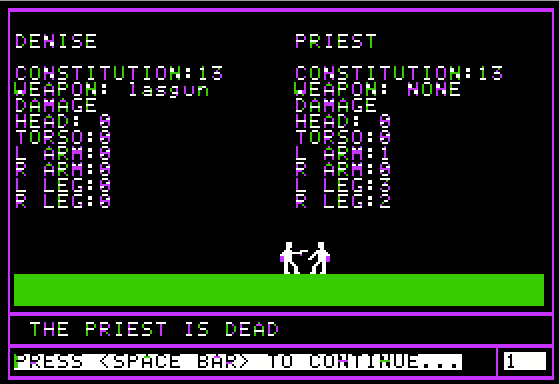
Keep reading. I actually have a good reason for killing a priest.

It's not a bad mechanic except for the rarity in which you need it. In about four hours of gameplay, I only had to fight one combat, though it was an option a second time when I was trying to evade arrest (I BRIBED instead). This is in sharp contrast to the first game, where combat came upon you with alarming frequency.

There are about eight planets visitable at the beginning of the game. Each has its own selection of stores, corporate offices, banks, medical offices, and embassies. Each planet consists of a straight road that wraps back on itself after six or seven screens; it's impossible to get lost. For some of them, going off the beaten path into the wilderness produces a special location, like a black market or an illegal temple to the Lord of Light.

Exploring the planet of Hwitrokken.

Only one planet has a "mercenary" store that sells advanced weapons and shields, but these are all illegal, so if you buy any, you have to pass an intelligence check every time you try to clear customs--which you have to do twice on each journey. Given the lack of combat in the game, it doesn't make a lot of sense to carry these things around.

The game has a reasonably sophisticated crime-and-punishment system. You can ROB stores, STEAL from NPCs, BRIBE customs officials, buy and sell drugs, and murder people for their credits.
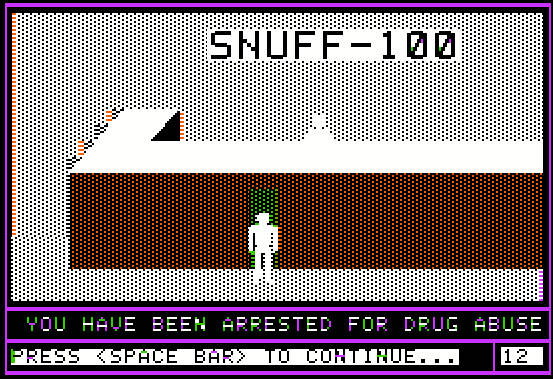
I would think a key to avoiding a successful police raid is to not sell your drugs in a big building that says "hedonistic services."

If you get caught at any of these things, you get sent to prison for several years. (Diplomats have "diplomatic immunity," but this can be revoked for serious crimes.) On one planet, Denieves, there's a "hedonistic services" building where you can gamble, buy drugs, or sleep with a prostitute. Each carries the risk of a raid that will land you in jail unless you FIGHT, BRIBE, or ESCAPE successfully. The gambling game is horribly weighted towards the house, so it doesn't help much financially, and visiting the prostitute also carries a risk of venereal disease. (Incidentally, I thought Wasteland was the first CRPG sex, but apparently it was much earlier.)

The candle is a nice touch.

Whether you play a pilot, businessman, or diplomat, I think the goal is to amass enough funds to fully outfit your own ship, which you can then, somehow, fly to Triskelion. (None of the commercial flights will take you there.) Getting rich is proving quite difficult, and more than a little boring.
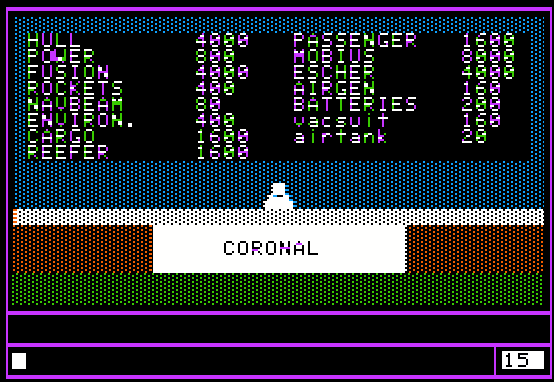
Some of the many parts you need for a ship.

I've done most of my playing with Denise the Diplomat. I find that the pilot class has way too many logistics to deal with, from buying the right amount of fuel for the ship, using "flight planning services" to PLAN a trip to a specific planet (they won't do Triskelion, so that's a bigger puzzle), taking the time to INSURE cargo, COLLECT impounded cargo, and so on. Even launching the ship involves enough steps to make a flight simulator proud. There are different flight considerations for intra-stellar and inter-stellar flight.
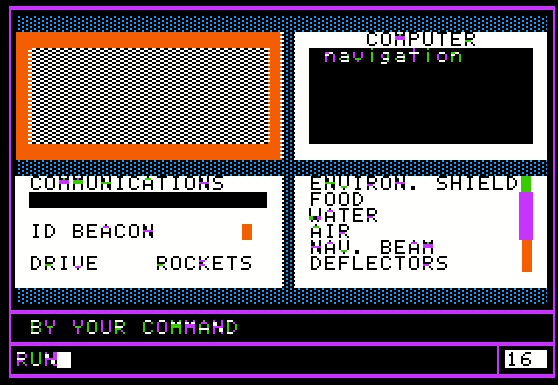
The pilot's role is logistically complicated.

The businessman has to mostly trade stocks, which is rather boring, as the prices only vary about 2% every 10 minutes.

Wow, is this exciting.

The diplomat visits embassies to get diplomatic missions. Some of the missions I've been assigned are to collect taxes from all the corporations and different types of stores; assassinate the high priest of the Lord of Light worshippers on Apollin (this was the one necessary combat); carry a diplomatic pouch to another planet; negotiate a treaty with an alien ambassador; and negotiate mining rights on the one mining planet.

Denise has just passed a charisma check and has just successfully negotiated a treaty with the one known alien species.

These sound exciting on the surface, but they're mostly about just getting to the right planet and entering the right building (with an occasional attribute roll). This process is complicated by a number of factors:

  • There's no rhyme or reason to the system of getting commercial transport from one planet to another. The available ports of destination are randomly rolled the first time you visit the spaceport. More than once, I've had to fly aimlessly from planet to planet until a route finally opened to my destination. Buying tickets costs a lot of money, and it's been impossible for me to earn more than I've had to spend.

I'm sure these places are nice, but I really needed to go to Prothocole.

  • Embassies mysteriously disappear. I'll be given a mission to deliver a pouch on, say, Hwitrokken, but when I arrive on Hwitrokken, there's no embassy. I have to leave for another planet and then find my way back to Hwitrokken and hope the embassy is there this time.
  • Sometimes, the mission is on a planet that is not visitable through commercial transport, so until I collect enough money to buy my own ship, I won't be able to complete the mission.

Going from one nondescript planet to another, having to PRESENT ITEMS at customs twice on each trip, trying to find the right combination of trips that will get you to the right place, watching your fortunes grow by pennies per hour . . . none of this is very much fun. I've started about six characters so far, and not a single one has died. Instead, they've just coasted to a stop. I get to the point where I can't get to the location of the next diplomatic mission, or afford passage to another planet, and I just run out of stuff to do. Again, the contrast between this and the first Empire game couldn't be more stark. In that one, you couldn't stay alive for more than 10 minutes; in this one, you can't get anything significant to occur.

The manual says that "Interstellar Sharks is the simulation of the complexities of modern day life projected onto a galactic scale." I guess I have to agree, but I find it bizarre that anyone thought players wanted a game like that, let alone make it. The game's good ideas (the stats checks, the crime system) are subsumed by a monotonous gameplay that contrasts starkly with the completely far-out game manual and back story.

I don't know how well Empire II did in its time, but the fact that the game is so lost (most mentions of it online are from people looking for it) seems to suggest that it isn't regarded as a beloved classic. I was lucky enough that one of my commenters, Odkin, had both the game and the manual. I keep meaning to ask him if he has Empire III, which is similarly lost. Knowing whether I'll be able to finish the series will probably matter a lot as to whether I bother to try to finish this game.

Later Edit: No one has been able to turn up a copy of Empire III. I heard from David Mullich and we had a brief e-mail exchange, but he didn't remember enough to be able to help me with the gameplay, and he didn't give me permission to post other aspects of our conversation on my blog. If I ever do find Empire III, I might give this game another try, but otherwise I'm going to move on.

Even Later Edit: I won Empire II over seven years after this initial entry. Read the second posting here.


Tuesday, February 4, 2014

Spirit of Excalibur: Final Rating

This picture is dramatic, but I don't really know what's supposed to be going on.

Spirit of Excalibur
United States
Synergistic Software (developer); Virgin Mastertronic (publisher)
Released 1990 for Amiga, Macintosh, Atari ST, and DOS; 1991 for Apple IIgs and Commodore CDTV
Date Started: 29 January 2014
Date Ended: 1 February 2014
Total Hours: 14
Difficulty: Moderate (3/5)
Final Rating: 33
Ranking at Time of Posting: 83/137 (61%)
Ranking at Game #456: 312/456 (68%)

Most games, even mediocre ones, have at least a few strong game mechanics--some element that keeps you playing and that may even prove legitimately addictive. I just finished Assassin's Creed: Brotherhood, and while I felt the game was far too long and horribly-plotted, I couldn't get enough of the mechanics of climbing buildings, jumping across rooftops, and collecting flags. Knights of Legend was a mediocre game with an epic, tension-filled combat system. In Hillsfar, I disliked almost everything except picking locks. It was fun to mine in Starflight long after I lost the need for money.

Spirit of Excalibur, on the other hand, underwhelms me in just about all of its areas. It manages to combine three genres--adventure, RPG, and strategy--without being good at any of them. The battles are too scripted, with not enough tactics or logistics, to be a good strategy game; there aren't enough puzzles to be a good adventure game; and there isn't enough character development to be a good RPG. The game really has only one narrative line, and the player has to figure out how to best adhere to it, rather than make his own role-playing choices and crafting his own path to the end.

Let's see how it does on a GIMLET:

1. Game World. This is perhaps the game's best element. It's not only one of the few RPGs to draw its story from Arthurian literature, but it creatively uses traditional themes to craft an original game world. I admire that the developers didn't do the obvious thing and set the game during Arthur's time, with Arthur himself as an NPC.

I had some fun in the posts noting the game's deviations from Arthurian tradition, and I still can't reconcile myself to its treatment of the Grail, but for the most part the deviations were within the spirit of the Arthurian legends. Even though the world develops and changes on a railroad track, it's fun to watch the slow and steady reunification of Britain. Score: 6.


2. Character Creation and Development. In this vital category for a traditional RPG, this game mostly falls flat. You don't get to create or define any of the characters; the most you can do is choose which heroes you'll field from a list. The only "development" is through the slow accumulation of combat points, nobility points, and faith points, and I don't even think these things really matter much in the game; most of the really tough battles are fought with objects and spells, not raw combat prowess. Score: 2.

3. NPC Interaction. The various lords, villagers, hags, maidens, and other figures that you find in the towns and keeps provide both bits of lore and clues as to the various quests. There's not much depth to the interactions, no dialogue options except the choice to accept or deny some quests. There is some intrigue in how you charm or bribe them. The dialogue is well-written, and a few of the villains are well-characterized, making it satisfying to defeat them. Score: 5.

The party gets some intel about Merlin's location from a townsman.

4. Encounters and Foes. The enemies in this game are mostly other knights plus various demonic hellspawn. Too many of the latter are defeated only through specific magic items rather than prowess in combat. There are a few light role-playing choices centered around the decision whether to rescue a maiden or continue your primary quest, or whether to accept a knight's challenge or risk a loss of nobility. None of them amount to much (usually, the choice is quite obvious), but they do have some effect on whether you end the game in charge of all Britain or just a part of it. Almost all encounters are scripted, with the exception of the randomly-roaming bandits and demons in the third and fifth scenarios, and you can't really do much with them anyway. Despite an adventure game feel to many of the screens, there aren't really any "puzzles" in the game. Score: 4.

This isn't much of a role-playing choice unless your idea of "role-playing" is simply "not being a complete jerk."


5. Magic and Combat. There's a fair amount of both, but they all feel more like semi-scripted events in an adventure game rather than the tactical battles of an RPG. Most of the combats, whether involving individuals or armies, are won or lost before they begin. In the case of individual battles, this means choosing strong knights (almost always Lancelot) with magic equipment; in the case of army battles, this means having the right forces in place when the battle commences. In either case, there are almost no tactics that can help you once the battle has begun. Despite options available on both screens ("attack," "defend," "flank," "engage"), the outcomes of the battles rarely vary no matter what you choose.

Lancelot takes care of a beast with a quest item.

In the case of magic, it's even worse. There are almost no spells that you can cast at will to influence the tide of battle; all of them are instead used to overcome specific obstacles or to effect permanent boosts to one knight's statistics. The "healing spell" and the "charm spell" (which make it more likely that NPCs will impart valuable information or give you stuff) are two exceptions. This is the second game in recent memory--the other was Elvira--in which spells are limited by the availability of reagents, and you have to be very careful not to expend them in the wrong place. Score: 3.

6. Equipment. Very little in a traditional RPG sense. Scattered about the kingdom are a couple of special swords, a handful of pieces of magical armor, spell reagents, and a few potions. These generally feel like quest items rather than a flexible inventory used to improve the character. There are no shops or random loot available from combats. The game's mechanism by which once you equip an item, it permanently grafts to the character and can't be traded, is a little inexcusable. Score: 2.

Nineve's late-game inventory of spell items.

7. Economy. You mostly need money to bribe herbsellers for reagents and a few townsfolk for information. There's more than enough money for this at the outset of the game (carried on individual knights or kept in the treasury at Camelot), so it becomes a simple matter of making sure that the right character has enough money at the right time. You can loot a few gold pieces from a small number of slain enemies, but for the most part, the economy is a minor part of the game. Score: 1.

8. Quests. The game has a main quest line, divided into five scenarios, and its full nature only becomes clear after you've played a few times. Like the back story and game world, the quests are reasonably interesting, though I found Morgan le Fay a little cartoonish as the villain. There are some limited side-quests having to do with whether you've rescued all the kidnapped maidens and princes and such, and disenchanted all the stoned rulers, with the results affecting how much territory you control at the end of each scenario and at the end of the game overall. Score: 5.

I did well. The walkthrough helped.

9. Graphics, Sound, and Interface. I thought the graphics for both scenes and monsters were relatively well-composed. The DOS version had no sound except annoyingly repetitive music. I felt the interface was rather poor. Although it offers the option for a mouse/keyboard hybrid, I found it too easy to hit the wrong option or click on the wrong thing. The process of transferring items from one character to another was needlessly cumbersome, as was the process of combining and splitting parties. In the end, it gets points only for the graphics. Score: 2.

A pretty shot of Lancelot and Nineve coming upon Merlin's cave.
  
10. Gameplay. I hold a special contempt for games that seem nonlinear but actually expect you to follow a precise path. What starts as "Wow! I can go anywhere in Britain!" Soon becomes "Wow! If I don't hit these towns in this precise order, there's no way to defeat the Saxon armies!" For this reason, although I acknowledge that I might be missing some potential avenues, I can't really see the game as "replayable," either. Its difficulty is pitched about right--a little easy, even--once you know the path, and I suppose its one virtue is that it doesn't take that long. If it had gone on for two or three more scenarios, I probably would have abandoned it. Score: 3.

With its highest scores in the "game world," "NPC interaction," and "quests" categories, we have a game that's relatively strong in narrative but weak in mechanics. The final score of 33 puts it slightly below my "recommended" threshold. Despite what sounds like a lot of pessimism, I'm glad I played it--but mostly for the plot alone. I enjoyed reviving my long-dormant interest in Arthuriana.


Computer Gaming World reviewed the game in the May 1991 issue. Todd Threadgill praised the graphics, which were state-of-the-art at the time, but this paragraph encapsulates a lot of my frustration with the game:

Unfortunately, the second observation that new players will make is that the documentation seems appropriate in terms of recreating an era when most of the population was illiterate . . . There is a thorough description of how to do things (via the game's icon-driven interface), as well as interesting historical background and account of the myths of King Arthur. Once one has mastered the simplest mechanics of the game, all this material proves of little use in enlightening the player as to what to do.

Threadgill also criticized aspects of the interface and the need to do so much wandering around to figure out the objectives of each scenario.

I'm glad I had a chance to play Robert Clardy's early games before arriving at Spirit of Excalibur. Although the game is far-removed graphically from Wilderness Campaign, Odyssey: The Compleat Apventure, and Apventure to Atlantis, it bears several elements of Clardy's modus operandi, including frequent shifts from the campaign level to the individual level, a variety of game mechanics, and a reluctance to adhere to the conventions of a single genre. While I admire this eclectic nature, you eventually have to incorporate the more sophisticated aspects of at least one genre to have a solid gaming experience. When I wrote my reviews of the Campaign series, I was forgiving--even admiring--of the limited combat mechanics, the extremely light puzzle solving, and the half-implemented RPG elements. It was early in the history of computer games, and there weren't many templates. But by 1990, there were plenty of examples of excellent role-playing, adventure, and strategy games, and Excalibur doesn't draw from any of them. If a game merged Sword of Aragon's gameplay mechanics with Spirit of Excalibur's graphics and story, it would be a fantastic game.

I'd like to see some evolution in this game's sequel, Vengeance of Excalibur (1991), but I've looked at the screenshots online, and it appears to use the exact same engine. It also appears to take place on the Iberian Peninsula, so at least I can look forward to seeing how the game manages to weave Spain and Portugal into the Arthurian legends.
 
It's worth noting, as a final nod to both legend and history, where the game leaves Britain in its happy ending. Constantine may have unified the island under the peace of the Round Table, but it won't last. It's maybe 550 at the game's end; by 600, the Saxons will have returned and effectively conquered and divided the island. One wonders, in the grand scheme of things, what Arthur, even in legend, managed to accomplish.

During my period of Arthurian studies, I read some histories that doubted Arthur ever existed at all, and others that were happy to completely invent the circumstances of his existence. The best that the latter sources were ever able to say was that he held off the Saxon advance for a time and preserved Roman traditions in Britain long enough that when the Saxons returned, they couldn't completely obliterate them. In the most optimistic sources, there's always some suggestion that the Saxons of Arthur's age were savages who would have ravaged the island had they won, but by the time they returned at the end of the Arthurian period, they were no longer the same barbarians, and the "conquest" was more gradual and peaceful. The same Saxons who are the villains of Geoffrey of Monmouth are, after all, the heroes of Ivanhoe.

The other popular thought is that even if Arthur's Britain didn't last, the example he set did, through story and song. As Arthur himself says in Tennyson's account:

I was the first of all the kings who drew
The knighthood-errant of this realm and all
The realms together under me, their head,
In that fair order of my Table Round
A glorious company, the flower of men,
To serve as a model for the mighty world

It is this impulse that informs so much modern Arthurian literature, including T. H. White's inclusion of an episode in which Arthur sends a young page named Thomas--anachronistically presented as Thomas Malory himself--away from the final battle to spread the tale of Camelot. This was adapted into the Broadway play as the final song:

Ask every person if he's heard the story
And tell it strong and clear if he has not
That once there was a fleeting wisp of glory
Called Camelot

But where the "saved us from the Saxons" story doesn't hold up to history, the "stuff of future memory" hypothesis doesn't hold up to the original legends. In the modern era, the "Knights of the Round Table" might be synonymous with slaying beasts, rescuing maidens, righting wrongs, and meting justice, but this is all a fanciful distillation of the Arthurian legends. In most of them, these noble deeds are the purview of the hero of the story--Lancelot, Erec, Perceval, Yder--and his actions are contrasted with the majority of the Round Table knights, who happily maraud, rape, murder, and engage in petty familial feuds. Arthur doesn't establish the Round Table as a place where "all men are equal, even the king" (as the dreadful First Knight has it); he inherits the thing from his father, or father-in-law, and membership is earned by winning tournaments, not being pure of heart. In more than one story, Arthur himself begets a son by raping a maiden, and when he hears about Mordred's birth, he tries to defeat prophecy by killing every baby of Mordred's age. The early legends simply do not emphasize the great mercy and justice of Arthur's Britain in the way that we think of it through modern lenses, nor do they always establish Arthur as a ruler to be emulated.

When you study the Arthurian legends, you eventually learn that the memory of Arthur persists not because of his historical significance or the nobility of his cause, but for one simple reason: the stories are fantastic. The Arthurian saga rose in an era in which the standard work of fiction had all the narrative sophistication of a kindergarten play. Then suddenly, within a century, we have a saga of epic struggles for kingdoms, love triangles, a sword in a stone, incest, filial betrayal, and a Holy Grail. The weight of the legend was such that nothing could resist its pull. Tristan and Isolde, originally a completely separate legend, got wrapped up in the intrigues of the Round Table. So did Geraint and Enid. Arthur's story grew to subsume the great Celtic heroes and gods--Culhwch, Peredur, Bran the Blessed, Gwynn, Llyr of the Sea--as well as true historical figures. Urien and his son Owain, kings of Rheged near the turn of the seventh century, got sucked back a century to appear as Arthur's knights. Ambrosius Aurelianus became Arthur's uncle, the Byzantine Emperor Leo I became his vassal, and of course a minor sixth-century king of Dumnonia, Constantine, became his successor.

To say that once unleashed, the story "spread like wildfire" is, if anything, understating the case. The Arthurian saga reached, and received contributions back, from every corner of Europe. Geoffrey of Monmouth's history from around 1138 (and it's near-immediate French translation in Wace's Roman de Brut) was clearly chief among the sparks that lit this fire, but it was not the only one. The Welsh already had their lives of saints, triads, and (probably) the Mabinogion; a non-fantastical chronicle of Arthur's deeds appears in Brittany in 1019; and 700 miles away, in the ancient Italian city of Modena, a relief on the Porta della Pescheria, probably pre-dating Geoffrey's text, depicts the rescue of Guinevere from Caradoc by Arthur, Yder, Gawain, and Kay--a story that Geoffrey doesn't even recount. By 1230, less than a century after Geoffrey's text first met a scribe, we have hundreds of poems and prose romances from France, Germany, Italy, Iceland, Norway, Holland, and other regions. The number of texts that we have from this era is rendered all the more startling when you consider how much literature must have been lost.

The legends bled into authentic history. King Richard the Lionheart claimed to have Excalibur, and he presented it to his ally, Tancred of Sicily, as a gift in 1191. The same year, the monks at Glastonbury Abbey claimed to find Arthur and Guinevere's graves. In 1486, with the first printing of Malory's Le Morte d'Arthur creating another spike of interest in the legends, King Henry VII bestowed the name of Arthur on his first son. If the prince hadn't died of an unknown illness when he was only 15, he would have reigned as Arthur II, and the world would have been spared a horrible Herman's Hermits song.

There is, in short, no other story like it--at least not in the western world. Robin Hood and Amadis of Gaul have not half the age; the Greek and Roman gods not half the texts. In a thousand years, no generation has been without its own crop of Arthurian texts, with the headliners of each age making their own contributions--names like Chaucer, Heywood, Spenser, Fielding, Scott, Wordsworth, Wagner, Tennyson, Twain, Steinbeck, and yes, even Tolkien. Movies were only a few years old when they took on an Arthurian subject (1904's Parsifal), and since then, neither television nor film have been able to leave the legends alone for long. It's only fitting that video games should contribute to the legend as well. The final word that I'll say about Spirit of Excalibur is that during my Arthurian studies in college, a period in which I read hundreds of Arthurian texts--some dealing with heroes, lands, and themes with only the most obscure and tangential relationships to Arthur--I never encountered a single one that cared to explore in detail what happened in Britain after the fall of Arthur's court. In most sources, Constantine's reign, the wars against Mordred's sons, and Lancelot's death are handled in a cursory, "wrap-up" manner. To that end, whatever I think of its gameplay, Spirit of Excalibur becomes part of a long and noble history of giving every Arthurian character his own geste. I'm happy I was able to write about it.

****

Further Reading: Check out the other games made with Synergistic's "World Builder" engine: War in Middle Earth (1988),  Vengeance of Excalibur (1991), and Conan: The Cimmerian (1991).

Sunday, February 2, 2014

Spirit of Excalibur: Won*

All hail Constantine, whose reign will last about eight months before the island is flooded with Saxons again--this time permanently.

In my last post, I indicated that each scenario requires a lot of trial and error before you figure out exactly what you're supposed to do and find the optimal path through the scenario (yes, even with the hints provided by the manual). This turns out to be true of the game as a whole. Namely:

  • If you don't begin building certain characters early in the game, they'll have a really tough time in the endgame. Baudwin, for instance, needs a "faith" score of at least 19 to use the Holy Grail (yes, it's a magic object that you "use"), and the only way to get it that high is to have him spend a bunch of time cooling his heels in a church early in the game.
  • If you don't collect all the reagents (or if you consume them) in the first few scenarios, you won't be able to get past certain obstacles in later scenarios. The chief offender here is "holy water," which you need to defeat at least one demon late in the game, but which the manual encourages you to spend healing characters.
  • If certain characters die in early scenarios, you won't be able to complete later scenarios at all. I don't see any way to win without Lancelot, Nineve, Bedivere, and Merlin.
  • If you don't find certain key quest items in early scenarios, they will be unavailable in later scenarios. Completing the game thus involves visiting a bunch of obscure locations at times when it seems like you have more pressing things to do than explore.

I thought this was a nice shot of the cathedral at Canterbury. It's too bad it didn't exist at the time.

I managed to get through Scenario Three, but I got lost in Scenario Four because of all the issues above. Frustrated, I consulted a walkthrough to help with my re-play, which accounts for the asterisk next to "won" above.

As the third scenario began, I had almost all my knights assembled at Camelot, and a giant was standing outside, demanding that some knight defeat him in one-on-one combat before he would allow anyone to leave. Melehan and Morgolon were coming down from the north with another huge army, and I needed to get my knights back to their castles so they could marshal their forces. The giant was magically protected and killed every knight who engaged him, and it was clear I needed magical equipment to defeat him. The only characters outside of Camelot were Lancelot, Nineve, Bedivere, and Dinas.

Two major points of irony in this speech: First, someone is explaining to Nineve where to find Excalibur. In most sources, it was her damned hand that caught the sword in the first place. Second, "only Lancelot has the purity to tread in Arthur's steps." Lancelot had a longstanding affair with Arthur's wife and caused the Round Table to go to war. Sure, he was repentant, but that still doesn't grant him "purity."

To win this scenario, I adopted the same technique I had to use for all of them: split up my characters, have them fan out and explore every town, castle, abbey, and other location on the map, and note what resources were available at each place. Then, after a few "trial" scenarios like this, I could start to piece together an optimum path for the "real" completion of the scenario.

It transpired that Tintagel castle held a magic helm and shield that had belonged to Arthur. But these only protected against the giant's attacks; they didn't hurt him. A marauding Cornish warlord named Andred had some Gauntlets of Power. Even though he had an army, I found that he would respond to a challenge for one-on-one combat, and Bedivere or Dinas could defeat him if they wore Arthur's helm and shield and got lucky with the combat rolls.

Andred does some trash-talking moments before Bedivere hands him his own intestines.

(Andred is a nod to the Tristan legend. He is the nephew of King Mark of Cornwall. Although in the earliest sources, he is a noble knight and good friend of Tristan and Isolde, his character degrades through multiple adaptation until he becomes a sniveling toady, always tattling on the lovers' meetings. He usually dies in some ignominious way towards the end of the story.)

The final piece of the puzzle was Excalibur. I had to cast a "Charm" spell on a bishop to get its location in a lake north of Oxford. A monster guarded the lake, and Lancelot wasn't capable of defeating it without the magic equipment, so I had to have Bedivere kill the monster, then have Nineve approach the lake and cast "Summon Undine" to get the Lady of the Lake to present the sword.

. . . and that Bedivere himself threw into this lake just a few months ago.

(This whole episode made me a little uncomfortable from a legendary perspective. "Undine," a water spirit who appears in Renaissance legends, is foreign to the Arthurian mythos, and Nineve herself is usually given as the Lady of the Lake. Bedivere is the one who hurled Excalibur in the lake in the first place, so he should have known where it was. And the whole purpose of tossing it into the lake was to await a future king, not pull it out again for some random giant.)

Lancelot is the only one capable of using Excalibur, but I had trouble timing things so that he could have all the other magic items, too. When a character "uses" (equips) a magic weapon, armor, or shield, it permanently grafts on him. You can't "unuse" it and then trade it to someone else. Some knight needed to be wearing the helm and shield to defeat Andred, but I couldn't get Lancelot all the way across the map fast enough to do that. If Bedivere retrieved those items and used them, he couldn't later give them to Lancelot. In the end, I had to live without Lancelot using the magic armor, and instead just sent him to the giant with Excalibur and the Gauntlets of Power. It took a reload or two, but I was able to defeat the giant.

One of my unsuccessful tries.

Prior to this final combat, though, there were several interludes in which yet another knight would go out of Camelot to try to defeat the giant. He would inevitably die, so I had to keep clicking the "withdraw" button to get him to flee from the fight before this happened. Unfortunately, this cost him "nobility points." Better than dying, I suppose.

With the giant gone, the knights automatically fanned out of Camelot to their respective strongholds. There were two problems with this:

1) The knights kept running into each other on the road. The game would ask if I wanted to "join forces." Not understanding the implications, I kept saying "yes," which changed two knights going to get two armies to two knights going to get one army. I later realized that I had to say "continue on" every one of the billion times this option came up.

2) Once they had their armies, the knights hit the road again--back to Camelot. The problem was, Melehan's army was headed for London. I had to keep finding and re-directing them.

Even with the most optimal use of time, this section was tense. In my best attempt at the scenario, Melehan reached London when only a few armies had arrived. They were enough to temporarily repel him and allow the rest of the armies to get there. Once they did, I had more than enough to kill the sons of Mordred for good. And unlike in the original legends, Constantine didn't violate the sanctity of a church to slay them.

Getting my armies to London just in advance of Melehan reaching the city.

Throughout this scenario, random groups of bandits were roaming southern England, burning every city they came to. At first, I tried to deal with them, but when you send a single knight into an army, it inevitably slaughters him without even bothering to give you a battle screen. Ultimately, I just had to ignore and avoid them. The cities they burned were magically re-built by the beginning of the next scenario.

In a real strategy game, in which you derive income and resources from each city, this would have some kind of negative effect.

Scenario Four was a bit easier, or at least more leisurely. It starts off with rumors of disturbances in the Forest Sauvage. These turn out to be a demon capable of turning people to stone. Meanwhile, a large group of Saxons begins a march on Camelot.

Lancelot and Nineve come upon a petrified king.

I say it's more leisurely because the Saxons are quite easy to defeat with the armies already at your disposal, so most of the game consists of a few characters (in my case, Lancelot and Nineve) wandering around the map, trying to find out how to defeat the demon.

The last major army-based battle occurs in Scenario Four, and it's absurdly easy.
 
The scenario is also punctuated by a group of magical knights roaming the roads. Lancelot, with Excalibur, seems to be the only one capable of defeating them, so I found it was best just to keep everyone else at Camelot.

Lancelot handles some "fey knights." In this case, "fey" means "otherworldly" and not "effeminate." I assume.

In the end, the only way to defeat the demon is with holy water or through a spell called "NOMED NOMMUS" ("summon demon" backwards), but first you have to find him, which requires a spell called "POINT OF EVIL." In both cases, only Merlin is capable of casting the spells, so you have to both free him and get his spellbook from Archbishop Dubric of Canterbury. (He appears in the original legends as the bishop who crowns Arthur and marries Arthur and Guinevere.)

 
Merlin is imprisoned in a cave on the coast, and you get its location by talking with various villagers. Once you find him, Nineve can free him with a "Fascinum Laxis" that first appeared in Scenario Two. This is one of those objects that if you lost track of it before the current scenario, you're screwed.


When freed, Merlin rails against being imprisoned by Morgan le Fay, another jar to canon. In no original legend does Morgan imprison him; this seems to have been introduced in the film Excalibur as a way to conflate the characters of Morgan (called "Morgana") and aspects of the Lady of the Lake. In the legends, it's Nineve herself who seduces him (or simply falls in love with him), steals his power, and imprisons him, and her actual motivations--as well as Merlin's participation in his own "imprisonment"--form one of the great mysteries of the Arthurian cycle. She doesn't seem to be a villain in other respects: she raises Lancelot, gives Arthur Excalibur, and serves him in a number of capacities throughout his reign. It's interesting to see how modern authors and filmmakers deal with this paradox.

Let's talk briefly about magic in this game, because it was only in Scenario Four that I got a handle on it. Between Nineve and Merlin, we have a variety of spells. Most of them require reagents to cast, and there are a limited number of reagents in the game. Some are only available within certain scenarios, meaning that if you don't pick them up then, you won't have them for the spell-heavy final acts. "NOMED NOMMUS" is Merlin's uniquely necessary spell in that it's the only thing other than holy water that kills demons (and killing demons takes a lot of holy water, which is in limited supply). It uses belladonna, and only six or seven sprigs of belladonna exist in the game. If you don't find all of them, you're in trouble.

This is a bad time to discover that.
 
You find some of the reagents at Camelot and other key locations, but most of them you get from alchemists and herb sellers. The game's trading mechanism is extremely awkward. The seller never specifies a price or anything. Instead, you use the "bribe" command to give the seller a certain number of gold crowns, then use the "request" command to ask the seller for one of his or her items. If the bribe was high enough, you'll get the item. Otherwise, you have to bribe again. Gold mostly comes from a fixed pool at Camelot at the beginning of the game. I spent a lot of the last two scenarios having random knights courier funds around Britain to those who needed them. 

Buying herbs through the odd process of "bribing" and "requesting."

Magic also requires magic power, and especially in Scenario Four, when Nineve is going around casting "Disenchant" on all the people turned to stone, it depletes quickly. You can restore it by casting "Repletion" while in Stonehenge. This is something I needed the walkthrough to tell me; the manual doesn't mention anywhere the uses of "Repletion" or the specific need to be in Stonehenge. I did a lot of shuttling between various places and Stonehenge in the final two scenarios.


The fourth scenario ends at a ruin in the Forest Sauvage. I had to defeat six "fey knights" and the "Brown Knight" before facing the final demon, which Merlin killed with one casting of "NOMED NOMMUS."

Lancelot prepares to engage the demon, but he can't really do any damage, even with Excalibur. All the hard work is done by Merlin in the background.

The battles with the knights weren't particularly hard with Lancelot and Excalibur, but I needed Nineve with me to keep casting the healing spell between battles. At the end of the scenario, Constantine controlled all of Britain except for about 75% of Wales.

You'd think I could just go conquer the rest.

Where the demon was the final boss of Scenario Four, Scenario Five has demons all over the map, roaming from town to town, killing any knights that they find. There isn't enough belladonna or holy water to waste it on these random demons, so I mostly had to ignore them and watch my knights get picked off one-by-one.

As you explore, you constantly run into townsfolk who ask you to rescue various kidnapped maidens, royal youths, and the like, and if you don't accept the missions, your party members revolt. Since so much of the game relies on doing things in a specific order, I found that it's best no to talk to random people at all in this scenario.

Lancelot unwisely refuses to help a maiden.

The goals of the scenario are to collect intelligence on the location of Morgan le Fay's castle, rescue the demons' kidnapped prisoners (and get the rest of Wales to ally with Constantine), find the Holy Grail, and defeat Morgan. The walkthrough suggests, and I concur, that the best way to do this is to have one party rescuing maidens while Sir Bors handles collecting the Grail.

Another ruler confirms his allegiance to Constantine.
 
The Grail part is a two-step process of first finding a Ring of Joseph at a church called Holyhead on Anglesey, then heading across the channel to "Castle Anguish" in Ireland, where the Grail is behind a locked door opened by the ring. Without the walkthrough, it probably never would have occurred to me to use the ring as a way to open the door. Bors can't actually use the Grail in combat, so eventually Baudwin the priest has to take hold of it.

Actually picking up the Grail and using it in combat is as sacrilegious to a scholar of Arthurian literature as it would be to a Christian if Jesus Christ was an NPC who could join your party and shoot enemies with a crossbow.

(A few footnotes: the Ring of Joseph is an allusion to Joseph of Arimathea, the Roman soldier-turned-priest who, in the Robert de Boron line of Arthurian legends--including Malory--brought the Holy Grail from Jerusalem to Britain. Holyhead is a real Welsh city, though as far as I can tell, it appears in no Arthurian legend. Castle Anguish is named after King Anguish of Ireland, a character who appears in the Tristan branch of the legends. Baudwin is Malory's Baldwin of Brittany, a character who originally appears in Sir Gawain and the Green Knight.)

The final battle at Morgan's castle was tough. There are a series of three dragons, three demons, and Morgan herself. The dragons can be defeated in regular combat or with "dragonsbane," so they're not too hard. But even following a walkthrough, I was short a couple sprigs of belladonna when I hit the demons, and I had to use holy water for the last two. This left me with only just enough holy water to cast the final spell.

Slaying the final demon.

Morgan herself is a bit anticlimactic if you know what you're doing. She's undefeatable in normal combat, but if Merlin casts "NEGARE POTIS" (negates magic), it brings down her shields long enough for Baudwin to use the Grail. At this point, she is "sent to the Ninth Circle of Hell" and all her magic is undone.

Lancelot, despite being in the foreground, has no role in this final battle.

You get one final map of a unified Britain before the endgame screen that leads this post.

I can't begin to describe how wrong the game's treatment of the Grail is. As I noted last time, the whole lesson of the Grail Quest was that the Grail is not an object that mortal man can possess. The quest is far more about the journey than the object; it's about the trial and effort necessary to become the sort of person who should be allowed into the Grail's presence. Most of the knights fail utterly, many are killed, and those who even partially succeed are removed from worldly service. The Grail Quest is effectively ruinous to the Round Table. The idea that the Grail is just sitting on a shelf in Ireland, and that it can be taken and used in combat is frankly offensive to the original legends.

Some random notes:

  • The game's pathfinding is awful. Characters kept getting hung up on peninsulas or going in directions that made no sense. If I needed to cover a long distance, I would have to micromanage the individual stages of the trip.
  • Castle Anguish is at the extreme western geography of the game map. At the extreme eastern end is Calais in France, but there is never any reason to go to Calais.

It is a pretty town.

  • As I said in my last post, only the ability to increase combat, nobility, and faith points among the knights qualifies this game as an RPG in the first place. But since so much of the fighting is done by just a few knights--primarily Lancelot--you don't really have any incentive to build more than a couple of heroes.

This post is already pretty long, so I'll save the GIMLET for next time. I don't anticipate it doing all that well, mostly because of its limited RPG mechanics.

Friday, January 31, 2014

Spirit of Excalibur: If not Always the Letter

Morgan's castle is something out of Dungeons & Dragons or Lord of the Rings, not Arthurian literature.

King Arthur, the Knights of the Round Table, Camelot, Excalibur, and other people and elements in the Arthurian legends are so well-known that you wonder why there aren't more role-playing games in this setting. I'm aware only of this one, its sequel, Legion: The Legend of Excalibur (2002), King Arthur: The Role-Playing Wargame (2009), and the Dark Age of Camelot series of MMORPGs. 

Perhaps one reason has to do with the non-fantastical nature of the Arthurian mythos. The core texts are more concerned with quasi-historical events and interpersonal relationships than anything to do with magic or the supernatural. Dragons rarely make any kind of appearance. There are no armies of goblins or orcs, no undead creatures. There are a few notable exceptions, to be sure--we have the enigmatic Questing Beast, the occasional giant, and a few other bizarre creatures in Welsh legend--but usually Knights of the Round Table are fighting each other, not monsters.

The nature of magic is also a bit underwhelming to those raised on D&D-style fantasy. In contrast to what you might see in some television and film adaptations of the Arthurian legends, the original texts rarely feature stark magic. No one waves a wand or shoots fireballs. Merlin is more sage than mage, and his abilities are either unobservable (e.g., precognition) or nebulous. The mechanism by which he changes Uther's likeness to that of the Duke of Cornwall, for instance, is never explicitly stated. He might have just made a really good mask. The few supernatural elements that do appear front-and-center are generally spiritual--explicitly Christian--and not arcane.

 
Magic items are also quite rare. Excalibur is just an awesome sword; it doesn't raise the wielder's strength or do fire damage. Again, there are a couple of exceptions. In some texts, Excalibur's scabbard prevents the wearer from losing blood, for instance. There's the love potion that ensorcelled Tristan and Isolde, plus a fun subset of legends in which some magic object--a drinking horn or cloak, usually--tests everyone's faithfulness. In general, though, magic items are unique artifacts and not something you just pick up in a shop.

Setting an RPG in Arthur's Britain, then, requires either going against familiar high-fantasy RPG expectations or forcing Arthuriana into them. Spirit of Excalibur does the latter. Nineve and some of the knights are capable of casting named spells, and there are fearsome beasts on the roadways. (Episode Five promises to have Morgan le Fay flooding Britain with demons.) There are magic items to find and wield (e.g., "Gauntlets of Power") and potions to drink. I realize that you almost have to do these things when adapting for an audience bred on D&D, but it does remove some of the gritty realism of the original stories.

I'm pretty sure "gaunts d'poeir" isn't proper French.

In terms of characters, the game cleaves to the legend in some areas but not in others. The list of knights that become available to the player as the game goes on are mostly drawn from Malory, they're mostly still alive at the end of the book, and Malory's sources, at least, include a brief episode in which they participate in the war against Mordred's sons. The whole episode doesn't seem quite as involved and dramatic as what's going on in the game, but the game certainly isn't non-canonical in its overall plot.

There are some violations of tradition that wouldn't bother most players but do jar me a bit. The distribution of knights among the cities of Britain is nonsensical. Most are allies of Lancelot and ought to be in France at the time the game begins, not ruling places like Dover. Peredur shows up as the head of Wroxeter; he's the Welsh version of Percival and either ought to be in Sarras or not in a game derived from French versions of the legend. The portrayal of Morgan le Fay is a little cartoonish in its villainy; in the legends, her character, while often antagonistic to Arthur and his knights, is not actually evil. In most of them, she is Arthur's half-sister, and dutifully bears his body to Avalon after the final battle.

But all of these pale in comparison to the worst offense: when the player encounters Lancelot in Episode Two, Lancelot is in the midst of seeking the Holy Grail. The Grail Quest, which occurred some years before Mordred's rebellion, absolutely ruined the Round Table, and the whole lesson of the quest was that the Grail could not be retrieved or possessed--in fact, it was taken into Heaven at the conclusion of the quest. I can't imagine why Lancelot is out looking for the Grail in Cardiff.

I didn't just find the Holy Grail sitting on a table, right?

Perhaps I'm talking so much about Arthurian lore because I don't really want to talk about the game, which I don't really like. Spirit of Excalibur is difficult and exhausting, forcing you to play each scenario multiple times to achieve an optimum outcome, and even then you might have lost a character, or forgotten to pick up an item, that turns out to be vital in a later scenario. At the beginning of a scenario, it has no compunction letting you send the wrong character off to the wrong side of Britain, with the wrong equipment. You do your best to complete a scenario only to realize two hours later that you were doomed the moment you left Camelot and sent Baudwin east instead of west.

It's possible that players of a different bent will like the mechanic, with the campaign/scene dichotomy, but I don't. I didn't like it in War in Middle Earth, either. I don't mind fielding massive armies in epic battles outside London's walls, and I don't mind exploring castles and bribing individual peasants to give me keys, but I don't like doing both simultaneously.

Melehan appears in the north and begins his slow march. Scrambling around to get everything in place before he reaches London is a key dynamic of Scenario 2.

Scenario Two begins with a large army of Saxons on the march to London, which you don't yet control. A rumor of an army amassing in Scotland, though it starts the scenario, is less pressing than stopping this Saxon threat. Once you defeat the Saxons, Melehan's army begins its march in the north and starts burning cities on the way to London.

Defeating the Saxons at London leaves it under Constantine's control.

To contend with both, you must raise armies, send them to London, and unify them under a single commander. Two armies are already available at Lincoln and Leicester, thanks to the events of the first scenario, and two more can be found in Dover and Arundel (both relatively close to Camelot) by solving a couple of quick quests. These are enough to defeat the Saxons. To win the battle against Melehan, you need to find and rescue Lancelot.

Hector rescues Lancelot. Hector is Lancelot's brother, not his "friend," though maybe Lancelot can't tell because of the visor and all.

After you do, a bunch of armies belonging to his allies suddenly become available.

I direct armies to London to await Melehan.

This description sounds easy enough, but it took me about nine tries to get it right. The relentless march of the Saxon and Scottish armies imposes a time limit on the scenario, and you really have no clue as to what direction to go when the scenario begins. There are innumerable ways to screw it up. Some examples:

  • Arundel's armies become available once you rescue an abducted maiden from a Saxon named Cynewulf. But he moves fast out of Arundel, so you have to choose one of your fast knights to catch up to him before he maxes it all the way back to the main Saxon army. After some experimentation, I was able to accomplish it with Lavain.
  • Dover's quest is to defeat a demonic creature wandering around outside, which requires a particularly strong knight.

Constantine fights a . . . something.

(Dover is oddly ruled by Palomides, one of my favorite characters from the legends. As a Saracen, he's out of place in Britain, but he still manages to find a seat at the Round Table. His story is characterized by his doomed love for Isolde. He was a strong, courageous, and noble knight, and in a fair world, he might have had a chance with her--if not for that pesky love potion, which of course he doesn't know about. He just has to sit there and watch the love of his life constantly and inexplicably pining for some vainglorious jock.)

  • To find Lancelot, you first have to get a clue from a peasant in a hut (which requires some exploration, which you don't have time for). Then, you have to go to Glastonbury to speak to Sir Bors, only Bors (having thrown off his armor for friar's robes) is bitter at the Round Table and won't talk to a knight. Fine, I thought the first time; I'll send Nineve. But it turns out he won't speak to her, either. You have to send the priest, Baudwin, who is the absolutely slowest-moving character you have. You basically have to start him heading to Glastonbury from Camelot as soon as the scenario starts if you want to find Lancelot in time.

I get it. It's 'cause I'm a woman.

(Bors's piety is, perhaps, a nod to his status as one of the successful "Grail Heroes" in the Vulgate/Malory version of the legends. Galahad succeeds in the quest because he's basically Jesus Christ; Percival succeeds because of his innocence; and Bors succeeds because he passes a series of dogmatic tests. The Grail Quest culminates at Corbenic, where Galahad, Percival, and Bors participate in a mass while Lancelot is allowed to watch from a distance. Galahad and Percival go on to Sarras and ultimately die, while Bors returns to Camelot to recount the adventures.)

  • But before the party seeking Lancelot can get to Glastonbury, a maiden pops up and asks for help rescuing her imprisoned sister. If you decline, you lose significant "nobility" points, so you have to accept. Only you don't want to accept with Baudwin, because he's useless against the evil knight and he doesn't have time to get all the way to Lyonesse and back anyway. Thus, even though your intelligence is specifically that Bors won't speak to a knight, you have to send a knight to Glastonbury first to run interference on the maiden's quest, then send Baudwin behind him.

I certainly didn't mind killing this guy. What a jackass.


  • Bors tells Baudwin that Lancelot has gone to seek the Holy Grail in Escavalon (which, according to the game map, is southern Wales). To figure out where he is, you have to break into a study in Cardiff and study a map. To get into the study, you have to get the key from the castle's steward, who is inexplicably a few cities away in Caerwent. To get his location, you first have to bribe a peasant woman outside Cardiff. In both cases, you have to have thought to give the knight in question some money from the castle's treasury. It took me forever searching around Wales for Lancelot to think of bribing the woman.

At this point, you can bribe the castellan for a key, or kill him and take it off his body. The latter results in a loss of "nobility."

Once you reach the castle where Lancelot is being held, you have to fight consecutive battles with five guards and then a necromancer. I found that only the best knight could win this battle, and even then I needed some potions that I had to have brought from Camelot way back at the beginning.

Amidst all of this, there are a couple dozen other locations to visit if you like, some with clues, some with random combat against challengers, some with items like spell reagents to buy. Again, it takes a lot of experimentation, trial, and error to find the best path through the scenario, and the "best path" means sending the right people, with the right equipment, in the right directions as soon as you leave Camelot.

Well, thanks. That was helpful. Glad I stopped.

It is possible to win against Melehan without Lancelot and his armies, but given that the scenario is called "The Return of Lancelot du Lac," my guess is that it screws you up in later episodes if you do. Also, I couldn't do it without losing a bunch of named knights and characters, and my suspicion is that you generally want named characters to stay alive. I've been reloading if they die. The game is hard enough without that.

The one-on-one combats depend far too much on luck. Sometimes, one of my knights will enter combat and die instantly, only to defeat his enemy without taking a single wound on a reload. My battle with the necromancer holding Lancelot was the hardest. He casts spells continually, preventing you from getting in an attack. Basically, I had to keep reloading until my knight was able to shrug off the first barrage of magic missiles and actually get close enough to hit him.


Army combats are a little more deterministic. As you fight, the game scrolls methodically through each of the individual units on the field, determining how much damage they take or how many soldiers they lose. I've seen very little variance in these figures no matter what tactics I adopt in battle (and there really aren't that many). After each round, you're given a chance to withdraw, at which point the attacker marks time for a few turns before attacking again. Even though I could have defeated the Saxons the first time, I used the option to withdraw three or four times to prolong the invasion so I had more time to find Lancelot in advance of Melehan's march.

My huge army takes on Melehan's forces in the final battle of the scenario.

As I found out the hard way, having multiple armies in the same city accomplishes nothing if they're not unified under the same commander. Otherwise, only one of them will fight in the battle. Unifying them is harder than it sounds. When you bring an army to a city where another army already sits, it gives you the option to "join" them, but only if you don't "stop and talk" first. If you do the latter, then you have to send the army out of the city and re-enter to join it to the first. Second, some knights always challenge each other to a duel, so you never get the "join" option. This was especially true of Bors. I wanted his army for the battle against Melehan, but he wanted to fight practically every knight in London. I spent a long time juggling various armies around, sending them in and out of London--all while Melehan was marching relentlessly towards me--before I gave up and decided I needed everyone else more than Bors. Overall, the process of managing parties is too annoying.

Dammit, Bors! We have bigger fish to fry.

Scenario Two ends with Melehan's defeat. Even though he "dies" on the combat screen, the game notes cryptically that his body isn't found among the dead. The scenario ends with a cutscene in which Morgan le Fay, I guess the "big bad" of the game, upbraids Melehan and Morgolon for their failures.

Really? A bare midriff? The woman has to be about 75 by now.


A few other notes:

  • Characters gain "combat points" for successful one-on-one combats, "nobility points" for doing good deeds, and "faith points" for spending time in abbeys and churches. These are the only methods of "character development" that prevent me from designating the game not-an-RPG.

Lavain gains a nobility point and a combat point rescuing the maiden from Cynewulf.

  • If Constantine dies, the game immediately ends. Anyone else can die, and the game continues, although I suspect this can place you in a "walking dead" scenario for later chapters.

If Constantine dies, Britain enters the "Dark Ages." I'm pretty sure this happens anyway.

  • You can search defeated knights for a few bits of gold. I haven't found much use for gold except bribing people for information.
  • I haven't experimented much with magic. Nineve is capable of spells like "Defend Spell," "Charm Spell," and "Shield Spell," but these use up reagents and magic power (of which she only has a limited amount per scenario). I've found it most useful to keep her with the main army and cast "Healing Spell" on heroes that suffer wounds. Each hero can suffer four wounds before dying.

Casting a spell in the midst of combat.

  • Some of the cities just feature outdoor screens where you can talk to a resident. Others have castles, monasteries, or other buildings you can enter and perhaps explore a couple of rooms. Usually, they're empty except when required by the plot.


  • The armor the knights wear is colored based on their "nobility" rating. The lighter the better.
  • The scenarios end when you've accomplished the main goals. You can't linger and explore after the main threat is over.

Episode 3 begins, whether I want it to or not.

  • In this (DOS) version, the music is okay, but it's so relentless and repetitive that I've been playing with the sound off. I don't think there are any other sound effects.
  • I'm not in love with the controls. The mouse is extremely sensitive, and clicking in slightly the wrong area can cause you to lose whatever submenu you're in.

Scenario Three opens with the arrival of a giant at Camelot. He stands outside and challenges anyone who wants to come out and fight him. This is a common Arthurian trope, most notably in the "Beheading Game" series of stories like Sir Gawain and the Green Knight. As I soon discovered, he's unbeatable (he has magical protection and won't take a single wound), and unlike the Green Knight, he doesn't just laugh and go away. He keeps standing there demanding victims. The only way I've found to spare my knights' lives is to withdraw immediately at the beginning of combat, but this makes them lose nobility points. Meanwhile, Lancelot and Nineve are approaching Camelot from one direction and Bedivere and Dinas from another (I don't know why they were even away). Anyone who reaches Camelot immediately dies at the hands of the giant, so I have to send them somewhere else.

Nineve ineffectually casts spells while Lancelot lies dead in front of the giant. I think I need to reload.

Melehan has arrived from the north with another huge army, and he immediately sacks and burns York before starting a march south. And a party of bandits is raiding and pillaging the east. None of my knights can leave Camelot and go command their armies until I deal with the giant. I can tell I have a long session of trial-and-error ahead of me before I can figure out how to navigate this one.