
 |
| I don't even... |
I don't tell my friends about my addiction or this blog, but I particularly don't tell my black friends. So when I called Corey to check with him on something, I had to pretend it was about a book.
- Me: "So let's say you're reading this book, and it's set in this fantasy land with wizards and stuff..."
- Corey: "Like Lord of the Rings?"
- Me: "Right...So, it's in this world and...Wait. Do black people like Lord of the Rings?"
- Corey: "Man, I told you before: you can't use me as some kind of bellwether about what 'black people like.'"
- Me: "Sorry. I know. But I was just thinking there are no black characters, and then you've got this whole 'Men of the West' metaphor and, you know, the orcs kind of--"
- Corey: "If this is going to turn into one of your 'Jawas-are-really-Jews' theories, I don't have time. I gotta get to work."
- Me: "All right. Imagine there's this character, and he looks like an old white guy when you first meet him, and he talks normally."

- Corey: "Like Gandalf. Are you sure you're not talking about Lord of the Rings?"
- Me: "No. Bear with me. He's an old warrior. And through the course of events of the book, he and his adventuring party comes across this Fountain of Youth."
- Corey: "Okay..."
- Me: "And when he drinks from the fountain, he's suddenly a young black guy."

- Corey: "So it's more like a Fountain of Youth and Style."
- Me: "Right. But here's the thing. Now that he's a young black guy, every time he opens his mouth, he speaks in Ebonics. He says stuff like, 'yo, blood' and 'I be' instead of 'I am.'"


- Corey: "...."
- Me: "So, would you consider that racist?"
- Corey: "I would consider that stupid."
- Me: "Right. But how would it make you feel about continuing to pla--uh, read--the book."
- Corey: "I don't know why I'd be reading that kind of book in the first place, but I'd probably stop at that point."
I said my goodbyes and hung up, satisfied that I had my answer, but I later realized that I don't know if he would have stopped reading because he thought it was racist or because he thought it was stupid. But here's my own verdict: when you have a game set in a fantasy world, and the only black character you include speaks in 1970s African-American street jive, it's at least a wee bit racist.
[Later edit: When I first wrote about this, the game to that point had included some silly elements but was otherwise a standard fantasy game. After this posting, the game completely jumped the rails, and absurdity and caricature became the norm. When a jive-talking black man was only one of dozens of looney characters and situations, it was less jarring than when he was the only WTF element in an otherwise normal high fantasy world. But I still think the developers should have thought a little harder about this one.]
[Later edit: When I first wrote about this, the game to that point had included some silly elements but was otherwise a standard fantasy game. After this posting, the game completely jumped the rails, and absurdity and caricature became the norm. When a jive-talking black man was only one of dozens of looney characters and situations, it was less jarring than when he was the only WTF element in an otherwise normal high fantasy world. But I still think the developers should have thought a little harder about this one.]
Less problematic, I suppose, is including a character named "Bruce Leon" who speaks in Vietnamese:

Especially when his foreign-speak is kind of a puzzle...
 |
| Except according to my sources, gold is "kim" or "vang," not "dong." |
...and it's actually reasonably accurate:

It's just, again, kind of stupid, given that a) there would be no reason for Vietnamese to exist in the world of Tangled Tales; and b) Bruce Lee was Chinese.
Oh, but I don't suppose I'll quit the game over it. I'm eager to see if a character named "Dextrous Gonzalez" shows up in the next world, encouraging my characters to "¡Andele! ¡Andele! ¡Arriba!"
Let's catch you up to where I am. After the first posting, I got in the mindset that the game was just a light, short diversion, so it started to annoy me a bit when it dragged on more than six hours. The area that I blogged about in the opening--the mage's tower and surrounding lands--turned out to be only one of perhaps many areas that the young wizard must visit in his quests. I'm currently in the second one. Once I began to think of Tangled Tales as a full game that might actually require multiple postings, I settled in and started to enjoy it a bit more.
 |
| Expanding my arsenal. |
Most of the rest of the first area took place in the fortress of the evil wizard Xavier. There were a succession of puzzles necessary to navigate this dungeon, obtain a couple of spells ("Shield" and "Energy Blast"), and find a vial of adamantium dust to give to Master Eldritch. They included:
- Rescuing an NPC named Jennifer, who had been turned to stone by a medusa, by pouring a potion of un-petrification over her.
- Defeating the aforementioned medusa by holding up a mirror when she attacked.
 |
| Are you kidding? I play adventure games. My backpack always contains a mirror, a book of matches, a rusty dagger, two rocks, a pile of leaves, and a caterpillar. |
- Finding a set of keys to release prisoners from Xavier's prison. One of them turned out to be a doppelganger who later tried to kill me while the party was resting.
- Killing a few of Xavier's lieutenants in reasonably-difficult combats.
- Finding some coal to light a magic brazier and get teleported to Xavier's inner chambers. This involved buying a pick from a disillusioned miner, picking up a dwarf named Sneezy (one of those rescued from Xavier's jail), returning to some caverns I'd already explored to let Sneezy use the pick to mine some diamonds, and putting the diamonds in a magic pool beneath the wizards' tower.

- Visiting the gypsy Esmeralda to learn a counter-spell to a "wall of mist" blocking passage to Xavier's chambers. (It was his name backwards.)
- Using the "Silence" spell to keep a deranged skull from repeatedly casting "Fear" on my party.
Entering Xavier's chambers involved a series of tough battles against three waves of foes. Xavier himself seems undefeatable. He disappears whenever a "Silence" spell is active and blasts my party to smithereens when it isn't.

Either way, I don't think it was necessary. I grabbed a vial of adamantium dust from his chambers and used a teleportation puzzle to escape from his fortress.
 |
| Would it have been that hard just to reach out and take it? |
As I returned to Master Eldritch, I actually thought the game was about to end. The manual had set up the recovery of adamantium dust as the major quest of the game, and I'd explored every area I'd discovered. But, no, after taking the dust and leveling me up (I got to choose an attribute increase), Eldritch gave me a new quest to investigate a drought in a neighboring kingdom and ushered me to a portal that would take me there. I suppose the portal could theoretically lead me to dozens more adventures, so I'm not sure how long the game will last.
 |
| Doesn't this happen pretty much, you know, all the time? |
The puzzles themselves aren't very hard. You don't type commands in this game (as in text adventures), nor do you directly employ your items by selecting them (as in graphic adventures and hybrids like Hero's Quest). Instead, you just select everything from the "action" menu. Since there is a limited selection, it's usually entirely obvious what you need to do, including when you clearly don't have the item necessary to continue with that puzzle.
 |
| One of the game's more memorable, if annoying, NPCs. |
The more interesting aspect of the game is the role of NPCs. They are memorable in characterization (and not always in a bad way, as in Maxwell's case); they frequently remind you of their presence by piping up; and they have interesting quirks. I currently have one female NPC with multiple personality disorder, frequently switching between the warlike (and competent) Sif and the pacifist Nina who refuses to fight. Another, a gnome mechanic named Gnu Gnu, has a way of speaking absurdly enthusiastic sentences with all the words breathlessly strung together.
 |
| This foe is called a "Power Plant," by the way. |
You saw the ridiculous cleavage portraits in my last posting, but women in this game aren't universally depicted this way, and Jenny the elf minstrel might be the most attractive female NPC we've seen in this blog so far. (Graphics didn't really support authentically beautiful NPC portraits until about this era.)

These NPCs don't just add character to the game, though: they're vital for solving puzzles. Without Sneezy the dwarf, I wouldn't have found the diamonds in the first area. In the second area, I needed Bruce Leon to kick apart a post to which a farmer had chained a pirate captain named Blade Jones. Then, I needed Blade Jones in my party to get a lift on his ship, at which point he and his crew robbed me and cast me adrift on an uncharted island, where I found the Fountain of Youth, which would have been useless without Maxwell in the party.
 |
| Not going sailing with pirates should be part of Adventuring 101. |
Even when they're not entirely necessary for puzzles, NPCs often provide helpful (and unsolicited) hints. At one point, I came across a blank wall where a magic mouth asked for the "magic word." I would have figured this was some puzzle to which I needed to find the answer somewhere else if one of my party members hadn't noted that when he was a child, his mother taught him the "magic word." I tried "Please" on the door and it worked. (Incidentally, I doubt "what's the magic word?" is a universal colloquialism, so this puzzle would be tough for players outside of English-speaking countries.)
 |
| I'm grateful for this, because finding secret doors is otherwise a matter of bumping into every wall. |
NPCs also fill in bits of lore, point out secret doors, shout battle cries before combat and victory cries afterwards, and drop hints when you don't have the item necessary to progress. A terrified priest named Imrahz wanted me to help him slay a demon but noted that the quest was "suicidal without a holy symbol." And kept warning me every three steps until I found one in a monastery.
 |
| I heard you the last 500 times. |
NPCs have a way of disappearing when their role in the story is finished, unfortunately, and they take with them whatever equipment you've given them. And they won't go through the portal in the mage's tower, meaning you have to start each new area alone.

Finally, you can also continue to engage in dialogue with the NPCs after they
join the party. I'm not entirely sure this is a first for CRPGs, but it
certainly is a first at this level of depth. Origin continued these
features into Ultima VI, which is otherwise a very different game. It's just too bad that their devotion to a quality NPC dynamic didn't translate to less goofy and stereotypical characters.
As I mentioned, I'm currently mired in the second quest, trying to find the origin of a drought. As with the first area, it's mostly a matter of exploring and figuring out which puzzles you can solve now, and which you need some other item or NPC to solve. The world seems bigger than the first one, with at least six indoor structures and dungeons.

A few other notes about gameplay:
- Although, as I mentioned last time, the game doesn't quite have Hero's Quest's sense of wit, it does have some funny moments. When I chose to hold up my hand mirror to a medusa I'd already turned to stone, it said, "It's not nice to gloat." When I attacked a magical mist, it told me, "You mist." (At least, I thought that was hilarious last night when I typed a note to include it in this posting, but in retrospect I had been drinking quite a bit of scotch.)
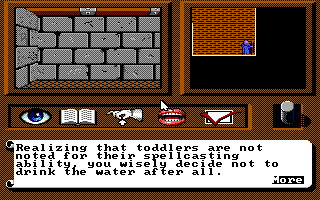 |
| Chester declines to sample the Fountain of Youth. It's too bad, really, I was looking forward to having dialogue options like, "What'chu talkin' 'bout, Master Eldtritch?" |
- As I get more spells, combat is starting to become a little more tactical, though I don't think it'll ever get nearly to the level of the better games I've played so far, like Wizardry, Dungeon Master, or Pool of Radiance. NPCs act on their own and only make physical attacks, so the only real decision I have in each combat round is whether to attack with my weapon or cast a spell. But the right spell--"Silence," "Energy Blast," "Time Distortion"--can make or break a combat, and sometimes the best move is to "Heal" an injured party member. Complicating things is that your spells always cast at the end of the combat round.
 |
| Most of the monster portraits in this game are quite good. |
- A single "Heal" spell or a night's rest fully heals all wounds, regardless of how serious (except death).
- Spell points run out fast, especially when exploring a dungeon where the "Light" spell costs a point every move (I have a max of 130). But it was a lot harder before I realized I could rest basically anywhere. For the longest time, I was hauling myself out of the dungeon and all the way back to my chambers in the mages' tower to sleep.
- I said yesterday that there was no way to "rotate" the first-person view. This is still true, although it does change depending on the way the party is facing, but the only way to change the way you're facing is to approach the square from a different direction. Since what you see in this view isn't really that important to gameplay, I guess it doesn't matter.
 |
| Checking out a room from different angles. |
- There was a puzzle in Xavier's fortress involving having to touch three dragons' heads--white, blue, and red--in the right order. There's nowhere in the game that tells you the order (at least that I found), but the "right" order is, of course, red, white, and blue. Perhaps Origin should have just put a stamp reading "For White Americans only!" on the box.
 |
| If you choose blue, white, and red, the game quits and deletes itself from your cheese-eating hard drive. |
- A wizard in the second area sold me a spell for 100 gold pieces that he said I should use when surrounded by enemies. The spell is called "GNIHTON," which of course is "NOTHING" backwards, which is exactly what it does.
 |
| Wanker. |
- On a farm, I found an adz, the nature and purpose of which I only know thanks to crossword puzzles (see also: jai alai, rara avis, Ara Parseghian, and Ima Sumac).
- I hate ghouls and ghosts in this game. They both paralyze characters very easily, and there's no "cure paralysis" spell. You have to haul the party to a healer.
- Gold is limited to 160 coins per party member. I was up to around 450 after Xavier's fortress, but I lost most of it when my party ditched me. I was steamed. I guess there's probably no way to save up for Esmeralda's answer to the mysteries of the universe then.
- I don't really think this game has a good handle on what a "gnoll" is.

My major quests at this point are finding a stolen copy of Ivanhoe for the monastery and rescuing a woman named Veronica who was kidnapped by a giant. I'm sure these quests will tie into the drought somehow.
 |
| Unless that's a Rose of Disintegration, I'd say you probably don't want to meet him anyway. |
Later edit: And another great one from towards the end of the game.


