Tuesday, July 20, 2010

Might and Magic: Final Ranking

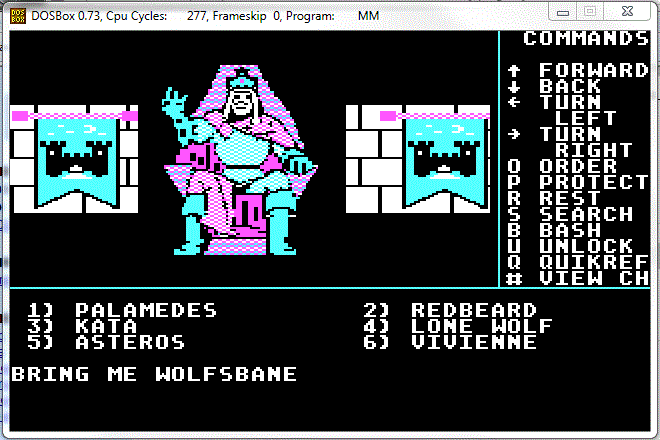
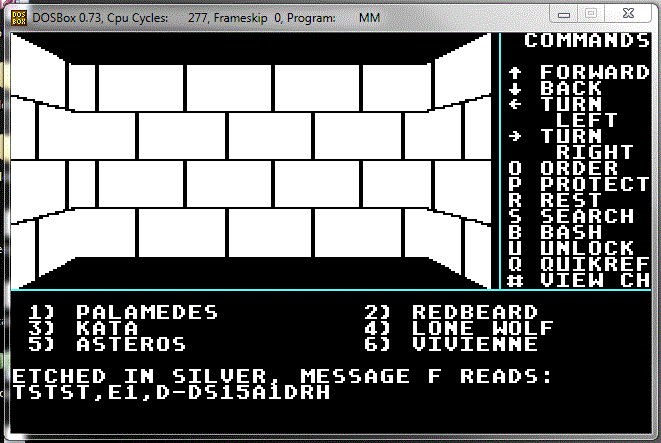
Although I won the game, there were a few encounters I was never able to beat. This is one.
         
Might and Magic: Book One - Secret of the Inner Sanctum
United States
New World Computing (developer and publisher)
Released in 1986 for Apple II; 1987 for Commodore 64, FM-7, PC-88, and DOS; 1988 for Macintosh, PC-98, Sharp X1, Sharp X68000, and MSX; 1992 for NES
Date Started: 3 July 2010
Date Finished: 20 July 2010
Total Hours: 50
Difficulty: Moderate (3/5)
Final Rating: 60
Ranking at time of posting: 19/19 (100%)
Ranking at Game #556: 548/556 (99%)

Matt Barton, who wrote, Dungeons & Desktops (2008; I talked about the book in this posting) has some good things to say about Might and Magic. He describes the series as a lesser-known younger sibling of many of the more prominent series of the decade (e.g., Ultima, Wizardry). King and Borland don't mention it once in Dungeons & Dreamers (2003). But, as we've seen, the game did "refine several gameplay elements that would show up in later games, such as having the characters' race and gender exert a strong effect on gameplay" (p. 128). Barton calls the game "a labor of love by developer Jon Van Canegham and his wife Michaela" and he praises the size of the game world, the number of encounters, and the mystery of the main quest. It made, he says, "a great impression on critics and gamers" (p. 129)—an impression that still holds favorable 24 years later.

As usual, my ranking is based on the 100-point GIMLET scale that I described here.

1. Game world. This is a tough one. Might and Magic launches you into the world of Varn (or VARN, as it turns out) with very little background and with no lore or history. You are left to explore the world and piece together its nature through quests—this is part of the game's fun. The world itself is large—around 50 16 x 16 maps—and varied in its terrain and encounters. Although graphics limitations make the dungeons and castles look mostly the same, each has a certain distinct character and purpose. The revelation at the end—that the game world is simply a biosphere/spaceship—makes Might and Magic unique among games, I'll give it that. But it also raises a lot of questions that the game doesn't begin to answer. How do fantasy conventions like magic and undeath fit within the sci-fi framework? Who thought it was a good idea to combine people and dragons in a spaceship? (Here's hoping Michael Bay never stumbles upon this site.) For that matter, don't the dragons bonk their heads against the "sky"? Except in a few cases, Might and Magic also has the drawback of most early CRPGs in which the game world doesn't react to your actions—nowhere is this more notable than the ending, in which you can "reveal" the false King Alamar over and over. Final score: 6.

2. Character creation and development. Character creation is fairly basic in Might and Magic: you choose from a list of six classes and roll a standard selection of attributes. You can choose name, sex, and alignment. Character development, while still fairly basic, is surprisingly satisfying. In a standard game, you might achieve around 20 levels, and each level-up makes you palpably more powerful and able to handle the game's difficult battles. This is true of spell progression, of course, but also in the way that your fighters get extra attacks and do extra damage, and your robber has a better chance of disarming traps. Because of this, the experience rewards you get from quests and combat are quite satisfying. The game does introduce some "role playing" based on alignments, although it is very light (whether to release, torment, or ignore prisoners) and doesn't have lasting consequences. There is one area in which sex matters. Most encounters play identically no matter what the class, sex, or alignment. Final score: 5.

3. NPC Interaction. The game is devoid of visible NPCs, but you come across them in certain squares, and your encounters with them are essential to advancing the game and learning about the game world. The game is one of the first to introduce choices in your NPC interactions—not dialog choices, unfortunately, but very basic ones such as whether to kiss, release, or ignore a maiden you find chained to a wall. A little better than The Bard's Tale (or, at least, more than The Bard's Tale) but not nearly as complex or satisfying as Ultima IV. Final score: 4

Oddly, option (A) is the only way to advance the game. More oddly, all of my characters were female at this point. Jayne will be in his bunk.

4. Encounters and foes. There are dozens of monsters in Might and Magic, almost all with a unique attack or two (sprites curse, centaurs put you to sleep, demon lords can eradicate your characters with a spell), almost all with special resistances, which makes encounters challenging as you try to figure out the best order in which to engage your enemies and the best weapons and spells to use. These foes are not well described, unfortunately, and most are standard fantasy game fare with the exception of some aliens. The game continues The Bard's Tale's tradition of throwing you up against wildly improbable groups of monsters in even more improbable settings: six green dragons and a herd of pegasuses in a cramped dungeon corridor, for instance. There are a few scripted encounters in which you have the option to do something other than fight, but it's almost always the poorer of the options and much of the game is hack & slash. I liked the way the game balanced fixed encounters with random ones. I also like how the game doesn't pull any punches. If you wander into the wrong map early in the game, your level 2 party gets fried by red dragons with no apologies. Areas re-spawn the moment you leave, allowing endless opportunities for experience-boosting. Final score: 6.

Honestly, how did this party of foes ever come together?

5. Magic and combat. Combat is fairly tactical, with a few nail-biting moments, especially at the beginning when opening every door is potentially deadly. The game is one of the first to include missile weapons, and the variety of items you can equip (see below) adds yet another layer to your options. The ability to immediately rest after most combat means that combats are individually tactical rather than tactical by accumulation as in Wizardry or The Bard's Tale. The first-person perspective doesn't offer a lot of opportunities for role-playing in combat. The magic system is well-balanced except at the end, when some of your spells become too powerful and you start to use them as crutches (by then, combat has become a bit boring anyway). Every level increase gives you something new to look forward to in combat, which is nice. Final score: 5.

6. Equipment. In this area, Might and Magic is one of the best of the early CRPGs. You can wield up to six items and carry up to six more, and there are a wide variety of weapons, armor, accessories, rings, boots, and other items to don and use. These have increasing levels of magic power, including some that boost your statistics or cast spells. This may be the first game to require magical weapons to strike certain monsters, but I'm not sure. Some equipment I didn't understand: I held on to a set of rope & hooks and a 10-foot pole all the way to the end of the game, thinking they'd eventually be required, but they never were. I felt that even after around 50 hours of gameplay, I only had encountered a fraction of the possible equipment. Treasure is generally randomized within the game world, but there are a few special items that you receive after fixed battles or encounters. Although the items have no descriptions, and it's tough to tell the relative worth of weapons and armor except by selling cost, this is one of the best CRPGs of this era when it comes to variety and utility of gear. Final score: 7.

Some of the varied types of equipment available in the game.

7. Economy. Not complicated, but not bad for a 1980s CRPG. You start out with no gold, so you have to start making some fairly quickly. As you do, you're able to equip yourself slowly. As you progress through the towns, you find that more advanced equipment is available, so making money to buy things (and to train your characters) remains viable well into the 12th hour of the game. After that, well, there are still things to do with your money. Donating at temples will temporarily bestow upon you every protective spell in the game, at much higher levels than your characters can cast, so it's worth it to pay before a big battle. Second, the magic fountain at Dragadune converts all your gold to experience—meaning that if you make use of it, you need to immediately start building your finances again if you ever want to level up. Third, there's a place in the game where you can exchange gold for gems, through the intermediary of trivia questions. Thus, cash rewards never stop being relevant. Final score: 7.

8. Quests. This is where Might and Magic really excels, particularly among its brethren of the Silver Age. As I remarked several times, the "main quest" reveals itself only in stages, which actually works well in a game that allows you open-ended exploration. The main quest is also unusual in its sci-fi theme and lack of a "big boss." More important, however, there are dozens of side quests—the first real side quests in any CRPG, I think. Some of them are unusual and reasonably complex: climbing all the trees in a grove, solving the magic square puzzle, the mystery of Portsmith, and the prisoner-Statue of Judgment quest among them. They even offer a little light role-playing. Some involve finding items, some visiting locations, some killing monsters, some answering riddles. This is all extremely advanced for a CRPG of the era, and they remain fun even today, even if they don't offer the narrative complexity or role-playing choices of, say, Neverwinter Nights or Oblivion. Very well done, JVC. Final score: 8.

Just picturing my characters doing this one is fun.

9. Graphics, sound, inputs. The graphics of the era still have not advanced out of the "functional" stage. The game makes good use of sound, for the time, but to modern ears it's repetitive and ultimately annoying—I played most of the game with the sound off. Keyboard controls are easy enough to get used to. Final score: 4.

10. Gameplay. As I previously covered, gameplay in Might and Magic is very non-linear, which (as I also previously covered), I like a lot. Except for a handful of locked doors for which you have to find the keys, there's almost nowhere in the game world that you can't trek from the starting town—assuming you can survive the monsters (hint: you can't). I liked that the game essentially required me to explore to even figure out what the main quest was about. The difficultly of the game is well-balanced. Although you die a lot, particularly at the beginning, the pace of the gameplay is fast enough that you don't really mind (assuming you haven't been a complete idiot about saving). Just as it starts to drag a bit, you start to get a selection of spells—time warp, fly, teleport, town portal—that make traveling about the world a bit faster, and low-level monsters much easier to dispatch. It was over just when I was about ready for it to be over, which is always the mark of a good game. My only complaint: no replayability. But that's par for the course in the Silver Age. In the end, this game was exactly what it should be to earn a high score on my blog: addictive. Final score: 8.

The final tally of 60 is the highest of any CRPG so far, even higher than Ultima IV. This gives me a few pangs, but although I like Ultima IV better as a story, I admit that I probably like Might and Magic better as a game.

As you'll see in my next posting, my next steps are not all that clear. More soon.
    
***
   
Further Reading: The series continues with Might and Magic: Book Two - Gates to Another World (1988), Might and Magic III: Isles of Terra (1991), Might and Magic: Clouds of Xeen (1992), and Might and Magic: Darkside of Xeen (1993). There was an unrelated game that preceded this one, called Might & Magic: The Lava Pits of Aznar (1983).  

Might and Magic: Won!

Might and Magic ends with a shameless plug.
     
Well, damn that took a long time, but in the wee hours of this morning, I completed Might and Magic: The Secret of the Inner Sanctum, easily the largest and, hence, longest game I have played in my blogging project so far. In fact, I think it's safe to say that it rivals modern games in its overall number of game hours. My last hours in the game were marked by stupid mistakes and laughable errors, starting with the revelation—after I had won the game—that I had missed the graphics setup executable in the game folder. Instead of seeing this for the past 50 hours of gameplay... 


...I could have been seeing this:


Oh, well, the important part is the gameplay, right? We'll get to that. When I last blogged, I was working to fill in pieces of each map and stop dying all the time. This was helped greatly as my spellcasters advanced and got hold of the more powerful spells, some of which could completely obliterate large groups of enemies in one casting. I was able to finish most of the surface and all but a few of the underground maps at this point. I solved two of the more important side quests, one of which involved slaying four big bads in each corner of the map and then spinning a wheel of fortune to get gold, gems, and experience as a reward. The second involved visiting each of the castles in the game world and determining what to do with prisoners found there. This quest was kicked off by a wizard named Ranalou who I met in a cave: 


The quest offered some real (if basic) role-playing choices that had to jive with your alignment. Among the prisoners you found were scared children, helpless maidens, and vicious demons. I had to decide what to do with each one and then head to the "Statue of Judgment" after dealing with all of them. Good characters were rewarded if they tormented the demon but set the other prisoners free. Evil characters were rewarded for tormenting everyone. Neutral characters were rewarded for walking away from each prisoner. Since my party had a mixture of good, neutral, and evil characters, no one got the full reward. If I were to play again, I would stock my party with characters of a single alignment.
       
As I covered in another recent posting, sex turned out to play a role. In one town—Portsmith—male characters were drained of hit points every time they walked through certain (unavoidable) intersections. This turned out to be the work of a succubus holed up in a secret room, and in due course I was able to find and kill her and her minions. But to even stand a chance, I used a magic pool in the town's dungeons to change the sexes of all of my male characters so they wouldn't be drained before the big battle. Then, in horrible show of non role-playing, I never got around to changing them back. "Redbeard" the dwarf fighter, and all of his compatriots, ended the game as females. I spent a lot of time fighting my way through the four levels dungeon of Dragadune to find the enigmatic "Clerics of the South," who rewarded me with this message: 


I had absolutely no idea what this meant, and I was a little annoyed at having worked so hard for it. Only after winning the game and checking a walkthrough did I find that this meant I could return to various spots that boosted my stats and get them boosted again, as well as complete the Statue of Judgment quest again. Oh, well. In the Castle of Doom, after battling my way through hordes of tough monsters, I found this message scrawled on a wall: 


I remember the Star Trek episode of the same title, and at first I thought this was just a geeky reference to it (the MM team is well known for its frequent Star Trek references, including "Q" in VI). But it turned out to be an important plot point in the game, as we'll soon see. In the corner of another map, in an area accessible only through the use of the "etherealize" spell, which allows the party to pass through walls, I found a "Land of the Lost" in which dinosaurs roamed. 


Battling through them, I found an "Hourglass of Time," which reverted all my characters to the age of 18. Many of them had been pushing 50 by then, which means that in game time, my party had been adventuring together for 32 years. That's quite a quest. My dungeon explorations allowed me to assemble the two strange "messages" that you find in pieces around the world. The first was singularly unhelpful, only telling me where the various fountains and pools and other sites were that raise each of your stats by 4 points each. I had already found them all by the time I figured out the message. The other one spelled out the game: 
     
THE SCOOP: FOR SUCCESSFUL COMPLETION OF BOOK ONE, THESE ARE THE TASKS THAT MUST BE DONE. RIDDLES AND QUESTS, DISCOVERIES AND TRAINING, EACH HAS A VALUE THAT INCREASES YOUR RATING. THE KING'S TRUE SELF YOU MUST IDENTIFY, TO BE WORTHY OF THE KNOWLEDGE THAT YOU CAN APPLY. RETURN FROM THE ASTRAL PLANE FROM 5 DIFFERENT LOCATIONS, THE 6TH VISIT WITH A KEY CARD SHALL END YOUR FRUSTRATIONS! YET 9th LEVEL YOU MUST HAVE ATTAINED FOR THE INNER SANCTUM TO BE CLAIMED. FROM MY DREAMS TO REALITY, AND REALITY TO DREAMS, A SEQUEL IS IN ORDER, WONDROUS IT SEEMS... JVC
        
A little helpful, I guess, but nothing I wouldn't have figured out on my own. "JVC" is the creator, Jon Van Caneghem, who I think is still in the business. Jon, if a little ego-surfing leads you to this blog, you made a hell of a game. The toughest quest leading up to the endgame concerned the blind seer Og. One of the first clues I got in the game, from a statue in Sorpigal, was that I needed to restore his sight with two idols, and this was somehow connected to a black and white checkboard pattern I kept finding in dungeons. Well, I did find the pattern a lot, and in two of the locations, searching yielded the necessary idols. I took them to Og and got this... 


Now, if I'm not mistaken, this is another Star Trek reference—specifically to the unexplained three-dimensional chess that they sometimes play in the original series. At least, it's the only way I can explain "levels." To solve this, I first thought, the creators wanted me to know the rules of 3-D chess from Star Trek? Jesus. Then I remembered three clues I had received in other black and white checkboard rooms. They were:
  • The first part is female
  • The second part is most valuable
  • The last part is the first
Helpful, right? Friends, I came awfully close to breaking my "no spoilers" rule. The first clue was easy enough: "Queen." The other two, I just couldn't figure out, mostly because I was thinking that 3D chess might have all kinds of esoteric moves. Answers I'm embarrassed to say that I tried include "QUEEN TO GOLD QUEEN" and "QUEEN TO DIAMOND QUEEN LEVEL" or some such nonsense. Ultimately, I realized the answer would have to parallel the challenge, with the name of a piece, the name of another piece's "level," and the number of the level. The "most valuable" piece is a king and could "the first" refer to something as absurdly simple as....yes, the answer was "QUEEN TO KING'S LEVEL 1." After all that, this is what I got: 
       
       
Great, right? Except that I had already found the prisoner in Doom! So all that was just for the 25,000 experience points, which by this point in the game I was getting in three or four battles with dragons. Bloody hell. Here was the aforementioned prisoner: 
      
       
This dovetailed nicely with what the crashed aliens had told me earlier in the game, so with the Eye of Goros, I went off to challenge the fake Alamar. 
        
       
Alamar revealed himself as the alien "demon" and threw me into a dungeon called the Soul Maze, where I was immediately confronted with this question: 
        
       
Now, folks, if I was embarrassed at how long it took me to solve Og's riddle, this one really fills me with shame. I spent hours mapping the dungeon making sure that I turned and faced each wall. To my frustration, I couldn't find any messages written anywhere that told me my captor's name. I must have gone through it three or four times before I finally took a good look at the map I had been making: 
       
       
I mean, could that be any easier to see? MY NAME IS SHELTEM (I don't know what to make of the enigmatic "HELP" in the upper left). Anyway, I gave the answer, and here's when things got weird:
       
        
Okay...well, I had a pretty good idea where the Inner Sanctum was: on the Astral Plane, which I had the foresight to have already visited and mapped. Somewhere along the line—I missed to tell ye in my tale—I found the key card I needed to get into the place, and so without further ado, I made my way. 
      
       
So it turns out that the game world, called Varn, was actually VARN (Vehicular Astropod Research Nacelle)—a space ship. An alien invader named Sheltem crashed on the ship and impersonated a king. And all the monsters and undead and magic were...what?....aspects of the same technology that powers the ship? Things get weird when you combine fantasy with sci-fi. The references to Corak are never explained, and it remains unclear what happened to Sheltem. Quite oddly, there is no final battle. I expected an epic confrontation with Sheltem that never came: if you re-visit Alamar's/Sheltem's castle, you just get tossed into the Soul Maze again. The game allows you to keep playing and finish any side quests. There are 37 according to one walkthrough, and I think through my exhaustive mapping of the game world, I was able to complete them all.
       
I made a video of the end game (it starts with me killing some dragons just because I can and is interrupted a couple of times while I take screen shots) if you're interested. Otherwise, it's time for my review posting and then on to...The Bard's Tale II. Bollocks. 
       

Friday, July 16, 2010

Might and Magic and Quests

The adventurers get a quest that truly tests their ingenuity.
    
I've been waiting for Might and Magic to settle in to a more cohesive narrative before I posted again, but that just isn't happening. The game is, rather, coming together like a puzzle, and until I get more pieces I won't be able to see the full picture.

After I found the Merchant's Pass, I was able to visit a couple of the castles and get quests. It appears that each lord gives a series of quests, starting with very easy ones ("bring me garlic!" or visit a particular location) and escalating to hard ones. My current quest is to find a medusa's head. I have a pretty good idea where to look, but gorgons and basilisks keep turning me to stone, and I won't have "stone to flesh" for another level yet. Fortunately, whenever I encounter obstacles like this, there's another map to explore.

In my first Might & Magic posting, I thought there might be around 35 maps to explore. Ha! I didn't account for all the dungeons, caves, castles, and fortresses—some with multiple levels. I'm up to 53 now, and I think it might be finally slowing down. Still making very little progress on the "main quest," but I'll let you know when that changes.

The game got a little easier when I reached Level 4 and got two spells: "time warp," which allows you to escape combat, and "surface," which allows you to quickly exit a dungeon. These coupled with "fly" mean that I'm never more than a few moves from a town, healing, and a save point. But you can't always rely on them. "Time warp" has a way of failing right when you need it most, and I still get wiped out in about 25% of my forays from town.

A few other random things from the game.

1. Black & white checkerboard rooms. I keep finding rooms like this one in dungeons:


A statue in Sorpigal suggests these have something to do with the seer Og (who I found on one of the maps but couldn't do anything with), but I have no idea what I'm supposed to do with them. (S)earching returns nothing and there are no secret doors.

2. Magic square puzzle. One of the dungeons had this neat soduku-ish game where the entire dungeon was laid out in a 4 x 4 grid. The center of each room had a dial that you could set to a number from 1-9. Some of them were already pre-set to numbers higher than 9. I figured out right away that it was a magic square in which all of the rows and columns needed to add up to the same number (34) and you could only use each number once. With a little help from Excel, I figured it out and was duly rewarded. I can't remember this type of puzzle in a CRPG earlier than this one.


3. Messages. One of the consistent features of Might & Magic is that you encounter a series of nonsense messages at various places in the game (in VI and VII they're on obelisks scattered throughout the land; in I they're written on walls). Once you've found all the messages, you interleave the letters or words to determine the total narrative. I've only found a few, so I can't even begin to guess. There seem to be two sets—one with letters and one with entire words.


4. Corak. In one dungeon, I found this message scrawled on a wall. It is the first reference to the enigmatic Corak, who appears in a bunch of the Might & Magic games, but frankly I forget what his specific role is. I just remember him—or references to him—in III. Maybe this game will remind me.


5. A dungeon with invisible walls. I stumbled into this one from a magic door. The "locate" spell didn't work and you couldn't see most of the walls—you could only try to walk into them and get a "blocked!" message. This was a pain to map. I'm still not sure what I'm supposed to do there; I apparently need some kind of card.


6. The experience fountain. In a ruined castle called Dragadune, I found this fountain, which takes your gold and gives you an equivalent number of experience points. I thought this was unique to Might & Magic VI. Now I'm wondering if all Might & Magic games have one and I've just forgotten—or missed them.


6. Little touches. Wandering through the fortress of the minotaur lord, you come across things like this. Yes, it would be nice if the game actually showed you these tapestries, but we're a few years away from those graphical capabilities. It's still a neat touch that keeps the game interesting.


My basic strategy has been to explore each map until I get blocked—either because I need an item I don't have or because the monsters get too hard—and then move on to the next map, revisiting the previous ones at higher levels. As much as I enjoy the game, I'm getting ready for it to end—my long list awaits—but I actually want to find out what the main quest is, who Corak is, and the fate of the alien invader. To me, that's a sign of a good CRPG.


Tuesday, July 13, 2010

Might and Magic and Adventure

I do like riddles in CRPGs, even if this one was pretty damned obvious.
     
You will be pleased to know that I've been living up to my name. I happen to be working on my PhD right now. I should be done with my coursework in February, provided I don't flunk out of the program before then. Yesterday, I had two papers due, but I put them off until today—turning them in a day late—because I spent most of yesterday playing Might and Magic. How far I've come since high school!

Usually when I don't post anything for a few days it's because I'm traveling or working and trying my best not to think about CRPGs. Lately, it's been for a different reason: I've been playing. Over the weekend, I didn't want to tear myself away from my gaming to blog about it. I have essentially the same problem with vodka.

As I mentioned towards the end of my last posting, I was dissatisfied with the combat performance of my spellcasters, largely because I hadn't taken into consideration the effects of speed on combat initiative. I rolled a new sorcerer and new cleric and spent much of my playing time getting them up to speed while still exploring. I've mapped at least some of all of the 20 outdoor areas, although almost all of those maps have notes for things I have to come back and do when I'm at a higher level or have found some key or something.

I'm also finally getting hints about the main quest—I think. Actually, a few things happened and I'm not sure which are related to the main quest. Here are my options:


Main Quest Possibility 1: Something to Do with a Minotaur King

I found clues in two towns directing me to a particular map square where I found a whistle that will allow me entry to the minotaur lord's enchanted lair. Part of me thinks this is the main quest because the hints came from two brothers I was told to seek by the wizard who finished off the first quest in the game. Also there was a statue in the first town that talked about the minotaur lord's castle in the Enchanted Forest. The strength of this possibility is that it appeared early in the game, which main quests usually do.

Main Quest Possibility 2: Aliens

On another map square, I met "the exiled Lord Kilburn" who gave me a map that prevented me from getting hopelessly lost in the desert.
            
               
It took me forever to explore the desert anyway because it's full of teleporters that randomly pop you around the map, and even if you don't get lost, walking through the desert consumes a unit of food for every step. Nonetheless, I finally found a circle of mountains in the middle of which was...wait for it...an alien spacecraft.
            
              
The game gave me a role-playing choice and I decided to be friendly. Suddenly, the alien spoke English:
           
             
Now, any player of any other Might and Magic game knows that the series has a way of diverging suddenly into science fiction. In Might and Magic III, the final dungeon is a spacecraft. Might and Magics IV and V have a sci-fi game ending that I won't spoil here. Might and Magics VI and VII have you battling alien invaders. There is a basic sci-fi mythology to the whole series, and I wondered if it would appear in the first game. I'm glad to see it does; maybe it will solve some of my confusion on the rest of the series. So the sci-fi element makes this very likely to be the main quest, but I can't be fully sure.
       
Main Quest Possibility 3: It Hasn't Started Yet
         
Main quests are often introduced by lords and kings, but I have yet to be able to speak to any of them. Why? Every time I go into a castle, I get booted out because I don't have a merchant's pass. It turns out there was one very easy to find early in the game but I overlooked it. Now that I have one, I can start speaking to kings and queens, see if they tell me anything useful, and perhaps expose the alien impostor besides.
       
Not having any idea about the main quest this late in the game is a bit unusual, but in Might and Magic, you get so easily distracted by side quests and other encounters. I've lost track of all the fun things I've encountered just wandering around the maps. Here's a quick sample:

  • A gypsy who reads my characters and tells me their signs. On another map, accurate knowledge of these signs compels a bridge guardian to extend a magical bridge across the ocean to a hidden area; getting the signs wrong destroys your characters(!)
  • A throne adorned with gems. A mysterious voice poses a riddle whose answer is "love." The correct answer provides the characters with a diamond key (don't know what it opens yet).
  • Very powerful creatures, including a black knight and a sea dragon. I know from a statue in Sorpigal that if I kill them, I'll get rewarded at the Wheel of Fortune (which I found), but I'm a long way from being a high enough level to do that.
  • A mountain peak whose views give you hints as to encounters on other maps.


  • A town (Portsmith) in which every resident is a woman and male characters are continually drained of their hit points, making combat nearly impossible.
  • A cave full of teleporters, the successful navigation of which puts you in touch with a wizard named Ranalou who gives you access to a bunch of portals to other places.
  • Fountains that temporarily raise your statistics.
  • A grove of trees. You apparently get some reward for climbing each one, but climbing them leads to encounters and I haven't survived yet.


  • A statue of a lion asking for a password.
  • A statue with a "scroll of judgment." Haven't figured out what to do there yet.
  • A forest in which mysterious weeping echoes throughout.


And finally, several notes to round out my previous discussion of combat in Might and Magic.
               
  • Might and Magic continues The Bard's Tale tradition of throwing at you rosters of monsters that seem implausible as coordinated groups. Three clerics, six vampire bats, and a acidic slug. A minor demon, three militiamen, and four swarms of bees. How do you plan an attack with a swarm of bees? Why do you?


  • There's a handy keyboard shortcut, CTRL-A, that makes you cycle through combat very quickly. Each character in melee range attacks, each one with a missile weapon shoots, and other characters just guard. Very handy for low-level monsters.
  • Donating at temples causes the priests to bless you with a battery of protection spells until you rest. You could cast each one individually, but they take time.


  • Attacking certain creatures (unicorns, pegasuses, clerics, etc.) causes your alignment to slip. Good characters become neutral and neutral characters become evil. You have to pay to right things. This is particularly annoying because there's no "talk" option, so if you want to avoid attacking a group of creatures, you have to try to flee.
  • Flee almost never works. Especially when you need it most.
  • Even when wandering low-level areas with high-level characters, you can never get too cocky. Centaurs and sprites, for instance, are both easy to deal with singly, but run into a pack of them and they will repeatedly cast sleep or curse (respectively), destroying your chances of fighting back. One unlucky random encounter can ruin hours of work if you don't keep going back to a town and saving (which has the unfortunate drawback of resetting the map).
  • I am still dying at the same rate as before: for every 30 minutes of gameplay only about 10 is "saved." This isn't as bad as it sounds because most of that time is spent mapping, and once that's done, it's done whether your characters survived or not.
  • I'm not sure what I'm doing wrong, but the "turn undead" spell, even on the basest of creatures, works about 1 time in 20.
             
Still having a great time, though. Games like this are why I started this project. No question about finishing this one.

Friday, July 9, 2010

Might and Magic and Ability Scores

Grey Star the Sorcerer: weak, slow, and clumsy, but lucky and smart
            
Might and Magic is the first game in which I'm really noticing the affects of ability scores. Every game up until now has had them, but I didn't really think about them once the game started. Here, their effects are front-and-center. Ability scores, attributes, characteristics--whatever you call them--are an element that almost all CRPGs share. In this, of course, they are adapting rules from pen-and-paper Dungeons & Dragons. The earliest games had only one or two scores. Rogue, I think, just had strength. But fairly quickly--by Ultima I, really--games had grown into the standard set of five or six ability scores. It's rare to find a game (like Ultima IV, which only had strength, dexterity, and intelligence) that reverts to fewer. I'm always amused by the numerous ways different games try to be original by changing the names of the ability scores. The standard D&D list is strength, dexterity, intelligence, wisdom, charisma, and constitution. Perhaps in an effort to avoid copyright violations, Wizardry offered a slightly different but nearly synonymous list: strength, IQ, piety, vitality, agility, and luck. "Charisma" was presumably left off the list because in early CRPGs, there were few ways to actually base anything on it. "Luck" is an innovation for Wizardry--an extra score that has subtle influences on just about everything--and it would carry over into other first-person, multi-party games like The Bard's Tale and Might and Magic
    
Wizardry's character screen with ability scores.
       
Might and Magic's contributions, such as they are, to the evolution of ability scores is to use "might" instead of strength, split dexterity into "accuracy" and "speed," and combine wisdom and charisma into "personality," the prime stat for clerics (in this they anticipate the third edition D&D rules). Like D&D games, each character class has minimum levels of attributes. Although the names change, the purpose of different ability scores remains fairly consistent. In descending order of prevalence, we find:
  • Something that determines how much damage the character does when he hits something. This is almost always called "strength" but of course is "might" in Might and Magic (otherwise, it would have to be Strength & Spells). Secondary uses of this attribute in some games include determining what type of weapon one can wield (Phantasie), how much weight the character can carry (Elder Scrolls) and whether the character can force doors or chests (D&D-derived games).
  • Something that determines the character's spell power. Usually this is "intelligence" but it also goes by "IQ." Like strength, it has secondary uses in more advanced CRPGs. In D&D games, for instance, it helps determine whether you can translate scrolls and identify magic items. In Baldur's Gate II, Neverwinter Nights, and Icewind Dale II, it also determines the sophistication of your dialog responses.
  • Something that determines how likely a character's attack is to connect. "Dexterity" is the D&D term, but we also have "agility," "accuracy," and "aim." I can't think of secondary uses for this one, but see below.
  • Something that determines how fast the character moves and, hence, how likely he is to be hit. In D&D, this is also "dexterity," but some games, including the Might and Magic and Elder Scrolls series, split it off into a separate "speed" score. In continuously-scrolling games (like all games are after the mid-1990s), this score may literally determine how quickly you move across the screen. Some of my fondest times in Oblivion is when my speed-enhanced character rushes up and down mountainsides, blasts through forests, and leaps across rivers. In turn-based games like Might and Magic, speed determines the attack order of characters and enemies (more on this in the last paragraph).
  • Something that determines how much damage you can take. Usually, hit points are a "derived" statistic based on your level and an ability score. In D&D, that ability score is called "constitution," but we also have "endurance," "vitality," and "stamina" in the repertoire. As games get more advanced, this statistic also determines how likely you are to succumb to certain spell effects and how much liquor you can hold.
  • Something that determines how charming you are. "Charisma" or "personality," generally. This has a bunch of different uses depending on the game, including spell power for clerics or priests, prices at shops, and relations with NPCs. In the Baldur's Gate series, it determines how easy or difficult it is for the PC to hold together a party of differing alignments, and it determines who the PC can romance.
  • A secondary characteristic for priest spells. In games that separate cleric/priest spells from wizard/sorcerer spells, "wisdom" or "piety" or "personality" will determine the power of those spells and how many the character can cast. Except when combined with the above attribute, this doesn't seem to have many secondary uses.
  • Do you feel lucky? Finally, as we've seen, Wizardry and its posterity introduced a "luck" statistic just to shake things up.
Setting ability scores in Ultima I.
    
CRPGs offer a lot of variety as to how these statistics are determined. Some automatically generate them and you take what you get. Some allow you to "re-roll" until you get the outcome you want. Some give you a fixed score pool and allow you to allocate the numbers the way you want. A few (Pool of Radiance and Temple of Apshai come to mind) allow you just to specify the attributes you want, which offers a usually-insurmountable temptation to just max everything. Perhaps the most unique attribute-setting method was found in Alternate Reality: the City, in which a constantly-spinning series of dials fixed in place the moment you walked through a portal.
"Hold it...hold it...Now! No, wait!...Okay, now!"
 

Perhaps one of the most variable aspects of CRPG playing is how mutable these statistics are once fixed. In D&D games, it practically requires an act of the gods to change your ability scores, and even then you can only change them by a little bit. This makes sense in the context of the D&D worlds, in which there is a theoretically upper limit for any human, no matter how heroic. In later Might and Magic games, by contrast, it hardly matters what statistics you have at the outset because your final characters will have many many times that initial number. I remember starting out Might and Magic VI with 15 or 16 strength and--thanks to potions, wells, barrels of colored liquid, magic items, and other fortunate finds--ending up with almost 300. Oh, let's quickly cover a few other aspects of ability scores worth thinking about:

  • They can be damaged. Spells, poisons, curses, and other assorted calamities can give you the strength of an infant and the intelligence of Glenn Beck.
  • They can be enhanced. Other spells, potions, and magic items can elevate your stats. I particularly like finding Gauntlets of Ogre Strength in D&D games and immediately transmuting a character with a strength of 6 to one with strength of 18 (the third edition ruined this).
  • They are modified by race and sex. If the game allows multiple races, very often you'll find yourself with higher strength (dwarves), lower charisma (half-orcs), or some other adjustment after finishing your character.
  • Each character class usually has a "prime requisite." Strength for fighters, dexterity for thieves, and so on. There is usually a minimum acceptable ability score for those classes. In some games, you choose the class first and the ability scores get adjusted; in others you get your scores first and have to choose from a limited selection of classes based on the results.
With a charisma of 6 and an intelligence of 4, I could only choose between the "Fox News Commentator" and "Galoot" classes.
      
Bringing this back to Might and Magic, as I said, I'm feeling the results of my initial ability score selection choices. I did well enough with might for my two fighting classes, and when their swords connect, they connect with a satisfyingly-high amount of damage. I did well with accuracy on my archer, too (19)--she lands every shot she makes. But I skimped on speed except for my robber (16). The result is that he almost always attacks first, but with an accuracy of 13 he often misses, and with a might of 8 he hardly ever does any damage. What you really want, I'm discovering, is a sorcerer with a high speed score, so he can immediately blast groups of enemies at the opening of the battle. Conversely, you want a cleric with a low speed score, so she can go last in the rotation and heal any major damage taken by party members in that round, getting them back on their feet for the next round. This is important enough that I'm considering ditching my existing cleric and sorcerer and re-creating ones with better (or, in the case of the cleric, worse) scores. Other than that, I'm still exploring and mapping, and collecting screen shots for a post later about the different things you encounter in the Might and Magic world.