The Third Courier
Manley & Associates, Synergistic Software (Developers); Accolade (Publisher)
Carol Manley (designer) and Ivan Manley (designer/director)Released 1989 for DOS, 1990 for Amiga, Atari ST, Apple IIgs
Date Started: 16 August 2013
Date Ended: 17 August 2013
Total Hours: 7
Difficulty: Moderate (3/5)
Final Rating: 29
Ranking at Time of Posting: 48% (51/107)
Final Rating: 29
Ranking at Time of Posting: 48% (51/107)
The Third Courier turned out to be almost exactly like B.A.T.: a nearly pure adventure game masquerading as an adventure-RPG hybrid, in which all but a couple of combats were unnecessary and avoidable, attributes and traits didn't matter at all, the plot was extremely limited, and the developers bulked up the game with inexcusably large and tedious mazes. Just like B.A.T. (and, frankly, a lot of games I played in 1989), it had some intriguing elements that simply didn't come together in any kind of coherent fashion.
The plot turned out to have three major parts: the recovery of a computer chip from the Charlottenburg Palace, the recovery of a disk from the Soviet Embassy, and chasing down a mole who ultimately stole both of those items after I had recovered them.
 |
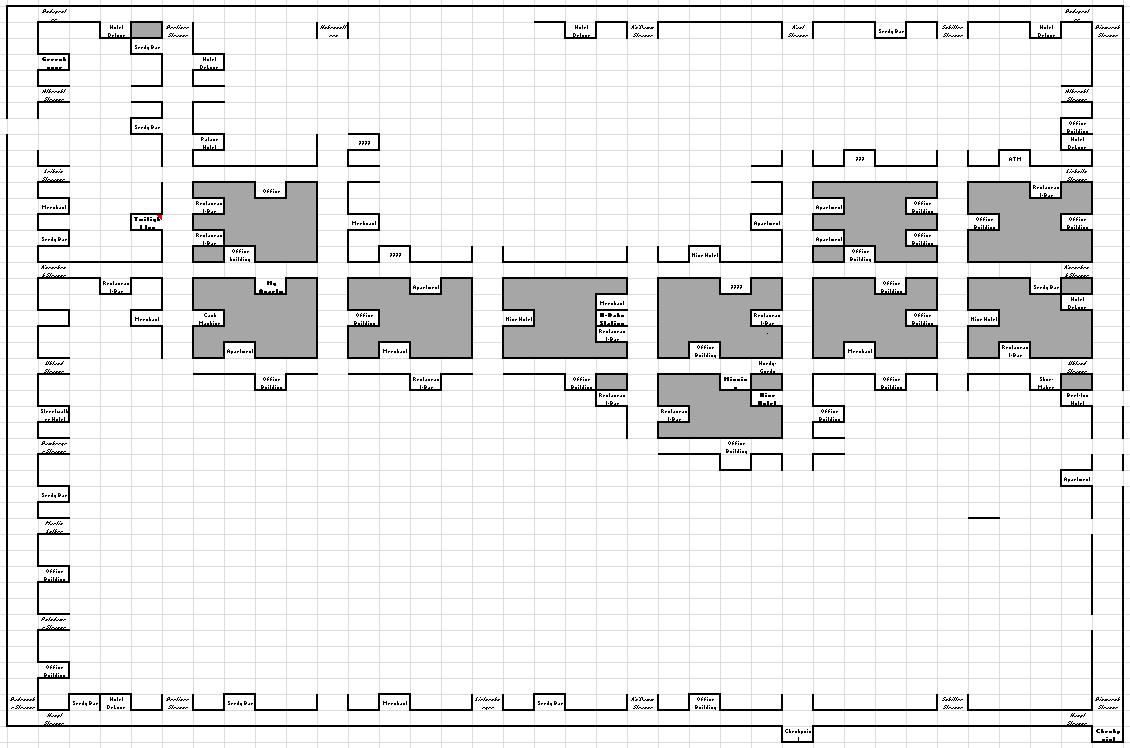
| My final map of West Berlin. Only about 10 of all the locations annotated here are necessary to the plot. |
Mapping the streets of West Berlin took almost as much time as the rest of the game. As time passed, I received several clues pointing me to a place called the Ax Bax Bar, which may have been a real place (it shows up on a couple of non-Third Courier sites). A sausage vendor asked me to get forged papers for his girlfriend, and I bought them from the shoe maker. He told me about Ax Bax, as did a mysterious message on my answering machine.
 |
| No idea who "Jack" is. |
When I bribed the bartender there, he told me to seek a guard at Charlottenburg Palace (definitely a real place) named Waldemar Verner. In the palace, I was presented with my first pointlessly enormous maze. Its two floors wound around forever, and I began to despair of ever finding anything valuable when I finally got a message that my FERAT (some kind of radiation detector) was beeping. In one of the displays, I found a hidden computer chip. I spent a couple of reloads trying to steal it but setting off the alarm before it occurred to me to bribe the palace guards. One of them (presumably Herr Verner, though the game didn't identify him as such) agreed to shut off the alarm, and I was able to escape with the chip.

For a while after this, I didn't know what to do next. But I discovered through exploration that I could take photographs of any of the NPCs I encountered--the butcher, a bookstore owner, street vendors--and automatically transmit them to CIA headquarters, receiving dossiers on them in return. One of them indicated that the butcher operated a black market and gave me the password. From him, I was able to buy a bullet-proof vest that greatly increased my survivability in combat.

A cryptic e-mail suggested that I check out the Tempelhof Building, which I had previously discovered. There was nothing there but a dark basement, so I had to return to Mission Support to get a flashlight. I saw that MS had a lot of new items for me, including a gas mask, a Visa card, a "super bug," a briefcase, and tannic acid. I never ended up using half this stuff, which I'll talk more about at the end.
Anyway, with the flashlight I was able to explore the basement and its subsequent entry into the aqueducts. The area was absurdly large, taking me more than two hours and plenty of reloads to map. Criminals attacked me constantly, exhausting my ammo and forcing me to pick up their dropped weapons so I could keep fighting (I got an Uzi out of it, so I guess I can't complain). Honestly, the size of the basement and aqueducts was ridiculous, even worse than the dumb maze in B.A.T., and there was no excuse for it except to bulk up the perceived time and difficulty of the game.
 |
| This view didn't change for hours. |
(I did discover during this process that "sneaking" all the time produced fewer random encounters, but it did increase the frequency of encounters with police on the street.)
At long last, through several locked doors I had to open with picks or the Visa card, I emerged in the basement of the Soviet embassy in East Berlin. It was also unpardonably huge, and I had to keep killing poor embassy guards as I explored. Eventually, I found an office and recovered a computer disk from a locked safe.
 |
| You don't see the ol' hammer and sickle enough these days. |
I wasn't about to return to West Berlin through those tunnels, but getting back was harder than I thought. The checkpoints kept finding my weapons and questioning me for hours, leaving me weaponless when I was finally released. At last I discovered that taking the U-Bahn would allow me to keep my weapons, though I had to keep presenting my passport to suspicious border guards. (I was surprised to see from Corey Cole's comment that there really was subway service between East and West Berlin in the 1980s.)
 |
| Living in Cold War Germany must have sucked. |
Back in West Berlin, I was almost immediately approached by a vagrant who told me that the chip and disk had been stolen back and were on the black market again. Sure enough, they were gone from my inventory. I admit I was annoyed enough to reload, but there didn't seem to be any way to avoid this plot development.
 |
| Who are you, and how do you know this? |
I spent some time screwing around, trying to get clues from places and people I'd already visited. I got some too-late clues that indicated the courier's girlfriend was the Soviet embassy secretary whose office I'd stolen the disk from. Eventually, the butcher told me that the "man I'm interested in" often has lunch at the Opern Cafe in East Berlin. I crossed back over, visited the restaurant, and heard someone saying "I don't know if I should trust Nigel" (the name of my CIA boss).

I staked out the restaurant and saw Nigel leaving in a cab. I was at last able to use the "follow that cab" option when hailing my own cab. Nigel led me to a safehouse where, in the game's only truly fixed combat, I had to kill a guard dog.

Entering the house, I found a dead body on the couch and Nigel arguing with another man (perhaps the disguised vagrant from before). Each tried to convince me that the other was the bad guy. The unnamed fellow said that there was no real theft of documents; the whole operation had been to draw out a mole. (Didn't Mission: Impossible use this same plot device seven years later?) Nigel's protests were much less convincing, consisting primarily of "I'm your boss!," so I shot him. The unnamed agent congratulated me and I got the winning screen above.
 |
| You can stop pointing. I already shot him. |
I never did find out who the dead body on the couch was. I assume it was William Martin, the titular Third Courier. On a reload, I tried shooting the other guy instead of Nigel, and I got a "bad" ending:
 |
| I died right after this, but I'm not sure why. Couldn't I have still shot him while he was confessing? |
I consulted a walkthrough and discovered that there were several alternate avenues to get to the same plot points. For instance, if I'd gotten the clues about the embassy secretary earlier, I could have broken into her apartment and bugged it, then listened to the recording to hear her talking with the courier about the disk being in the Soviet embassy. I could have purchased better vests and weapons from the butcher if I'd saved more money. If I'd managed to kill one of the assassins who attacked on the first day and searched his body, I'd have gotten the Ax Bax Bar clue much sooner.
There are a few other things to cover, but I'll handle it in the GIMLET below:
- 4 points for the game world. I liked the Cold War theme, and the game did a reasonably good job (for the 1980s) recreating divided Berlin and some of its most famous landmarks. We're running out of time for Cold War themes to appear in any other CRPGs; even this game is almost too late, as the Berlin Wall would come down within a year of its release. The major negative about the game world is the ridiculous number of random restaurants, bars, office buildings, merchants, and hotels, none of which mean anything during the game. I was particularly disappointed that none of the hotels, each with numbered rooms and maze-like corridors, played any role in the game.
 |
| There's nothing to do here at Brandenburg Gate, but it's fun that they included it anyway. |
- 2 points for character creation and development. The game has an interesting creation process and rewards the player with experience points for both combat and puzzle-solving, but ultimately it's all a sham. Experience rewards for hitting the plot points vastly outweigh what you get for dealing with random thugs, and increasing in levels just seems to increase the difficulty of random encounters. I never saw any evidence that intelligence, knowledge, and intuition had any bearing on gameplay, and I'm not even sure about strength. I also didn't like how everyone called me "Moondancer" despite having me select a name at the outset. Was it too tough to program "Nice work, " & [CHARNAME] & ". You saved the world!"?
- 3 points for NPC interaction. There are lots of NPCs in the game, and you must interact with them to solve puzzles and advance the plot, but basically all you're able to do is bribe them. "Chat" never produces anything useful, and there are no dialogue options.

- 4 points for encounters and foes. The random street thugs are distinguishable only by weapon and mostly unmemorable. There are plenty of random encounters if you want to grind, but mostly no point to doing so. The quality of the puzzles is okay. I'm going to regard the ability to send photographs of each NPC to Langley and get some intelligence as falling into the "encounters" category, since it prepares you to deal with them later. It's a fun addition.
- 1 point for magic and combat. There's no "magic," of course. Combat is three options: threaten, fight, and flee, and "fight" is the only real option most of the time. There are no tactics associated with combat, and I'm not even sure the attributes matter.
 |
| Isn't that just like an East German living under Soviet occupation? Brings a knife to a gunfight. |
- 3 points for equipment. There's a decent selection of handguns, rifles, and automatic weapons, but it's not entirely clear how they compare to each other in terms of damage. The armor is easier to evaluate because it has a protection factor in its name. Beyond that, the equipment is all for puzzle-solving, and I don't know why the game included so much of it that was purposeless. Things I never found a use for include the gas mask, the "bug killer" (for ensuring private conversations), the bug finder, the bomb sniffer, Amyl Nitrate, tannic acid, a briefcase, and the "super bug." I'm not saying none of these items had a use, but even the writer of the walkthrough I consulted post-game didn't have any clue about some of them.
- 2 points for economy. You do need a lot of cash in this game, mostly for taxis and bribes, but also to buy certain equipment from the black market. Unfortunately, there's only one way to really make money, and that's to visit the CIA "Mission Support" office, where a new 1000 DM becomes available every day. Slain foes don't drop cash. The only other way to get it is to periodically withdraw 100 DM from your own personal bank account. Basically, you can easily get enough money with a little patience, so there's no challenge here.
- 4 points for the quest. We don't see spy missions often in CRPGs. This one isn't terribly well done, and I didn't understand what was happening half the time, but it gets points for originality. I also like the good and bad endings, though this is less a role-playing choice than a player intelligence check.
 |
| You don't know me very well if you think that's going to work. |
- 3 points for graphics, sound, and interface. The graphics are passable. The only sound is painful bloopish music, which I turned off. (I guess the Amiga version had both sound effects and animated graphics.) The interface is reasonably intuitive, but the keyboard shortcuts didn't work very well in some places, and I was essentially forced to use the mouse. I also didn't like that keyboard-based navigation used NESW instead of the arrows or keypad.
- 3 points for gameplay. It's somewhat nonlinear, at least in the way you explore the world. I like that there were a couple of ways to get the necessary clues. It's a minor game, but it seems to understand that it's a minor game, and it doesn't take too long to finish, nor is it too easy or too hard. I can't forgive the enormous, boring, and pointless mazes, though.
The final score of 29 is exactly the same rating I gave B.A.T., which doesn't surprise me. There's an admirable effort here, with some nice innovations, but it simply isn't enough of an RPG to deserve a high rating on my scale.

Just a few days ago, I was criticizing Computer Gaming World reviewer Dennis Owens for overly-rosy reviews, so I was happy to see that for this game, he broke the pattern. In the April 1990 issue (page 24), he criticizes the amount of time the player must spend wandering around, finding key locations, the limited combat options, and the relentless encounters with random street thugs. He praised some of its innovations, such as its spy/mystery theme, but ultimately found it wanting. Reviews aggregated by MobyGames are also mostly negative. Perhaps the best summary is from Zzap!:
If exploring Berlin, talking to drunks, and visiting every accessible establishment on every street in an effort to find the odd clue sounds like fun to you, well, I recommend this sleuthing RPG. Otherwise forget it.
Lisa Wroble, on the other hand, writing for the February 1990 Compute!, was unabashedly positive. Calling it "one of the most clever action/adventure games I've seen," she praises character creation, the graphics, and the robust puzzle-solving challenges.
The Third Courier is not the only Manley/Clardy collaboration on my list: in 1991, they produced Vengeance of Excalibur. But the Manleys were more known for side-scrolling action games and educational games with an appeal to children, such as Hometown U.S.A. (1988), Home Alone (1991), The Wizard of Oz (1993), Paperboy 2 (1993), and Dinopark Tycoon (1993). Clardy would continue to work on some RPGs throughout the 1990s (Warriors of Legend, Birthright: The Gorgon's Alliance) but was also significantly diversifying his portfolio, with action, strategy, sports, and educational titles. In general, this game is a strange divergence for both developer and programmer, and I'd love to hear more about how it came about.
Think I can handle Keef the Thief this quickly? We've only got two more games in the 1980s.