|
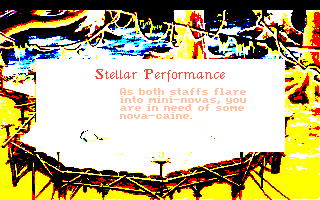
| Note that the box character is explicitly the paladin. |
Quest for Glory III: Wages of War
United States
Sierra On-Line (developer and publisher)
Released 1992 for DOS
Date Started: 1 April 2018
Date Ended: 18 May 2018
Total Hours: 25
Difficulty: Easy (2/5)
Final Rating: 46
Ranking at time of posting: 256/290 (88%)
Even if originally unplanned and somewhat interpolated between Trial by Fire and Shadows of Darkness, Wages of War is a worthy game that continues the series' admirable efforts to walk the line between heroic epic and whimsical fantasy. As I did with the previous games, I had a lot of fun playing it, as evidenced by my insistence on going through it 5 times.
However, I must conclude that while (to my limited perspective) it performs just as well as its predecessors as an adventure game, it does slightly less well as an RPG. I think this is less because of the game's approach and more because of the issue that a lot of games experience in which character development is less palpable the further the character gets from his starting skills. Here, any character who built his attributes and skills to near-200 in Trial by Fire can coast through the game, winning every combat and passing nearly every skill check without having to put in any effort. The only exceptions I can think of are "Throwing" and the "Agility" attribute, both of which must be developed to the mid-200s to win the warrior initiation rituals.
As for spells, the game seems to have completely forgotten the skill level attached to them. I guess "Flame Dart" and "Force Bolt" did more damage as my skill went up, but there was no threshold attached to successful uses of "Juggling Lights," "Fetch," "Reversal," "Open," "Trigger," or any of the puzzle-based spells. This was also true of a few non-spell skills like "Climbing" and "Pick Locks." It's important that the series not abandon skill checks because what makes the games such good hybrids is that knowing the solution to the puzzle isn't enough: you also have to have developed the skill to a high enough level to use it successfully.
My fighter was the only character to face a true challenge, starting with statistics lower than a veteran character coming from Trial by Fire. This allowed me to experience the changes in the combat system in a way that I couldn't with the previous characters. I think Wages of War's combat mechanics are the best of the series so far: It's clearer when you need to dodge or parry, and you can't just spam attacks. Moreover, the wizard is effective enough (and has enough mana points) that he can survive in combat entirely as a spellcaster.
 |
| Enemy movements help determine the best times to slash or thrust. |
The poor thief limps into Shadows of Darkness having enjoyed no place to practice his skills. There are only two locks to pick (and the nose trick no longer works). There are a couple of places to climb, and one (the Anubis statue at the end) that you can climb repeatedly, but none of them seemed to increase the skill.
Finally, I'll note that achieving a perfect score is much more of an achievement here than in previous games. A lot depends on luck, and it's easy not to realize that you've missed a potential encounter. For instance, if you encounter Harami in the bazaar during the day and agree to meet him at night, you get 4 points. But if you encounter him first at night, you can progress with his side-quest, and yet you miss the 4 points.
Several points are dependent upon temporary dialogue options. For instance, you get 2 points for telling Kreesha about the leopard woman after you dispel her but before you marry her. So if you don't trek back to Tarna between dispelling Johari and marrying Johari, you can't get those 2 points. Similarly, you get 2 points by talking to Uhura about marriage after marrying Johari but before giving her any gifts. Other points depend on selecting the "correct" dialogue option while meeting with Rajah or the Laibon. If you try to cover everything, you may miss out on the point-giving option when he gets tired and kicks you out.
Finally, I think some of the points are just bugged. The walkthroughs I consulted say you get 3 for reading the bulletin board in the tavern, but I just tested it and got none. I also don't think my paladin got the points he was supposed to get for defeating the Demon Worm towards the end, nor defeating an ape man for the first time.
Since points don't affect the character's skill or power, it's easy to say that it's no big deal if you leave this game having missed 25 or 30 of them. On the other hand, points are important because they're the only way to tell that a player has experienced most of the game's content. As we saw with my "Bad Chester" experience, many of the actions and moments in Wages of War have no practical value in terms of the direction of the story. Giving gifts to Johari, helping Harami, participating in the Sekhmet ritual, playing the mini-games in the Simbani village, and most NPC encounters and dialogue options are reflected only in points. It's too bad they're not more practical. It would be cool if the number of points earned in each game was translated to a bonus pool of skill points that you could allocate at the beginning of the next game.
I expect Quest for Glory III to rate about even with II, which was a bit lower than the first one. I think the lesser RPG elements will be balanced by higher scores in game world and combat. Let's see.
1. Game World. For this, I can pretty much just quote Alex's final rating at The Adventure Gamer:
But I also agree with Alex that the story is a bit weaker. Everyone is too-easily manipulated by the demons, whose overall plan really isn't that clever or original. Still, this doesn't detract too much. In general, Wages of War offers almost everything I'm looking for in this category. Score: 8.
2. Character Creation and Development. I continue to admire Quest for Glory's skill system, and the satisfying way that attributes and skills increase as you use them. Some of them are delightfully unintuitive, such as the way intelligence increases when you perfectly-time a dodge or parry. (I still have no idea what "Luck" does or how it goes up.) The increases are regular and rapid enough to be satisfying, but you still have to grind (which isn't necessary) if you want to reach the end with perfect scores.
Perhaps most important, the series is a rarity in offering tangibly different experiences for different classes, to the extent that I had to replay it several times to see all the content. The differences among classes seem to grow more stark with every new game in the series. In So You Want to Be a Hero, the differences amounted to a couple of side-puzzles (that anyone could engage in if they had the skills). In Trial by Fire, each class had a side quest but mostly followed the same path. In Wages of War, class choice makes fairly significant changes to the story.
My primary quibble in this category is what I discussed above: the lack of necessity of character development, particularly if you import a character from Trial by Fire. And in some ways, the series seems to be losing its grip on the importance of skill level to success. Score: 6.
3. NPC Interaction. As usual, we have a great cast of characters here with individual personalities and interesting back stories. More so than the previous games, each character has different dialogue "trees" for different points in the game, so it's very easy to reach the end without having spoken to everyone about everything. The need to click on yourself to explore various "Tell" options was disconcerting at first, but it ultimately added to role-playing, as did the time limits imposed by certain conversations. I have to tell you, though: I miss the need to take notes and type the dialogue options. All the clicking made it too easy to go too fast and overlook key bits of information. Score: 7.
4. Encounters and Foes. I found the enemies less imaginative in this entry. Almost all of them could have come from Dungeons and Dragons but with different names. (In particular, why name a charging lizard-beast something as bland as "dinosaur"?) The puzzles were a bit too easy, as usual, and mostly involved having the right item rather than doing the right thing. However, there were occasional multi-stage puzzles that offered a satisfying challenge, including the thief missions, the wizards' duel, and the endgame sequence. Score: 5.
5. Magic and Combat. Slightly improved. The combat control panel is easy to master, whether you're just fighting or switching between physical attacks and spells. It's clearer when you should time dodging, parrying, and attacking, although the monsters aren't hard enough for it to really matter. The wizard can engage in combat solely as a wizard, and spells like "Calm" and "Dazzle" do what they're supposed to do pre-combat. I like that good throwers can take down enemies with daggers and stones. But the system remains mostly optional, with too little in the way of tactics, for a very high score. Score: 4.
Since points don't affect the character's skill or power, it's easy to say that it's no big deal if you leave this game having missed 25 or 30 of them. On the other hand, points are important because they're the only way to tell that a player has experienced most of the game's content. As we saw with my "Bad Chester" experience, many of the actions and moments in Wages of War have no practical value in terms of the direction of the story. Giving gifts to Johari, helping Harami, participating in the Sekhmet ritual, playing the mini-games in the Simbani village, and most NPC encounters and dialogue options are reflected only in points. It's too bad they're not more practical. It would be cool if the number of points earned in each game was translated to a bonus pool of skill points that you could allocate at the beginning of the next game.
I expect Quest for Glory III to rate about even with II, which was a bit lower than the first one. I think the lesser RPG elements will be balanced by higher scores in game world and combat. Let's see.
1. Game World. For this, I can pretty much just quote Alex's final rating at The Adventure Gamer:
Tarna as a city and a land is an absolute joy to behold. Wages of War’s African-inspired setting was unique at the time, and remains so to this day. It’s an underused milieu, as evidenced by the popularity and aesthetic impact of Marvel’s recent smash Black Panther movie. Audiences, whether in movies or games, like to see things that they have not seen before, and Wages of War delivers.
But I also agree with Alex that the story is a bit weaker. Everyone is too-easily manipulated by the demons, whose overall plan really isn't that clever or original. Still, this doesn't detract too much. In general, Wages of War offers almost everything I'm looking for in this category. Score: 8.
 |
| I didn't talk about it much while playing, but the documentation perfectly complements the game setting. At the same time, so much exposition is delivered in-game that the documentation is almost optional. |
2. Character Creation and Development. I continue to admire Quest for Glory's skill system, and the satisfying way that attributes and skills increase as you use them. Some of them are delightfully unintuitive, such as the way intelligence increases when you perfectly-time a dodge or parry. (I still have no idea what "Luck" does or how it goes up.) The increases are regular and rapid enough to be satisfying, but you still have to grind (which isn't necessary) if you want to reach the end with perfect scores.
Perhaps most important, the series is a rarity in offering tangibly different experiences for different classes, to the extent that I had to replay it several times to see all the content. The differences among classes seem to grow more stark with every new game in the series. In So You Want to Be a Hero, the differences amounted to a couple of side-puzzles (that anyone could engage in if they had the skills). In Trial by Fire, each class had a side quest but mostly followed the same path. In Wages of War, class choice makes fairly significant changes to the story.
My primary quibble in this category is what I discussed above: the lack of necessity of character development, particularly if you import a character from Trial by Fire. And in some ways, the series seems to be losing its grip on the importance of skill level to success. Score: 6.
3. NPC Interaction. As usual, we have a great cast of characters here with individual personalities and interesting back stories. More so than the previous games, each character has different dialogue "trees" for different points in the game, so it's very easy to reach the end without having spoken to everyone about everything. The need to click on yourself to explore various "Tell" options was disconcerting at first, but it ultimately added to role-playing, as did the time limits imposed by certain conversations. I have to tell you, though: I miss the need to take notes and type the dialogue options. All the clicking made it too easy to go too fast and overlook key bits of information. Score: 7.
 |
| Even this guy had a whole dialogue tree. |
4. Encounters and Foes. I found the enemies less imaginative in this entry. Almost all of them could have come from Dungeons and Dragons but with different names. (In particular, why name a charging lizard-beast something as bland as "dinosaur"?) The puzzles were a bit too easy, as usual, and mostly involved having the right item rather than doing the right thing. However, there were occasional multi-stage puzzles that offered a satisfying challenge, including the thief missions, the wizards' duel, and the endgame sequence. Score: 5.
5. Magic and Combat. Slightly improved. The combat control panel is easy to master, whether you're just fighting or switching between physical attacks and spells. It's clearer when you should time dodging, parrying, and attacking, although the monsters aren't hard enough for it to really matter. The wizard can engage in combat solely as a wizard, and spells like "Calm" and "Dazzle" do what they're supposed to do pre-combat. I like that good throwers can take down enemies with daggers and stones. But the system remains mostly optional, with too little in the way of tactics, for a very high score. Score: 4.
6. Equipment. Pretty weak on the RPG side. The paladin gets a weapon upgrade, and the fighter can if he becomes a paladin. Other than that, weapons and armor remain what you started with. Almost everything else is a puzzle item except for the pills. Score: 2.
 |
| Does anyone know why my thief carried this thing around for the entire game? |
7. Economy. Unfortunately, quite bad. Some easy improvements in this area would have affected the whole game. The problem is that you start with as much money as you need to get through the entire game. This leaves no incentive to fight for gold, for the thief to steal the chests in the two huts, or even to engage in the "bargaining" mechanic. It also encourages you to make a single trip through the bazaar and buy everything at once instead of prioritizing--and returning now and then to get new dialogue options with the NPCs. When the economy is too generous, there is basically no economy at all. Score: 1.
8. Quests. There's a solid main quest and several character-based side quests reflected in points rather than story outcomes. As I covered in my experience with "Bad Chester," I was disappointed that so few of the options really mattered in the endgame. I feel like a few tweaks could have made this better: if you didn't give the gifts to Johari, or help Harami, or free Manu from the cage, or even meet Yesufu, they simply don't show up. The player then has to overcome more enemies than if he had his full contingent of sidekicks, and may fail if he doesn't have enough pills. (This approach would have made the economy more relevant, too.) This also would have forced the player to pay more attention to Sekhmet's prophecy and fulfill its various clauses. Ah, well. Score: 4.
 |
| I don't think I previously offered this cool shot of all my companions fighting their doppelgangers. |
9. Graphics, Sound, and Interface. The VGA graphics are really the best we can expect with the technology of the era. They look beautiful and evocative, and they make great use of the setting and theme. I particularly love the way the overland map is framed as if you're looking from high atop a southern mountain, with trees in your immediate periphery.
 |
| I like this shot of the Lost City with my thief surrounded by corpses of ape men. He had to kill one every time he came down from the Anubis statue, and he was trying to build his "Climbing" skill. |
Sound effects were fine. The disagreements that I have with most players about music are only going to get more hostile as the quality of music compositions increases over the years. As I've noted repeatedly, while I can appreciate the effort that went into the game's score, I still don't want to hear it all the time. This is true in other aspects of life, too. Take any of my favorite songs--Louis Armstrong's "Potato Head Blues," Louis Prima's "Just a Gigolo," Sarah Vaughn singing "For All We Know"--and put them on in the background while I'm trying to concentrate on something else, and I'll ask you to turn them off. To me, background music is like a background television show or a background movie: it distracts from, rather than adding to, the foreground. This is why my GIMLET doesn't include music in this category.
Taken by itself, the music here (credited to Rudy Helm) is superbly composed. It's approached as a true score rather than just a bunch of individual melodies, which means the same motifs are used across multiple songs, but with different tempos, harmonies, and keys to represent different settings. Alex linked to a YouTube video containing the full-length versions of all of the game's songs, and the entire "album" clocks in at 90 minutes. Several compositions follow classic sonata-allegro form and others seem inspired by Debussy's orchestral impressionism.
I turned it all off while I was playing. You know what I preferred to continual background music? When I walked up to Baba Yaga's hut in Hero's Quest and there was like a six-second leitmotif and then it stopped. So I apologize to composers and video game music lovers everywhere, but this is going to be a constant issue and there's no point getting on my case about it with every game.
I preferred the text parser to the point-and-click interface, although I admit that the latter has uses for targeting. I remain impressed with how many individual screen objects had a "look" description attached to them; I couldn't have clicked on more than 25%. But I had all kinds of other problems with the interface, including an "Action/Special Items" menu that refused to stay active, an inability to coax my character off the edge of the screen, and crashes to the desktop every half hour or so. I realize that some of these are likely to be emulator issues, but I have to rate what I experienced. Score: 4.
10. Gameplay. I'm sure I said the same things about the previous two games: a little too linear, a little too easy, and a little too short--but only a little. The series continues to get major points for "replayability." Score: 5.
That gives us a final score of 46. Hmm. That's actually 4 points lower than Trial by Fire, which I didn't expect. It appears that a couple of slight gains (game world, combat) were overrun by several losses (economy, quests, interface, gameplay). As always, I trust my current opinion more than 4-year-old memories, so we'll leave it at that. The difference is a small one. (For readers unfamiliar with my scale, I should point out that a score of 46 puts it in the top 15% of games I've played on this blog.)
 |
| The ad emphasizes the right sentiment, but boy does it use the wrong screen shots. |
The Adventure Gamer's score came in the other day at 68, which was two points higher than Trial by Fire and the same as the original Hero's Quest. (And keep in mind that they're more generous overall.) This bolsters my opinion that it's equal to its predecessors as an adventure game.
I guess my own GIMLET contributes to the idea that Wages of War is the least of the series (assuming that I rate the next two games higher), but I still think Matt Barton goes too far in Dungeons and Desktops when he says that "most fans of the series regard it as pedestrian at best." I would think that most fans, like me, would regard even the least Quest for Glory better than the average game of the time. Contemporary reviews don't offer any suggestion that the series has dipped. Jeff James's review in the January 1993 Computer Gaming World is unabashedly positive, lauding the "exotic new landscape" of Fricana, the "sumptuous hand-painted graphics," and the soundtrack. The only "blemishes" he found were a few bugs and the frequency of enemy encounters. (Alex mentions the latter, too. I didn't find the frequency to be so much overly-frequently as bafflingly variable. Sometimes I'd cross an entire screen of savanna with no encounters, and other times I couldn't walk more than an inch between them.) In his conclusion, James explicitly calls Wages of War the best in the series so far. This is echoed in the April 1993 Dragon, which starts out by saying, "This is by far the finest of the Quest for Glory adventures."
(I've long passed the point of finding new ways to make fun of Dragon for giving nearly everything 5/5 stars, but for the first time, I've forced myself to read several full issues, and I think I realize the reason: they rated everything. They didn't limit their "Role of Computers" column to RPGs. The same issue that has the 5-star Quest for Glory III rating also rates several adventure games [King's Quest VI also gets 5 stars], Battle Chess [5 stars], and @#$%ing Miner 2049er! No wonder actual RPGs always seem to jump out as cream-of-the-crop.)
In a time too far ahead to try to estimate, I'll determine if I agree or disagree with the other common assertion that fans find Shadows of Darkness (1993) the best in the series. I don't know how much longer I'll be doing this, but I can guarantee I won't stop before then.
I guess my own GIMLET contributes to the idea that Wages of War is the least of the series (assuming that I rate the next two games higher), but I still think Matt Barton goes too far in Dungeons and Desktops when he says that "most fans of the series regard it as pedestrian at best." I would think that most fans, like me, would regard even the least Quest for Glory better than the average game of the time. Contemporary reviews don't offer any suggestion that the series has dipped. Jeff James's review in the January 1993 Computer Gaming World is unabashedly positive, lauding the "exotic new landscape" of Fricana, the "sumptuous hand-painted graphics," and the soundtrack. The only "blemishes" he found were a few bugs and the frequency of enemy encounters. (Alex mentions the latter, too. I didn't find the frequency to be so much overly-frequently as bafflingly variable. Sometimes I'd cross an entire screen of savanna with no encounters, and other times I couldn't walk more than an inch between them.) In his conclusion, James explicitly calls Wages of War the best in the series so far. This is echoed in the April 1993 Dragon, which starts out by saying, "This is by far the finest of the Quest for Glory adventures."
(I've long passed the point of finding new ways to make fun of Dragon for giving nearly everything 5/5 stars, but for the first time, I've forced myself to read several full issues, and I think I realize the reason: they rated everything. They didn't limit their "Role of Computers" column to RPGs. The same issue that has the 5-star Quest for Glory III rating also rates several adventure games [King's Quest VI also gets 5 stars], Battle Chess [5 stars], and @#$%ing Miner 2049er! No wonder actual RPGs always seem to jump out as cream-of-the-crop.)
In a time too far ahead to try to estimate, I'll determine if I agree or disagree with the other common assertion that fans find Shadows of Darkness (1993) the best in the series. I don't know how much longer I'll be doing this, but I can guarantee I won't stop before then.