Showing posts with label Fate. Show all posts

Friday, February 17, 2017

Fate: Gates of Dawn: Summary and Rating

   
Fate: Gates of Dawn
Germany
reLINE Software (developer and publisher)
Released in 1991 for the Amiga and Atari ST
Date Started: 21 April 2016
Date Ended: 3 February 2017
Total Hours: 272
Difficulty: Moderate (3/5)
Final Rating: 42
Ranking at Time of Posting: 200/239 (84%)
Ranking at Game #455: 392/455 (86%)

Fate was conceived as a successor to Alternate Reality, which had promised much--a city, a wilderness, an arena, a palace--but delivered little. In that, Fate succeeded. Not only did it retain most of the logistical considerations of Alternate Reality--hunger, thirst, fatigue, nutrition, encumbrance, disease, and so forth--as well as the complex NPC interactions, it allowed multiple characters in the party, created a full game world, and added a main quest.

The problem is that the game didn't know when to quit. I recommend that modern players, if they want to play Fate, end when they solve the Cavetrain quest. Up to that point, it's a great game. Different NPCs create a very different experience in combat and exploration, as in the beginning each one only has one or two spellbooks. You get to explore a large city, a large wilderness around it, a smaller sister city, and a large, complex, 7-level dungeon with a variety of navigational puzzles. Leveling is relatively swift and rewarding, and the economy still holds some value. Hints are plentiful, and the main quest is adequate. Seriously, play it this way. Don't read the backstory. Some mage has cut the city of Larvin, enclosed by mountains, from the outside world. Winwood is the son of a tavernkeeper whose family was murdered by marauders looking for supplies, since no goods are coming in from the outside world. Your only quest is to restore the function of the train. You'd have a 60-hour RPG with decent mechanics, and you'd walk away happy.

Instead, the game continues for another 200 hours, with senseless plot developments, character development that becomes less and less important (my characters ended the game with dozens of improvement slots), and combat that becomes either mindlessly easy (outdoors) or absurdly deadly (indoors). Equipment upgrades slow and then stop, the economy spins out of control, and the player spends dozens of hours just getting from one place to another. What would have been high GIMLET scores for Fate: Quest of the Cavetrain start to bleed away as the game gets more sprawling and pointless.

Yes, I got seduced by the map. It's happened before, often at work. With major projects on my "to do" list, I'll get sucked in by some boring, menial, seemingly-incompletable task and I'll have to tear myself away from it. "Chet, that report was due last week!," I'll hear, and respond, "Sorry! I'm busy coding some variable I'll probably never use across 200,000 records!" The process of filling in those little boxes became an opiate. I'm glad I stopped myself before insisting that I finish. I will admit that the map is pretty cool. The developer could have set an excellent RPG there, full of lore and side quests. He just didn't.

The plot of Fate starts out intriguing. Winwood is transported from the real world and current year to an alternate Earth in the year 1932 in which magic is real and other races exist. The agent behind his transport seems to be an evil wizard named Thardan. Thardan uses one of his followers to disable the Cavetrain and block Larvin's access to the rest of the world, ostensibly to keep Winwood from escaping the starting area.

It's not a bad beginning, but from there the game doesn't develop the plot at all. Thardan's motives are never revealed. Unlike the much later Lionheart: Legacy of the Crusader, Fate doesn't try to put real-world analogues into its alternate Earth. (And I'm not suggesting that Lionheart is a particularly good game; it's just the only other one I know set in an alternate history.) Neither the maps nor the names of the cities suggest an alternate Earth. The only real "plot twist"--having Winwood whisked to the dungeons beneath Cassida via the wand on Naristos's body--isn't explicitly part of Thardan's plot. If it is, it was a stupid idea, as it was the only way that Winwood came into contact with Bergerac and Morganna.

Morganna, the deus ex machina, comes out of nowhere with a compelling back, but no compelling backstory. Thardan comes to a swift and ignominious end without even the traditional villain's exposition. He remains a passive villain the entire game.
    
Fate officially jumps the shark.
   
The hint system, which starts out strong in Larvin, requiring only that the player find the right class of NPC, completely disappears by the end, where the player has to make several nonsensical leaps of logic.

The name of the game remains a complete mystery throughout. What are the "gates of dawn," exactly? What "fate" is at stake here?

I don't even know what to expect from a GIMLET at this point.

1. Game World. The backstory of the alternate Earth is clumsily explained and never referenced in-game. As noted above, Winwood's part in the world starts out intriguing and ends stupid. On the other hand, the developer did a good job with the design and mechanics of the game world. The cities feel like huge places, populated with hundreds of NPCs. The map is exquisitely detailed, if light on the thematic content. The day/night cycle and changes in the weather pattern have meaning and consequences in the game. A mixed bag overall, but I suppose a step up from the typical RPG of the era. Score: 5.

2. Character Creation and Development. There's no creation, but the game gets some credit for the variety of ways that you can develop your party by selecting different NPCs. The strengths, weaknesses, and abilities of the various classes create a fundamentally different game for each player, particularly in the opening stages.

The races are entirely unreferenced and unused. The guild-based development system, supplemented with boosts from the altar in the Alarian Vaults, is only "okay." I saved my development slots the entire time I was in Larvin because commenters told me it was more efficient to use the better guilds outside the city. Once I did so, I really didn't notice that much improvement in my characters' performance, even though in some cases their attributes (like strength, dexterity, and skill) went from the 20s to the 90s. Acquiring spells is the more important mechanism of development, but even this stops being important after each character has 3 or 4 books.

I also give the game credit for the multiple-party system, which I really didn't exploit the way I could have. For instance, instead of circling my single party around the world to look for hints, I could have kept several parties in convenient locations. Since all party members get experience from all kills, it wouldn't have diluted my leveling very much; in fact, it would allow you to develop a party explicitly for grinding and to keep them in a convenient grinding location (near an inn and tavern in Katloch would have worked well), switching to them periodically to add a couple of levels while everyone else explores.

I don't know whether to regard the various logistical challenges--hunger, thirst, nutrition, fatigue, sins, conditions--as part of character development or not. Either way, the game made them too easy. Trivial amounts of money and time take care of them, and by mid-game you can deal with them all with various spells. Score: 5.
     
Fate features a large number of attributes and statistics to develop.
     
3. NPC Interaction. NPCs make up a major part of the game. You need them to join your party, give hints, train your characters, and further a variety of steps on the main quest. A complex system of gaining their favor with various chat options is undermined by a system that allows you to simply bribe most of them. Like most things, it's stronger in the beginning game than the ending.

I do like that once characters join the party, they have some wants and preferences of their own. They occasionally pipe up with hints or random comments. They may refuse to give their money in bribes, to hide in combat, to yell, or to go off on their own in taverns. I look forward to later games that develop these unique personalities deeper and allow more role-playing encounters with the NPCs. Score: 6.
    
A party member refuses to follow orders.
    
4. Encounters and Foes. There is a huge variety of monsters in the game, and it follows the old Bard's Tale tradition of using the same graphics for many different monsters, some of which are trivially easy and some of which are bafflingly hard. The inclusion of monsters that never die from any hit point loss, no matter how many rounds, was inexcusable, as was making an initiative system in which some groups of enemies always go ahead of the party. Overall, the various strengths and weaknesses of the foes never really impressed me or led me to create different tactical templates for dealing with them, beyond simply bashing weak monsters and using my few NUKE options against tough ones.

I do admire the various pre-combat options, which allow some limited role-playing and additional encounter tactics. Again, though, these are terribly unbalanced. "Prayer" shouldn't work as often as it does, nor should it be necessary as often as it is.

Then we have the various non-combat encounters with objects and buttons and such, all of which use the same set of menus. Since the correct selection is often nonsensical, you learn to just try every option, often with every party member, before the solution is revealed. The various button and lever puzzles never rise to the level of even the weakest Dungeon Master knock-off. Score: 4.
    
These types of special encounters were nice, but rarely offered much in the way of role-playing.
     
5. Magic and Combat. "Overblown" is probably the best word to describe the combat and magic systems. I like systems that have lots of options, but only when those options come together to create real tactical decisions. I never found any use for "Grope," "Steal," "Warcry," or "Mock," even when they worked. Many of the spells, as I covered extensively, are essentially useless, or duplicates of each other. Straight attacks become overpowered when you get "greater melee weapons" that damage all creatures in one attack.

And yet, we have to give credit for the sheer number of options, even if they don't all work. As with everything, the first third of the game does best here, as you gingerly approach each new party and try a variety of actions to create "tactical templates" to use against different foes. When each character only has a couple of spellbooks, you find yourself experimenting more than when all characters have half of them. Some of the spells are highly-original and fun. Score: 5.
    
Towards the end of the game, combat difficulty got pretty nutty.
    
6. Equipment. This category is perhaps Fate's strongest. I always like games in which you regularly get equipment upgrades, and this only happens when the game offers numerous equipment slots or numerous characters. Fate does both. Each character gets two weapons, two pieces of body armor, a helmet, gloves, and boots, plus a variety of potions and special items. Multiply that among 7 characters in a single party and potentially 28 characters in all parties, and you find that the game never stops giving regular rewards except in the final act.

Fate also has solid mechanics here. Examining each item tells you most of what you need to know about it, including who can equip it and how it affects your statistics. Encumbrance becomes a real concern as the best armor tends to be quite heavy. My strategy was generally to equip the best item and deal with the encumbrance effects by discarding other things, but it's possible I could have done better by equipping lighter armor and keeping a greater variety of weapons in inventory, for instance.

Fate gets the highest score here that I can offer without complex item interaction (a la NetHack), detailed item descriptions (a la Might & Magic VI-VIII), or item crafting. Score: 7.
    
Rarely do games give you this kind of detail to help with equipment choices.
     
7. Economy. I like games that give you plenty to buy. Early in the game, Fate sets a tone like Alternate Reality in which you need gold just to survive. You might find yourself murdering a peasant for enough cash for your next meal, or a night in the inn. If you find a nice weapon, it's a real dilemma whether to keep it or sell it for enough rations and water to keep you going for the week. Above those basic needs are a variety of shops selling weapons and armor, healers, chapels selling indulgences, and of course new spells and character upgrades. Offering "alms" to NPCs also burns through the cash very quickly.

But having a lot of things to spend money on is only fun if money itself is scarce. From the moment you wander outside, kill your first dwarf, and get 1,500 "piaster" for the deed, you generally have as much money as you need the moment you need it. There was never a point in the game that I worried about going broke, and because of that, I never bothered to sell a single piece of equipment--I just dropped it when I was done with it. You saw how I bought about 6 redundant ships (perhaps the most expensive item in the game) and shrugged off the loss of over $7 million towards the end.
     
Towards the end of the game, when you have millions of piaster, the most expensive potions--such as this one that restores all spell points--only cost a couple of thousand.
    
The imbalance in the economy is perhaps best illustrated by the uselessness of the banking system. The developer spent a lot of time positioning banks with various investment opportunities throughout key cities, but you'd have to be daft to bother with them. Just go kill some more dwarfs. Score: 3.

8. Quests. The game only gets credit for having a main quest, and a rather stupid one at that. There are no alternate paths or outcomes, no opportunities for role-playing, and worst of all, no side quests throughout the enormous game territory. Oh, I suppose you could argue that it has some "side-areas" that improve character development, but anything it would gain here would be lost in light of the idiocy of the main questline. Score: 2.

9. Graphics, Sound, and Interface. The graphics and sound are perhaps the best that they could have been for the era. The developers put a lot of effort into well-composed monster and NPC portraits, outdoor settings, and little mises-en-scène in the taverns, shops, and train. They certainly pass the "good enough" point that I require for this category. The sound effects go beyond that; not only are the clashes and zaps of weapons and spells done well, the game is one of only a few to offer evocative background sounds, so well-composed that I sometimes confused them for the real thing.
     
A diverse group awaits the Cavetrain.
     
The interface is the only place that I had real trouble. The game is meant to be used with a mouse--which makes me hate it already--but even worse, you have to click on very small menu options and frequently double-click by accident. Although you can use the keyboard in a limited sense, you have to mentally number the menu options to select the right key; an explicit numbering would have partially redeemed it. Too many options that you might want to use in concert are on different menus. All told, a bit of a nightmare. Score: 6.

10. Gameplay. Fate offers extensive map non-linearity but not plot non-linearity, and I prefer to see both together to really enjoy myself. (The 7-part Moonwand quest, which you can do in any order, was the exception and probably the high point of the post-Larvin part of the game.) I definitely would not call it "replayable." You'd have to be insane. In difficulty, it starts with a nice moderate level but goes off the rails after the Cavetrain quest, alternating between very easy and very hard. For "pacing," we of course award a big, scrawled "F" for being way, way too long. Score: 2.

This gives us a subtotal of 45, which puts it fairly high on my existing list. I'm not sure how to feel about that. On the one hand, the game does so well mechanically that you absolutely have to recommend it. For 1991, it is a wonder to behold, and when I first started it, exploring Larvin and its environment, every hour I discovered some new nuance that led me to admire the developer even more. On the other hand, the inability of the developer to know when to quit seems like it ought to count more than a few points in the final GIMLET category. And it's especially bad for offering an ending that isn't worth reaching, and for hints and directions evaporating towards the game's end. In the end, comparing it to the other games on the list, I feel better knocking off 3 points and kicking it down to the level of Knights of Legend, which had similar problems, at a final score of 42.

But let's talk for a moment about the game-within-the-game: Fate: Quest of the Cavetrain. Not only does it not lose those 3 additional points, it gains 3 more in the "gameplay" category for not being too long, 1 more in the "quests" category for not being stupid yet, 2 more in the "economy" category for not having gone out of control, and 1 more in "character creation and development" for development being more significant, and 1 more in both "combat" and "encounters" for not yet becoming bland and rote. Fate: Quest of the Cavetrain is a solid 54-point game, 9th-highest on my blog so far, better than everything except titles that offer extensive side-quests and more detailed role-playing options, and an obvious candidate for 1991's "Game of the Year." Don't cheat yourself out of this excellent game. Just don't worry about where the Cavetrain leads.

I say all of these things coming from an era in which 200- or 300-hour games are hardly uncommon. Steam tells me that when I last played Oblivion on my PC, it took me 213 hours. Skyrim took 278. (Neither totals count the multiple times I played both games on my console.) But of course these titles are packed with content, including so many side quests and faction quest threads that it's hard to keep track of them all. Even if you don't take a single quest, simply exploring each dungeon or structure and learning its individual story provides more rewards than the totality of Fate's plot.

On top of this, I have a sneaking suspicion that Fate was actually supposed to take even longer. I base this on the horribly unbalanced initiatives of the monsters towards the end of the game. Certainly, the developer didn't intend for the player to "pray" away every fight, right? Certainly, he didn't intend every encounter with the wandering demons to completely wipe out the party. Given that Morganna joins the party at Level 105, I wonder if the party wasn't supposed to be of a comparable level (my characters topped at around 60) before braving the Cassidan dungeons in the first place. That would have required an insane amount of grinding, but the game is already pretty insane.
   
Before any of my characters even had a chance to act.
    
I was therefore curious how reviews of the time treated a game of such unprecedented length. I scanned reviews offering both the best rating (89/100, from Amiga Joker in March 1991) and the worst rating (26/60, from Aktueller Software Markt in November 1991). Of the two, the Amiga Joker reviewer seems to have gotten the furthest--screenshots show scenes that could only be in Mernoc or Katloch, plus hit-point totals that suggest Level 50+ characters, which is pretty impressive. While recognizing that the game will involve "months of play," he doesn't seem to attach much quality to that, though he does warn of the game's overall difficulty. He particularly seems to enjoy the graphics and sound, and like me, he praises the background effects. (I only translated parts of the review, so if any German-speaking readers would like to read the entire thing and offer more details, I'd be grateful.)

The ASM reviewer, on the other hand, manages to make most of his negative points not about the gameplay or length but about the very graphics that everyone else seems to like. Only Amiga magazines would take a game with graphics as well-composed as this and find some way to bitch about them--in ASM's case, the complaint is that they're not animated. This is the 1991 version of modern reviews that, faced with a game like Fallout 4 where you can count individual blades of grass, conclude that the graphics "suck" because the blades don't cast individual shadows. ASM also seems to have issues with the scope of the game, at least in terms of numbers of party members, spells, and dungeons.
 
I'm hard-pressed to find any contemporary reviews of the English version. I understand reLINE was going out of business (although later recovered) just as the English version was published. It's possible that it barely made it to English players' Amigas, let alone American ones. This is unfortunate, because--no offense to my European readers--American players had the most experience in 1991 with actual RPGs, and it would have been fun to see their reactions to both the length (Scorpia surely wouldn't have been able to finish the game before turning in her review, which would have galled her) and the clear foundation in Alternate Reality mixed with The Bard's Tale. Most European reviews focused on its relationship with Legend of Faerghail (1990), reLINE's previous RPG, which also showed a heavy Bard's Tale influence and also featured graphics by Matthias Kästner.
  
 
Fate's auteur was Olaf Patzenhauer, who apparently began working on the game around 1986, after some experience with Alternate Reality, The Bard's Tale, and some of the Ultima titles. I otherwise haven't been able to find very much about the man, such as age, education, or previous employment. He died in late 2011 or early 2012, some sites say from a heart attack but I was unable to find a specific obituary. Fate and a 1992 strategy game called Dynatech seem to be Patzenhauer's only non-adult games, and as we've seen, even Fate had plenty of adult material. His post-Fate credits include Penthouse Hot Numbers Deluxe (1993) and Biing!: Sex, Intrigue, and Scalpels (1995), described by MobyGames as "an erotic hospital-management simulation," which raises a number of questions I do not want answered.

From what I can gather from message boards, mostly in German, sometime in the early 2000s, Patzenhauer wrote a Fate 2 but never published it. Instead, he sent a personalized copies to friends and fans with the stipulation that they not share them. Accounts suggest that the game was never finished and had no main quest. (If any German-speaking reader would like to browse the forums here, you might find more information about the game than I did.) I've seen some sites that say the source code was destroyed upon Patzenhauer's death, as per his will, and others that say he lost the game in a computer crash before he died. (On one message thread in 2006, Patzenhauer talks about a computer crash but later says he recovered his data.) What everyone does seem to agree on is that the game featured plenty of manga-influenced graphics and nudity, if not outright hentai gameplay. (By his own account, Patzenhauer developed a deep interest in all things Japanese in the post-Fate years.) The image below, minus the black bars, came up in an RPG Codex thread in 2008, for instance. (As for the black bars, the images in my "won" posting are as explicit as a I dare get without worrying that Google will require me to turn on the "adults only" flag.) There are some rumors of a fan sequel in-progress called Fate 3.
     
Purported screenshot from the privately-distributed Fate 2.
    
It's going to be weird not having the occasional Fate session on my "to do" list, and I have a feeling that my memories of the game are going to be wrapped up in my memories of a weird year in which Irene and I moved 4 times. I played Fate in the cramped study of a temporary apartment in Boston, and on the porch of a beach house we rented for a few months on the North Shore. I had it going on the kitchen table of a one-bedroom in Portland as the summer breeze came through the window, and in the comfy office of the condo we eventually bought near Bar Harbor, as the snows fell on the harbor outside. Perhaps the instability of my living situation explains why I took refuge in the stability of mapping square after square of the huge game world. And perhaps it also explains why I was so personally offended at its shaggy-dog ending. Despite a relatively high score, I'm glad to be done with it and moving on.


Sunday, February 12, 2017

Fate: Won.

Yes, we'll talk about this in a minute.
     
As we wrapped up my last substantive posting, I was expecting a long journey to Thardan's castle and another interminable 7-level dungeon. What I found was such the opposite that it's hard to be believed. The dungeon under Cassida (where Winwood was separated from, and reunited with, his party) was the last dungeon of the game. Some battle I fought there with minotaurs and ghouls was the last substantive battle. I almost wish I'd known at the time.

As the characters exited from Cassida, Bergerac and the rat-rabbit in tow, one new element became immediately clear. Every wandering outdoor monster in the game--every thief, mage, rat, snake, barbarian, and wisp--was replaced with parties of demons. At first, I thought they were the same old wispy ghosts and liches I'd massacred by the hundreds while mapping the contours of the Forbidden Zone. But when my entire party was dead by the end of my first encounter, I realized they were different. Though using the same images, they had names like "Thor Demons." Like the creatures in the dungeon, they always acted first in combat, and even a couple of them were able to kill all of my characters in the first round, before I even had a chance to act.
    
This was unexpected.
    
Fortunately, there weren't that many of them, and they didn't actually seem to be trying to attack my party, unlike the usual pack of wandering monsters. I was mostly able to avoid them. Perhaps some buffing spells or some more attribute upgrades would have helped protect against them, but I didn't see the point this late in the game.

Since the outdoors were a little dangerous, I spent some time riding the Cavetrain from town to town, looking for hints. I had to buy tickets for Bergerac and the rat-rabbit. There were no clues or new dialogue options in any of the towns. "Going around" in the taverns produced nothing either.

At this time, I was still under the illusion that Thardan would be found in some kind of structure. I thought maybe his little zone had a small town or castle leading to a layered dungeon. The overhead map seemed to support this hypothesis, with a large square that looked like a town in the upper-northeast of the Forbidden Zone. I didn't know if the rat-rabbit in my party was the powerful witch Bergerac had mentioned or if I'd find her in Thardan's fortress. I only knew that with Bergerac in my party, I could penetrate the inner Forbidden Zone. I decided to travel there and at least get a sense of what I was facing.

I followed various roads out of Mernoc. Most of them ended in inexplicable 3 x 3 platforms of pavement that served no purpose. But one of them wound its way to the northeast, past mountains and forest, into a dense thicket. The dangerous demon parties wafted around in my periphery, but they were far less plentiful than the lesser demons that used to occupy this area, and the few times I accidentally ran into them, Elgarette was able to pray them away.
   
Thardan's corner of the world.
   
I saw the end of the road approach and expected I'd find myself facing the door of a town or castle. Instead:
     
Thardan, I don't want to alarm you, but I think your arm is on fire.
    
Yep, Thardan was standing right there in the middle of a square of pavement. And without even the briefest explanation of how he performed the deed, the next screen showed all of my party members dead.

Okay. So I guessed the rat-rabbit probably was Bergerac's witch, and I needed to get her dispelled before confronting Thardan. I had no idea how to do this, so I scanned my map for anything promising. I noted that every location I had marked as "unknown" or "mysterious"--the monolith in the woods, the four pools of water in the northwest, the wand stuck in the ground near Cassida--had turned out to play a role in the game. Everything except a statue of a stone lion in a "memorial area" west-northwest of Valvice. Much of the game world was still unmapped, of course, but I had already used the magic jewels to scan for interesting patterns or structures in the unmapped portions and found none.

I couldn't imagine what a stone lion would have to do with anything, but I was out of ideas, so I took the Cavetrain to Valvice and walked to the memorial. I really didn't expect anything to happen, so I was surprised when Rabby stuck a paw in the lion's mouth, "the strange being vanish[ed] in a cloud of red smoke," and a woman named Morganna stood in her place. She related that Thardan had turned her into the rat-rabbit when she was a young child, "but now I have the power to destroy his evil force! Now it's the time for Thardan to quiver with fear! The day of revenge is near!" Okay, then.
     
Every child in Germany knows that you can reverse spells by sticking your hand in a lion's mouth. It's from the Aesop fable "The Man with no Hand and the Lion."
    
Morganna accomplished a lot in her youth, it seems. She's Level 105--about 40 levels above my characters--has over 1,000 spell points and comes with a dozen magic books, including the "Master" book.

Now, at risk of being again misunderstood and called a Puritan, we have to deal with the issue of Morganna's nudity, because the way it's used here is stupid and tiresome. When I talked about nudity in the context of Wizardry VI, I was not upset at the nudity itself but rather how forced it was. I was annoyed by the implicit expectation that I would enjoy it, because after all, everyone knows computer games are for adolescent boys. It's not even that the nudity was "gratuitous"; gratuitous nudity is fine. It's that it ran contrary to anything that made sense plotwise, and was being shoved in my face for no purpose except that it clearly excited the creepy creator.
    
Fate had gratuitous nudity throughout, but only at the end did it get pathetic.
    
So far, the English version of Fate: Gates of Dawn has only included stark nudity on the infrequent copy protection screens, where it's definitely gratuitous, but whatever. These aren't named characters that we know anything about. They're not even NPCs. They're just window dressing. But here comes Morganna, who has been a rat-rabbit since before puberty, so she has the mental age of a child. Her portrait only suggests a state of undress, but she explicitly refuses to put on armor.
    
    
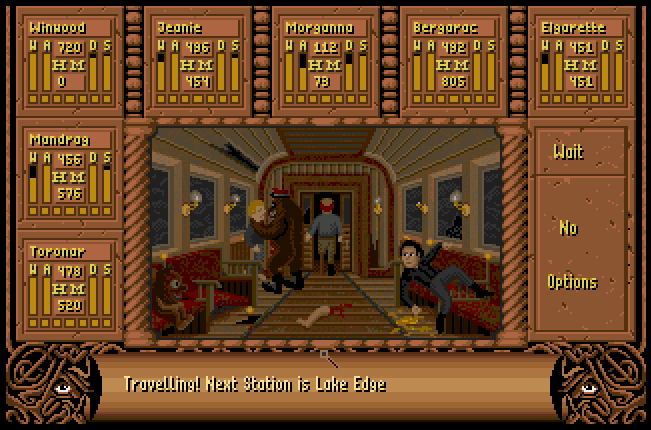
On the Cavetrain back to Cassida--would you want to ride in a public transportation car with no clothing?--she scares the ticket inspector:
   
    
Off we go back to Thardan's castle--or, rather, Thardan's square of pavement. Look, my last few posts have stressed how tired I am with the game. I didn't really want a big dungeon. But I wouldn't have minded a small dungeon. So as I walked along the pathway--gingerly, to protect Morganna's bootless soles--I half-hoped that Thardan was simply blocking the entrance to his fortress, and now that I had Morganna, he'd run inside and we'd have to chase him a bit, maybe fight a few battles and use that "Master" spellbook more than once, and the game would come to a proper conclusion.

Alas, when we reached his square, what I got instead was Morganna turning to face the party and giving us some full-frontal:
     
     
And then she blasted Thardan out of existence.
     
    
No final battle, no confrontation. Just some pixelated nudity as an implicit "reward" instead of a proper, satisfying ending. In case anyone is still confused: I don't object to nudity. I object to nudity used in such a puerile, juvenile way, in place of a proper narrative ending.

"We've done it! Our world is free again! Thardan has lost all might and will never appear again!" Morganna exclaimed. "All his power is now in my mind! Thus I'm able to create the magical gate for Winwood's return!"

"But wait," the game offered before this return could be shown or described, "There may soon be a FATE Part II!"
   
    
And that was it, except for the option to replay the final scene over again.

What a ridiculous letdown. Almost 300 hours of gameplay ends with a stunted confrontation in which my characters play no role, the big bad is defeated by a deus ex machina character whom I never heard of until 98% of the way through the game, no explanation is offered for Thardan's bringing me to this world to begin with, and I'm supposed to forget all of this because I got to see a fuzzy pair of B-cups.

I want 250 of those 272 hours back.


Saturday, February 11, 2017

Fate: Very Long Game

Fate is the kind of game that makes you wait in real time while your characters take a train.
    
I think I might have mentioned it before, but this game is very long. Very long. Indecently long, really. I mean, I could come up with adverb after adverb to put in front of "long," and I'm still not sure it would adequately convey how long Fate is. 

And large, too. I guess that's a function of "long," or vice versa. We're talking 400 x 640 squares, 9 cities that each have a 56 x 56 grid (even if they don't use it all), and 5 dungeons of 7 levels each, each level of which has its own 56 x 56 grid. Even accounting for unused squares, if you mapped everything, you will have mapped over 200,000 squares. 

Speaking of mapping, I don't believe I'll be finishing mine, although I did make a few updates. This is where it ended up:
     
     
Mapping the rest on top of a nearly-300-hour game probably wouldn't be the best use of time.

Not much else to add right now. One wonders why I even published such a short post.

Time so far: 268 hours

Tuesday, February 7, 2017

Fate: Untethered

A plot point introduced 120 hours ago is finally resolved.
    
This posting represents more than 30 hours of gameplay. Eager to finish the damned game, I cleared my schedule for two whole days and did nothing but play Fate from morning to night. It got me through one dungeon—a dungeon large enough that in any other game, it would be the whole game. Fate has now exceeded NetHack as the longest game on this blog.

When I wrapped up last time, Winwood had been separated from his party and whisked to an unknown dungeon via a wand that acted as some kind of portkey a la Harry Potter. I never really got any explanation for why that happened. Maybe Thardan left the wand on Naristos's body as a trap for Winwood? Who knows.

Either way, the separation had me spend the longest time since the game started with more than one party. The mechanic is interesting but weird. When one party is active, time passes for the other (characters get hungry, thirsty, and tired; spells run out), but the other party can't be attacked. If one party goes to sleep, the other party gets activated automatically and can't switch back until the first party wakes up. I ended up keeping both awake and alternating between them every 5 to 10 minutes.
    
On his own, Winwood proves poor at identifying fountains.
    
The non-Winwood faction returned to Larvin. I was going to have them get some sleep, but they didn't have any money. At first, I thought Winwood had taken it when he vanished, but it turned out that he didn't have any money, either. Somehow 7 million piaster just disappeared. Fortunately, I made half that much back again in my explorations of the dungeon.

Commenters had spoiled (at my urging) that Toronar might say something about what to do next, so I kept checking back to see if he had any dialogue. When none was forthcoming, I had the party (led by Jeanie, so I'll call it "Jeanie's party" to distinguish it from Winwood) board the Cavetrain (fortunately, they had monthly tickets already) to return to the outer world. I figured that the game would switch me to Winwood while Jeanie's party rode the Cavetrain between stops, but it didn't. I had them get off in Desert Falls, an area with plenty of squares to be mapped, and set them exploring and mapping while I waited for someone to say something.

Back to Winwood. Alone and bereft of magic—no "Locate" spell to determine coordinates; no "Flare" spell to create light and find secret doors—it was like I was just starting the Catacombs 240 hours ago when I didn't know what I was doing. On the floor of the starting chamber, I found a "Goldeneye" and a "Lightwand," both of which create light. There was also a "Heal All" potion and a "Fracwand," which is supposed to stop time, but it didn't actually work in this dungeon.
     
They do look pretty dumb.
    
I soon began to encounter the dungeon's enemies: minotaur-like creatures with names like "tauri" and "grecs." Unfortunately, they qualified for NUKE status: Winwood was unable to kill them with melee attacks. This was particularly alarming because I didn't have any spells, nor did I have a cleric to pray them away. However, I determined that the "dupe" action (which is like an instant-kill backstab) was 100% effective against them. The problem is, they did over 100 hit points damage in melee attacks, and if Winwood ran into a party of more than 5 or 6, there was a good chance he'd die while trying to use "dupe" against one enemy at a time. I found a couple of healing fountains and camped near them as I slowly cleared out the level. I had about 8 Holy Scrolls (instant death to all enemies) to use in a pinch.
   
I ended up being glad that I saved a number of these scrolls.
     
On the surface, I didn't know if it was time or movement that triggered one of the characters piping up with a hint. Because it could be a factor of the number of squares moved, I kept them in motion, mapping some of the northern sections of the the land. I had long ago finished mapping any area with an interesting-looking structure, so all they found were fields and trees.

In the dungeon, Winwood found a network of teleporters and one-way doors. Again, without a "Locate" spell, it was tough to figure out the destination of teleporters until I'd mapped the surrounding area. I had to make multiple small maps and piece them together. Frequent return trips to the fountains kept me alive, but there was a fair amount of reloading going on, too. Eventually, after mapping most of a roughly 20 x 20 area, I found a teleporter that seemed to take me to a completely different section of the dungeon.

Outside, the rest of the party continued to map and fight thieves and have no particular revelations.
    
At least we're earning some of our money back.
     
Winwood ran across an inactive teleporter, which is almost a sign of some kind of quest. Bolstered by frequent fountains and "Heal All" potions, and occasional reloading after death, he made it through the minotaurs and found a switch. Unfortunately, to get out of the switch area, he had to take a teleporter that dumped him back in the starting area.

On the surface, the rest of the party mapped a large section of woods and fought a bunch of wolves, but continued to say nothing about Winwood.

Winwood made his way back to the previously-inactive teleporter. His health meter showed that he was starting to get hungry. The teleporter now took me to a maze of one-way doors, some of them leading me back to areas I'd already explored. I continued to fight grecs and tauri using "dupe" as my only weapon, getting whittled down from their physical attacks. Eventually, my explorations brought me to a down staircase.
     
Otherwise known as "the opposite of what I was looking for."
    
I got sick of waiting for my other characters to pipe up. I knew from the spoiler thread that I had to do something with the wand stuck in the ground northeast of Cassida, so I headed there. The wand was still stuck in the ground. Through experimentation, I found that if Jeanie (enchantress), Elgarette (priestess), or Mandrag (archmage) tried to pull it out, the game just said it was stuck. But if Dichara (banshee) or Toronar (warlock) tried to touch it, they vanished and joined Winwood in the dungeon. I have no idea why those two in particular. There's no spellbook that they share that only they share. I would have preferred to send Elgarette for her healing and praying powers. After debating it a bit, I had Dichara go. She had an "Enchanter" spellset, which included useful exploration spells (like "Locate"), plus more hit points, plus a better weapon. I didn't think to stock up on some food and water first.
     
If you can come up with an explanation for why another portkey-wand was sticking in the mud amidst a copse of trees northeast of Cassida, I'd love to hear it.
     
I expected Dichara to end up alone in a third party, but she didn't. Instead, when I switched to Winwood's "party," Dichara suddenly appeared with him. That's useful. I thought I'd had have to go back to the first chamber.

So, great. Winwood had a companion who could at least cast some spells. And the first thing I did was determine that we were only one level below the surface, in Cassida. But while I'm familiar with the concept of going down to get back up—particularly in Fate's dungeons—I didn't relish pressing forward with only two characters.

The rest of the party, meanwhile, headed to Cassida. Eons ago, I'd mapped an inactive teleporter there, and I wanted to check on its status. It was still inactive, but I parked Jeanie's party there for now. I had a suspicion.

With no other options, Winwood and Dichara moved downwards. My mapping fidelity, I should mention at this point, was taking a hit. I stopped bothering to annotate treasures, since I wasn't going to ever visit those squares again, and I stopped worrying about errors and just crammed everything together the best I could. I avoided mapping entire sections by using magic maps as guides. See the subtitle of my previous Fate post for an explanation.
     
As long as all enemies are incapacitated—frozen, in this case—you can just end combat between rounds and still earn experience and gold. I wish I'd discovered this earlier.
    
The duo pressed forward, mostly using the banshee's "Freeze" to take enemies out of commission long enough for Winwood to dupe all of them. I also discovered that if you can incapacitate all of your opponents, you can use the inter-round command of "leave off" to simply walk away from combat, collecting the experience and gold of the enemies already slain. I wish I'd known this earlier in the game.

Here, however, I have to unleash a litany of complaints against the game and its combat system, as I became plagued with a problem that lasted the rest of my time in the dungeon: enemies always go first. Always. Initiative is supposed to be determined by character level, skill, and dexterity. But even Dichara, with 99 dexterity and skill and a relatively high level ended up acting after every enemy, every time. I feel like I've done nothing but grind, grind, grind for the 200+ hours I've played this game, and yet it wasn't enough.
  
Only in Fate are simple creatures like "ghouls" massively over-powered NUKEs.
    
If the duo ran across 6 minotaurs, 5 ghouls, and a demon, every one of those creatures would get an attack or spell before either Winwood or Dichara could act in combat. I'd just have to sit there and hope that no one was killed, stoned, or possessed because I had no way to undo any of those things. Later, when I had the full party, the parties I encountered might consist of 15 demons of various types and 30 undead of various types. If I couldn't pray them away and if I didn't want to use a Holy Scroll, it was practically an automatic reload.
     
This is simply not a survivable encounter for two characters, particularly if they all get to hit first.
    
This was all true, at least, until I discovered a trick. I found that if I saved and quit the game and then started it anew, for the rest of the level, I'd only encounter parties with 1 enemy each. I think this may have happened in some previous dungeons, too, but I didn't figure out the pattern until now. I hesitated to use it, but I'm afraid I succumbed to it when nothing else would keep me alive.

Running, I should mention, almost never worked. I think that the game evaluates your success in fleeing based on the total number of monsters versus the total number of party members. I had previously noticed that every time I encountered a really big party, "flee" failed. Now, with only two characters in one of my parties, almost every enemy party was large, proportionally. It's a bit ironic that when you need to flee the most, it's most likely to fail. Continuing the theme from the Agyssium, neither "Invisibility" or "Time Stop" worked, either.

One-way doors kept funneling us back to the level's starting point, but slowly we found the right combination of teleporters and doors to move forwards—to yet another down staircase. I began to wonder if the pair of us would have to go all the way to Level 7 before working our way back up. However, we found a staircase going back up to Level 2 from Level 3, which seemed to be an improvement.

Treasure was everywhere: armor, helmets, weapons, gloves, boots, potions. The problem was, most of it was worse than what we already had. I ended up discarding almost everything I picked up. 
    
I wouldn't have even made it this far if this weapon would be considered an "upgrade."
    
In one room on Level 2, I found a cross on the wall. Winwood determined that it would rotate. I tried it a few times and nothing happened, but I've learned something about this game from having played it for the equivalent of 6 work weeks, and my suspicions were validated when I switched to my surface party and they were able to enter the previously-inactive teleporter. It brought them to a building on an island in Cassida's river, and a few steps forward led them to a staircase into the dungeon.
   
Fate likes to make things more complicated than they need to be. A simple button would have sufficed.
    
My efforts were now bent on reuniting the parties, but I had no idea where. The area to which I descended was in a completely different section from the one that Winwood had previously explored. Nonetheless, I decided to move downward with my larger party first and see if could find common ground. They had an easier time moving through the dungeon because of the extra spells (including healing), and Elgarette's ability to pray away enemies, but they still suffered the issue where the enemies always went first.

I'll spare you the details because this is already getting pretty long, but it took a lot of exploration, several stairs up and down, a lot of praying, a little reloading, one switch to activate a teleporter, the use of something called a "Brol gem" that I didn't understand, and over 6 hours to get Jeanie's party down to Level 4. At that point, I began to doubt that they'd find a way to hook up with Winwood, so I switched back to him to see if I could get from where I was to Level 4. 
    
Oh, and at one point I had to burn myself to activate a teleporter.
    
Returning to Winwood was painful. I kept encountering parties of numerous enemies and there was no way to avoid combat. I'd just have to save after each successful one, reload if I died, and hope I didn't get killed before even having a chance to act in a combat round. But through persistence, I found the right combination of teleporters to put Winwood's party in the same area of Level 2 through which my other party had passed. Following their footsteps, I reunited them at last on Level 4. That was about as much relief as I've ever felt in an CRPG.
     
Together again, again.
    
I debated going back to the surface, but I realized that even if I did, I had no more hints or clues. There were several unexplored levels below me, and there was a better chance of finding the next plot point there than any place on the surface. I thus reluctantly pressed downward.

It paid off. In an area full of parallel hallways on Level 5, I found where someone had stashed the stone statue of Bergerac. Mandrag used the stone heart on it, and Bergerac came to life and joined the party. Now we were cooking with gas. I cast "Rejuvenate" on him to restore his stats, but I was surprised to see he had pretty low attributes except for intelligence and wisdom. He was, however, Level 88, and he came with 12 spellbooks, including the "Master" book. He was able to equip most of the stuff Winwood had been saving for him, finally un-burdening Winwood.
    
     
He soon piped up with some dialogue, reiterating that Thardan lives beyond the inner Forbidden Zone and that he and Mandrag would together be able to neutralize the "death sphere." He went on to say that Thardan is immortal, but there is one way to strip him of his power: yet another Cassidan mage, a witch, who could out-spell Bergerac even when she was a little girl. Thardan abducted and cursed her to neutralize her power, but I can find her in the "castle crypt." I assumed this was referring to a dungeon in Thardan's castle.

I couldn't see any reason not to head for the exit and to the Forbidden Zone, but knowing there were probably two dungeon levels beneath me nagged at me a bit. It would be stupid to come this far and miss something crucial. I forced myself to finish mapping, even though it took another 14 hours on top of the 16 I'd already invested. It was a good thing I did.
    
Just what you want to see when arriving on a level.
    
Level 6 wasn't bad: a maze of broadly-spaced corridors with lots of treasures at the dead ends. There were no more teleporters or one-way doors, and I didn't miss them. They came back with a vengeance on Level 7, an extremely dense level with almost nothing but one-way doors and teleporters, plus traps that drain magic with every step. After suffering a few frustrating deaths, I did the save, quit, reload trick to make my time much easier; mapping it was hard enough without impossible combats to add to the difficulty. I continued to find frequent treasures and to discard them just as frequently.

A message told me to dig in a particular square, so when I finally got to that location, I dug and found a "Bane Key." Hours later, I discovered a cage that the key unlocked. Inside, some creature wanted to join my party. I began to wonder if I was actually in the "castle crypt" despite Cassida not having a "castle" to speak of. But even if the creature wasn't Bergerac's witch, it was clear that I was meant to take it out with me. Reluctantly, I let Dichara go. She was a strong mage and a good warrior, but she had the most redundant spellbook. Curse this game for making me get rid of so many longstanding party members!
    
"Look, a rodent in a cage! Clearly, we have to get rid of a party member to accommodate it."
     
The creature that joined the party looked like an ugly rabbit. Winwood named it "Rabby." It has no statistics and can't carry an inventory. In battle, a "heavenly sphere" repels any attacks directed against it.
     
Or maybe it's a rat.
    
I finished mapping. As with the Agyssium, there was no shortcut back to the surface. I had to trudge and battle my way back up. Emerging in the night air, the party immediately checked into an inn, rented the finest room, and slept for 12 hours. As did this player.

The next morning, I went to a guild and bought spells to fill up my spell permissions. Jeanie acquired the "Master" book. The party ate a proper meal in a tavern. The people of Cassida were no longer rude, but they had nothing new to say, nor were there any new dialogue options that suggested I'd learn anything if I kept asking. I don't know why hints have dried up so much towards the end of the game.

Thus, I wrap up this very long session with the resources I need to enter the Forbidden Zone and an ugly rabbit that may or may not be some precocious witch who can break Thardan's immortality. I can go charging into the Forbidden Zone to see what happens, or I can wander around looking for hints about this rabbit.

The idea of splitting up the party and making one character explore with limited resources isn't a bad one. It was just poorly implemented: first, by coming after 200 hours of gameplay, when the most dedicated player was sure to be exhausted already; second, by throwing that character into a dungeon that would be difficult enough for a full party. Still, I have to give it points for originality.

I assume Thardan's castle or dungeon or whatever will be the largest and most annoying of them all, but it feels like the end is at least somewhat near.

Time so far: 268 hours
    
****


Saturday, January 28, 2017

Fate: Spells

Winwood prepares to enter the Chamber of Lhanis.
   
Fate has 200 different spells organized into 20 different books, giving it more spellcasting classes than any game I've experienced so far. Spellcasting characters generally start with the same class as one of the books--magician, conjurer, sorcerer, wizard, archmage, fairy, witch, enchanter, valkyrie, cleric, priest, angel, warlock, nymph, druid, alchemist, monk, banshee, elementary, and master. (The last two are exceptions, having no particular class.) But each class can learn additional books in a fixed progression. Once the enchanter or enchantress acquires the 10 spells of her initial class, for instance, she can learn witch, conjurer, magician, angel, nymph, alchemist, monk, and banshee spells. I'm not sure about the exact order, and I'm not sure if characters can ultimately acquire all 20 classes (9 is the maximum that any of my characters have), and I'm not even sure if the ladder is the same for all characters of the same class. But whatever the case, once the character has acquired 4 or 5 spellbooks, he or she is pretty well-rounded.

Spells in each book are acquired by paying guilds for one spell at a time, and they basically go in order of power.  The banshee book starts with a "Mindzap" that costs 6 points and hits one creature, and it ends with "Mindcrack" that costs 40 points and affects every creature in every enemy group, often killing them. The cleric progresses from a 3-point "Heal 7" that only works on one party member to a 36-point "Healall" that restores all hit points to all party members.
      
The manual tells you a little about what each spell does, but you have to figure out a lot on your own.
     
Spellbooks tend to be organized around a theme. Aside from a couple of "Light" spells, for instance, the conjurer's book is all offensive spells, and all of them have something to do with casting status effects on the enemies: "Nuts," "Greed," "Weaken," "Scare," and "Entangle," for instance. Wizard spells are also entirely about enemies (not one targets the party), but in a more directly damaging way: "Poison," "Iceball," "Icefist," "Shock." In sharp contrast, every angel spell affects the party or a party member, with several types of "Heal," "Cure," and "Protect." Cleric and priest spells are similarly weighted towards healing and undesirable effects. The valkyrie gets a set of spells that all improve melee combat, such as "Deprotect" (destroys enemy armor), "Surehit," "Longthrow," and "Weapon!" (strengthens the power of all party members' weapons).

Spells in the elementary book are largely about exploration: "Light," "Rain," "Zaptraps," "Zaprain," "Invisible," "Teleports" (turns them off), and "Storm" (for sailing) highlight the book. "Rain" and "Zaprain" are quite unusual, even unique for the era. Rain does have the effect of suppressing the number of enemy parties, but for the most part its effects are seen and heard. Very few games give you spells to manipulate the nature of the graphics on the screen for purely aesthetic reasons; perhaps the "Clear Skies" shout in Skyrim is the closest I can think of. Between "Zaprain" and "Storm," I must really be messing with this world's ecosystem.
     
"Calm winds" sounds great unless you're trying to sail. Looks like it's time for "Storm."
    
More than half of the druid's and alchemist's spells involve creating potions. For these to work, the caster has to have a water bottle (purchased at taverns) in his inventory. The idea isn't bad, but the potions are so underpowered that it's laughable, and almost all of them have redundant non-potion spells in other books. Since potion spells require creating the potion, then trading it to the character you want to have drink it, and then drinking it, they're far more annoying than other spells. Even at the beginning of the game, "AC Plus 1," "Heal 4," or "Dexterity +1" would have been more trouble than their slight advantages provided. (Attribute and skill boosts from created potions are temporary, I should clarify.)

There are quite a few redundancies so that early-game characters of any class can make a go of it. For instance, a bunch of classes start out with a weak-to-moderate spell that does direct damage to a single enemy, like the wizard's "Poison," the archmage's "Acid," the witch's "Stormfist," and the valkyrie's "Blast." Later, they get spells that damage an entire enemy group (e.g., banshee's "Firestorm," warlock's "Mindfire," witch's "Fireball") and from there maybe one or two that affect all enemies at once. A lot of classes have a spell that removes an enemy group from combat for a few rounds, like the Nymph's "Calm," the druid's "Passout," the wizard's "Sleep," and the enchanter's "Tornado." There are a handful of spells meant to soften enemies for other characters' melee attacks, and several classes have some variants of "Heal," "Cure," and "Cleanse."

A few classes are mysteriously worthless. The monk is foremost of these. He comes with a couple of very weak healing spells, and a handful of offensive spells that do less than the typical melee attack to a single enemy. His most powerful spell is "Slimefist," which costs 15 points and does a whopping 5-20 damage to a single enemy group. The master class is the opposite of this, with one spell that by itself costs 70 points and does 5,000 to 9,000 damage to all enemies on the screen. But none of my characters have yet achieved this book.

By the time you have several spellbooks, things get really complicated and you find yourself wishing you could delete some of the lower-level ones to save time and space. Fairies, clerics, priests, angels, and nymphs all come with healing spells that heal less than 10 points of damage to a single character. I'll never cast them again. Ditto all of the single-enemy offensive spells from the bottoms of several lists.

I should also point out that once you complete a few books, you no longer have to pay attention to a lot of the logistical considerations of the game. Early on, any number of "Light" spells obviate torches--and once you have the enchanter's "Flare," which not only lights things up but also reveals secret doors, you'll never cast a regular "Light" again. The cleric's "Zapsin" means you can murder friendly NPCs without having to pay for absolution at chapels anymore. The priest's "Zaphunger" and the cleric's "Vitamins" and "Rejuvenate" make resting, eating, and drinking a thing of the past (although I'm not sure if they're perfect substitutes, and I only use them when I can't stop for the night in a town). A priest with half a dozen spellbooks and a few "Restore" potions (which restore all magic points) substitutes for almost all of the taverns, inns, chapels, healers, and potion-sellers in the game.
    
The enchanter's "Locate" is easily the most-cast spell in my game.
    
Finally, there are a handful of starkly original spells among the lists. Oh, you'll tell me that they have analogues in other games, which is fine, but I've never seen them before, and they must be unusual if not unique. I guess I'd start with the enchanter's "Reveal," which "exposes an opponent's treasure." You cast it during a battle, and when the battle is over, you get more gold than you would have originally. For getting rich, there's also the alchemist's "Goldrain" which literally creates a few hundred gold pieces out of nowhere. Since the average mid-game combat might deliver 10,000 gold, the spell is hardly worth casting, but at the beginning of the game it can make a difference.

"Invisible" appears in many games, of course, but rarely like it does here, where you use it to avoid tripping encounters with enemy or friendly parties. You just walk through them as if they were ghosts. Several "Time Stop" spells are unique because of the effects they have in the game: not only do they prevent enemies from acting, but they also prevent a bunch of environmental effects, like teleporters, from operating.

I've covered "Getback" before, which retrieves characters' thrown weapons in combat and allows them to continue using them. Another odd one is the druid's "Mummy": if you want to revive a dead character, you have to do it within a time limit or they're too decomposed. "Mummy" preserves them until you can get to a healer (of course, once you have "Revive" yourself, that's moot).

My favorite pair, in the early part of the game, is the warlock's "Berserker" and "Candor." "Berserker" turns a single character into a humanoid monster with 99 strength, dexterity, skill, and stamina, but only 1 intelligence, wisdom, and charisma. He acts on his own in combat, performing devastating melee attacks, and he has a way of attacking friendly NPCs, too, without your consent. As fun as he is, he ignores his equipped weapon, and once you have greater melee weapons (which damage all enemies at once), you'd rather he didn't do that. "Candor" (an odd name) restores him to regular form. I wonder if the German developer wasn't translating offenheit, which I believe can mean something like "plainness" in German.
   
The "1 charisma" thing makes sense....this is a female character.
     
There is one particular oddity to spells that I find half-vexing, half-relieving: enemies don't seem to have particular resistances. Or if they do, they're quite rare. There are some enemies highly resistant to magic in general, no doubt, but fire-based enemies don't seem to have any special resistance to fire attacks, for instance. Enemies without "minds" to speak of (e.g., snakes) will still be affected by mental spells. Undead will respond to "Itch," "Cough," "Sleep," and "Scare." In some ways, this is good--I don't have to learn a bunch of resistances along with the spells themselves--but it's also uncomfortably weird. Because of this quirk, damage spells are just damage spells--whether the manual tells you the damage is caused by fire, ice, acid, or whatever, they all have the same effect.
    
This is almost embarrassing.
   
A lot of my time lately has been sussing out which spells work reliably against NUKEs: "nigh-unkillable enemies." These include the bane giants of Katloch, the dracs in the Valvice grottoes, and the ingols in Mernoc. These creatures seem invulnerable to physical damage. The combat screen will tell me that I've dealt it to them, but no matter how much I do, they never die. They have some kind of Wolverine-like regeneration going on between rounds, I guess.

The only way to kill these guys is through some kind of critical hit or a spell that causes an effect like stoning or instant-death. Fortunately, many of the weakness spells (e.g., the magician's "Armorzot," the valkyrie's "Weaksphere," the banshee's "Unprotect") seem to make them more vulnerable to critical hits. A few spells (e.g., the banshee's "Mindcrack," the warlock's "Stonecloud") have a chance of killing them, and the magic-resistant ones are softened by the warlock's "Zappower." Finally, while I'm testing all of these things, some of the "incapacitation" spells like "Time Stop" and "Faint" at least keep them from attacking me. Such high-level spells drain magic points quickly, so I suspect I'm going to have to stock up on "Restore" potions before the end of the game.
     
"Deprotect" seems to make NUKEs like ingols more vulnerable to melee attacks.
    
It's only late in the game that I've bothered to experiment with spells in such detail. Melee attacks are so effective, and all my spellcasters have excellent melee weapons, that it's easy to just spam attacks against everything except NUKEs. I'm now paying for the lack of accumulated experience. I'd appreciate if those who have played the game can respond with any spell tricks I might be missing.
  
In plot terms, a few things have happened since last time. I found the location of the Chamber of Lhanis--a paved area in the middle of the woods. My hints had only said to "linger," so I had to leave the game running for about 3 hours of real time, checking periodically as I worked on other things, before a gate opened in the middle of the area at 03:00. After some trial and error, I determined that Winwood had to enter the gate alone (in a split party) carrying each of the Moonwand pieces. When he came out, he had a re-forged Moonwand, but he noted that the Dreamstone had not been absorbed in it.
    
      
I had promised to return the Dreamstone to its owner, Rinoges, in Laronnes, and I didn't see any reason to delay that task. I boarded the Cavetrain at one of the forest stations, rode it to Laronnes, and sought out Rinoges in his usual place after midnight. He was happy to get his Dreamstone back and rewarded me with 7 ability improvement slots.
     
     
After that, it was time to use the Moonwand for its intended purpose. Unable to find where I parked my boat, I spent another $3 million on a new one, set sail, and moments later:
     
Doh!
    
I stopped at Pirate Rock on the way to Katloch and stocked up on "Restore" potions. Given that these are my final "money sink," they don't really cost that much. Even having wasted money on six ships, I could purchase about 3,000 of them.
    
I haven't bought anything in a store since the lamps I used to explore the first dungeon level.
     
I fought my way through the streets of Katloch and to the "blood circle" (really just a platform surrounded by water), used the Moonwand, and was automatically teleported to a walled-off section of town. There, a set of stairs led to the fabled Agyssium.
    
The walls and creatures of the Agyssium.
     
I suspect the Agyssium is a large, 7-level dungeon full of NUKEs and plenty of opportunities to update our understanding of combat in the later stages of the game.

Time so far: 236 hours