

One more 1980s game. I was planning to issue a posting about this one in early August, but I never got it fully written.
Dragon Fire--not to be confused with the 1984 action game Dragonfire--is a slight, largely forgotten offering for the Apple II, but I thought it managed to have a lot of fun with its limited gameplay. In its basic concept, it seems influenced by Robert Clardy's Dungeon Campaign (or perhaps the older Dragon Maze), though with more options and features. [Later edit: Two years after originally posting this entry, I discovered that Dragon Fire is an update of an earlier game called Super Dungeon (1979), by the same author, Rodney Nelsen. See my post on the earlier game for more about the similarities and differences.]
A single character uses the IJKM key cluster to navigate a randomly-generated, 10-level dungeon to reach the lair of a dragon, defeat him, and make off with the dragon's haul (and whatever else he's picked up along the way). The game uses a combination of low-res graphics and text to drive its story.
 |
| The PC (represented by the white rectangle) on level 8. He has 1,387 constitution, 41 strength, 8 armor class, and 51 "life." He's amassed 321 experience points on this level. |
Dragon Fire's innovations (for its time) start in the character creation process. You name the character and it automatically rolls your constitution (basically hit points) and strength. You then choose from one of five classes: warrior, huntress, wizard, elf, and dwarf. Each is described in well-written detail, and if you got unlucky with your stat rolls, you get compensated with the ability to choose a class that earns experience faster. The elf, for instance, earns experience most quickly when he has less than 15 strength.
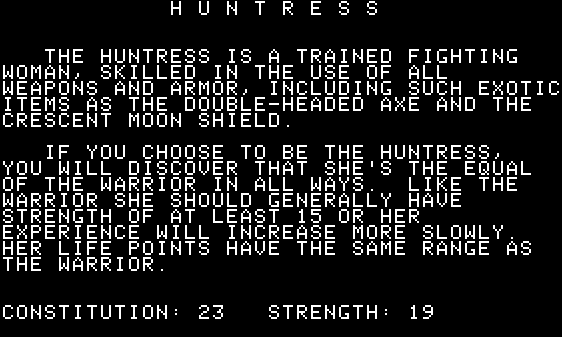 |
| If only I hadn't given my character a male name first. |
After this, you go through the process of purchasing weapons, armor, a horse, and food.

The character class descriptions, weapons, armor, and other trappings are all just thinly-disguised illusions, of course. Once the game starts, your "character" is indistinguishable from any other, and you don't actually have an accessible inventory. Instead, these choices simply make small adjustments to your starting strength, constitution, speed, and life scores--but it's fun that the developers tried to make it seem like you're creating and equipping a character as in a classic RPG.
The same fantasy continues in the gameplay itself. As you explore the maze, you enter little blue "rooms" which contain varying amounts of treasure and (usually) an enemy with varying strength, armor, and speed. Combat with the enemies is a simple matter of assessing whose scores are higher (although there's also a luck factor based on the difficulty level you choose at the outset) and either fleeing or letting the computer duke it out for you; there are no tactics or spells or anything to adjust this cold math. Again, this is much like Dungeon Campaign.
But the game makes the most out of this limited mechanic by randomly generating evocative, tabletop-RPG-style room descriptions as you enter each room.

The descriptions all start with "You are in a room...." The dozens of endings include:
I won't pretend that I faithfully read every one of them; by the end, I was just blowing through the rooms for the experience. That doesn't negate the welcome effort expended by the developers to turn something bland into something interesting.
The monsters themselves don't really matter except as statistics, but that doesn't stop the game from getting creative with them. You get standard D&D fare (lycanthropes, gorgons, copper dragons, cyclopes, gremlins, chimeras), original creations (gray silences, bloody bones, ice beasts), and demons and spirits drawn from Celtic and Gaelic folklore (Bheulach, Beithir, Peallaidh, Phouka, Guytrash). Again, the game manages to make something fun out of a very simple mechanic.
Similarly, you don't just find "10,000 gold pieces" in dungeon rooms. You find silver statuettes, copper plates, gold bars, and antique jewelry. That the game just monotonously converts these to "kraums" doesn't mean that the variety isn't welcome.
Combat has basically two modes: round-by-round and "fight to the death" where the computer keeps generating rounds until either you or the opponent is dead. Round-by-round combat is helpful when you think you might be able to defeat an enemy but want to keep the option to flee. Towards the end of the game, when enemies have hundreds of hit points, the "fight to the death" rounds can take several minutes even on my speeded-up emulator. I imagine that on the original Apple II, you must have had to sit down with a sandwich to watch some of them.
Although there are no individual combat tactics, there's a kind of macro-strategy associated with the game. You have to fight to gain experience, and every time you change levels, you can spend your accumulated experience on either constitution or life points. The game's use of the terms is a little odd. Practically, "constitution" serves as what most games call "hit points," and "life points" are a kind of timer. They deplete each step, every couple of seconds if you're standing still, and when certain in-game actions occur (you lose 5 when you attempt to force a door, for instance). If you run out, you die. Constitution seems to have no maximum value, but your maximum life value is set by your class and how much food you bought at the beginning of the game, and it's only enough to last 5-10 minutes even if you stand still.
Thus, the player has to engage in combat to build up experience to spend on life points (as well as on constitution to replace damage done during combats). Your goal on each level is to reach the end of the level with more experience than you've lost in both constitution and life, and you can't do that if you only fight low-level enemies. So you have to explore the rooms and analyze a) whether you're likely to beat this foe; b) if you do, whether the experience rewards will outweigh the lost constitution. And you have to time these room visits and combats to still leave you with enough experience to make it to the level exit.
The game ups the ante during this process by throwing random events at you. Cave-ins screw up the map and can even trap you, effectively ending the character. You can encounter (usually low-level) creatures in the hallways and be forced to fight to the death; these combats sap constitution but don't provide experience. Vampire bats can appear and chase you, forcing you to either outrun them until they give up, or suck up a loss of about 50 life points. "Blue smoke" might lift you up to a previous level, making you navigate back down. "Ponds" appear, and falling into them drains all your stats.

One thing that I particularly like is that while increasing levels tend to increase the difficulty of the most difficult monsters you find there, even on the highest levels there are still plenty of low-level monsters. That way, if the player makes a mistake and ends up on a high level with fading health, he isn't necessarily doomed. He can still scrounge some low-level monsters for a boost and work his way back up.
You also find good things (randomly) during the course of the exploration, such as special weapons or magic items that add strength, speed, and armor class. Like the initial purchases, they don't actually go into any kind of equippable inventory; they just add numbers to your attributes immediately. It's still more interesting to read "you find boots that increase your speed by 3!" than "you gain 3 speed points" for no reason.
Some of the items you find are "keys" that are "rumored to overpower the dragon." I don't know exactly what they do, but they must be helpful, because when I encountered the final dragon, I had 2,578 constitution against his 3,222 strength, but I still won.
The same fantasy continues in the gameplay itself. As you explore the maze, you enter little blue "rooms" which contain varying amounts of treasure and (usually) an enemy with varying strength, armor, and speed. Combat with the enemies is a simple matter of assessing whose scores are higher (although there's also a luck factor based on the difficulty level you choose at the outset) and either fleeing or letting the computer duke it out for you; there are no tactics or spells or anything to adjust this cold math. Again, this is much like Dungeon Campaign.
But the game makes the most out of this limited mechanic by randomly generating evocative, tabletop-RPG-style room descriptions as you enter each room.

The descriptions all start with "You are in a room...." The dozens of endings include:
- "With a large wood chest, the iron lock has rusted completely through and the sides have rotted from the dampness."
- "Carved out of solid rock. A skull lies beside a quiver of arrows."
- "With a large cedar cabinet filled with motheaten robes of black and gray."
- "This is very large. A huge metal kettle is sitting on a large pile of ashes where once a giant fire burned."
- "Built for a king of old. A tremendous throne is attached to one wall and a big round table surrounded by large chairs stands in the center."
I won't pretend that I faithfully read every one of them; by the end, I was just blowing through the rooms for the experience. That doesn't negate the welcome effort expended by the developers to turn something bland into something interesting.
The monsters themselves don't really matter except as statistics, but that doesn't stop the game from getting creative with them. You get standard D&D fare (lycanthropes, gorgons, copper dragons, cyclopes, gremlins, chimeras), original creations (gray silences, bloody bones, ice beasts), and demons and spirits drawn from Celtic and Gaelic folklore (Bheulach, Beithir, Peallaidh, Phouka, Guytrash). Again, the game manages to make something fun out of a very simple mechanic.
 |
| I don't even want to know what kind of monster this is. |
Similarly, you don't just find "10,000 gold pieces" in dungeon rooms. You find silver statuettes, copper plates, gold bars, and antique jewelry. That the game just monotonously converts these to "kraums" doesn't mean that the variety isn't welcome.
Combat has basically two modes: round-by-round and "fight to the death" where the computer keeps generating rounds until either you or the opponent is dead. Round-by-round combat is helpful when you think you might be able to defeat an enemy but want to keep the option to flee. Towards the end of the game, when enemies have hundreds of hit points, the "fight to the death" rounds can take several minutes even on my speeded-up emulator. I imagine that on the original Apple II, you must have had to sit down with a sandwich to watch some of them.
 |
| Trading blows with a "Guytrash," northern English dialect for a kind of demon spirit. |
Although there are no individual combat tactics, there's a kind of macro-strategy associated with the game. You have to fight to gain experience, and every time you change levels, you can spend your accumulated experience on either constitution or life points. The game's use of the terms is a little odd. Practically, "constitution" serves as what most games call "hit points," and "life points" are a kind of timer. They deplete each step, every couple of seconds if you're standing still, and when certain in-game actions occur (you lose 5 when you attempt to force a door, for instance). If you run out, you die. Constitution seems to have no maximum value, but your maximum life value is set by your class and how much food you bought at the beginning of the game, and it's only enough to last 5-10 minutes even if you stand still.
Thus, the player has to engage in combat to build up experience to spend on life points (as well as on constitution to replace damage done during combats). Your goal on each level is to reach the end of the level with more experience than you've lost in both constitution and life, and you can't do that if you only fight low-level enemies. So you have to explore the rooms and analyze a) whether you're likely to beat this foe; b) if you do, whether the experience rewards will outweigh the lost constitution. And you have to time these room visits and combats to still leave you with enough experience to make it to the level exit.
 |
| "Leveling up," in both senses. |
The game ups the ante during this process by throwing random events at you. Cave-ins screw up the map and can even trap you, effectively ending the character. You can encounter (usually low-level) creatures in the hallways and be forced to fight to the death; these combats sap constitution but don't provide experience. Vampire bats can appear and chase you, forcing you to either outrun them until they give up, or suck up a loss of about 50 life points. "Blue smoke" might lift you up to a previous level, making you navigate back down. "Ponds" appear, and falling into them drains all your stats.

One thing that I particularly like is that while increasing levels tend to increase the difficulty of the most difficult monsters you find there, even on the highest levels there are still plenty of low-level monsters. That way, if the player makes a mistake and ends up on a high level with fading health, he isn't necessarily doomed. He can still scrounge some low-level monsters for a boost and work his way back up.
You also find good things (randomly) during the course of the exploration, such as special weapons or magic items that add strength, speed, and armor class. Like the initial purchases, they don't actually go into any kind of equippable inventory; they just add numbers to your attributes immediately. It's still more interesting to read "you find boots that increase your speed by 3!" than "you gain 3 speed points" for no reason.
Some of the items you find are "keys" that are "rumored to overpower the dragon." I don't know exactly what they do, but they must be helpful, because when I encountered the final dragon, I had 2,578 constitution against his 3,222 strength, but I still won.
 |
| The setup for the final encounter is well-told. |
The ultimate goal is to reach Level 10 with enough constitution to survive against the dragon Salmadon, find him in a random encounter, and kill him to escape the dungeon and win the game.
 |
| I don't know. I can count pretty high. |
Whether you win or die, your character appears on a scoreboard, with the score based on the amassed treasure during the expedition (defeating the dragon provides a lot of additional treasure). If you win, you also get a "certificate" of your victory.
 |
| This is going on my resume. |
You'll note from my certificate that I won on the easiest level, "novice." I tried a few games on higher levels but naturally found them much more difficult. Still, with a lot more time and a lot fewer games, it would be fun to see if I was up to the challenge to beating the game on its highest difficulty setting.
If a modern game tried to mask simplistic mechanics with a bunch of florid prose, I'd probably tear it in half in my review. But I feel the opposite about a 1981 developer who, constricted by low-res graphics and limited space for complex gameplay elements, still tried to stretch beyond the game's limitations and offer the the player a creative experience that mimics (as well as possible) the experience of exploring a dungeon in a tabletop RPG. We'd have to wait until Pool of Radiance before we again saw such expressive descriptions.
If a modern game tried to mask simplistic mechanics with a bunch of florid prose, I'd probably tear it in half in my review. But I feel the opposite about a 1981 developer who, constricted by low-res graphics and limited space for complex gameplay elements, still tried to stretch beyond the game's limitations and offer the the player a creative experience that mimics (as well as possible) the experience of exploring a dungeon in a tabletop RPG. We'd have to wait until Pool of Radiance before we again saw such expressive descriptions.
 |
| Here's another one, just for fun. |
I'm giving Dragon Fire 18 points on my GIMLET scale, with the highest values in the "game world" category, for the care put into the descriptions, and the "gameplay" category, for its brisk and challenging pace and its constant replayability. It's not a great game by modern standards, but among the myriad of early-1980s Apple II offerings, it stands out of the pack.
Dragon Fire had an in-name sequel the same year: Kaves of Karkhan, a first-person adventure game with not enough RPG elements to make my list. It's really only a "sequel" in the sense that the framing story, well-written by sci-fi author Steve Rasnic Tem, uses the same characters. Rodney Nelsen has a few other games to his credit in the 1980s and 1990s, but no other RPGs.
Understanding that I'll still dip into non-DOS 1980s games occasionally, let's transition to 1990.

