Showing posts with label Deathlord. Show all posts

Monday, January 29, 2018

Deathlord: Summary and Rating

       
Deathlord
Canada
Independently developed; Electronic Arts (publisher)
Released in 1987 for Apple II and Commodore 64
Date Started: 3 June 2017
Date Ended: 25 January 2018
Total hours: 36
Difficulty: 4/5 (Hard)
Final Rating: 40
Ranking at Time of Posting: 232/282 (82%)

At the end of the last Deathlord session, I was debating whether to explore the new continent or return to the old one and grind first. I ultimately decided on a compromise: I returned to the old one long enough to get everyone enough experience for their next levels (most were already there), then sailed back to the new continent.
        
Enemies on the high seas are deadly, as I later found out.
      
I soon discovered a town called Clearview (at least, that's the name of its prison). It was another huge town that required about an hour of running around, smashing doors, searching for secret doors, and talking to people. I was perturbed that the weapons shop didn't sell anything better than what I already had.

NPC dialogue didn't offer a lot that was new, but it did offer that "there's a word in the dungeon" and "there's a dungeon in the canyon northwest of here." Since the bulk of the game seems to be about finding the seven words and six items that will defeat the Deathlord, that was welcome news. I'd been asking about WORDS and ITEMS constantly and didn't have any clues until now.
        
"It is an obscenity spraypainted by a teenager."
        
Annoyingly, the new continent uses a different color and style for its poison tiles. I couldn't find any way to the dungeon without crossing poison, so I sailed my ship around the coast until I located it. 

The dungeon was uniquely constructed. I didn't understand half of what was happening while I was in it, but a map I found online later made it clear. It consists of four levels. The center part of each level is nothing but an 11 x 11 map of up and down staircases: all down on the first level, all up on the fourth, and a mix in between. To even get out of this central area means walking five steps to a wall, all the while you're transitioning levels. Fortunately, the druid's (or whatever's) ichihan spell lets you know what level you're on. Every time I cast it, I want sushi, because Ichiban is the best sushi restaurant in Bangor, Maine.
       
Arriving in the "stair dungeon."
       
Around this central area is a double ring of square rooms, connected by illusory doors. You have to find a path through the illusory doors--some of which actually teleport you to other levels but to positions that look exactly like the ones you vacated! There are other staircases other than the one in the middle. Some rooms hold treasure pots.

Unique, yes. Very craftily constructed. But can you imagine how long it would take to explore and map this thing by hand? You have to test every wall for illusory doors. You have to cast ichihan every time you go through a secret door to make sure you haven't changed levels. Periodically, you have to return to the central area and get tossed to a new level before you could finish mapping the old one.

And after all that, the corridor that leads to the "word" is in a place that completely breaks the pattern--an illusory door to the north in a place that by the configuration of the rest of the dungeon should have no space at all. At the end of this corridor is a door that leads to a group of "vapor demons," creatures far harder than anything else in the dungeon, with the ability to paralyze characters and cast mass-damage spells. I lost Poniteru and Kuriboshi, whose hit points remain stubbornly in the single digits, in the first wave of attacks.
     
These bastards.
      
By this time, I was so frustrated with the game that I was already making decisions as if I wasn't going to keep playing. First, I was looking at an online map, having failed to find the word in hours of exploring because I missed that errant corridor on Level 3. That's another thing: most games, if they were going to do something so indecent, would at least do it on the bottom level where you'd expect to find the big treasure. I spent a lot of time on the bottom level for that reason. But no, it's on Level 3.
     
Andrew Schultz's map of the dungeon level in question.
        
Second, rather than turn around with my tail between my legs yet again, I insisted on plowing through the vapor demons. But to do so, I had to capture save states essentially every combat round, reloading if the round went bad. Friends, there's no coming back from that kind of cheating. But I made it through the room and recorded the word: it's chijoku, meaning "disgrace," which I thought was rather fitting.
    
       
My mood was dark as I returned to the surface and boarded my boat. At this point, the game or the universe in general gave me a way out. In the middle of the sea, I got attacked by some dragon serpents, and my entire party was wiped out. I reloaded the last save state, and was surprised to see I hadn't made one since leaving the dungeon. Here's the problem: the game saves the world state separately from the party state, and in the game's world state, there was no ship waiting for me on the outside. Since Clearview doesn't sell boats, I was effectively marooned. Maybe pirate ships occasionally come along and you can steal them? I don't know. I circled around for a while and didn't find any.

The only "out" the game gives you in such circumstances is to "disperse" the party from the main menu, which puts them back on the roster but undoes all their work. Upon reconstituting them, I found myself outside Kawa at the game's beginning again. My characters all have their levels and gold, but I don't think they have any of their accomplishments. The Emperor has regressed to demanding "news on whoever is responsible for these outrages!"
      
Here we go again.
        
In viewing the map of the last dungeon, I had inadvertently educated myself about the sheer size of the game world. The maps on GameFaqs (supplied, of course, by Andrew Schultz), show a total of 15 continents and archipelagos, all insanely far away from each other. Amidst these landmasses are 23 cities and towns (including palaces) and 20 dungeons and ruins, comprising 125 dungeon levels. Is there a larger permadeath game? In 36 hours, I explored less than a fifth of it--cheating. I don't think we've heard so far (in the comments) from anyone who won the game legitimately. I would love to know how you did it. I could easily see buying this game in 1987 and not winning until 1994.
      
This map, courtesy of Andrew Schultz, shows the real spacing between continents.
      
At the same time, I hold a growing admiration for the game's chutzpah (what's that in Japanese? Daitan?), and part of me does want to keep going and properly document it, including some of the crazy-looking levels. But if I'm going to start over, it's not going to be now. I'm going to have to give it some space. Also, I think I need to replace two of my characters; my genkai and my mahotsukai have such low constitutions that they only get 1 or 2 hit points per level. They could be Level 20, and they'd still be vulnerable to some of the mass-damage spells that enemies throw at us.

Thus, I'm technically wrapping things up now, but I'll keep open the possibility of returning to the game once I finish catching up on 1988/1989, perhaps dipping into it periodically. If I do start playing again, I'm going to try my best to adhere to its intended rules.

For now, the provisional GIMLET:

1. Game World. The brief backstory offers nothing that we haven't heard before (evil warlord taking over), and the pseudo-Japanese coating really adds nothing to the gameplay. On the other hand, the world does really feel like a world, and I appreciate the permanency of the world state. There were signs of a growing plot within the game itself rather than just in the background materials. Score: 4.
          
2. Character Creation and Development. Both are about as extensive and rewarding as an AD&D game of the era, which makes sense given the game's dedication to AD&D spells and classes, albeit (as commenters pointed out) with RuneQuest's attributes. By starting the characters so weak and inept in the first place, the developers left a lot of room for them to grow. So far, there haven't been any class- or race-based encounters or role-playing options. Score: 5.
           
3. NPC Interaction. The creators adopted a system about halfway between Ultima II and Ultima IV, where NPCs have a stock dialogue line or two, but you can also "inquire" about specific keywords. The lack of clear NPC names, the cumbersome system for interacting with them (there are multiple "talk" commands), and the rarity of responses to keywords all make the system less enjoyable than the later Ultima titles. Score: 4.
         
You'd call this "role playing" if the nature of the game didn't basically require you to smash every door and talk to every NPC.
       
4. Encounters and Foes. The impressive bestiary offers about as much diversity in strengths and weaknesses as a Gold Box title. Learning them, and how to counter and exploit them, is a highlight of the game. I didn't find many non-combat encounters or puzzles, although perhaps more would have surfaced as the game went on. The quantity of encounters is particularly satisfying. Dungeons were often frustrating for other reasons, but I rarely felt that they had too many enemies. Walking between towns on the surface, you might face one or two combats, but not enough that you want to scream. And yet there are a few obvious places for grinding. Score: 5.

5. Magic and Combat. A highlight, and I'm sorry I didn't get deep enough into the game to devote an entry solely to this topic. Fusing a Wizardry approach with an Ultima interface and a Dungeons and Dragons spell set was a brilliant idea. D&D offers a great selection of offensive and defensive spells, spawning numerous tactical options. Unlike Wizardry, the game supports pre-combat buffing. There are original spells that assist extrication from combat when necessary. Combats last long enough to be interesting but not so long that they get frustrating and boring.

Finally, I thought the number of spell points and rate of regeneration was near-perfectly balanced. In too many games, the mage quickly becomes a worthless contributor because he runs out of spell points. In too many others, his pool is so great that he can spam his most powerful attacks the entire game. Deathlord puts the fulcrum at just the right place. And if I'd kept leveling, I would have found a "Mark/Recall" spell and one that makes it easy to escape dungeons.

There are weaknesses to the system, such as the inability to target specific enemies, no tactics for fighting classes, nothing special for thieves to do, and no utility for missile weapons. But overall, I enjoyed the system. Score: 6.

6. Equipment. Perhaps the most disappointing category. You can only carry one primary weapon and one suit of armor at a time. You rarely find upgrades, either in shops or as loot, and when you do, there's no easy way to evaluate items' relative strength. In most games, you could compare armor items by wearing them and noting the effects on armor class, but here once you choose to take an item, you lose what you already had, so there's no method of comparison. This is true even if you can't technically wear the new item because of class restrictions! I also didn't find many items to "use." Score: 2.
         
Arriving on a new continent to find the same old stuff was a disappointment.
          
7. Economy. I felt it was a bit too generous. I always had plenty of gold for training, equipment, food, and bribes, and I probably could have afforded a new boat on a regular basis. On the other hand, I cheated on the permadeath, and a player playing straight would have had to pay for resurrection a lot more than I did. Even so, I think the developers could have done more with the economy by offering better equipment and, for gods' sake, "restoration." Maybe there would have been more to buy on the other islands. Score: 4.

8. Quests. One main quest with multiple parts. I didn't experience any side-quests, though there are plenty of side areas. Perhaps too many. I'm not sure anyone wants to explore a 10-level dungeon for no reason. I don't get the impression that there were any choices or alternate outcomes to the main quest. Score: 4.

9. Graphics, Sound, and Interface. The iconographic graphics are functional but were never beautiful, and the lack of monster graphics puts the game at near-roguelike status. Sound is also unimpressive. The keyboard interface, on the other hand, works great. I particularly appreciate the ability to bring up a list of valid options with the ? key when casting spells. My only problems were from my own muscle memory; I kept pressing "T" to talk instead of "O" (for "orate"). One thing I didn't cover is the availability of macros to streamline common commands. So instead of having to press (C)ast and then select the healer and then type (or select) NASU, you can string these together in a macro and activate them from a single key. On the negative side, the lack of an automap is only forgivable because of the game's year. Score: 4.
        
In a game where all the spell names are in Japanese, I'm grateful not to have to type them out.
      
10. Gameplay. The game gets points for nonlinearity, particularly after the party gets a ship. Since you can buy a ship and don't have to wait for the emperor to give it to you, I suppose you could theoretically explore the game in any order. I also recognize a bit of replayability given the many optional dungeons. But the game is simply too big--as I said in the first posting, the mechanics and content aren't deep enough to support an epic size--and is particularly too big for permadeath.

Permadeath might even be forgiven if the variability of difficulty wasn't so high. There's nothing more infuriating than having no problem with three levels of a four-level dungeon, only to suddenly encounter an enemy 10 times as deadly as anything that preceded him. If I were to start over, playing with permadeath, I think I'd have to force myself to grind up to Level 10 before entering a dungeon, thus ensuring that I had the equivalents of "cure poison," "cure paralysis," and "cure moderate wounds." The difficulty is so problematic that it subtracts from the positive things I would otherwise say in this category. Score: 2.

That gives us a final score of 40, which sounds low until you reflect that less than 20% of the games I've played through 1991 have broken 40. With a less punishing difficulty, a better approach to NPC dialogue, and a more robust equipment system, Deathlord could have been near-50-point game and in the top 10%. 
          
There's no way "1 chance to save" wasn't supposed to be a joke.
         
Scorpia generally agreed with my assessment in the April 1988 Computer Gaming World, although I'm impressed to see that she finished it, apparently by frequently backing up the scenario disk. She complains about permadeath, a "bland" ending, omissions and errors in the manual, mapping difficulty, and the shallow use of Japanese themes. ("No attempt has been made to draw on the rich folklore and mythology of Japan . . . Rather, the authors have created a compendium of standard CRPG features glossed over with a tinge of pseudo-Orientalism by pasting Japanese names on as much as they could.") She had particular venom for a dungeon full of doors--"one of the most idiotic dungeons ever"--which I didn't explore. Overall, she branded it "a mediocre effort at best" and "a game for the serious player to avoid."

The highest review numerically (89/100) comes from the March 1989 Advanced Computer Entertainment. It's one of those reviews that makes you wonder if the reviewer really played the game. Since over half the review is dedicated to character creation, I suspect not much. He doesn't mention permadeath (or difficulty) at all, only passingly mentions the Japanese themes, and saves his criticism for the combat system--the main criticism being that it's done via menu rather than by showing the characters in their positions (thus showing a lack of experience with anything except perhaps Ultima III and IV). At the end, he suggests that with Ultima V on its way to the Commodore 64, there's not much reason to buy Deathlord except the lower cost.

The ACE reviewer wasn't the only one to see Deathlord primarily as an Ultima competitor. Multiple sources (including the November 1992 Computer Gaming World) report that Richard Garriott was "furious" at Electronic Arts for publishing such a blatant Ultima ripoff. Origin dumped EA as its distributor and included a unflattering pirate in Ultima VI named after Trip Hawkins, EA's president. Ironically, Garriott sold Origin to EA in 1992 and accepted a vice presidency there, but I'm sure that $30 million causes "water under the bridge" to take on a new prominence in your daily vocabulary.

Perhaps even more ironically, EA's purchase of Origin marked the last time Origin made a decent RPG (if we assume that Ultima VII: Part Two and Ultima Underworld II were already well in development at the time of purchase). I don't know much about the other genres in which they've worked, but when it comes to RPGs, EA's history is pretty abysmal. Their first in-house effort was the idiotic Fountain of Dreams (1990), and the universally-panned Ultima VIII (1994) and IX (1999) were developed under their watch. Moreover, half the time that they publish another developer's game, they make a hash of it, whether insisting on a comedy theme for Keef the Thief (1989), destroying the intended scope of Richard Seaborne's Escape from Hell (1990), or insisting on a last-minute Japanese theme for Deathlord.

Deathlord's two primary authors, Al Escudero and David Wong, had some excellent ideas. They were smart enough to take the best elements of the most popular titles at the time. No other game of the era fuses an Ultima interface with Wizardry combat and Dungeons & Dragons spells. At the hands of a better publisher, they might have gotten some sage advice, like "lose the permadeath and cut it down a bit," instead of "translate everything to Japanese." In a November 2012 interview by Crooked Bee on RPG Codex, Escudero says that he was "quite upset" at EA's insistence on the Japanese skin and the quick turn-around:
       
I had a game I had crafted over a year and a half, and I needed to convert to an entirely different style at the 11th hour and wasn't given sufficient time to do the new style justice. It felt like a hack to me, and I hated doing it. If I'd had a few months, time to do reading on Japanese culture and myths, time to craft a tale that tapped into their rich mythology, I feel I could have done a far better job.
           
It's too bad we didn't see the game as originally written with a Norse theme; we would have encountered draugr for the first time here in 1987. He also laments making the game so hard--"If I knew then what I know now, I would not have made the game save on death"--and thinks the difficulty might have been responsible for poor sales. The low sales and poor reviews probably killed an intended sequel in which the heroes would have had to resurrect the titular Deathlord to restore the "natural order."

Escudero later found some work with SSI, and we'll see him again with Spelljammer: Pirates of Realmspace (1992). Later, he formed a company dedicated to online games and was, like Origin, purchased by EA. Today, he serves as chief product officer for a company that makes mobile games. David Wong joined EA Canada in the 1990s and has worked on numerous racing and sports games, but never another RPG. Incidentally, it was in writing this paragraph that I discovered that both developers were Canadian and have thus listed the game accordingly in the master list.

With this wrap-up, I finally end my second pass through 1987. It's time for a transition posting and to re-consider "Game of the Year." Braminar fans, prepare your arguments.

*****

If anyone reading this has won Castle of Tharoggad, I would appreciate a hint (or outright spoiler) as to what to do on the final level to win.

Wednesday, January 24, 2018

Deathlord: Mizu no Sekai

The party nears the solution of the first major quest.
     
After my negatively-toned entry about Deathlord last time, I decided this time to slow down and try to re-create how I would have felt about the game if it was 1987 and the only game that I'd purchased that year.

In that sense, it performs better. Yes, the game map is indecently large, but it's worth noting that an enormous amount of content is optional (including, I think, all the dungeons on the main continent except the one under the castle), so you could explore and discover without feeling too bad about missing things. Yes, the permadeath still makes it crazy difficult, but that makes every new level feel like a major victory. And in fairness, I should note that the spell system gives you more tactical opportunities in combat than the typical Ultima clone, including some spells that allow you to retreat from hopeless combats. I should also note that the game is not stingy on gold. It knows that you're going to need to resurrect, cure poison, and cure paralysis a lot, and it gives intrepid players enough money to do that.

Still, I can't force myself to play with permadeath rules intact. I just can't. I've tried to limit my saving to once every 30 minutes, which is hard enough given the difficulty of some foes. Repeatedly during this session, I thought I was doing fine, felt that I was finally over the hump, enjoying some dungeon level or another, and then suddenly encountered an enemy capable of mass-damage spells or critical hits that wiped out half my party in the first round. Back in the day, I would have suffered two or three such incidents and then spent 200 hours grinding before even trying to explore the rest of the game.

As it happened, I did start this session with a fair amount of grinding, trying to recover from last session's level drains. When I was up to Level 4, and starting to get two attacks for some of my fighters, I took on the "diamyo" of Kawa, allowing myself to save before the battle. Battles within cities are particularly hard because you have to give the enemy the first attack. If you pre-emptively attack, no matter how hostile the enemy is, the entire town turns against you.
        
A daimyƍ was a feudal lord. I'm not sure what this is.
          
It took about five reloads to get a favorable outcome. The diamyo's death rewarded me with a Rod of Death, which I guess is a pretty good weapon.

Kawa also had another surprise. In an area hidden by secret doors, I found the "Yakuza Guild." Upon entry, I was swarmed with parties of yakuza. These thieves aren't trivially easy, but neither are they particularly hard, and they served as good test objects for my spells. They both delivered a reasonable amount of gold and were guarding piles of treasure chests.
      
Fortunately, the exit is just one step away.
      
The guild had a lower level with even more groups of enemies, some of them a little tougher. These included ninjas capable of critical hits. But smart use of spells and occasional retreats to safe ground allowed me to clear them enough to get their treasure. Because the parties kept respawning, the guild was a great place for grinding, and I got to Level 6 in short order, which opened up a new level of spells for my spellcasters.

Feeling stronger, I decided to chase rumors about someone named "Kawahara" lurking in the dungeons beneath the emperor's palace. I wasn't expecting the size and length of the complex, which consisted of six large levels with multiple secret doors, illusory doors, teleporters, and pit traps. I'm sure I didn't find close to everything. Some highlights:
      
In fact, both doors descended to different areas and neither led to my doom.

A secret door leads to a single square surrounded by water. Guess what's to my right?
A long time ago, an NPC had told me to "step east on the second drop."
Whatever's over there, I guess I don't want it that badly.
A teleporter in the corridor kicks you back one step without warning, so it seems like you move "south" forever. You have to find the secret doors on the side to get around.
         
In general, the dungeons in this game are well-designed. There's only so much you can accomplish with tiles and 1987 technology, but the developers pushed that envelope, and I think the results are superior to both Ultima (at least through V) and Wizardry. Secret doors mostly mask optional locations (e.g., treasure rooms) rather than mandatory ones, so you only have to exhaustively search the walls if you care about every last gold piece. The number of combats is challenging but not overwhelming. The walls make interesting patterns and encircle underground lakes, forests, pools of lava, and other fun environmental features. Treasure is plentiful, although I wish there were more equipment upgrades amidst all the gold.

Eventually, I found my way to Kawahara. Of course, he proved about 20 times more difficult than any other enemy in the dungeon, launching a spell that killed three characters in the first round of combat. Playing honestly would have meant escaping from combat, returning to the surface (without getting killed by other monsters), and resurrecting the three characters. If I wasn't going to do that, I should have at least fled after reloading and forced myself to grind some more. But instead I kept reloading and trying different buffing spells until either that or luck kept us alive for enough rounds to kill the wizard. I felt a little pathetic after the battle and decided that will be the last time that I abuse saves in such a way.
             
My first attempt didn't go so well.
       
Kawahara had a note on his corpse that read as follows:
         
To his most noble countenance, the Emperor of Demons and Lord of Death!

Greetings, master! I have done your bidding and sent forth the initial wave of creatures that were readied for the invasion of the kingdom. I have also ordered a contingent of skeletons to loot and pillage the surrounding area. 
         
Part of the incriminating document.
         
It is my duty to inform you that your legions have met with stiffer resistance than was anticipated and although they managed to raze the town of Gold Rock, the wizard somehow escaped, destroying fully half of the army in an explosion the like of which I had not known was possible.

I am currently in the process of restoring the bulk of the army sufficiently to allow me to crush the Emperor and send his soul to your domain, that he may suffer for the inconvenience that his treason has cost.

Your servant, Kawahara.
            
Interesting stuff there. "Gold Rock" would seem to be a proper name that was overlooked in the conversion to Japanese. I think it probably refers to the town called Yokohama elsewhere, though it doesn't seem to be a translation of the original.

I took the letter to the Emperor. I was hoping that he'd give me a reward, but he just told me to go to "Oceanspray," take a boat, find the Deathlord, and "don't return until he is no more!"
      
This may be a good time for everyone to recall that I'm doing you a favor.
       
"Oceanspray" is another English name that was missed in translation, and it took me a while to realize that it referred to the town of Tokushima. (If I'm not mistaken, this translates as something like "profit island," which would have been a better replacement for "Gold Rock." Even more confusingly, the map that came with the game labels the boat city as Tokugawa and an eastern city as Tokushima, but from in-game text, I'm 99% sure the names are supposed to be reversed.) Boats normally cost 10,000 gold there, but after the Emperor's decree, I was able to board one without paying.
      
Or maybe I just stole it.
    
Before I spent any time on the high seas, I wanted to finish exploring the mainland. I spent a lot of time in the ruins called Wakiza, which supposedly hid pirate treasure. I found a secret passage I had missed before (probably because you have to walk through deadly swamp to get to it) and found myself in another multi-leveled system of caverns and corridors. I got down to the fifth level, which opened up into a maze of canals (with boats supplied) and thin walkways of land between them. But I got attacked there by "sea dragons," capable of killing my characters in one hit, and I adhered to my previous vow not to save-scum to defeat them. I marked the area for later return and limped my way back to the surface.
       
If I was playing under the game's intended rules, I would now have to somehow escape combat, make it all the way back up 5 levels with one character and 4 hit points, and make my way to the castle for resurrection. Or, more likely, start completely over with a new party.
           
I also explored the ruins of Yokohama. Even though the town was destroyed, the game still saved every time I initiated an attack against a party of skeletons or whatnot, just as it does in "real" cities. The whole area was filled with poison squares and I soon got sick of threading my way through them. I need to spend more time there to discover if there are any remaining NPCs amid all the monsters.
           
Note the subtle difference between poison squares to the left of the sign and non-poison squares to the right.
         
Finally, I retrieved the boat from Tokushima. Before leaving, I explored the northwest quadrant of the city, accessible only by boat, but it just had a tavern and a small treasure chamber. I then took the boat around the continent to the city of Tokugawa, which I'd already explored except for a small island in the southeast.

The game does something interesting with cities that I forgot to mention. Unlike Ultima, you don't enter a city by standing on it. Instead, you stand next to it, hit (E)nter, and specify a direction. The position from which you enter the city determines where you end up once the city map loads. If you enter from the north, you'll end up at the north side of the city map.

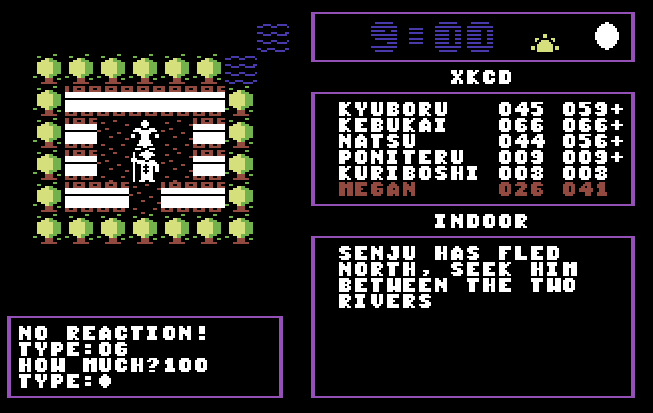
In the case of Tokugawa, there's an island in the southeast part of the city, and I wanted to see whether I'd be able to access it if I entered the city while still in my boat. It worked, making Deathlord the only game of this type that I know where you can sail your boat into a city. The island had a sign labeling it "Bone Island," and it just had one NPC. That NPC, when given gold, told me to seek Senju "between the two rivers," somewhere to the north.
                
North on this continent or north to another continent? Or north within this city?
             
Other NPCs had previously told me to "find Senju," and I suspect he's the wizard mentioned in Kawahara's letter.

Miscellaneous notes:

  • I don't care what game you're playing, there is little more infuriating than casting the equivalent of "Cure Light Wounds" on a character who really needs it and having it heal 1 hit point.
  • The maximum amount of gold a single character can carry is 10,000. Not 9,999: 10,000. What the hell?
  • Speaking of gold, my failure to adhere to permadeath means I have a lot more of it than I probably should. I can't think of anything to spend it on. Perhaps the other continents will offer opportunities, or perhaps the various NPCs will turn out to be right and my ships will get stolen frequently, forcing me to spend 10,000 on new ones.
         
There would be more joy in these moments if I knew there was a naginata +5 waiting in some weapon shop.
        
  • I found a sword called "Dragonslayer" at one point and took a screen shot of finding it, but I can't remember what circumstances preceded this.

Now I just have to find a dragon.
        
  • There are multiple creatures, pit traps, and chest traps that result in poison. Given that, it takes an awfully long time for characters to get a "cure poison" spell. I won't have it for two more character levels; I have to rely on a "slow poison" spell and healers until then.
  • Environmental changes are permanent in this game. There's no looting the same treasure room multiple times. I have noticed, however, that smashed doors seem to get repaired and closed again eventually.
  • When you step on a staircase, you automatically ascend or descend. Once you get to the destination, you have about two seconds to move before the game automatically "waits" a turn and sends you back to where you came from.
      
Trapped in an endless loop.
      
I started exploring the ocean, and all I can say is, the actual map bears no resemblance to the back of the box that someone linked me to. I went hundreds of squares in multiple directions and found no other land at all. Finally, I pushed off from the northern coast and figured I'd sail until I hit something or returned to where I started. After like three minutes of holding down the north button and going through multiple loading screens and one disk change, I finally came to the southern shore of a new island. If there's this much space between landmasses, I may have to break down and look at an online map.
     
I know it's a new shore because I've never seen those mountain textures before.
      
I didn't save here, though, because I have a lot left to do back on the first continent, including the lower levels of Wakiza and the eastern caves. Some wizard named Yang still menaces the southeast quadrant of Tokushima, and there's an imprisoned demon in the Emperor's palace. I don't know if any of it is necessary for the main quest, but I think I'm going to stick around until at least the fourth spell level.
  
Time so far: 32 hours

Friday, January 19, 2018

Deathlord: Resurrection

The party, quite appropriately, wanders a graveyard.
          
Deathlord is just a really hard game to get into, as evidenced by the fact that I'm four entries and 20 hours into this game and can only barely say that I've "gotten into" it. After putting it on the back burner in July, I've spent the last half-year trying and failing to come up with reasons to abandon it. A couple of pesky commenters have made it clear that it's not just going to slip out of everyone's mind.

To recap, Deathlord is the product of a group of first-time game developers who fused elements from several sources. From Ultima, they took the top-down, tiled interface, NPC dialogue, many keyboard commands, and the shape of the main continent. From Wizardry, they took the combat system and permadeath. From Dungeons and Dragons, they took the races, classes, and spells; from RuneQuest, the attributes. After Electronic Arts agreed to publish it, they made the developers put a Japanese skin on everything, "translating" races, classes, spells, and other proper names into Japanese equivalents. 

The story concerns an "outcast wizard" who has raised monstrous forces and attacked the kingdom of Kodan. The emperor offers a reward to a party who can defeat this "Deathlord." The party's quest is going to somehow involve collecting seven words and six items.

The game is famously difficult. You have only one save file, which gets over-written every time you transition areas and, most importantly, every time someone dies. It doesn't even wait until the combat is finished; in fact, it saves so quickly after death in combat that the blank screen that accompanies disk access is generally how you find out that someone died in the first place. It also auto-saves when you do something in a town to turn the citizens hostile. It does not auto-save when good things happen.
         
Resurrection is expensive. But you definitely want "Resurrection" unless you feel like losing a point of constitution every time.
       
Wizardry had permadeath, too, but it was a much smaller game in which the action was self-contained in one dungeon with a menu town on top. If a character died, it sucked, but you could replace him without a lot of difficulty, and eventually, given enough funds, you could resurrect him. Deathlord, on the other hand, takes place on a huge continent with only one healer that resurrects. Moreover, there's no way to boot a dead character and create a new one once the game has started. You have to accept the death until you can afford and find resurrection, unless you want to start over with a new party. Since new characters have hit points in the single-digits, it's near-impossible for a player playing "straight" to get through the first few hours.

Still, the difficulty doesn't bother me nearly as much as all the ways that they made the game . . . inconvenient. To enumerate some of them:
        
  • The towns are indecently large, making it very difficult to determine if you've visited every location. You have to make maps to be sure, and it's always tough to map top-down games.
  • There's no simple command to "open" a door. All doors must be picked or smashed, both of which have a greater than 50% chance of failing. Smashing causes hit point loss when it fails.
  • Towns are full of deadly creatures behind locked doors, so you can't fully explore them at early levels.
  • Towns don't have obvious names. NPCs sometimes refer to town names, but there's no clear "Welcome to Whatever" when you enter a town. You have to figure it out like a logic puzzle.
  • Most NPCs don't have names. And instead of one command to just talk with them, there are separate sub-commands for chatting, talking, and inquiring.
  • It's often not clear which NPCs run shops. You have to use the (B)uy sub-command to make sure.
  • You can pool gold but there's no command to divide it.
  • When you find new weapons and armor, you have to immediately decide whether to replace your old ones without testing effects on armor class first.
      
I don't know if anybody will.
      
  • Since the spell names are all in Japanese, you have to constantly refer to the manual.
  • Both towns and dungeons are full of secret areas. There are two types of secret doors: illusory ones, where you just walk through the wall, and hidden ones that you have to search with the "F" key. Thus, you pretty much have to walk into and F-search every wall. Oh, and the F-search might "fail" even if there is a secret door, so you have to try it on every wall multiple times.
  • Outdoors, swamp squares, containing deadly poison, look barely different from forest squares.
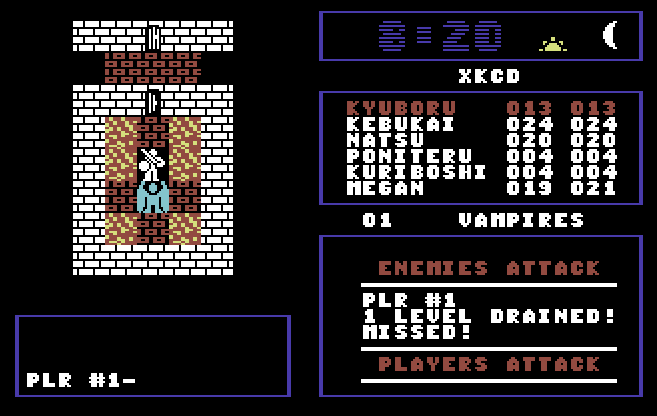
  • One I just discovered this session: there are neither spells nor healers that can restore levels lost to vampires and other level-draining creatures. A bad combat could send a super-character back to Level 1, permanently.
       
Note that there's no "restoration" option here.
    
To all of this, you have to add the size and scope. It was tough enough when I thought the main continent and its handful of dungeons was going to be the entire game. It turns out that there are over a dozen separate continents and islands. The manual isn't kidding when it promises to fill a "few hundred" hours. 

The answer to the difficulty is obvious enough 30 years later: I can use save states. I have been. But that just means I have to spend a few hundred hours feeling like I'm playing like a jackass. There's no question that, back in the day, I would have played this game with the disk drive open so it couldn't automatically overwrite my save game. I probably would have also backed up that single save game after every session, something that the manual mentions but says is "not the most honorable." You know what? Screw you, Deathlord manual. You haven't earned the right to lecture me on "honor." I'm the goddamned Avatar.

Since it's been 6 months, I spent most of this session re-visiting the cities and towns, checking them exhaustively for secret doors, talking with all the NPCs, and taking a new set of notes. I also peeked into a dungeon in the eastern part of the first continent. I had explored it before but missed a secret door.

I started in Tokushima in the northwest corner, thinking it was the town I had originally explored first but it turns out that was Kawa. Tokushima has the largest selection of stores on the continent, with shops for food, weapons, armor, and missile weapons, a shipwright, and a trainer. I don't really understand the purpose of missile weapons since you can't use them from the rear rank.

Behind a door I hadn't previously opened was a lava area shaped like a skull, and beyond that were fights with two stacks of zombies. I had just acquired "Turn Undead" (tsuiho, which Google translates as "addendum"), so that was a good excuse to use it, and it worked well. But in a room beyond that, with some treasure chests, a couple of ghouls came out and paralyzed two of my lead characters in the first round. I won't get a "Cure Paralysis" spell for another two character levels. I declined to hike all the way to the healer and reloaded instead, marking the area for later exploration.
        
Getting ready to turn some zombies.
     
From NPCs in Tokushima, I learn that ruins are rich, kobito hide gold, there is a group of mages staying at the palace, don't get caught outside at night, look to the north, seek the seven, find the words, map dungeons, the yakuza of Kawa are famous, and Kawahara awaits below the palace. No idea who that is. A plaque in a tower reads "Due south of the second stone."

I realized I had enough cash to buy some weapon and armor upgrades. You have to carefully watch the game when it comes to armor. Each character can only have one set at a time. If it's a type of armor they're allowed to wear, they automatically wear it; if not, they just carry it. You have to look at the armor class statistics to see what's happening for a particular character.

I'm a few thousand shy for a boat. That will have to come later. It looks like there's a section of the city only explorable once you have a boat. I smash my way into a cemetery in the south of the map and find a large mausoleum, but I can't figure out anything to do with it or the tombstones.
         
Soon.
       
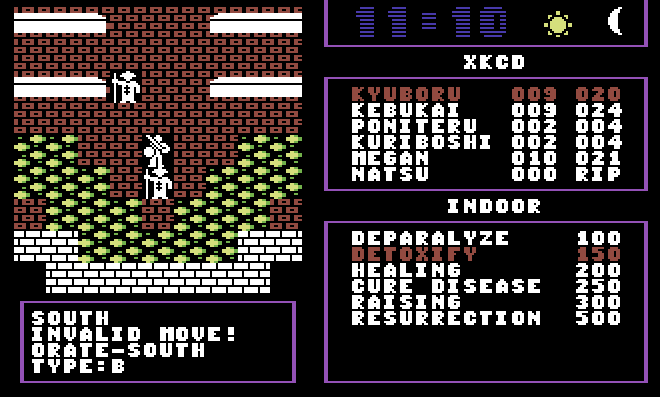
I move on to Kawa, a large horseshoe-shaped city ringed by forest. I explore the forest exhaustively but find no one. I decide to smash my way into the chambers of the "Daimyo" or "Diamyo" depending on which text you read, and it's here that I have the unpleasant revelation about vampires and their ability to permanently drain levels. Fortunately, I get lucky with a couple motu ("paralyze") spells in a row and only my lead character is drained while the rest kill the vampire. A secret room full of treasure chests next door seems to make it worth it.
       
Level drains with no "restoration" ability is the apex of evil.
      
The vampire isn't the "Diamyo," though. The moment I smash open his door, he kills my second character in one hit, then kills two more the next round. I again reload and mark his chamber for a later visit.

In another chamber to the northeast, I smash a door and find myself in battle against 10 kobito. Thankfully, they're as bad at hitting us as we are at hitting them (my fighters miss at least 75% of attacks), and we're able to defeat them with the help of a mass-damage spell and a sleep spell. A chamber beyond holds a bunch of chests with almost 500 gold pieces; we might be able to afford that boat soon. (This area is probably the source of the NPC line about kobito hiding gold.) I'm feeling good, but the next door I smash has 6 shisai behind it, and within two rounds everyone is paralyzed.

Annoyed at getting my butt kicked every three minutes, I abandon my explorations and head to some caves to the east of here that I've already explored, figuring I'll grind a couple of levels. It turns out that I missed an entire level the last time I was here--one of those illusory doors--and it has an area full of pillars and a bunch of treasure chests. Awesome! I start opening them, and I release a vampire, and he kills us.
      
Just before the vampire. Note that the grinding worked, and everyone can level up.
      
I think my grinding idea was a good one. I'll just stay on the earlier levels of the caves. My only concern about that is that if a vampire is going to drain me either way, maybe I'd rather have him do it when I'm Level 3 rather than Level 6. But that's probably going to be an issue throughout the game, so I can't let it stop me from leveling here.

My apologies for the paucity of screenshots in this one. I started playing it right after a session of Eye of the Beholder II and forgot that CTRL-F5 doesn't do anything in VICE. I had to go around and recreate some of them from earlier saves.

The game is frustrating as hell, but I don't want to give up on it until I've at least finished exploring the main continent and purchased a boat. We'll see how long that takes. In some ways, it's convenient that this game will probably outlast Eye of the Beholder II, as it keeps a 1992 game from creeping into the second game slot before I make the 1991/1992 transition post. I'll be impatient for it to be over soon after that, though.

Time so far: 20 hours


Wednesday, July 12, 2017

A Little about Deathlord and a Bunch of Thoughts on a Mistborn RPG


The party battles a large group in some ruins.
      
Ugh. Despite being "off" for the entire month, I'm having the worst time making progress with Deathlord. I never give up and look at online maps this early in a game, but with this one I've been tempted so many times that I keep forcing myself to stop playing rather than spoil the game.

What commenters told me about training was true. A few more combats and everyone had his "+". I headed back to Tokugawa, which had the only training center I'd found, and leveled everyone up. It just about doubled their hit points, but my mages only started with 2, so they remain pushovers compared to their fighter colleagues.
      
Leveling up in the training hall.
       
I resumed my systematic exploration of the continent, focusing on the interior this time. During my travels I again came upon the ruins of Wakuzi, which is supposed to have pirate treasure, and decided to explore it fully. This didn't take long, but I'm sure I missed a lot, considering I never found any pirate treasure. The western edge was all water. I don't know if you can bring boats into dungeons, but if so, perhaps there's more to find across the water (it will be a long time before I have the Level-6 water-walking spell). There were also some poison squares that I declined to cross because just a few steps kills my spellcasters.

An NPC standing by a wall said "pay up!" I consulted the manual and saw that I could bribe such NPCs with one of the "orate" subcommands. I think I've missed such opportunities in other places. I gave him 20 gold and he told me that the pirates' treasure would be found in the "caves under the town." But I never found a way to those caves, so again perhaps the entrance is beyond the water or poison.
     
How much more for directions to those caves?
   
Outside, day had turned to night again. The exploration window becomes so small at night that the manual just encourages you to sleep until morning. It's a good idea anyway. Hit points and spell points regenerate at a rate of about 1 every 70 moves, or about every 25 game minutes. I've been able to make it through most days with that slow regeneration, bolstered by castings of my one "heal" spell. But by the end of the day, I'm usually at the end of my resources, and a restorative night's sleep is the best approach. My food still continues to deplete at a slow rate--I'm on about 88 of my original 100 meals.
 
Pitching camp for the night.
      
After exploring the interior of the entire continent, I had only found one "new" location: a dungeon in the eastern part of the island. (I might have missed something, though.) The two-level dungeon was full of zombies, skeletons, ghouls (who can paralyze, a reload condition since I have no spell to cure it and it never wears off), harpies, gremlins (who can summon other gremlins), kobitos, and something called "stonebrows," which are hard to hit but die easily. I confirmed that monsters do re-spawn in dungeons. 
     
"Stonebrows" sensibly look like stone creatures with large brows.
     
The levels were large enough but had no special encounters or treasures. As usual, I felt like I must have missed something, but I did test every wall square and search each one for secret doors. I'm hoping it isn't the case that I need to search each wall square multiple times for secret doors. That might be a deal-breaker. In any event, when I left the dungeon, "+"-es were starting to appear next to the characters' names again, so it was time well-spent.
     
I repeated this process on every wall square.
     
At this point, I basically decided it was time to start over, systematically explore every inch of the towns and dungeons, and re-engage each NPC with the full range of dialogue options. I still don't know about mapping. The game manual suggests mapping on graph paper and insists that each dungeon level will fit on a standard 8.5 x 11 sheet. This may be true of dungeons, but I'm skeptical that it's true of towns, which seem a lot larger. 

I did find several secret doors in Kawa, but they all just led to unproductive dialogues with guards.
     
I suppose he could be blocking yet another secret door, but this doesn't seem like the kind of game where you kill innocent guards just to find secret doors.
        
I also smashed my way into a graveyard, and then to a small area beyond with graves surrounding some kind of mausoleum, but I couldn't find anything to do there.
       
This seems like a location that ought to have some purpose.
     
Since I'm basically starting over in my exploration efforts, I might punt Deathlord a little later on the list and focus on something that lets me achieve more momentum. I don't really like the game, but it's a bit too early to call it quits. I haven't really accomplished anything yet.

Time so far: 13 hours

*****
      
Since this post is so short, let me talk about something else that's been occupying my attention this week: how you might make an RPG out of Brandon Sanderson's Mistborn setting. I've been re-reading through all 7 books in the series and I've become obsessed with how good an RPG it would make, particularly if the game was set in between the original trilogy and the more recent "Wax & Wayne" series. I particularly like the idea of playing it with guns, so I suppose it would have to be closer to the latter.

If you're not familiar with the setting, the series uses an ingenious magic system based on metals. The original trilogy only has 10 metals, but by the latter books, the characters have discovered 16. The magic-using characters, called "allomancers," swallow metals and "burn" them to achieve various magical effects, including being able to push or pull against a metal object, strengthen their own bodies or senses, inflame or soothe emotions, and predict an opponent's moves in combat. The pushing-and-pulling mechanic is perhaps the most detailed of the powers. Sanderson pairs the magic with realistic physics: You can only push directly away from you or pull directly towards you. If you push against something heavier than yourself, you go flying backwards; something lighter, and it goes flying backwards. The characters in the novels use these powers somewhat like Magneto, shooting metal objects at enemies, sending armored opponents flying off castle ramparts, deflecting bullets, or imparting additional force to their own bullets.

Much is made of the allomancer's ability to essentially fly using his push-and-pull powers. They use all the accoutrements of cities--nails in doors, window latches, lamp poles, and so forth--to launch themselves high into the air and fly over the streets. When they lack an obvious object to push against, they drop coins or bullet casings on the ground and use those.

I'm not a huge fan of action RPGs, but I don't see how you'd make this one fun without an action approach. I figure a Dishonored-style interface would work well. You'd have to have a meter for each metal, which deplete depending on the speed at which you use the associated powers. You'd pick the powers themselves from a wheel on a console or function keys on a keyboard. Pushing and pulling would be so common that you'd have map those to easily-accessible controls--perhaps the two triggers on a console or the two CTRL keys on a keyboard.

You'd have to use some kind of highlighting system to determine the metal object against which you're pushing or pulling, as well as available metal objects in the area. A simple mouse approach would handle that on the PC; on a console, you'd have to combine looking with the left stick with perhaps a "cycling" approach using the arrow pad. Either way, you'd have to give the player the ability to pause the action to fine-tune the selection of the metal object. Perhaps you'd do this in a VATS-style interface in which the action kept going, albeit slowly.

What I haven't decided is how you'd handle the acquisition of allomantic powers. In the books, characters are either "mistings," with one power, or "mistborn," with all of them. Mistborn acquire their powers by "snapping," and then they get them all at once. But for a classic RPG approach, you'd have to make the character earn his powers through experience and leveling. While this isn't supported by the novels, you could come up with some plot device that makes it necessary for the RPG protagonist. Levels would also impart health and perhaps the ability to burn metals more efficiently so they'd last longer.

I also don't know how you'd handle atium and the "atium shadows" that it produces, showing which actions an enemy is likely to take next, allowing you to fine-tune your own attacks. But if you set the game after the original trilogy, I think all the atium is gone (sorry--spoilers), so perhaps it's a non-issue. Gold and electrum wouldn't be very useful in-game but might serve at various plot points.

What really excites me is how you'd incorporate feruchemy and hemalurgy into the game. Feruchemy is another magic system by which the character stores attributes--speed, healing, strength, weight, and so forth--in pieces of metal and then draws upon them later. The neat thing about the system is that the character has to purposefully weaken himself in order to store attributes. To be able to move at double speed for a few minutes, he has to move at half-speed for a few hours first. Imagine how cool that would be in an RPG. You have to spend a few game hours walking around at half-health to store up healing abilities for later. You have to suffer with an encumbrance of only 50 pounds for a few hours so that later you can jack up the encumbrance to 400 pounds for a while. There would be a lot of tactics associated with this trade-off.

Hemalurgy, meanwhile, basically allows the allomancer to "steal" the allomantic powers of another allomancer by killing him with a metal spike and then driving that spike into himself. It's considered an evil power, and thus it would give evil characters a way to acquire powers without having to level.

There are a lot of ways you could take the plot. There are something like 300 years between the two sets of novels, so you could envision plenty of adventures during that period as the new world finds its legs, as cities grow and pioneers begin populating the "roughs." It's too bad that you wouldn't see the ashmounts and ashfall, but perhaps there could be mechanisms for "flashing back" to the time of the original trilogy. Ironeyes, Harmony, and some other obvious characters would appear as NPCs. Enemies would be tough since Sanderson doesn't really put any "monsters" into his setting, except perhaps the koloss. I think they would mostly be other allomancers, and you'd have to study their powers to figure out how to defeat them. Or maybe the plot could involve the kandra taking various bestial forms. Maybe you could play as a kandra, swapping out various "blessings" as needed--that could be really cool. (I've long since lost people who haven't read the novels.)

Whether they take my advice or not, some developer really needs to get moving and make this. After Downfall, of course.