|
I won't tell you how to win. I'll just tell you what I did to win.
|
The Return of Werdna: The Fourth Wizardry Scenario
United States
Sir-Tech (developer and publisher)
Released 1987 for Apple II; 1988 for PC-88, PC-98, and DOS; 1989 for FM-7 and Sharp X1
Date Started: 23 May 2022 (9 October 2010 originally)
Date Ended: 2 August 2022
Total Hours: 70 (84 including 2010)
Difficulty: Hard (4.0/5)
Final Rating: 27
Ranking at Time of Posting: 258/483 (53%)
Summary:
This famously-difficult entry in the Wizardry series casts you as the evil wizard that you would have defeated in Wizardry: Proving Grounds of the Mad Overlord (1981). With limited resources you must make your way up 10 levels of a hostile dungeon, emerge into the sunlight, and seek your final destiny in the castle. Billed as a game for expert players, Werdna requires a lot of patience, careful mapping, some knowledge of previous games in the series, and a generous tolerance for reloading. The sparse graphics and lack of sound are well out of date by the game's release year, and it lacks most RPG mechanics. Character development occurs at fixed intervals; combat is more about luck than tactics; and there is essentially no economy. The plot is threadbare and rife with in-jokes, pop culture references, and nerd humor. But for all that, the game succeeds very well in its primary mission, and it offers a rewarding experience for an old-school mapper.
*****
The so-called "Grandmaster" ending commenced with my arrival in the hidden Level 11 of the dungeon. It was a highly-symmetrical level with no combats, just a lot of riddles at regular intervals.
The theme of the level is made clear with Oracle hints about the Qabalah and the Roots of the World. I was primed to see it because I had been trying to figure out what "Live the Qabalah!" had to do with the game, and thus I had been Googling QABALAH and its alternate spelling, KABBALAH. With every search, I kept seeing the same images.
 |
Various images when Googling QABALAH.
|
I'll let you do your own reading on Kabbalism if you're really interested. For our purposes, we need to know only that a key concept of its theology is the sefirot, or the ten "emanations" by which the infinite god (Ein Sof) manifests in the material world. Each emanation has a name, and they are usually presented in a complex "tree" diagram in which the top emanation, Keter, is the most esoteric and the bottom, Malikhut, is the most concrete. There is a long tradition of overlaying this diagram with the human body, or replacing it with an image of the human body, and thus each emanation ends up associated with a body part.
I originally put a table here with the ten emanations, their traditional body parts, and Werdna's interpretation of those body parts. I decided to remove it because I'm not an expert on Kabbalism and I didn't want to get into arguments about what is "traditional." My understanding, for instance, is that usually Chochmah and Binah are associated with the left and right brain whereas Werdna has them associated with the left and right cheek. Similarly, Yesod is usually associated with genitalia while Werdna associates it with the stomach. Nonetheless, there are a lot of books about the sefirot, both traditional and modern, and for all I know, Roe Adams had a book in front of him that gave the ten parts exactly how he included them.
 |
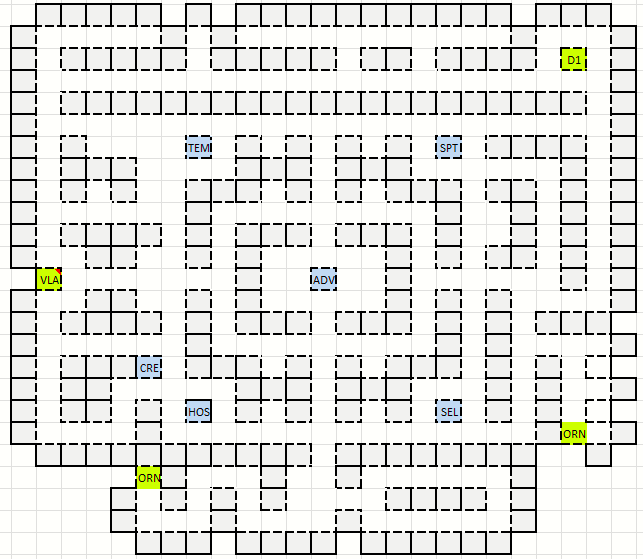
The final level, looking a little bit like the sefirot tree.
|
While having that specific book or any book about Kabbalism might help the player understand exactly what's happening on this level, I think you could probably get through most of the riddles without it. The level is presented as a squashed sefirot diagram (Adams had to fit it into a square). You arrive in the south-center and make your way to the "mouth" via a linear path (with a lot of one-way doors that take you back to previous areas) that walks you through the emanations in traditional (reverse) order.
Along this path, you face a series of riddles whose answers are body parts. The riddles are relatively straightforward if you ignore the first sentences. For instance, the first riddle is: "I am discrimination at my best and avarice at my worst. I symbolize the part of the boy upon which all the rest stands." The answer is FEET, which makes sense with "all the rest stands" but not really with "avarice" or "discrimination" unless you're cramming together your location on the sefirot diagram with traditional teachings about the associated emanation (Malikhut).
Similarly, the next riddle is: "I am independence yet I am idleness. I symbolize the part that fuels the body with energy." The answer, STOMACH, works great for the second sentence. You can concoct an explanation for why it works with the first, but you'd never get it organically unless you knew you were walking through a giant sefirot diagram.
I had the most trouble with this one: "I am unselfishness, yet I am lust. I am the foundation of the body upon which the main rests. What am I?" FEET and LEGS had already been used here, and SPINE and BACK didn't work. I tried some frankly embarrassing guesses based on the first sentence before finally getting the answer with HIPS. Fortunately, getting a wrong answer only knocks you back a square.
Having read about the sefirot did prepare me for some answers needing to be qualified with LEFT and RIGHT, which makes sense in the map only if you imagine it represents a figure facing you (i.e., the riddle whose answer is LEFT ARM is on the right side of the map). The RIGHT CHEEK gave me some trouble ("I am the part of the face upon which the sun rises each day"), but by then I was used to just listing body parts anywhere near that part of the diagram.
 |
CHEST is obvious if you only read the last two sentences.
|
The final body part riddle is clued with: "I am attainment. I am that part of the body that is above all the rest, yet beyond mere touch. What am I?" I tried MIND and then got it with BRAIN.
You then move south into a room that appears roughly where the mouth is. On the sefirot diagram, this place is given to Da'at, an "eleventh" emanation that I guess is understood as a part of Keter, the top emanation and the one associated with the conscience. Werdna had an entirely different riddle here: "The answer to the Greatest Question is also the simplest. Upon what paths have you trod? Where are you?" I tried several spellings of SEFIROT to no avail. I remembered the Oracle hint about the "roots of the world," tried that, and also failed. It took me some more Googling to find that the tree of the sefirot is often called the TREE OF LIFE, which was the answer. That might have been a tough one in 1987.
 |
You also need the Void Transducer at one point, but I forgot where this happened.
|
The game told me that I was "truly to be counted among the wise." I then met a being dressed in a miparti: "I am knowledge. As a seeker of truth, I present you with this gift. With it, you can cut the veils of illusion. Now go. You have a destiny to fulfill!" The item shows up in the inventory as a Kris of Truth, a kris being a Malaysian dagger with a wavy blade.
The Kris of Truth doesn't help if you want to become king, but it can take the place of one of the swords when you go to confront Kadorto. After you defeat the Softalk All-Stars and Hawkwind as before, the endgame sequence commences with you using the Holy Limp Wrist on Kadorto and Kadorto tossing you the amulet. Only after you catch it does the text start to change:
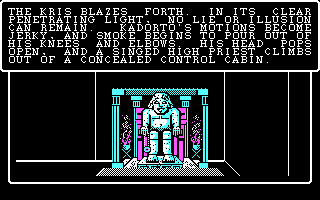
You draw your dagger of clear light, and face Kadorto unafraid, for you are whole and secure in your knowledge of the Tree of Life. Kadorto stops his laughing when he sees your blade. "No, no, not that!" he cries. The kris blazes forth. In its clear penetrating light, no lie or illusion can remain. Kadorto's motions become jerky, and smoke begins to pour out of his knees and elbows. His head pops open, and a singed high priest climbs out of a concealed control cabin. Now you see the real truth! Kadorto is a fake, an invention of the priests, a cunning device to perpetuate their social position and control over men!
 |
If this is true, how did I get stuck in statue form for centuries? And why would this kind of ruse be necessary with Hawkwind guarding the door?
|
You laugh at the ridiculous sight of a high priest with his robes smoldering. It feels good to be alive. You take out the amulet, and in the light of the kris, you see it for what it really is: a dangerous trap for those unwary. A joke of the gods. For it is neither good nor evil, but fashioned out of pure chaos. You vow to "return it" to its makers, and you are sure the Kris of Truth will aid you. But that can wait for tomorrow. Today is to be enjoyed!
Outside, into the beautiful sunshine, you walk, feeling at last free and alive. You have returned to the world. You look back at the temple for a moment and wonder . . . Have you forgotten something? You laugh, for you know that you have not. You are master of your fate, and the winding paths of the Tree of Life illuminate the shape of your destiny!
 |
I'll take it.
|
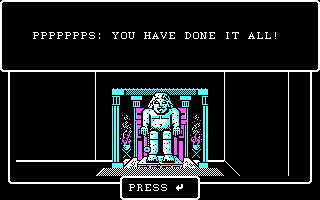
A couple of congratulatory screens follow, including one that offers a special number to call to inform Sir-Tech about your victory. You also get a screen bestowing the title of "Wizardry Grandmaster Adventurer" upon you and a series of goofy "P.S." screens, including another "Have you forgotten something?" and a follow-up that assures, "Don't worry, you haven't." Is it just me, or would this repeated question have made more sense if it had been "Have you overlooked something?" or "Have you missed something?" Not having found something in an obtuse maze isn't the same thing as "forgetting" it.
 |
Thanks for the reassurance.
|
It's an interesting ending, although not a perfect one. I must point out that it conflicts a bit with the others. The Kadortos that you fight in the various sword endings are manifestly not just priests in giant suits. I like the idea that the amulet is just a device to draw out megalomaniacs. I'm not sure why "return it" is in quotes above, and I find it amusing that the ending specifies that Werdna is "master of [his] fate" but also that he has a destiny. As with the whole business of bathing in pools of water to change alignments, Werdna's transformation in this ending is a bit too easy. I don't know if Roe Adams had some personal belief in the Qabalah, but it's a bit odd to introduce it in the eleventh hour when he could have made it a persistent theme throughout the 10-level dungeon. Imagine a game in which each level gave Werdna not only mechanical challenges but moral temptations to overcome, with the multiple endings determined by how well he had achieved enlightenment during his journey. It's just another way that lore, theme, and storytelling aren't really the strong suits of this game or this series.
But we should remember that at this point in CRPG history, nothing quite like this had been done. It was rare enough to find a game with multiple endings, let alone one with a hidden "true" ending. I wonder if I would have found it without a hint. I'm certain that I would have known that there was something to find--there are too many unused Oracle hints otherwise. But I'm not sure how I would have hit upon the idea of trying to teleport below Level 10. I probably would have needed some kind of hint that led me to realize the dungeon was deeper than it first appeared; something like "Seen Inception lately?" or "the dungeon is primed with levels." I otherwise probably would have spent a long time trying to get something to happen at the lych-gate and then given up. I wonder who the first person was to find the hidden ending, and how long it took him.
Twelve years ago, I gave Werdna a 30 on the GIMLET without explaining it. Today, I would rate it:
- 4 points for the game world. It's an original approach, and the backstory as presented in the manual and opening screens are clear enough about the nature of your quest. Unfortunately, the lore of the setting is hopelessly tangled in SCA in-jokes and nerd references, diminishing the impact of the various endings.
 |
I would like to never hear this question again.
|
- 1 point for character creation and development. There's no creation, and you develop only at fixed intervals (pentagrams), once per level. Everyone plays the same Werdna with the same abilities and spells.
- 2 points for NPC interaction. I'm basically using this category to give some credit for the variety of allies you can summon at the pentagrams; learning their strengths and weaknesses are key parts of the game. There really are no individual NPCs otherwise. I don't think the Oracle is worth a point.
- 4 points for encounters and foes. It gets this for both the variety of enemy "do-gooders" that you have to analyze and learn and for the inventory puzzles and riddles throughout the game, most of which are fair.
- 3 points for magic and combat. Combat tactics come down to knowing what spell to cast, what allies to keep with you, and when to flee. It's still worth a few points.
 |
I'm going to miss my monster allies.
|
- 2 points for equipment. Most of the stuff you find in the game is for puzzles. Regular equipment for Werdna is not a big part of the experience.
- 1 point for economy. You get tons of money that you need only for the Oracle and for the weregild in one of the potential endings.
 |
In retrospect, many of the Oracle's "hints" turned out to be spectacularly unhelpful.
|
- 4 points for quests. You have a main quest with several alternate endings. My only quibble is that these alternate endings have more to do with luck than with role-playing, and some of them feel a bit arbitrary (e.g., a good ending for choosing a blue sword but a horrible one for choosing a green one).
- 2 points for graphics, sound, and interface, all for the keyboard interface. You don't play this series for graphics or sound.
- 4 points for gameplay. I'm giving full points on the "difficulty" variable. Although I might rate the game as "too hard" if it was a regular game, it's the right difficulty for what it both intends and promises. It has some replayability at the end, and although it's a bit too long, it's mostly too long because of that replayability.
The subtotal of 27 is lower than my original rating, but I was overly generous during my first year or so, and I think this better represents how I feel about it now. It is not a very good CRPG, but it is a good game in a category for which it is essentially the only representative. You get exactly what the box promises. Although I didn't like it when I first encountered it, I was playing it wrong. This is a game to be taken slowly, in long sessions where you map a whole level at a time and then take a break for a while. It's a perfect game for my current practice of alternating at least two games, and it's a perfect game for someone who has a summer off to concentrate on it.
Having now finished it, I think the hyperbole about Werdna being "the most difficult game in CRPG history" is mostly wrong, particularly for any ending. It requires time, patience, and careful notes and maps, but with those things, there are only a couple major stumbling blocks. With someone else's notes and maps, it would hardly seem difficult at all. I would reserve "hardest game in CRPG history" for titles in which knowledge and skill aren't enough to save you, where battles are titanically impossible or rely on incredible odds. Almost any game with permadeath is objectively "harder" that Wizardry. For all the time it takes to map Werdna, what happens on those maps is relatively straightforward. Many Dungeon Master derivatives like Knightmare and Chaos Strikes Back are "harder" in that you have to note complex chains of cause-and-effect often in remote locations. "The hardest CRPG in history" would have something like an invisible button on Level 2 that opens a door on Level 9, but only if you press it twice.
(This issue has made me think about what it really is that I'm measuring with my "difficulty" rating. It's really more of a "fairness" rating, I think. I should clarify and perhaps differentiate the two variables at some point.)
I've had my disagreements with Scorpia, but somehow I had faith that she would "get" this game, and thus I had been looking forward to her review. I wasn't disappointed. In the November 1987 Computer Gaming World, she said "the answer is a resounding 'Yes!'" to the question of whether the wait for the game (originally promised in 1984) was worth it. (She uses the term "vaporware" in the review; it amuses me that there was a time that word was used after a delay of only three years.) She warns readers of its difficulty but also says that the game "is eminently fair and is perhaps one of the most finely-balanced games I've ever played." She had complaints about the lack of advancement in graphics and long disk access times, and she "had trouble accepting" the resurrection of all enemies every time you save the game. (I thought it made saving a tactical decision and added nicely to the game's challenge.) "Unique, and not to be missed!" she concluded.
Dragon didn't get to the game until February 1989 and only gave it 3.5 stars, but their complaints were more about the graphics and copy protection system than anything else. "No other scenario can offer more bang for your buck" for the experienced player, they said. Curiously, the magazine had offered a "preview" a year earlier, after the actual release of the game, in which they noted that Sir-Tech's hint line would only offer help after a certain amount of time had passed. You could get hints for the first level on release, but you'd have to wait a few weeks before they'd give you a hint about Level 5. They really wanted gamers to figure it out for themselves.
Despite positive reviews,
Werdna sold abysmally. It was Sir-Tech's worst-selling product in history, probably because of a combination of the outdated interface, word-of-mouth, and multiple box warnings not to even think about buying the game unless you were an "expert." Robert Sirotek,
interviewed by Matt Barton in 2014, indicated that he was always skeptical about Adams's approach:
There were other hard-core players in the market that loved it. They said, “Ah, why doesn’t everybody do this?” Well, we don’t because you guys are a minority. If you’re a glutton for punishment, you’re going to have to get your pleasure somewhere else because nobody can survive catering to such a small number of people.
I don't know under exactly what circumstances Adams left Sir-Tech; all I can say is that this was his last game for the company. The delays and reception couldn't have been great for his future prospects, although the delay seems to be less his fault and more that of programmer Robert Woodhead, who had decamped for Japan and had one foot out Sir-Tech's door.
I tried hard to track down Adams to interview him for this series. He supposedly lives in Maine. (As always, please don't make any attempts to contact authors on my behalf. Chances are, I've already tried whatever methods you're using and they didn't respond to me, so further attempts are just harassment.) He'd shown a lot of promise as a game designer, contributing significantly to Ultima IV and The Bard's Tale. In fact, there are some accounts that indicate he had more to do with the plot to Ultima IV, including the creation of the eight virtues, than Richard Garriott. An interest in the religion and philosophies of other cultures does seem to unite both Ultima IV and Werdna. [Ed. This statement proved controversial and has touched off some debates involving both commenters who seem to have a bone to pick with Garriott and those who want to deny Adams's contributions to Ultima IV despite him being listed in the manual. Who invented what is not really the issue. Both Ultima IV and Werdna draw from mythologies under-represented in most RPGs and have some similar themes. Surely, Adams had some influence on Ultima, and that influence is consistent with the way the same themes were used in Werdna. Beyond that, we can't say with available evidence, but it's not particularly important to get into greater detail anyway.]
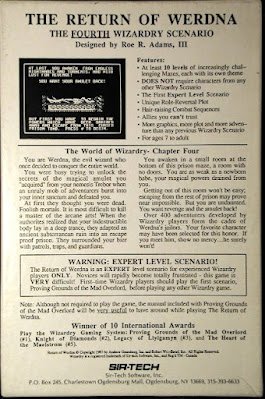 |
The game's difficulty was, I'm sure, a marketing challenge, but there must have been a better way to meet it than by putting a "warning" on the box.
|
Werdna may have been a commercial failure, but it wasn't an artistic one. Nonetheless, either discouraged by Werdna's reception or just eager to get on to other things, Adams went back to writing game reviews and founding AnimEigo with Robert Woodhead, a company that licenses Japanese animation and films for redistribution in North America. I'm not sure if Adams actually moved to Japan with Woodhead or just served as the U.S.-based representative of the company. Either way, he all but disappears in the 1990s, showing up on only a couple of obscure games as a consultant. Although his LinkedIn profile indicates that he was a game designer all the way through 2017, I can't find anything about what he was working on for the last two decades of that period, and I can't find any evidence that he was ever interviewed after about 1992.
Werdna took a good chunk out of the year, but I'm satisfied that it was time well-spent. I have a friend who was a respected professional for decades but always felt bad because he had never even finished his bachelor's degree. He finally went back to school at the age of 45, got the degree, and told me that although he didn't "need" it, it makes him feel better about calling himself an expert in his field. That's how I feel.