Thursday, April 21, 2022

Ultima Underworld II: Don't Fear the Reaper

It was too early for me to face ghosts.
       
This session began with what was supposed to be a quick trip back up to Castle Britannia to dump off some equipment and spend a couple of training points. Chastised by many commenters in my last entry, I had decided to train up "Casting," the lowest of what I had identified as the most important skills, and "Attack." The latter was no problem--I found Geoffrey almost immediately--but so far, the only "Casting" trainer has been Nystul, and I couldn't find him anywhere. This entry was nearly subtitled The Search for Nystul. I don't know where he was for 99% of my search--not in his chambers, not in the throne room--but after about 30 minutes of looking around, I found him in the Main Hall, acting as if he'd been there all along.

I decided to try the alternate ladder, in the southeast section of the castle. It just brought me to a locked portcullis on Level 2. I tried bashing it for a while to no avail, so I had to return to Level 3 the way I had entered the first time. I stopped and tried to take on the headless again, but an entire mana supply of "Magic Arrow" plus numerous melee attacks didn't do the trick. I only succeeded in damaging my sword. It appears that when an enemy outclasses you in this game, one way you know is that your weapon gets damaged faster.
 
How you know your approach isn't working.
     
I jumped some platforms to get to a passage in the southwest. Like the first game, jumping is very generous. Whether you run and jump or do a standing jump, you jump farther than it feels should be possible. At the end of the southwest passage, I found a ladder down to the next level. I still had headless and gazers to kill on this level, but no good ways to go about it, so I moved forward.
   
The ladder brought me down to a thin strip of land east of a large underground lake. There were lurkers in the lake, and while I was fiddling around trying to get within striking distance, I fell in and could not fight against the current to get out. I swam with the current to the southwest, where I found an exit that brought me up some stairs to an elevated wooden platform. There, I found a couple of fish and a fishing pole next to a bench. The fish were rotten, but I took the pole. I continued around past another pole until I was above the spot where I had entered, jumped down, and continued exploring to the north. Before long, I killed a bloodworm and hit Level 4.
       
There was a small area with lava walls. I have no idea why. We weren't that deep.
   
More bloodworms, bats, and mongbats attacked as I continued north and then west around a central lake. A passage led to the north and soon split into east and west branches. I followed the east and stumbled into a cavern full of giant spiders. I prepared to attack but noted that they weren't hostile. I tried making some friends by throwing them some meat, but they ignored it. So I just walked past them and explored their chamber, taking a magic scroll from a ledge.

The chamber opposite the giant spiders had three or four headless, and I was no more capable of defeating them than I was on the last level. I ran around their chamber looting it for all I could find, which included a Wand of Lightning, 12 gold pieces, and some chain leggings. Back out in the main cavern, killing another cluster of bloodworms and mongbats brought me to Level 5. I'm mostly using magic for "Light" and "Lesser Heal." Bloodworms poison, but it wears off quickly enough. 
       
Hitting Level 4 as I fight bats on the side of a lake.
    
The cavern kept wrapping around the lake to the west and then to the south. Then it left the lake to the west. It brought me back to the network of rat-infested passages that I'd explored previously before losing my life to the reaper.  Before I met the rats again, though, I met a peaceful goblin who was grateful for my clearing the lakeshore of the bloodworms. He greeted me as "Wormslayer" and offered me a fish, which I accepted. He said that the Moglop clan had traveled to the sewers "to escape the endless petty warfare between the other goblin tribes," then got trapped by the blackrock. I'll remind you that goblins don't exist in Britannia in any previous Ultima except the first Underworld. I had some hostile options, but I honestly can't decide if there's any problem with a tribe of goblins hanging out in the caverns below Britannia. We parted as friends. 
   
A second goblin, a bit to the south, was named Rogwump. He complained about constantly having to eat fish ("I used to love to eat fish!") and wanted to barter for something else. He didn't have anything I really wanted, except some leeches, which can cure poison. I offered him a cheese wheel and three loaves of bread for them, but he wouldn't budge, so I told him he could eat the leeches if he wanted some variety in his diet and continued on. In the next cavern, though, a goblin called "The Dripper" happily took two bottles of ale for his leeches. Within a few steps, I found four bunches of leeches just sitting on the floor. 
   
"Rogwump" sounded familiar, but I couldn't find many references beyond this game.
    
In the next section, I killed about 20 rats. The corridors led me to a giant rat sitting on a bed of cheese. He never turned hostile, so I didn't kill him, but I did liberate a magic scroll and a purple potion from his nest.
    
"Yuck" is not a good enough reason to kill.
      
I made my way back to the swampy area to the south, where I killed the reaper with four blasts from the Wand of Lightning. I made Level 6. The reaper was guarding some gold, a jeweled sword, and the key to Britannia's armory. I took everything, which brought my encumbrance up to almost the maximum, and headed back to the ladder.
   
I realized during my return trip that my leveling had given me access to "Water Walk" (YLEM POR). I figured I'd use it to explore the lake and kill the lurkers. The problem was that the lurkers were nearly impossible to hit, despite my having killed one with ease on Level 3. (I think there's a "greater lurker"/"lesser lurker" thing going on.) Despite this, I stubbornly remained on the lake, swinging away, healing and resting when I had to, until I'd killed all the lurkers a couple of hours later. I hit Level 7 on the death of the last one. An island in the middle of the lake had the way down to the next level.
     
A lurker and a bat both attack at once.
      
As I fought, I reflected on the strengths and weaknesses of the combat system. Even though I gave it a lot of credit in the previous Ultima Underworld, I'm not sure I really reflected on how unusual (and thus perhaps gutsy) it was, blending player dexterity, speed, and probability. The Dungeon Master line had given us action gameplay with RPG-style probabilistic values, but its action elements amount to hitting a single attack button. I think the first Underworld is the first game in which more complex variables come into play, such as facing direction and distance and the length of time you hold down the mouse button.
 
The "gutsy" part comes in requiring the player to execute a visible attack--a swing, a stab, or a chop--and yet still allow the attack to miss even when it visibly connects. In many ways, it violates fundamental rules--albeit of action games rather than RPGs. The developers had to trust that the audience would be primarily RPG enthusiasts who would consequently understand what was happening, rather than action game enthusiasts to whom player accuracy always means character accuracy. 
      
As much as I found of Level 4.
      
The more important factor for me is how combat is integrated into a larger environment, such that you can knock enemies off platforms, throw just about any item at them, and flee by entering terrain that they can't enter. (That was largely how I defeated the lurkers.) Again, Dungeon Master paved a lot of this way (e.g., closing doors on enemies, throwing, dropping down pits), and later titles would introduce even more environmental effects, but for an early game, the system is still pretty mature in Underworld.
 
Back in the castle, I ran into an NPC I don't remember talking to before: Charles, Nell's brother. He was worried about the castle's access to water despite a fairly large and obvious fountain running in the main hall and an underground lake beneath us. I had no dialogue options to reassure him. 
        
People just need to come a level or two downstairs. FYI, I haven't been able to figure out a way to the top of this waterfall. I bet there's stuff down that hallway.
       
I took the pantry stairs down to the basement and used the reaper's key to open the armory. It had a lot of weapons and armor, but nothing explicitly magical. I replaced my buckler with a tower shield, my leather cap with a helmet, and my leather armor with a breastplate. Then it was time to spend some of my 6 skill points. I used one point each on "Attack," "Defense," "Charisma," and "Lore" and saved two for later. I had thought to put a point or two into "Sword," but I couldn't find Syria for the life of me.
   
I spoke to Miranda in the Great Hall, and she said that both Nystul and Patterson wanted to see me. All Nystul wanted to do was remark that some of the tunnels beneath Castle Britannia are thousands of years old, and that their mysteries may be useful to us. Patterson just wanted to suggest that a library might be more helpful than those same tunnels. I thought this might be a hint, so I went to Nystul's library and poked around but didn't find anything new. Nanna had a new round of complaints about how hard she works for no appreciation. Julia said she'd been trying to teach weapons repair to Patterson but he's no good at it. 
       
You're right, Nanny. Next time I capture an island, I shall name it Whiner's Isle.
      
I paid a visit to Lord British. Among all the NPCs in the castle, he alone stays completely in his bedroom. He never pops into the Great Hall to see how things are going or to, you know, lead in any material way. He had nothing new to say. The thief Fissif was in one of the jail cells, but oddly the only dialogue option I had with him was to threaten to arrest him again, which causes him to "make for the nearest ladder" (to turn himself in) by leaving his cell and disappearing. I hope he either returns to the jail or wasn't important in the first place. 
       
The would-be burglar rots in jail.
     
I returned to the sewers and tried again against the headless. I was able to kill the two on Level 3 in a long battle that used up my wands and involved a lot of retreating. This didn't leave me especially eager to try against the half dozen on Level 4, so I bypassed them and headed down to Level 5. 
   
The ladder deposited me in a small room with a corridor heading north. It bent west before opening into a large cavern that, just like the level above, had a lake in the middle. The place was swarming with slugs, bats, and lurkers. Bats in this game are horribly annoying. If they don't die in one hit, they flee, sometimes upwards. For the rest of your time on the level, you can hear them flitting away in the darkness. Killing them all seems impossible, so you never get the merciful silence of a cleared dungeon.

On an island in the center of the lake, I found the miniature blackrock dome that Nystul hypothesized must exist. It pulsates with a blue glow. There are seven or eight facets, and one of them, facing north, is a lighter blue than the others. 
    
I suspect I'll be coming here a lot.
       
I decided to finish exploring the level before messing with the gem. The southern half was a mixture of water areas and dry corridors, with occasional minor treasures. One large chamber was guarded by two hostile ghosts, whom I couldn't even hit. I annotated them for later and ran past them. Near the bones of some previous adventurer, I found a POR rune, which I already had.
        
My map of Level 5 beneath Castle Britannia.
       
(Overall, I was disappointed that I didn't find more runes during this session. I had wanted to play as a mage, but the only offensive spell I'm capable of with existing runes is "Magic Arrow," which simply doesn't do enough damage to serve as a primary offensive tool. The game is also very touchy with spell distances. There's a very small window between "close enough I can see the enemy through the darkness" and "too close to cast a targeted spell.")
       
This "not enough room" nonsense comes up too often.
      
An eastern corridor led to a ladder upwards, and I was surprised to find myself in Castle Britannia's basement, where the armory is, behind a locked portcullis. A switch let me open it from this side. This route gives me a quick way down to Level 5 from the castle.
   
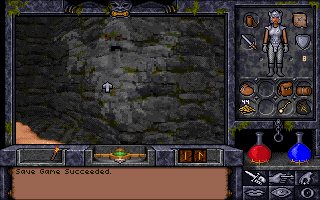
Back I went to the blackrock gem. Clicking on it didn't seem to do anything. If I got too close, it repelled me with the message that "that face of the gem remains opaque, and you are bounced back." I tried approaching the lighter face, and I walked into the gem. There was a brief transition, and I found myself in a small corridor with a door at the end. The automap noted only that I was on "Level 1." Behind me, the corridor was covered with an opaque blockade of blackrock, but I tested it and discovered that walking into it returned me to the gem beneath the castle. This gem thus must be the nexus of the subtitular labyrinth of worlds.
      
We'll pick up next time in this strange new location. 

Time so far: 8 hours

Friday, April 15, 2022

Lands of Lore: Timing and Balance

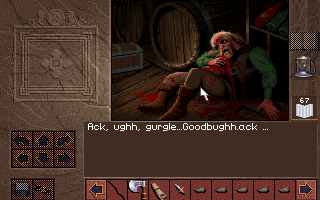
A game that doesn't really have "acting" per se still manages to ham up a death scene.
          
My most recent session with Lands of Lore left me angry and frustrated, all the more so because I couldn't put my finger on exactly why. I continue to admire the various elements of the game, but this week they somehow didn't come together well. I nearly didn't even say anything about it because it could be that I was just in a bad mood. It's happened before.

As we continue into the 1990s, this is probably going to happen more often. During the formative years of CRPGs, it's not hard to pinpoint what makes a game fail to work. It's usually missing some key element or has implemented another one poorly. I can write something like, "There aren't enough tactics in combat" or "There's no economy," and you all know exactly what I mean. I don't really need to analyze it. But by this era, I have to say things like, "The animation that provides the illusion of continuous movement rather than tiled movement leaves ambiguity as to the exact moment the enemy enters melee range, leading to a frustrating number of missed attacks, only you can't be certain that they missed for that reason because accuracy against certain enemies is extremely low in the first place." I don't know--did that make any sense?
   
Writing this blog has given me a lot of sympathy for game developers. It has to be a tough craft. On the one hand, there's no purpose to a game that doesn't offer any kind of challenge. On the other hand, there's a fine line between the type of challenge that you delight in overcoming and the type of challenge that just pisses you off. The variables are subtle, often coming down to timing and balance, plus an x variable that depends upon the mood and energy level of the player. All I can say is that in the Draracle's caves, either Lands of Lore managed to seriously piss me off, or I was already pissed off from something else and probably shouldn't have been playing Lands of Lore.
          
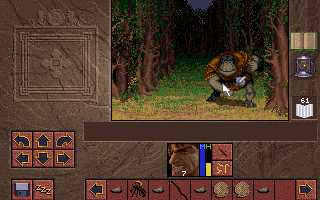
This guy was a little easier than he looks.
        
The session started pleasantly enough in the forest. At the end of my first session, Conrad had been killed by some thugs guarding a cave. I spent about 20 minutes using the thugs to test out various combat options and how they differ from other Dungeon Master-style games. In doing so, I first noticed the problem I described above. Like Dungeon Master and Eye of the Beholder, the world of Lore is divided into fixed tiles. But where enemies in those games would advance a tile, pause, and then advance to the next tile, the creators of Lore managed to animate the enemies in a way that makes it look like they're moving continuously. This makes it hard to tell exactly when they've entered the tile in front of you and are thus vulnerable to melee attacks. It also means that classic strategies like the "combat waltz" are harder. Strike too soon and your attacks miss. Strike too late and the enemy has time to turn and strike you back.
  
The waltz also doesn't work for reasons I'll have to analyze later, but some other tried-and-true tactics are available, including the retreat in which you throw objects. Throwing in this game is completely independent of attacking, so you can do it during cool downs even if the enemies are right in front of you. In fact, you can pick up and throw the same item repeatedly, since it just lands at the enemies' feet. By the time I had three characters, it didn't seem to make sense to throw things in melee combat anymore, since the cool down for one character is usually lifting by the time you've attacked with the third.
   
Throwing remains useful when the enemy is far away, but wow is it slow. It takes a second or two for a thrown item to travel through a single square. If you're tossing something at an enemy at the end of a long hall, they'll likely advance a couple squares by the time it hits them. Fortunately, this is also true of items fired or thrown at you. You see crossbow bolts coming a mile away and can easily dodge them unless you're at the end of a dead-end corridor.
    
Using a key to open a chest in the thugs' lair.
        
Anyway, I killed the thugs and entered the cave they were guarding, a very small map that nonetheless had several mechanical puzzles. The game has Beholder's penchant for putting nearly invisible buttons on its walls, but the difference here is that such buttons show up on the automap. By checking the automap frequently, you can identify buttons and levers that you otherwise may have missed. Buttons sometimes open passages or sometimes just make other buttons appear. There was also a pressure plate that I had to weigh down with rocks to keep a door open. In the end, the caverns gave me a brass lantern, a lockpick, a "bezel cup," 15 crowns, and some salve.
       
Fortunately, buttons are clearly notated on the map.
        
I later found some oil flasks for the lamp. In general, the lamp seems to be optional. When it's newly-refilled and the flame is bright, it increases the detail that you see and the distance you can view, and it generally makes everything more pleasant. But even without it, you can see well enough to navigate and fight. I can't remember any previous games in which light has mostly aesthetic rather than utilitarian value. I suppose that may change later in some dungeons.
        
The dungeon gets momentarily brighter and more pleasant.
         
My inventory line started filling up fast, and I reached the end of this section without finding time to really organize it. Having it scroll left and right is a cute idea, but I wouldn't have minded if it had shown two rows at once.
  
I noted that Conrad continued to narrate even small things ("There are silver coins in here!" upon discovering a pouch), which I rather enjoy. Late in the session, when I had three characters, rarely did 10 seconds pass without one of them making some comment or another. These comments enhance the sense of individuality among the characters, which is often absent in classic "blobbers."
    
Back out in the wilderness, I met a young woman on the road. To his credit, Conrad was immediately suspicious. When she asked Conrad to escort her to King Richard's keep because she had "forgotten the password," he balked. I would have preferred that the game offer me the role-playing choice, but I would have done the same thing. Revealing herself as Scotia, she called me a "timid fool," turned into a jackdaw, and flew off.
       
I just had mandatory security training about exactly this kind of scenario.
     
I finished exploring the woods. In this game, paths often end at static scenes like shops, taverns, and dungeon doors. You can usually click around these screens to get individual descriptive messages, much like you can click around with the "eye" icon in a Sierra adventure game. If there are people, clicking on them will usually get you a line or two of dialogue. I really enjoy this aspect of the game. For years, I've been enjoying the mechanics of Dungeon Master-style games but wishing they would occasionally provide a little more lore, flavor, and NPC dialogue. Eye of the Beholder started the trend, but Lore realizes it much more fully. 
   
In the woods area, I found a lake called Lake Dread, a closed cave entrance, a few tree hollows with miscellaneous items, and a ferry terminal in which a woman accepted my writ from the king for passage to the "south lands." After a quick boat animation, I found myself in another wooded area swarming with orc-like enemies and giant lizards.
 
Cool animation of a ship.
            
Combat was a lot harder than the previous areas. When I started playing the game, I wondered if there was any drawback to simply resting whenever you can. Time doesn't seem to have any effect on anything, and there's no hunger/thirst mechanic. I ultimately concluded that resting continually between combats is possible but perhaps a bit abusive. By the end of this session, I had realized that it's essential. Spell points and mana deplete too quickly.
  
It was also in these woods that I came to realize that enemies respawn. I still haven't nailed down the exact rate at which they respawn or where they respawn, but they definitely do. I'm a bit torn on the issue, because as you know, I don't like games that have a fixed number of enemies and thus ensure that every player reaches the end in exactly the same place. On the other hand, the inability to ever clear an area and feel safe gets annoying. It wasn't so bad in these woods, but later, respawning contributed to my growing aggravation with the game.
        
This guy is about to give me a level up in "fighting."
     
My fighting and magic skills hit Level 2 in the woods, and throughout the game, I tried my best to keep them balanced. The game simply doesn't use thief skills enough that it's easy to prioritize thief development.
   
I eventually found my way to Roland's Manor, which had been invaded by orcs, or whatever they are; the game regrettably shares Dungeon Master's reticence to put names to the creatures you face. It was a relatively small map, made long by the sheer number of combats. I eventually killed what must have been the orc chief and found a magic axe called "Dominance," although it mysteriously contributed less to my strength than the mace I was already using. 
 
Creatures burst through a door in Roland mansion.
      
A burnt scroll in the fireplace held a message from Roland to Richard, explaining that something would have to be joined with the Ruby of Truth to combat the Nether Mask. This will surely be the Shard of Truth described in the texts in Richard's library.
       
A partial message.
     
Eventually, I found Roland himself, wounded and hiding in a closet behind a secret door. Before he bled out, he said that the Dark Army had stolen the Ruby of Truth. A nearby chest held some coins, a compass (which grafted on to the interface), and a saber.
     
Conrad, read the room.
      
I finished exploring the southern forest before returning to the ferry. There was a trapper named Buck who bought and sold items from his cabin in the woods. I sold some excess weapons and purchased some boots and a shield from him. 
      
Buck is uninterested in a rock.
       
Elsewhere was a tavern called the Grey Eagle, and it had more things to click on than any other screen so far, including several NPCs. One guy drinking at the bar named Timothy seemed important; he had a lot of dialogue and description, and he had some things to say about Scotia (nothing new), but I otherwise couldn't do anything productive with him.
     
The tavern screen had a message for practically everything.
     
When I got back to the ferry terminal, I was annoyed to find that I had to pay 100 silver crowns to return to Richard's kingdom. It's a good thing I didn't buy more at Buck's place.
   
I hurried back to Richard's keep and walked right into another cinematic. The king was kneeling on the floor while Scotia did something to his arm. The white-robed woman I'd seen in the king's chambers before was confronting her. Scotia called the other woman "Dawn." The two women exchanged spells, and Scotia once again turned into a crow and flew away.
        
Scotia spills her plan.
       
This scene transitioned directly to a small conference attended by Dawn, Geron Arbroath (the chamberlain), the herbalist, some knight named Paulson, and Dawn's apprentice, a Thomgog named Baccata. Dawn said that Richard was poisoned and near death. She cast a spell to put him in stasis until an antidote could be found. The group otherwise debated how Scotia got into the castle in the first place and what to do next. Paulson announced his intention to lead a force into the Urbish Mines (where Scotia found the mask). Dawn asked me to go to the "Draracle" and ask about anything that might cure Richard. Baccata joined my party.
         
Dawn puts the king in carbon freezing until he can be cured.
   
Dawn gave me an "album" to hold spell scrolls, and it came with "Heal." It appears in the upper-left corner, and you just click on the spell you want before casting it. I guess everyone in the party has the same spells. Later, I had cause to use "Heal" quite a bit, since characters never die in this game but rather get knocked unconscious. When they're unconscious, resting doesn't heal them; only the "Heal" spell does.

Baccata started as a Level 3 mage (Level 1 in everything else). He speaks in a deep, slightly slurred British accent, sounding more cultured than he looks, which I guess makes sense for a mage. He directed me to the entrance to the Draracle's caves, even though I had already found them.
    
Do you mean (bear east and then proceed north) as soon as possible, or (bear east) and (then proceed north as soon as possible)?
       
I've explored two levels of the Draracle's caves and found two types of enemies. The first are giant rat men, the second some kind of barbarians. Both are annoying in their own ways. The rat men simply will not be hit. At least four out of five of my attacks miss. Worse, they cause poison, which causes a loss of a hit point every second. Ginseng cures it, but I ran out of it fast. The only other thing that cures it is "Heal" cast at Level 3, but for some reason only by Conrad. A Level 3 heal takes most of my spell points, so every time I get poisoned, I have to find a place to rest until Conrad restores his mana enough to cast it. If Conrad himself is poisoned, I have to keep his health from draining too much (via "Heal" from Baccata) until Conrad can cast it. Adding to the problem is that I really need to save my mana for "Spark" spells to use against the rats.
       
Conrad is poisoned again.
      
The barbarians are a bit easier, but they hit so hard that you need to take them out as quickly as possible which also favors "Spark" over melee attacks. Inevitably, I end up having to rest a lot, which causes more enemies to spawn, ultimately keeping me trapped in a loop. I had hoped to finish this session with my triumphant exit from the caves, but I got so annoyed with the game the other night that I just had to stop playing.
      
The barbarians knock away Conrad's health in two hits.
       
At these times, of course, I have to wonder: What do I really want? An easy game? No, of course not. It's just that sometimes, a game's challenge feels like a vaccination needle. It hurts a bit, but you know it's going to make you healthier. And there are sometimes that a game's challenge feels like someone putting a wet finger in your ear. It doesn't hurt at all, but get the #$& away from me. Again, though, it might have just been my mood.
    
Speaking of disgusting things.
        
I did find a third companion in the caves. At one point, we descended to a chamber in which there were three disgusting sacs. Two of them had nothing but blood and gore, but one had a living thief named Lara. She said that her people had chosen her to serve the Draracle so he would continue to provide their farmers with forecasts. She starts as a Level 4 thief, but that hasn't been terribly useful so far. Mostly, her purpose is to suck up one or two hits from enemies before she gets knocked unconscious.
       
Lara's statistics are pretty bad.
      
One final note: it's becoming clear that this game is going to be linear a.f., as the kids say today. What I've described above is the exact reason I prefer nonlinearity--get stuck or annoyed in one place, move on to another. That's going to hurt it in the end.
   
As you can see, I have found plenty of things to like about the game, and I'm sure I'll like the combat again after I take a couple of days to cool off.
   
Time so far: 5 hours
  

Wednesday, April 13, 2022

Game 456: Dragon Ball: Daimaō Fukkatsu (1988)

     
Dragon Ball: Daimaō Fukkatsu
"Dragon Ball: Revival of the Dark Lord"
Japan
d&d Corp. and Tose Co. (developers); Bandai Co. (publisher)
Released 1988 for NES in Japan
English translation courtesy of Stardust Crusaders, 2011
Date Started: 2 April 2022
Date Ended: 11 April 2022
Total Hours: 6
Difficulty: Easy (2.0/5)
Final Rating: 17
Ranking at Time of Posting: 104/460 (23%)
      
When Dragon Ball came up in a random sort of games, I groaned. It feels like I have been remaining willfully ignorant of the franchise my entire life. I've usually seen it with a Z on the end, and until this week, I thought the Ball and Z were all one word, pronounced "balls." Beyond silly things like that, however, there is a host of foundational stuff that I don't understand, including various tropes found in anime and manga. I wasn't much interested in researching it, but I sighed and did my best.
     
I now know that the sprawling franchise started in 1984, with a set of serialized stories by Akira Toriyama. They spawned several additional manga series, anime television series, a live-action film, and close to 100 video games for various platforms. My understanding is that the franchise is set in a weird alternate Earth, where flying cars and characters with guns exist alongside dragons and dinosaurs and animals that can talk. The stories concern (at least in part) quests to find legendary Dragon Balls, which can summon ancient wish-granting dragons. One of the Dragon Ball seekers, Goku, becomes the ultimate defender of the Earth from various criminals, megalomaniacs, and demons. One of the latter is named Piccolo, the "Daimaō" of this game's title.
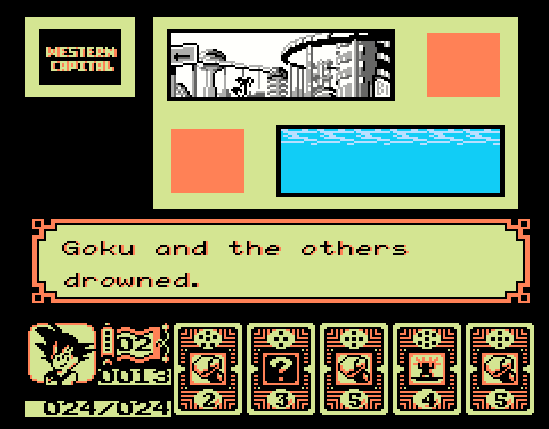
   
With uniforms, too, with a shiny gold braid on the coat.
     
If I have readers who enjoy the franchise, I'll be curious to hear what you think its strengths are. I watched some summary videos, and even putting aside my normal dislike of anime (and the animation style used in Dragon Ball is somehow worse than just regular anime) and child protagonists, it just felt to me that the setting and characters were a bit chaotic. I'm a firm believer in Brandon Sanderson's Laws of Magic in which limitations are more important than powers. In addition to magic systems, these limitations, in most stories, extend to things like technology and, well, gravity. Dragon Ball seems to be immune to these considerations, which makes me wonder how you possibly create tension in the storytelling.
  
In 1988, the original Dragon Ball show was in its eighth season despite only having premiered two years earlier. The premiere on 24 February 1988 had launched the "King Piccolo Saga." Goku's friend Krillin (a bald kid who looks like a Buddhist monk) is murdered by the demon King Piccolo, who was recently released from eternal imprisonment by the evil Emperor Pilaf. Piccolo hopes to find the Dragon Balls to restore his own youth and conquer the world, or maybe the universe. Goku now wants to collect the Dragon Balls to wish for Krillin's resurrection. The game picks up from here and apparently tells a story different from what the show depicted during the same period.
       
Goku's reaction to finding his friend's dead body.
    
This game is the third video game based on the franchise. The first was released in early 1986 for the Super Cassette Vision. It's a top-down shooter called Dragon Ball: Dragon Daihikyō ("Dragon's Great Exploration"). The second, released in late 1986 for the NES, was called Dragon Ball: Shenron no Nazo ("Mystery of Shenron") in Japan and Dragon Power in the U.S. It's a pure action-platformer. With this title (sometimes called Dragon Ball 2, as it was the second in the Bandai NES series), the developers introduced a new set of mechanics that have come to characterize the video games, all the way through the modern era. 
    
A few things differentiate Dragon Ball from other NES RPGs of the time. The most obvious is the combat system, in which victory is resolved through a War-like card game. The player has a constant hand of five cards on which three variables appear: the level of the card (represented by the number of dots at the top), the speed of the card (represented by the number at the bottom), and a symbol in the middle indicating the type of attack, and thus the resulting damage. (The middle symbols were Japanese characters in the original and were updated to more visual clues for the English translation.) Each played card is immediately replaced by another. Levels go up to 6 and speeds to 9.
     
 I execute a combo attack using a card with a strength of 4 and a speed of 7. If this doesn't kill the enemy, my next card has a strength of 5 and does a random attack.
     
In combat, you and the enemy play a multi-round game of War, each turning over one card at a time and comparing the results. The character with the higher power gets to perform the action on the middle (with the one exception that a one-star card played by Goku beats a 7-star card played by the enemy). The other character may dodge the attack, with the chances based on his card's speed value.
       
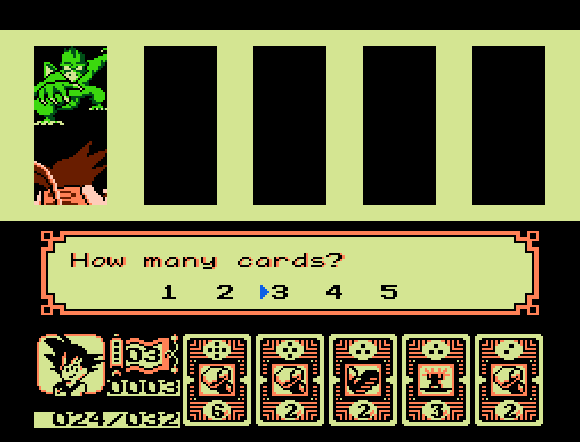
At the beginning of combat, the game asks how many cards (rounds) you want to do. I have no idea why it matters, since if you choose too few, combat continues anyway, and if it ends before whatever number you choose, the extra cards are just returned to your hand.
    
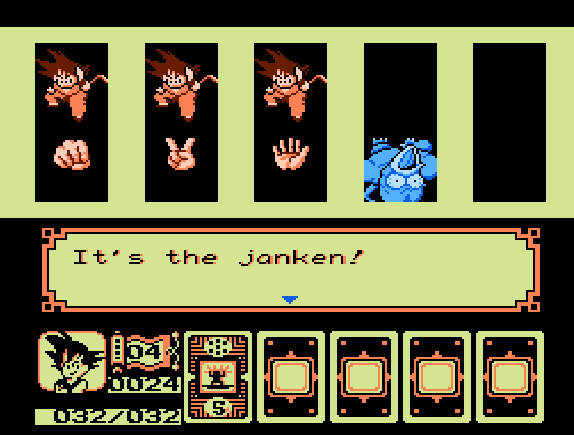
There are seven types of card: punch, kick, combination, bo staff, special attack, flee, and random. Except for the last two, their power is in roughly that order. If you use a special attack, the game has you pick from among five cards to determine the nature of the attack. (The "five cards" thing is just an illusion; I verified with save states that the game chooses a result at random before you even pick, and you get it no matter what card you choose). The results include some kind of punch combo called janken, a double-fisted punch called hasshuken, and a ray of power called kamehameha. They are all significantly more powerful than regular physical attacks. Am I correct that the notion of special attacks with multi-syllabic Japanese-sound names goes back to Street Fighter (1987), or is there an earlier source?
     
Fighting some kind of double-headed robot. We both pulled a "special attack" card with the same speed, but mine (bottom) has a higher level.
     
You may wonder how such a combat system qualifies the game as an RPG. Experience and leveling, it turns out, play a subtle role in the types of cards you draw to replenish your deck. Higher levels increase both the strength and speed of the average card, the likelihood of a special attack, and the power of special attacks when played. Levels also increase Goku's maximum hit points.
   
I imagine that the system was meant to be an in-game representation of the Carddass collectible card game issued by Bandai the same year. As I say, it's not that much more complex than the old card game War. It actually made me remember an episode from third-grade in which our teacher caught me and another student playing War during what was supposed to be an educational period. Card games were fine in general, but they had to teach us something. The teacher balked that there was nothing educational about War, to which I replied, "It teaches us to tell what number is higher." She rolled her eyes and said, "Chet, I'm going to pretend you didn't say that." The next day, the other student and I returned with the rules to a new game that we called War Plus. It had a bunch of different conditions, probabilities, and wagers that required multiple draws and a bunch of math. We successfully lobbied for its acceptability as an educational game. I don't remember what the rules we invented were, but I'm sure it was more complex than the system used by Dragon Ball. The system had enormous staying power, appearing in Dragon Ball RPGs well into the 2000s, so I can only assume that it similarly gets more complex.
    
I'm not entirely sure what kind of attack this actually is.
         
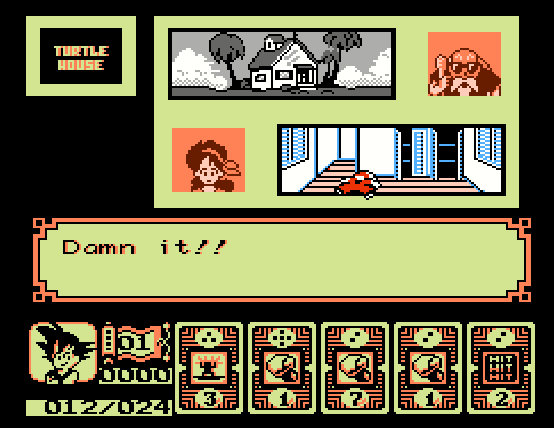
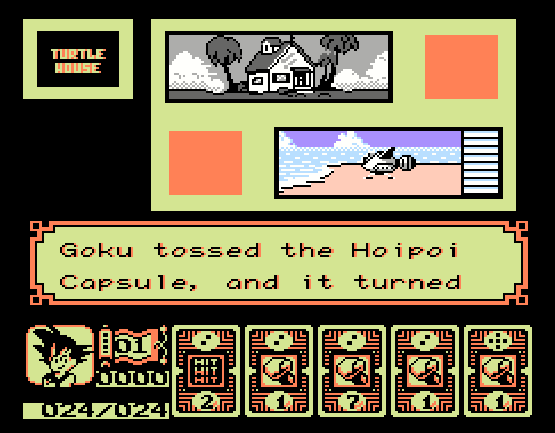
Dragon Ball's combats occur during and in between adventure game-style episodes in which Goku explores various cities and fortresses, trying to find the seven Dragon Balls or otherwise find the next step in his quest. Each area has multiple screens, and each offers some menu combination of moving, searching, using items, or talking to NPCs, those both attached to the location and in Goku's party. The game starts in adventure mode in a place called "Turtle House," where Goku was relaxing with friends after a recent martial arts tournament. They come home from a shopping trip to find Krillin dead upstairs and a scrap of paper with Piccolo's symbol in a kitchen drawer.
 
Goku sets off in pursuit of Piccolo and ends up fighting a henchman, a winged demon called Tambourine. I reloaded multiple times trying to win this combat before I figured that Goku's loss is scripted (fortunately, this is the only place in the game where that's true). Tambourine breaks Goku's "dragon radar" and steals his bo staff, sending Goku back to Turtle House. His loss is attributed to exhaustion following the recent tournament (and represented by half-health). Goku rests and heals, and then the game begins properly.
      
Moving between areas. I have no idea who the guy in the upper-left is.
    
It is extremely linear, going from episode to episode in a fixed order. To get from one place to another, the player has to maneuver Goku along paths on a world map. Each path has a number of nodes along the way. To move, the player chooses a card and then travels a number of stops equal to the power of the card. Upon reaching the final stop, Goku gets a new card and then has to play a little minigame in which he chooses from among five cards presented by his master, Kamesennin. As with the special attack cards, the "choice" is irrelevant because the game rolls the outcome before the player has even made it. Results include:
   
  • Piccolo's Card: Goku must fight an immediate battle with one of Piccolo's minions, almost always a giant bird called Ukelele, but in the late game also Tambourine and a couple of others.
  • Sheng Long Card: The dragon god's card will either give you some kind of hint and restore health or allow you to trade one card for another. (Healing is otherwise accomplished by occasionally finding food on slain enemies.)
      
A tip from Sheng Leng.
     
  • Lady's Card: Has three potential outcomes: 1) all your cards are swapped for new ones; 2) Kamesennin walks you through "training" which is basically just combat with Kamesennin; and 3) You pick another card.
  • "Bust" Card: Nothing happens. This is accompanied by what I first interpreted as a "golliwog" image, but I guess it's just a character from the show named "Mr. Popo."
          
Both this image and "Mr. Popo" have different connotations across the Pacific.
      
The game requires a fair amount of backtracking, and moving along the pathways is maddeningly slow. If you're in a hurry to get from one place to another, you naturally want to play the card with the highest level, but most of the time, you want to save such cards for combat. Thus, the better strategy is to play cards with the lowest level, even though you mince along and have to screw around with Kamesennin's games so many times you want to scream. This method also ensures that you fight plenty of random battles and thus level up between fixed combats.
        
This was a cool graphic from some point in the game.
     
I'll try to recount the story, but it's so nonsensical to me that I don't know how to string it into a comprehensive narrative. Either a lot is lost in translation or the game requires knowledge of the series or both. In broad strokes, Goku and his friend Lunch first set out for the Western Capital to find his friend Bulma, who can fix his dragon radar, which helps to find Dragon Balls. He rescues her from Ukelele and she fixes the device. The party then goes to the Henshin School looking for two additional friends, Oolong and Puar. They have been taken prisoner by Ukelele who is impersonating Oolong, but you fight him and free them.
   
Goku then heads for a place called Jingle Village for reasons I can't remember, where he frees yet another friend named Hatchan who has been taken over by some kind of machine. Here, Emperor Pilaf makes his first appearance in a suit of armor called the Pilaf Machine. At the end of the episode, the village elder teaches Goku how to summon something called a Nimbus Cloud, which I guess is how Goku gets around for most of the anime series.
 
Looks like that snowman is struggling, too.
      
Goku then goes to Pilaf's castle, where he has to fight and defeat Ukelele twice more before he can encounter and fight Tambourine and find the second Dragon Ball. (Yeah, he got the first one somewhere in there.) Lacking any intelligence on the rest of them, he goes to a fortune teller named Baba, who wants him to bring her a treasure. Goku decides to steal the treasure from pirates in an under-sea cavern. While searching for it, he fights a henchman named Banjo and gets the third Dragon Ball. Back at Baba's, she reveals that the fourth Dragon Ball is back in Pilaf's castle, hidden in a way that somehow requires Goku to blow a saxophone in the right room. He finds it on a second visit.
  
Dragon Ball five is found in a tower called Karin and the last two are in Penguin Village. For some reason, finding all seven Dragon Balls isn't enough, though. Goku then has to retrieve an enchanted hammer, ring, and glasses from the realm of an elephant god named Konpei, who fights Goku repeatedly. 
     
I get the last Dragon Ball.
      
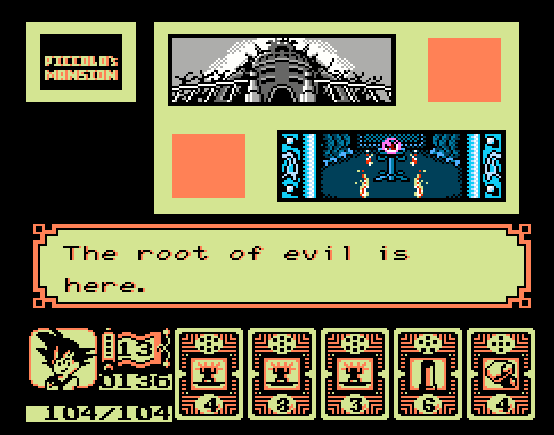
Goku finally goes to Piccolo's mansion, the headquarters of the Evil Clan, where he uses the enchanted hammer to smash the Root of Evil and free the souls of the people killed by the clan, including Krillin. He then heads to the Dark Castle, where a long maze brings him to the final showdown with Piccolo.
      
Nonsense. This game has no economy.
    
If all of that seemed somewhat nonsensical, it's nothing compared to trying to solve the "puzzles" in adventure mode. You basically just have to try every option in every location, stringing together a series of illogical actions and outcomes until you finally complete the quest and can move on to the next place. There are a lot of ways to meet instant death during this process.
     
But he can breathe in space.
   
Sometimes, you have to do the same action multiple times before you get a result, and it was these times that I was most likely to have to turn to a walkthrough. For instance, there's an early screen where you have to talk to Lunch four times in a row to get her to sneeze, which causes her to switch to an alternate personality who notices something that Goku doesn't.
      
"This must be the solution to a puzzle!" -- an adventure gamer.
     
Even with help, there were a lot of things I didn't understand, such as whether the NPCs accompanying me really did anything (except the couple of times they were necessary to a puzzle), how something called a "hoi-poloi capsule" seemed capable of creating whatever the character needed at the time (including an airplane and a submarine), why Goku has a monkey's tail, and why Bulma insists on calling Goku "son." 
  
Don't question it.
    
The combats in the game aren't very hard. I wasted a lot of time in the beginning thinking about strategy, trying to save the best cards for more difficult combats, but eventually I got bored and just started using the cards in the order that they appeared in my deck, and I found I was rarely in danger of low health. Only for the final combat with Piccolo did I need to make sure I had a decent deck (by burning low cards in earlier combats), and even then I won the first try with a couple of hadoukens or whatever.
   
And I had two more after that.
    
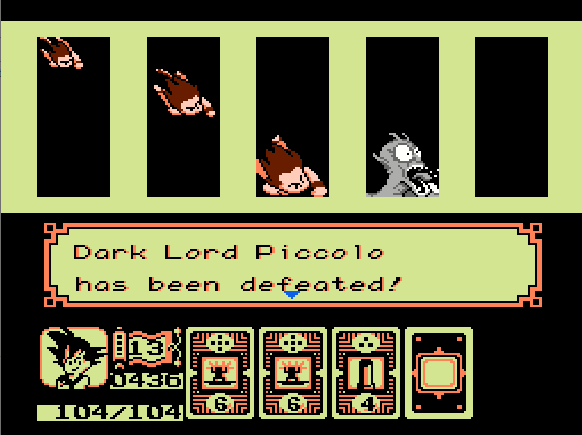
The final animation shows Goku bursting through Piccolo's chest. Piccolo then has a villain's speech worthy of Malcolm Trandle: "How!? How could this be!? Me? The Dark Lord Piccolo? Defeated? I am in awe . . . but I must warn you . . . Don't think you've seen the last of the Evil Clan!"
       
Gruesome.
     
I give the game an 17 on the GIMLET. It does best in "game world" for at least having a detailed backstory, even if I think it's silly. It gets 0s in "equipment" and "economy," as the only inventory is of the puzzle-solving variety, and finding it is scripted. Everything else gets 2s. I wish I could give more for the combat system, which is at least original, but there just aren't enough tactics. It got boring and repetitive fast, particularly where you have to fight the same enemies repeatedly. (Honestly, how many times do I have to thrash Ukelele before he gets the hint?) It's also far too linear, and the puzzles are so nonsensical that I can't give much credit for encounter design.
       
I played the game, didn't I? Do you have to twist the knife?
     
If I continue dipping occasionally into console games, I guess it's inevitable that we'll encounter Dragon Ball again. I guess the Z series, depicting Goku as an adult, is more popular than the original. I watched videos of some of the later games but couldn't get much of a sense of the evolution of the card approach; I wouldn't mind hearing from readers who have played later games if it gets more advanced or interesting.