The Magic Candle III
United States
Mindcraft Software (developer and publisher)
Released 1992 for DOS
Date Started: 7 September 2019
Date Ended: 8 March 2021
Total Hours: 36Difficulty: Easy-Moderate (2.5/5)
Ranking at Time of Posting: 369/412 (90%)
The Magic Candle series ends its three-game run (three core games, that is) having maintained a certain uniqueness. Although manifestly inspired by the Ultima series, it went its own way from the first entry, offering many elements not seen in other series, or at least novel twists on old ways of doing things. Every single one of them sounds good on paper: tactical, turn-based combat; a magic system that depends on acquired spellbooks; a complex skill development and training system, including both combat and non-combat skills; a tight economy with an option to work mundane jobs for money; dozens of NPCs and hirelings to choose from; and best of all, a high priority given to information and lore, including libraries where you can look up the history of the area and a searchable notebook that records your findings.
That last element is of particular interest to me. I truly value games that offer complex plots and require players to dig deep into the lore to uncover the truth. No game is doing that terribly well yet, but a few come close, and certainly this series is among them. If I have to keep a notepad going and create a little mini-encyclopedia as I play, I'm a happy gamer.
 |
| Yes! Tell me of Vorhamme! |
It's hard to pinpoint exactly how it went wrong--and there is some extent to which it went wrong in all three of the titles--but I suspect in the end it revolves around that oh-so-elusive concept of "balance," combined with small elements that serve to undermine most of what would otherwise be 60-point games. Take the backstory and lore to start. While undoubtedly better than most of the dreck of the 1980s and early 1990s, this entry fails in making its story interesting. III would hardly be the first game to invent its plot well after the earlier entries, but most other series do a better job disguising it. (They didn't even bother with a subtitle!) There are suddenly these "Solian Lands" that no one has ever mentioned before with yet another collect of humans, orcs, elves, and dwarves--but no reference at all to Eldens, Aletsens, or demons. The forces of Gurtex came all the way across the ocean but ignored the lands just to their south?
But the primary problem with The Magic Candle III is how it makes so much of its own content superfluous. For a game that offers so many mechanisms of character development (awakening gods, paying for training, developing skills through use), it almost goes out of its way to make the development unfelt by the player. My characters didn't seem to get any stronger throughout the game at all. Granted, by importing two of the heroes, I started in a place of strength, but I would maintain that even a newly-created party, comprising any of the characters in the game, could win without a single skill or attribute increasing by a single point. I had to replace two of my characters late in the game, and the replacements performed just as well as their predecessors.
 |
| Just walking in this game is a bit tedious, with characters having to rest or eat Sermins every 6 steps. |
Throughout the entire game, I only used a teleportal once, and that was just to have the experience of using it. I never paid for any training. I didn't cast 80% of the spells, and I wouldn't have cast 90% except I made a deliberate late-game effort to experiment with some of them. I never tried to hunt for food. I used the "OTHER" dialogue option for only one keyword. I never used a mindstone. I had exactly one party member bother to work a job, and that was only because I was experimenting with that mechanic early in the game. (Come to think of it, I never returned to him.) I never picked a mushroom from a patch, slept in a stronghold, changed the party leader, played a musical instrument, or used the "Solo" command in combat (it's a weird command that almost provides an auto-combat option, but not quite). There are a million little things, admirable on paper, that never engage the player because the game isn't big enough, hard enough, or long enough. Take this quote from the manual:
When camping outdoors, blankets ensure comfort and full recovery of energy. Without a blanket, a camper will not be able to restore energy to above 50 points unless there is a skilled carpenter in the party to build a temporary shelter.
That's awesome! That's a roguelike level of detail and realism. In practice, though, you just chew a Sermin and move on.
In fact, mushrooms are a big problem in the series in general. A player who eschews them faces a much more challenging game, and it might be worth avoiding them for that reason. You need exactly three things to win The Magic Candle III (not to mention the two predecessors) without really trying: the "Jump" spell, Gonshi mushrooms, and enough money to buy them. That's it. Even late in the game, while Mirgets and Nifts were helpful, Gonshis and "Jump" got me through nearly every situation.
This application is horribly unfair to the game's spell system, which offers an incredible variety of buffing, healing, offensive, and exploration spells. I started to force myself to experiment with them, realizing after a few hours that I was basically writing the same entry as one I wrote for The Magic Candle II four years ago. Suffice to say that almost all my casting was "Restsoul" and "Shield," with a bit of "Sharpen" at the end.
As often happens, I've spent the better part of this "summary and rating" entry offering complaints about a game destined to land in the top 25% of GIMLET-rated games. You might thus be surprised to find that I do like The Magic Candle series despite everything I've said. As with my students, I try to judge games against their own potential rather than against each other, and thus the primary way in which The Magic Candle III is wanting is in light of the developer's own clear competencies. So let me try to offer some more obvious praise. It's one of the few Ultima-inspired series that managed to differentiate itself from Ultima. It's one of the few "complete" RPGs of its time, hitting every point on my GIMLET with enough force to at least earn a 3 or 4. It does a few things hardly any other game of the period is doing, such as the ability to juggle many more characters than the party allows, "assigning" them to various tasks and communicating by mindstone. It takes the trouble to create its own, mostly original, bestiary.
In the end, I praise the mechanics and intent of the game far more than
the specific implementation. If it were a modern game, I'd say it was
ripe for a dedicated modding crew who could rewrite the plot, jack up
the difficulty of the enemies, and make a few tweaks to the interface.
In many ways, it's a shame that the developers ended here without giving
it another try.
1. Game World. The story of III works better as a standalone game than as a sequel to two prior games, but it's still a complete story, full of lore that's only revealed to you as you explore and research. I don't know why the creators felt that it was necessary to include the standard Tolkien races; none of them are interesting except for the orcs and goblins. I like how the Blight progresses during the game and creates a sense of urgency, even if the world otherwise doesn't change much during your time in it. Score: 6.
 |
| If you wait long enough, the Blight eventually covers the whole world . . . but the game doesn't end. |
2. Character Creation and Development. I like it on paper. You have attributes and skills. You can pay for training to increase skills or you can just use them. There are original attributes, like "Bravery" and "Loyalty." Your attributes go up when you solve quests to awaken sleeping gods. Some of your skills help you make money at honest work, and even these have subtle influences on your adventuring. For instance, a good "Tailor" increases the party's effectiveness in dialogue, and someone with "Gemcutter" adds that skill to his "Trading" skill when selling gems. It's just too bad that things are so unbalanced in practice, where only the skills you employ in combat ever increase, and then maximize well before the end of the game; you rarely need the subtle bonuses imparted by the other skills; and even the weakest characters can succeed against the game's enemies with the right mushrooms. Score: 3.
3. NPC Interaction. A key part of the game, flubbed a bit by the interface. This is one area in which the creators would have been better off literally copying Ultima IV. NPCs don't have quite enough keywords; the "OTHER" command is under-utilized; and I've never liked the series' practice of making NPCs disappear and vanish at different times of day, forcing you to do things like pass 24 hours in the tavern just to make sure you talk to everyone. The division of joinable NPCs into regular NPCs and "hirelings" is a needless complication. I do like the variety of people who will join the party, and the game pioneers the concept of "banter" a bit. Score: 5.
 |
| There's no sense of characterization for any of the characters, but at least they have something to say. |
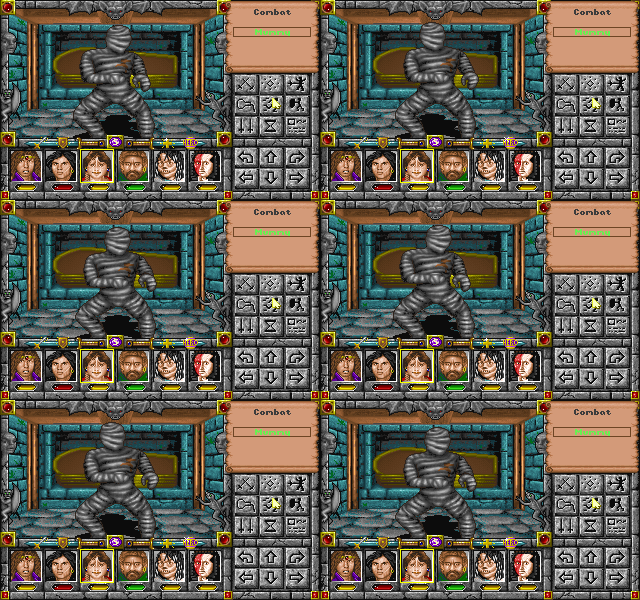
4. Encounters and Foes. The game has an original bestiary with foes that behave quite differently, and there are more than enough to see you through the game. It might have been a good idea to include a few who don't fall so easily to the sword. There really aren't any non-combat encounters, alas, nor puzzles to solve. Score: 4.
5. Magic and Combat. Again, the system sounds good: a tactical grid, turn-based, with lots of positioning and spell options. There are three problems. First, a few tried-and-true strategies always carry the day, which discourages you from exploring all the options. Second, because of those strategies, combats are fundamentally too easy. Third, they're paradoxically too hard. Let me reconcile those two second points: the combats are too easy if you pay attention and know what you're doing, but too hard if you just try to blow through them. Thus, every combat ends up requiring time and mental energy while offering a predictable outcome. It's for reasons like this that you avoid as many as possible; that I found myself reloading rather than fighting if there was a way to avoid it; that Andrew Schultz's walkthrough has several pages of recommendations for creating tortuous formations of your party to avoid ambushes. I do have to give some points to the sheer variety of spells even if the game rarely calls for them. Score: 5.
6. Equipment. The series has never been terribly strong on standard RPG weapons and armor. You get slots for a melee weapon, a missile weapon, armor, clothing, and a helmet. There are no gauntlets, boots, rings, necklaces, and so forth. Even the meager slots you do get generally only have one upgrade during the game--from a bronze helmet to a steel one, say, or a long sword to a magic long sword. Usable items like shovels and picks add another dimension, and of course the real equipment advantage is in the variety of mushrooms and herbs. They're so effective that you almost wish the game didn't have them. Score: 3.
 |
| My dwarf's equipment towards the end of the game. |
7. Economy. A strength. Those overpowered mushrooms are at least expensive, as are other items of equipment, spell books, training, and the simple renting of ships. You have a variety of ways to earn that gold, including combat, selling found items, putting characters to work for a wage, and gambling. Tight in the beginning, the economy is ultimately a bit generous; perhaps mushrooms should have cost a bit more. Score: 7.
8. Quests. One main quest, no choices, no role-playing. You can regard awakening the gods as "side-quests," and even without this, there are "side areas." I'll also give an extra point here in doing something original with the main quest. Score: 4.
9. Graphics, Sound, and Inputs. I don't like the iconography of this game. The graphics are too small and try to be too complicated for graphics so small. Even by the end of the game, I could barely distinguish my own characters in combat. I was forever trying to talk to trees and lampposts. I generally found the sound shrill and unimaginative. The interface is adequate. It can be run entirely by the keyboard, which I like, but . . . I don't know. I found it hard to get into a rhythm like you do when you master the commands of most games. Casting a "Heal" spell ought to be a matter of hitting the character number, then "R" for "Recall," then "H" for "Heal," then ENTER to select it, then "M" for "Magic," then the number of the character to receive the spell. But if I tried to do that too fast, I'd look up and find that I just ordered the entire party to eat a ration of food, or everyone was suddenly in camp, or something like that. It's one of those things that's hard to replicate when you deliberately try but it happens all the time in the normal course of play. There were other issues that I discussed with pooling and distributing items and acknowledging dialogue. The cut scene graphics are nice. Score: 3.
 |
| These graphics are quite nice. |
10. Gameplay. It gets solid points here. It lies in the upper end of what I consider the 25-40 hour sweet spot. It's quite nonlinear after the first quest. It's mildly replayable, particularly with different party configurations. Its only major problem here is that it's a bit too easy. Score: 6.
That gives us a final score of 46. I find myself surprised not that it's lower than the original (52) but that it's higher than II (43). This took me back to my final entry on the second game, which I haven't read since I wrote it. Looking it over now, I'm surprised at how much of what I wrote in 2017 would fit this game perfectly. I complain about the same things, make the same points about subtle issues of balance. In that entry, I made a list of all the things I didn't do, and that list is pretty much the same as it is for III. I even made a reference to "banter" in my discussion of NPCs. Overall, the scores are nearly identical except I thought the economy did well here and I was more charitable in the "graphics, sound, and interface" category there. I don't know why, since I complained more than I praised. Fundamentally, though, these are very similar games. They were only a year apart.
Scorpia really didn't like this one. In the May 1993 Computer Gaming World, she took it to task for some peculiarities with an early quest that I didn't experience. Where I found the economy satisfyingly tight, she just found it stingy. She did offer the same point I did about the endgame being a bit too easy, though. Her conclusion:
Magic Candle III is a dull game. I had a hard time getting into it, and slogged on mainly to get it over with. We've all been here before and there isn't anything really new or exciting. The game is unnecessarily lengthened by the constant need for money and, overall, one is left with the feeling of doing things by rote rather than going on a grand adventure. It is all very depressing and rather a shame.
While I think that goes too far, the "hard time getting into it" part definitely applies to me given that I took over a year between the first entry and the second. There is something ineffably cumbersome about this game that none of my entries adequately captured and that perhaps makes the rating of 46 a bit too high. Until I read Scorpia, I thought it was just me.

The game's reception is too bad given how hard Mindcraft was trying to make a franchise out of this setting, although in doing so, they made some weird decisions. For instance, you hear repeatedly in III about how King Rebnard is busy conquering the continent of Gurtex. Mindcraft released Siege, a strategy game, the same year, which you would assume is about Rebnard's conquest. But no--it's about the original conquest of Gurtex by the forces of evil. Who wants to play that?
Siege had an expansion called Dogs of War the same year, which is set in the Solian lands, but again in a history largely unmentioned during III. Since the demonic forces never conquered the Solian isles, Dogs of War simply puts the "children of light" (humans, elves, etc.) against each other, something not even hinted in the histories of the core games. The company advanced its approach to strategy gaming in Ambush at Sorinor (1993), which most sites claim is set in the Magic Candle universe, although I didn't recognize any of the proper names, including the one in the title.
We'll have one more experience with this engine in the final Magic Candle universe game, Bloodstone: An Epic Dwarven Tale (1993), a prequel set sometimes in the Solian lands' past. I look forward to seeing whether one final pass at the engine improved it.