Thursday, May 21, 2020

Game 366: Abandoned Places: A Time for Heroes (1992)

Or A Tinne Fot Hetves if you go by a literal interpretation of the font.
       
Abandoned Places: A Time for Heroes
Hungary
ArtGame (developer); Electronic Zoo (publisher)
Released 1992 for Amiga and DOS
Date Started: 15 May 2020
         
It's nice to see a new country enter the CRPG fray. We're going to have four games from this country in the early 1990s (including Abandoned Places and its sequel) and then nothing for a decade. It's also nice to see a new take on a familiar template. I had a fun first session with Abandoned Places, and I'm looking forward to my next one. I just wish Ultima VII hadn't gotten bungled, because this would be a near perfect game to trade time with that one. 

Abandoned Places is based heavily on Dungeon Master, right down to the framing story, which has a benevolent mage going to a crypt to resurrect former heroes rather than create characters from a living population. This was the least satisfying part of the game, as I was asked to choose two warriors from a selection of six and one mage and one cleric, each from a selection of three, based on nothing more than their character portraits. I was assisted in this endeavor by Saintus's 1992 coverage of the game, in which he tried all possibilities and analyzed their strengths and weaknesses. I chose the fighters Lianon and Cromer, the cleric Felius, and the mage Pomphis. My primary concern was that I get a cleric with the "Create Food" spell because I hear that the party gets hungry fast in Abandoned Places.
         
Assembling a party.
        
The game manual has nothing on the backstory, so we have to rely on the opening animation. Information is scant. It is told from the perspective of a mage who awakens the deceased heroes.
            
The ancient scrolls have led us to the location of the Heroes, the Champions of Kalynthia, turned into living stone, waiting for the time to once again fight evil. The council emissaries will travel across land and sea to the Temple of Heaven's Fight. There, far below the surface, the Heroes are to be found, but our powers are waning and we only have the power to turn four of the heroes back to flesh and bone. No one can tell what the effects of 900 years as statues will have on them. But they are now our only hope to stop the cursed Bronakh. May luck be with us all.
     
An unnamed mage restores life to some statues.
          
The game begins as the four heroes wake up in their crypt with no equipment and a couple of gargoyle-looking things prowling the rooms. Fortunately, it's sufficiently like Dungeon Master or Eye of the Beholder to figure it out in a hurry. You right-click on hands to attack, after which there's a "cool down" period. Only the first two characters can attack in melee range, but the rear two can use missile weapons and cast spells, and the mage comes with a useful "Magic Bolt."
              
Almost immediately, the game thrusts you into combat.
        
The interface is fairly intuitive. You left-click to move objects and right-click to use them. Everything is contained in one window. The developers sacrificed exploration window space to keep the inventory and character sheet always visible. You click on the character portraits to cycle through their inventories. The character with the active inventory and character sheet is different from the character with the active combat options; you change those by clicking the number buttons right next to them. Because of the nature of the interface, you really need a mouse so that you can drag items from the floor to the characters, operate switches, and so forth. But it does offer keyboard options for commands such as movement and--thank you!--attacking. You can also specify the direction of attack with the little pad beneath the character portrait, but I haven't played with that yet.
    
The gargoyles dropped a couple of keys, and the room was scattered with rocks and torches. One of the keys went to either of two doors at the south end of the room, both of which opened the way to the same area of a higher level.
          
My map of most of the temple.
         
The temple ended up being five levels, but with only three of them taking up any substantial space. The goal turned out to be finding the exit on the bottom level, which was the largest, taking up 16 x 29 coordinates, but using nowhere near that much space. (The game uses a "worm tunnel" approach, which automatically cuts out a lot of squares.) Standing in my way were things that looked like gargoyles, skeletons, and maybe fire elementals. They were all pretty easy to kill even though I never found any armor and the only weapons I found were minor ones: clubs, daggers, and one short sword.
          
This thing looks like it ought to be harder than it was.
       
I like the way the game allocates experience, which is by successful action rather than simply killing someone in combat. Fighters get experience for each hit. Spellcasters get experience for each spell successfully cast, including noncombat ones like "Create Food." Nonetheless, by the end of the dungeon I did have a rather large experience imbalance in favor of the fighters. No one had reached Level 2 yet, though. I need to spend more time casting spells, since magic regenerates relatively quickly. As in Dungeon Master, a full spell point bar is just wasted potential experience.

Navigation puzzles were easy in the introductory dungeon, consisting of just a few keys, buttoned doors, and levers that opened new sections of hallway. Towards the end of the level, I had to avoid fire squares and water squares, although you can try to cross them quickly if you don't mind a little damage. The only thing that bothered me was that I left four locked doors on the lower level for which I never found any keys. There was also a stairway on an upper floor that was blocked somehow. Maybe these were red herrings, or maybe we'll be back to the temple later.
           
A skeleton comes out of a buttoned door.
          
There was a chest full of food on one level, but it barely did anything. If I didn't have the "Create Food" spell, my characters would have been starving for three-quarters of the expedition. Starvation causes a periodic loss of 1 hit point. I also noted that the game told me the characters were "exhausted" quite early in my explorations and torches didn't last very long. (By the way, to use a torch in this game, you have to hold a "firestone" in one hand and the torch in another and then right-click on the firestone. That took a while to figure out.) I suspect this all means that I have the cycles set too high in DOSBox. Discussion question: Is there ever a good excuse for a developer to base such considerations on CPU cycles rather than real-time or number of moves? It feels like authors in this era never considered the possibility of faster machines.
     
When we found the exit to the dungeon, I was surprised to find myself on a top-down overworld map. Well, not completely "surprised" because I'd read the manual, but still--this is an unusual addition to the Dungeon Master sub-genre. The rest of the game takes place over a reasonably large map with one large island and three small ones. The map is dotted with towns, castles, and ruins, and I assume most of them have some kind of dungeon to explore. (The overland map is similar enough to Legend from the UK that I wonder if the developers weren't influenced by it.) I like the approach, as long as the dungeons are of modest size. If they're each as large as the typical Dungeon Master clone, the game will wear out its welcome quite fast.
          
Boarding the boat from the starting island.
          
My first goal was getting off the southern island that houses the Temple of Heaven's Fight. From atop the mountain, I could see a ship making daily trips from the large island to our small one, so we headed for that ship's port of call. Along the way, the game said we found some horses. There's a button that lets you switch between various modes of transportation. When we reached the boat, we switched to that, and it brought us to the "continent."

I headed for the nearest city, which turned out to be a quiet little town called Frampton. It was home to a priest whose services I didn't need. There were no other shops.
               
The town was pretty, though.
           
Lacking any guidance about where to go--Why didn't the mage who awakened us stick around? Or at least leave a note?--I decided to work my way roughly counter-clockwise around the continent. A fortress in the middle of a lake with a long bridge leading to it looked promising. When I arrived, the game told me I was at Pedroc's Abbey, but that it was closed.
            
The overworld map has a lot of interesting-looking features. There just isn't much to do when you get there.
            
I continued moving over mountain and river until I came to a small town called Timberville, where "most of the villagers have some kind of weapon in their hands." Timberville had another healer and a tavern, where we spent the 15 gold pieces found in the temple on a meal (2.0) and lodging (2.5). I'm not sure if either did anything for us, as I stopped getting messages about hunger and fatigue the moment I reached the outdoor map.

You occasionally have to fight wilderness combats, which take you to a small 3D map crossed with bushes and rivers. The only enemies I've had to face so far are giant bugs, which drop no gold. You can't leave the fights until you've killed all the enemies, and it can be annoying to find them sometimes.
          
Fighting a giant bug in the wilderness.
          
I couldn't even find the entrance to a castle (called "Twilight" on the map) across the lake from Timberville, and two villages further along the coast, Hyde and Trailcross, had the same options as Timberville. Something called the Tower of Scions was destroyed and offered nothing to do. Cities called Iron Home and Tol Al Nerak wanted 10 gold pieces to enter, which is all I had left. I saved and tried anyway, but both just had shops that had nothing I could afford.
        
It's nice to know such things exist. I'll be richer someday.
      
I ultimately spent the gold getting into Kal Kalon, the capital of the country, where I found a guild. The guild leveled up my first fighter and mage--fortunately, for free--and said I need a few hundred experience points more for the other two. I couldn't take advantage of the other services and left.
         
Not so much "bad luck" as "uneven distribution."
       
I finally found something to do at Souls Abbey in the southwest of the main island, nearly a full loop back to where I'd started. A monk told me he might have a job for us, but he'd need us to prove our skills first. He said his guards would take us to a "place full of monsters," and that we would prove our worth by destroying all of them.
         
Our first quest.
       
We agreed, and soon found ourselves in a new, dark dungeon--the only problem being that we only have one torch left and it's hard to see in the dark. Hopefully, we'll find some more.
          
Dropped off in my second dungeon.
       
Aside from that hour where I was wandering around the land experiencing nothing, Abandoned Places has started relatively strong. To many players, Dungeon Master is perfectly satisfying on its own, but I'm rather glad to see a game that adds an overworld, an economy, and NPCs to the template. And while I always enjoyed Dungeon Master's approach to leveling through action, I'm glad to see it quantified (or perhaps I should say quantified in a way visible to the player) here. My major concerns are whether it will introduce more interesting puzzles than it has already, and whether the game world will open up a bit. It would be a waste of the overland map if you had to hit all the dungeons in a particular order.

Time so far: 4 hours

Tuesday, May 19, 2020

The Black Gate: Clearing Out

The king without a throne! The land without a king!
          
Owing to circumstances, this will be a brief entry, but I wanted to at least talk about some of the things that occurred to me as I continued my explorations of the Dungeon Despise. Despise is the dungeon that, to its shame, the game accidentally calls Shame. It is wrong. Not the dungeon Wrong--that's further north. Or maybe the confusion is part of the Guardian's attempt at deceit. Not the dungeon Deceit--that's north of Verity Isle. I wish I could go on like this but "destard" isn't even a word. They must have been going for "dastard."
        
Despise turned out to be a large, twisting labyrinth that made full use of the mountain ranges to the north and east of Castle Britannia. There's no plot reason to be here, so I'm not sure if I ever even checked it out in previous sessions with the game. I enjoyed it a lot, and until I discovered the fatal bug, it was serving its purpose of loading me up with gold and other goodies.
       
Just what I was hoping to find.
         
There were numerous combats with trolls, skeletons, slimes, headless, gazers, gremlins, rats, and probably a few other creatures that I didn't note. Because of the game's approach to respawning, you can fight them essentially endlessly. You have to make peace with the fact that you're never going to "clear" the dungeon.
     
As I noted last time, combat in Ultima VII is perhaps a little bit better than a lot of reviewers would have you think. It can be graphically confusing at times, but it's never mechanically confusing. Characters generally perform their programmed action with their equipped weapon, and success comes down to attributes (strength and dexterity) and weapon and armor quality. Even with multiple enemies, combat is over relatively fast, so at least if everyone's going to die, you don't find out after 45 minutes of investment. When characters do something that seems contradictory, it's usually for a good reason. When their hit points get down, they naturally flee. If you've equipped them with a weapon that requires strength or dexterity they don't have, they drop it and find another one. 
           
The skeletons had something weird going on.
          
But there are admittedly a few things they could have done better. One would be getting rid of "friendly fire" damage unless you deliberately do something stupid, like cast "Explosion" in the midst of a melee that includes allies. There are entire weapons that you can't possibly use unless you're playing a single character because otherwise the whole party gets slaughtered. Chief among these are the Firedoom Staff, the Triple Crossbow, and "burst arrows" for a regular bow. I discovered some of the latter in Despise, gave them unthinkingly to Shamino, and watched as the next combat dissolved into a horror show. 
       
One of the best things about any multi-character game is the satisfaction of incrementally improving weapons and armor. Despise hooked me up with a lightning whip, a magic axe, some magic gauntlets, some leather helms (some of my party members had no headgear), and lots of spell reagents. One issue that I'd forgotten is that characters can wear gauntlets or rings but not both.

The dungeon was tough to navigate. There were lots of locked doors, at least half a dozen keys, and plenty of traps. I don't like how traps work in this game, where you can't detect them. They just go off when you walk on their pixels. One particularly nasty one teleported me to a small section of corridor where a wall continually spewed fireballs. 
        
Yow.
        
Another corridor had a more benign teleport trap that just sent me back to the beginning of the corridor. I had to get around this by finding a secret wall. That's something else I don't really like in this game. There's no way to detect them, visually or magically. You just have to bump in the wall and note that the characters sink into it.
         
This game's method of "secret doors" looks a lot like a bug.
        
There was a bit of a mystery when my characters opened a door and all of them started to scream, "Oh, no!" Then they doubled over and vomited. I didn't see or find anything on the other side of the door that would have accounted for this reaction. Later, they were put to sleep by some flora surrounding a pool, but that made more sense. 
            
Those plants look like trouble.
            
In one room, we found an insane mage named Garok who said he was hiding from the Britannian Tax Council and had gotten lost. He had gone mad from the same malaise afflicting other mages, and his crystal ball showed him the source of the problem was in a dungeon, so he randomly chose Despise to explore. Now lost, he needed help with directions out. When we gave him directions, he returned the favor with reagents and then teleported away. I wonder if he went somewhere else in the game. 
           
I can sympathize.
           
Elsewhere, we found a staircase going up, which was confusing. The staircase took us out of the dungeon, across a bridge, and back down into another part of the dungeon in a different mountain range. That was kind of cool. 
           
This is trippy. I just don't remember seeing this structure from the "outside."
      
The dungeon has a lot of magically-locked doors. We eventually found enough reagents to deal with all of them, but early in my explorations, I ran out. Thus, after finding a few gold bars in a barrel, I took my party out of the dungeon and had us sail south across the mountains to Lord British's castle. We traded in the gold bars at the Mint, and here I saw the first evidence of what would be a fatal bug: the Mint had no doors and no furniture, and Claudia was standing in an empty room. It was like one of you sociopaths had somehow invaded my game and performed your customary Mint robbery.

Casting "Unlock Magic."


I went north to Lord British's castle and found that the drawbridge was gone. At first, I thought it was just "up," but it turns out that it had disappeared completely--along with the winch that controls it. Exploring the castle (I had to take the magic carpet in), I found all furniture missing--beds, tables, endtables, even Lord British's throne.

This is a bit ominous.
            
At first, I was just amused, and I bought some reagents from Nystul and kept exploring Despise. Then, I slowly started to realize that it might be more of a problem than I thought. A quick trip with the Orb of Moons confirmed that every city is affected.
 
I can just hear you. "This kind of thing has happened often enough that surely you've developed a comprehensive, foolproof backup system by now!" The answer is yes, I have--but I bought Ultima VII through GOG, which defaults to its own directory if you fail to change it, and I didn't have my backup system set to include that directory. I alternated among multiple saves, but I don't have one from before the problem except one that I made many hours ago upon my arrival in Paws.

There's no way I'm not going to finish Ultima VII, but I hate doing things twice and I can't see myself doing it immediately. I'll probably take a week off, alternate a couple other games, and then try again. I just wish I knew what triggered it. Maybe using the Orb of Moons while I was in the dungeon?
      
Either way, this is a short entry so we'll have the next one in a day or so.

Time so far: 22 hours


Sunday, May 17, 2020

Game 365: Muryaden (1989)


You are not misinterpreting this screen. The troll is having his genitals stimulated by a magic stone. It's that kind of game.
          
Muryaden
France
Elrik et Deckard (developers); Bytlejuice (publisher)
Released in 1989 for Apple II
Date Started: 12 May 2020
Date Ended: 14 May 2020
Total Hours: 5
Difficulty: Moderate (3/5)
Final Rating: 24
Ranking at time of posting: 156/379 (41%)
          
At first glance, Muryaden is another Ultima clone, but I guess it was intended as a sort of anti-Ultima. It was made by developers who held at least mild contempt for not only Lord British but the entire history of American RPGs. I get this from a web page that one of the authors used to maintain; I would appreciate if anyone who speaks French fluently would scan this page and let me know if there's anything in the following account that I got wrong. I can read French, but I'm having trouble with this French, which seems to include a lot of slang and nonstandard uses of words. Do French people really use ricains as a slur for "Americans"?
     
Anyway, the chief complaint of Elrik and Deckard seems to be that the American approach to fantasy RPGs was too "clean." They were less interested in high fantasy of the Tolkien type and more interested in gritty Conan-style sword and sorcery, with attendant sex and gore. In their authors' desires to ensure that their programs wouldn't be banned by "austere Puritan traditionalists," they argued, American RPGs always take place in a "quasi-religious atmosphere" in which a noble purifier "arrives at the right time to deliver the world from a diabolical oppressor." The plots are interchangeable and the universes are "clean and hygienic," with no sex, brothels, or even any latrines.
          
The game is credited to "Elrik" and "Deckard."
        
I think the authors go a bit too far in imputing motive to American RPG developers (and not far enough in appreciating them for, you know, inventing the genre in the first place), but I'll concede that they have a point. American CRPGs in the 1980s are awfully vanilla. I don't know that the solution lies in graphic descriptions of demon ejaculate, but at least it gets points for originality.
     
The backstory for the game thus reads less like someone trailblazing a new era in realism and more like the fruits of the perverse imaginations of two sex-starved young men. I'm going to elide quite a lot, partly to prevent Google from putting an NC-17 warning on my blog, partly because I didn't always understand the language, and partly because I just found it gross. Some misunderstandings of my previous positions have led to an incorrect "The CRPG Addict has a problem with breasts!" belief, but I have no problem with the perception that I have a problem with graphic description of anal manipulations with tentacles. That belief is 100% accurate.
          
The story begins when a sorcerer named Mithgul moved into the middle of a fairly generic fantasy kingdom. He holed himself up in his fortress and got to work on various inventions and experiments, almost all of a sexual nature. He created a "stone of beauty," an artifact that endowed its holder with "unlimited charisma," such that he could drive a crowd of people to mass suicide. He mated humans with demons and beasts to produce all kinds of abominations. He collected fluid samples from dozens of species and invented a number of creative aphrodisiacs.
              
The game is at first visually indistinguishable from one of the Ultimas.
         
Mithgul's efforts came to an end when the seed of a demon mixed with some other chemicals and caused an explosion that destroyed Mithgul's tower. Unfortunately, the escaping vapors engulfed the nearby town of Bar-Calenlad and turned the entire population into nymphomaniacs, leading to massive population growth. A local order of paladins didn't have any hope of maintaining their chastity vows, and soon their fortress had expanded enough in population to form a new city, Bar-Tolainor. Trolls escaping from Mithgul's dungeon formed their own city, Echorkeliant. Generations later, each city has developed its own sado-sexual traditions. Lately, a villain named Beltrik the Skatomancer has re-inhabited the ruins of the fortress. He's kidnapped the daughter of King Valdrin and caused such strife among the trolls that they've split into two factions. Into this milieu, the character is dropped without an explicit quest yet.
                
Character creation.
        
Character creation doesn't break much new ground. You assign a name and race (human, elf, dwarf, hobbit), after which the game randomly rolls for wisdom, strength, dexterity, and intelligence, modified by race. These four attributes together determine the derived statistics of vitality, charisma, skill, and perception. Your choice of class (sorcerer, priest, warrior, thief) has further effects on these statistics, and finally you can specify a "type" (charmer, skillful, attentive, resistant) that makes further modifications.
          
My early-game character sheet.
         
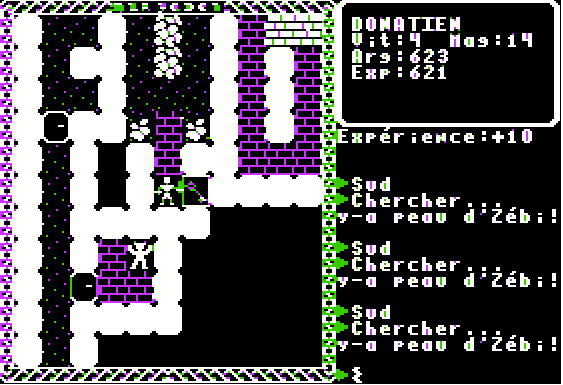
The game begins with the character standing on the plains outside Bar-Calenlad. The game world is a small 58 x 58, but it seems larger because of frequent random encounters. There are the three cities mentioned in the backstory plus a few dungeons and Castle Gondarnost. The interface follows Ultima's tradition of mapping commands to individual keys, such as C)hercher (search), O)uvrir (open), and P)énétrer (enter, as in a city).
          
Can someone tell me what the phrase y-a peau d'Zébi means?
          
Enemies mostly include fantasy standards like orcs, trolls, bandits, mercenaries, zombies, kobolds, and giant spiders and snakes. They're not seen in the environment until they attack. Combat is a little more complex than Ultima but not quite as complex as, say, Wizardry. You face only one enemy at a time, and you have options to fight, change weapons, cast a spell, use an object, advance, back off, surrender, or steal. "Advance" and "back off" are unusual commands, but there's a distance consideration in combat, with enemies and characters occupying four potential spaces from très proche (very close) to très loin (very far). Certain weapons work better (or don't work at all) at various distances. 
        
Fighting an ettin from "close enough."
                   
The cities are menu cities that offer various options depending on the city. Bar-Calenlad offers an inn, a Temple of Eros, a guild, an alchemist, a weapon/armor shop, and a fence. Early on, I didn't understand the options for the other places, so I just bought a dagger and robe (the only items my strength would let me wield) and headed out to fight.
            
Menu options in the troll city of Echorkeliant.
          
It took me a lot of deaths (fortunately, reloading is quick) before I realized the importance of getting physically close to the enemy when all you have is a dagger. The good news is that when you're that close, enemies spend a lot of their turns trying to back off, which you can allow or not. If you're successful in disallowing it, the enemy has wasted the turn; if he manages to back off, you can just advance your next round. These advantages helped make up for how lousy a dagger and robe are as melee weapons.
        
After I strike a decisive blow, the thief tries to back off.
         
Still, combat was pretty hard, so after I'd won a few battles, I went into the town to check out some of the other options. Fully healing takes only a single gold piece at the Temple of Eros, which is nice. But equally beneficial are temporary boosts to each attribute that the temple offers for 20 gold pieces. If you load up with a couple of these (strength, dexterity, or vitality) before heading out, they greatly improve your chances in combat. You can get similar boosts from potions at the alchemist's, only these you can carry with you and use in the field at the appropriate times. Finally, when you earn a few hundred experience points, you can spend them at the guild for permanent attribute increases. As you buy these, the game re-calculates the derived statistics. All told, it's a tight, satisfying combination of character development and economy.
         
Even better, you can pay experience points to change classes. If you decide you want some magic in your life, that's only 100 or 200 experience points away.
          
In 7 more experience points, I can increase my dexterity or change to a sorcerer or warrior class.
       
I spent a couple hours fighting, building my fortune, and buying attribute increases as I tried to count the number of tiles in the land. Once I was loaded up on buffs, I headed off on the first quest lead, which I got from the inn. When I first checked into the inn, I saw three options with escalating values, and I assumed they were different quality rooms. Later, thinking I was buying a room for the night, I chose the first option. It turns out that the three options are subjects about which you're bribing the bartender. For the subject "Ered-Morglin," I learned:
          
It is a cyclops who directs the mines of Ered-Morglin. His talents as a blacksmith allowed him to make powerful relationships. However, the wise men of Bar-Tolainor suspect him of having allied with Beltrik. They promise their eternal gratitude to whoever brings them the head of the one-eyed monster.
       
I explored around until I found the dungeon of Ered-Morglin. Dungeons are top-down in this game, not first-person. Otherwise, they're like exploring cities in the early Ultimas. Some enemies appear out of nowhere, just like in the wilderness, but others are in fixed locations. Secret doors are clued with little breaks in the walls, just as in Ultima IV.
         
Note the secret door in the wall to my left.
         
If there's any way so far in which Muryaden lives up to its backstory and intent, I suppose it's in the room descriptions that you receive while exploring the dungeon, although none of them are as bawdy as the backstory.
       
  • You see a convergent layer of manticore excrement and blood.
  • The remains of an orgy: the bowels of elves marinated in the blood of gnomes.
  • You see a statue of Grumsh impaling an elf on a lance!
        
The combats in the dungeon wore down my vitality to the point that I couldn't really take any damage or I'd have to reload, but I stubbornly kept at it until I found the cyclops and managed to kill him and take his head. I also found a key beyond him that must be important somewhere. There were only two treasure chests in the dungeon; both had a modest amount of gold.
            
I have slain the cyclops and can now take his head.


I triumphantly carried the cyclops head to the city of Bar-Tolainor. I visited the sage, who I don't think gave me any reward at all unless you consider a new quest a reward:

        
My premature ejaculation is a sign! You are the chosen one. Your destiny is to fight the libidinous Beltrik whose secret I will reveal to you. In fact Mithgul did not perish when his complex exploded. He and the demon he had summoned suffered the full effect of the brunettes. Thus they have fornicated for centuries until the effect of the malefice dissipates. The demon then became familiar with Mithgul. The archmage is daring and perverted by his experience. Had lost much of his knowledge. He renamed himself Beltrik and dedicated himself to the forces of chaos. Here is a letter of introduction to the king. Valdrin will no doubt offer you a substantial reward.
           
Meanwhile, from the other two auberge options back in Bar-Calenlad, I learn:
           
  • In Térégroth resides the Matriarch and her supporters. All are fanatical worshipers of Vaprak and pay bloody tributes to him. The ritual sacrifices organized in honor of the Destroyer are also cannibal orgies, where sins of flesh and money are indiscriminately consumed. This citadel has never, until now, been threatened, thanks to its high walls and its mithril door. Yet each door has its own key; that of Térégroth could also open the Matriarch's chastity belt.
  • The lair of Beltrik, the lustful wizard, remains unknown to this day. The sages, however, called it Coron Raugul and claimed it was protected by an invisibility spell. They also say that it is guarded by a nigh-invincible golem. This sentinel, however, has a weak point: its diarrhea, which it can only wipe with the sheets of a spellbook cursed three times. This book is the Pnakoticus Qhultis of Count Bren-lette, also called P. Q. The golem will gladly let pass anyone who offers him a roll of this precious paper. [The joke here is that P. Q. in French is the abbreviation for toilet paper.]
           
So few golems in ricain RPGs are cursed with diarrhea, and I just want to say I think it's what's been missing. 
         
Getting a clue on the final quest.
          
Unfortunately, I ran into a technical problem that's going to prevent me from continuing with the game without starting over. While I was exploring Ered-Morglin, testing the walls for secret doors, I found an illusory wall that let me out of the dungeon, onto a random part of the map terrain. I figured that it was a secret "back door." By walking one space back the way I'd come, I returned to the dungeon. I didn't think anything of it, and I finished the dungeon. Because it was closer to the cyclops than the main entry, I used the "back door" to get out. I was able to turn in the quest without any problem.
           
I soon realized that the "back door" wasn't that at all but a game corruption. The game still thinks I'm in the dungeon, and if I wander on the map into any coordinates that the dungeon level covers, I suddenly find myself back in the dungeon. Since there are towns and dungeons, and I think even the castle in that coverage area, that's no good. I need to be able to enter those areas on the main map without warping to the dungeon. Unfortunately, trying to exit from the dungeon the regular way just freezes the game. I thought maybe if I found a second dungeon and entered and exited, it would work, but those aren't on the accessible part of the map.
          
As far as I can get.
      
Fortunately, I don't need to win it myself because "Deckard's" web page describes what happens: The player takes the letter of introduction from the sage to King Valdrin of Gondarnost, who steps out of his harem long enough to give the player a new quest. Valdrin's daughter was kidnapped by Beltrik, used as a "toy" for a while, then given to the Matriarch of Térégroth. Valdrin wants her back so he can marry her to the troll king, Bortrog, to seal an alliance between the cities. Valdrin also suggests that Bortrog would reward the character for killing the Matriarch.
           
Defeating the Matriarch. Don't ask me why the screen shots are in this color.
             
The key found in Ered-Morglin turns out to be the key to Térégroth and the Matriarch's chastity belt. The player goes to Térégroth, kills the Matriarch, recovers the chastity belt as proof, and frees the princess. The game makes a point of noting that the princess's cell smells of urine, because that was important. The princess appears in your inventory, and from then on you can "use" her like any object for things I'll leave to your imagination.
                
You return the princess to Valdrin, who does marry her to Bortrog. Bortrog rewards you for the Matriarch's belt. But he doesn't think his new bride is sexy enough, so he wants Beltrik's beauty stone. The scroll found in Térégroth turns out to be the key to finding the invisible city of Coron Raugul. It's also the item necessary to give to the golem to let you pass. 
          
The player confronts Beltrik.
       
In Coron Raugul, the player defeats Beltrik and his pet demon and finds the stone, which turns out to be called "Muryaden" for whatever reason. Bringing it back to the troll king results in a congratulatory screen in which the troll king gives you the stone (after he's done using it). His mage attunes the stone so that it will serve like a permanent Potion of Healing. The player can continue killing monsters and building his statistics if he wants.
          
The winning screen.
          
It will surprise no one that the plot elements of Muryaden aren't my favorite parts of the game. The authors' complaints about a certain lack of grit in the typical RPG of the period are not wrong, but the solution would lie in the future, with more complex characters, more nuanced plots, an in general better writing, not in the toilet humor of a couple of teenagers. At the same time, though, there are plenty of elements of the game that I don't mind. I like the low-key nature of the quests. I like that the main character is more of a mercenary than a hero, and that none of his employers are sparkling clean. I like that the developers kept it small and short, understanding that they didn't have the mechanics for an epic game. And as I said above, character development and combat are pretty tight. It earns a 24 on my GIMLET, doing best in character development, combat, economy, and gameplay (3s). That's not a horrible score for an independent Ultima clone.

Elrik and Deckard continued their partnership with Muryaden Livre 2 in 1991. I can only hope that the extra two years matured their storytelling while preserving their inventiveness. I'm not sure what happened to them after that. "Elrik" was a pseudonym for Eric Bertrand, and there is a programmer of that name with numerous credits on Ubisoft titles, but his ludography doesn't pick up until 2006, or 17 years after Muryaden, and I'm not sure if it's the same developer. "Deckard" seems to be a Jean-Marc Boutillon; from an interview he gave, I don't get the impression that he worked on anything more than these two titles.

We are going to move on to Abandoned Places: A Time for Heroes after another Britannian episode.


Friday, May 15, 2020

Chickened Out

Just a quick note. I've disabled comments on this because I don't really want a bunch of comments. I've heard the arguments for and against, I've made them to myself. The bottom line is that it just feels wrong to deliberately move forward without finishing a year. So I'm going to back off and not take that step right now. That doesn't mean I won't take it in the future. But for now, I'm going to go back to alternating pre-1992 games (that we discovered after I'd passed those years) with 1992 games until I finish 1992. I've thus rolled new titles for the "upcoming" list.

Because Might and Magic IV and V straddle 1992 and 1993, I've removed it from the upcoming list so I can play it last for the year.

Whatever your opinion is on the change--either the original change or my reversal of it--I respect it, but I don't really want to get into another discussion of it. Please just roll with it and let it go. I'd rather not see comments about this on other entries to make up for a lack of comments here.

Thursday, May 14, 2020

The Black Gate: Open Your Eyes

Having woken up after 200 years, Penumbra really needs to hit the head.
         
We leave the troubled Vesper behind us--planning to return once we have the "Unlock Magic" spell and some more money--and head east across the channel. It has been long enough since I played an Ultima that I have forgotten the specific configuration of the islands that house Moonglow, the Lycaeum, the Shrine of Honesty, and the Dungeon Deceit, so I decide to start at the top (which turns out to be Dagger Isle) and work my way down.
         
Piling into a cave.
          
We land on the island, between the Shrine of Compassion and a small mountain range on the island's southern tip. As we enter, I realize two things for the first time. First, the dungeons actually exist on the same scale as the outdoor maps, and on the same plane. Previously, I was thinking that we were transitioning to different areas, but now I realize that when we entered the dungeon above Cove, for instance, the corridors wrapped around to the east and south in a perfect imitation of the mountain range that houses them. This is an interesting approach, but it means that the developers were far more constrained in the shape and size of their dungeons than when dungeons were on the -1 plane. I can't help but wonder why they did it this way. Second, the game wastes no space, housing a dungeon in every mountain range--at least, every one I've seen so far.
          
Punny gravestones have long been a specialty of the series.
          
The small range south of the shrine turns out to have a little cemetery. The gravestones have Ultima's usual mixture of the goofy and the sentimental:
     
  • Here lies Argent, died a sergeant.
  • Targ, a worthy opponent.
  • Lynn. She had the grace of a swan.
  • Here lies Mystral. Shined like a crystal.
  • Rover. Man's best friend, over and over.
  • Felcore. Age-old love never dies.
             
At the end of the corridor is a grate with a sign that says "pauper's grave." Opening the grate reveals a gruesome collection of skeletons. 
          
I don't know what I expected.
         
North of the cave, we find the Shrine of Honesty, which is in good shape. Based on what we'd heard in Cove, I expected to find the shrines in dilapidation and disrepair, but this one was clear of debris and even had a little bell on the altar. (Double-clicking it caused it to ring.) As usual in this game, double-clicking on the altar does nothing, which was a bit disappointing.
            
The Shrine of Honesty looks like someone is taking care of it.
          
North of the shrine, we enter the Dungeon Deceit. Our explorations are drawn up short by a magically-locked door just a little way down the corridor. We make a note to return later.
     
We return to the carpet and ride it south to Verity Isle, landing at the northern tip, next to a large building. A plaque on the ground invites us to "hammer here to enter," but we lack a hammer, so we continue south into Moonglow. During our explorations of the city, several characters remark that Moonglow and the Lycaeum have "merged" over the last 200 years. But it isn't so much that as that Moonglow has spread out. Where once "Moonglow" was six buildings clustered in the south end of the island, now it's the same six buildings all over the island. The island has changed shape, too, now further east than it was before, its various peninsulas shortened and blunted, making the island look fatter.
           
Thanks for sharing, Shamino.
          
The two-story Lycaeum is in roughly the same place. It's run by Nelson and his assistant Zelda. Zelda is in love with Nelson's twin brother, Brion, who runs the observatory, while Nelson pines for Zelda. In my conversations with them, Brion said he was too busy for love, so I convinced Zelda to accept Nelson as a "second best."
         
You might, you know, not call him that.
        
A scholar named Jillian increases intelligence and magic. She's married to Effram, a stay-at-home father to baby Mikhail, and he's angry about it. 
          
Does divorce exist in Britannia? I don't believe anyone is ever described as somebody's ex-spouse.
        
Mariah is in the Lycaeum, addled like all the other mages, though not too addled to sell spells and reagents. She doesn't recognize me and keeps complimenting the furnishings of the building. 
        
Is this supposed to be some kind of hint?
        
The Lycaeum has so many books that I begin to seriously regret my "Books of Britannia" entry, but I updated it with all of them. Some highlights:

  • The book The Complete History of the Lute has a foreword by Iolo in which his last name is given as "Arbalest." This contradicts the material for the last couple of games which give his last name as "FitzOwen." On the other hand, an arbalest is a type of crossbow, so perhaps it's meant more of a sobriquet than a last name.
           
It occurs to me it's been a long time since we heard the "master bard" play anything.
          
  • Nicodemus's Pathways of Planar Travel notes that while so far, all visitors to Britannia from other planes (like Lord British and the Avatar) have been benevolent, we must consider the possibility of a malevolent entity coming through. This naturally foreshadows the plot of this game. 
  • A Short Treatise on Britannian Society by someone named Clayton is an obnoxious book that suggests a natural social order, starting with Lord British and moving to the Great Council. Interestingly, the book puts winged gargoyles next in the social order, followed by the Britannian masses, followed by wingless gargoyles. 
  • Landships of War suggests using the tactic of firing missile weapons from carts at enemies, since the same enemies cannot climb up on the cart to reach you. This works with the magic carpet, too.
  • A History of Stonegate suggests that the former Shadowlords' keep passed from the cyclops family to some wingless gargoyles before Lord Venelon of Jhelom evicted the gargoyles and kept the keep in his family for a few generations before it was destroyed by a natural disaster. It's now a swampland inhabited by trolls and an ancient wizard. It makes me curious to visit.
  • Apparently, Spark's father, the man whose murder kicked off my quest, authored a book: The Blacksmith's Handbook.
  • The Forest of Yew gives a hint about the furry Emps living there.
                
As for the rest of Moonglow, there's a Fellowship Hall run by Rankin. Carlyn runs Carlyn's Clothes. Chad, a weapons trainer, increases dexterity and combat. Phearcy, the bartender at the Friendly Knave, has gossip about everyone. There's a farm owned by two brothers: Tolemac and Cobalt. They have a farmhand named Morz. Tolemac is enchanted by the Fellowship while Cobalt hates it; he thinks it's a perversion of the eight virtues. I am unable to convince Tolemac to abandon it, but I am able to convince Morz not to join. Morz has a stutter, the result of falling off a wagon as a toddler. He doesn't like to talk about it. I thought there would be some quest related to this, but nothing developed.
       
Ultima VII offers the meanest dialogue option in any game so far in my chronology, perhaps ever.
        
There's a dock to the south of town. Crates left on the docks have stacks of reference books, presumably for the Lycaeum. There's no shipwright or dockmaster to ask about the Crown Jewel.
      
Earlier, when I clicked on a cat, my party started yelling things like "Here, Kitty!" and playing with it. So when I see a fox gamboling about, south of the Lycaeum, I think I'll see what they do when I click on him. To my surprise, he starts talking. He introduces himself as Frank. Frank has come to mistake bluntness for honesty, and he manages to insult all of us before I kill the conversation. No explanation is given for the episode, but my head canon is that it's somehow Chuckles.
            
Shamino, I think killing a small animal for insulting you would rather be proving his point.
          
Brion runs the two-story observatory in the northeast of the island. He has a telescope which can be used to scan the entire world. Moving east from Verity Isle takes you across the ocean . . . and then wraps around to Skara Brae. So the idea that Britannia is flat existed for only one game--Ultima VI--and even there it was subverted by the fact that sailing a balloon does cause you to wrap around, once you cross the void. That opens the question: if the world doesn't have an "other side," where did the gargoyles come from?
          
Skara Brae looks in bad shape.
       
Meanwhile, Brion's orrery clearly shows every planet in the system--nine of them--to be round. On the other hand, Brion's orrery also shows the nine planets in orbit around a blue orb while the yellow sun just sits there above all the planets' orbits. So, really, I give up trying to understand the geography or astronomy of Britannia. 
         
How is the orb in the middle blue? What does that even mean?
          
I can't actually see the real orrery yet--it's in a second building that requires a casting of "Telekinesis" to enter--but Brion gives me a viewer that I can use to observe it at any time. (I have to run a quick side quest to purchase a crystal from a traveling peddler at the tavern.) Brion is excited about an upcoming alignment of the planets. 

After talking with everyone in town, I don't feel that anyone has lied to me, but I decide to go with Elad the Healer as the most honest person in town. First of all, and I know this doesn't deal with honesty specifically, Elad is just a nice guy. He lets a random traveler from out of town stay with him. When you ask him about the other people in town, his descriptions are charitable, not blunt or gossipy. Elad is struggling with his own ethical dilemma. He wants to see the world and partake in adventures--he even suggests joining the party at one point--but he feels a duty to Moonglow, and he hates the idea of leaving them without a healer. (Note that this is the same choice Jaana faced, but she didn't even agonize about it. She just ran out the door with the party, leaving two injured patients behind.) Choosing duty is perhaps more reflective of honor than honesty, but honesty is a part of honor, and I like that he's truthful to himself (and a stranger) about his motivations and inhibitions. I slip the rune into his desk drawer as we leave.
             
I designate this "surplaying."
        
The most important resident of Verity Isle turns out to be Penumbra, the gypsy mage who told our futures in Ultima VI. Several residents of Moonglow remark that she put herself to sleep 200 years ago, and that supposedly only the Avatar can awaken her. It's her house with the plaque outside the front door calling for a hammer.

The hammer turns out to be the first piece of a treasure hunt that will take us through a lockpick, a golden ring, a spool of thread, and a gold piece before the plaque finally disappears to reveal the key to the front door. These items are all found around town, and while at first I feel bad for taking them, no one objects (not even the owners), and the items are placed oddly, as if they only exist for the purpose of the treasure hunt and not as actual personal property of the residents. As each new item is brought to the plaque, it asks for the next one. The statements are perhaps meant to be cryptic ("Pick item carefully to keep going"; "Grasp not at threads"), but if you interpret them literally, it all works out.

We enter the building and, sure enough, find Penumbra asleep on a stone slab. An orange "awaken" potion is on an adjacent table, so we feed it to her and she perks right up. She's happy to see me for about 15 seconds before she starts clutching her head and screaming in pain; clearly, the issue affecting other mages is affecting her as well. She says she needs some kind of "barrier." The only impenetrable substance I can think of is blackrock. She says yes, yes, please go find four pieces.
          
Why didn't you put yourself to sleep in the comfortable bed in the next room?
          
The only blackrock I've seen so far is one piece in the Vesper mines, although I suppose there could be more pieces behind that magically-locked door. I return to Mariah, and while she has the "Unlock Magic" spell that I need, she doesn't have the blood moss or sulfurous ash that I need to cast it. Buying the spell from her takes up all my remaining gold anyway. Thus, the party hops back on the magic carpet and heads for Britain, first to sell our accumulated gold nuggets to the Mint, and second to see if Nystul has the needed reagents.
           
Having to buy things via the conversation system is a little awkward.
       
The mint gives me 190 gold pieces for my nuggets, and Nystul takes half of it for 5 of each reagent. We float back to the Vesper mines and Gideon casts the spell on the door. Fortunately, not only do we get the piece of blackrock we could see from the outside, but a barrel has three more pieces--exactly what we need.
          
Nice!
         
We return to Penumbra, who has put herself back to sleep, and arrange the four pieces of blackrock on convenient pedestals around her room. Another orange potion (she has a second in her laboratory) wakes her up. She's feeling much better. She does some magical scrying and determines that the source of the problem is some kind of tetrahedron-shaped magic generator in the Dungeon Deceit, which is damaging the magical ether. She says I can destroy it with the Ethereal Ring, which is in the possession of the gargoyle king, Draxinusom, in Terfin.
           
A player might be forgiven for thinking that this is the main quest of the game, even.
         
I have to see Draxinusom anyway, so a trip to Terfin doesn't seem like such a bad idea, but we decide to go to Jhelom first. Following the revelation that the world is round (or at least that it wraps again), Jhelom is just a bit to the east and south.  

But the party needs gold more than anything, which is why I've been trying to explore the dungeons that go with each city. It occurs to me that I haven't explored the one that goes with Britain: Despise. You'll recall that I briefly walked into the dungeon that the game said was Despise when I got the magic carpet, but that was Shame. Real Despise should be elsewhere in the Serpent's Spine.

As I sailed to Britain from the west, I happened to notice a dungeon entrance just to the west of the city and decided to check it out. It wasn't Despise, but it had some interesting encounters with gazers and gremlins. Gazers have legs in this game, making them look a bit like giant spiders, and they completely disappear when killed. Gremlins make up for stealing your food in the previous games by dropping lots of food here. I find a couple of Potions of Healing and Cure Poison in a corner, which come in handy when we're attacked by actual giant spiders further along. A battle with rats caps the experience. The dungeon offers no wealth. I find myself longing for the days when all enemies dropped a bit of gold and you could sell used weapons and armor.
        
Giant spiders in real life would send me running for the hills.
         
The entrance to real Despise is north of Lord British's castle. We walk in and immediately find a corpse with a stack of gold and some swamp boots, so things are looking up already. A switch opens an early set of double-doors, and a key from the corpse opens a second door. A third one remains stubbornly locked. A fourth and fifth require "Unlock Magic," but between them I find a bag of reagents and the key to the third door.
         
Lots of locked doors in this dungeon.
       
A fight with a troll nets us some modest money, a serpent shield, a magic shield, and a lot of food. In a hallway, we run afoul of some caltrops. They suck because although you can move them, you can't get rid of them entirely. The best you can do is pile them in some out-of-way corner and hope no party member bumbles there.

In continued explorations, we fight giant spiders, scorpions, and skeletons. We find more swamp boots and "love arrows," which I have no idea what to do with. A mage appears in a room full of traps and attacks, but we kill him. He has an invisible chest that includes a set of plate armor and a lightning whip. Ultimately, we get trapped behind some switch-activated doors that reset (with the switches on the other side) after we pass them. I use the Orb of Moons to escape, and we find ourselves on Verity Isle again, but just jumping back into the moongate takes us to Britain, which works out.
        
Looting the Dungeon Despise. All those crates and no gold bars.
        
Miscellaneous notes:
         
  • If people are sleeping when you want to talk to them, trampling on their beds seems to get them up. Although they scream at you for bothering them, they don't have any trouble engaging in regular dialogue.
  • A crystal ball in Brion's place is fixed on some bedroom in some building that looks like a fortress, although it seems to have a swimming pool or bath within it. Brion may not have time for love, but he clearly has time for voyeurism. 
  • Somehow, the Avatar got half a dozen bottles of ale in his inventory. I don't remember anything happening that would explain that.
  • Normally, when you drop an item on the middle of a character's portrait, the game shunts the item to the slot in which it best fits--a weapon to the hand, for instance, and a helm to the head. But dropping armor on Jaana's portrait causes it to go to her left hand. She's been holding her armor the entire game until I happened to notice it.
  • When you encountered people in sick beds in previous Ultimas, you could usually talk with them and ask them about their injuries. Every time you run into a wounded person in a healer's place here, he just moans in pain.
            
Your counterparts in Ultima V were more interesting.
           
  • You can turn on the mining machines by double-clicking on them. One in the Vesper mines produced endless pieces of lead ore. I wonder if you can take the ore to a blacksmith's shop and smelt it. That's the kind of thing that you would be able to do in this game.
  • Would it be asking for too much for the potions to say the color when you click on them, instead of just "potion"? I had to call Irene into my office twice so I wouldn't accidentally poison Penumbra.
  • My party members keep complaining about being tired (in addition to being hungry) except that the "tired" icon isn't showing on their character sheets, and I've been sleeping regularly.
  • As someone noted in a recent comment, two-story buildings in Britannia are apparently taller than mountains, as you can cross mountains on the flying carpet but you run up against the second floor of buildings.
            
I think I'll finish exploring Despise before moving on to Jhelom. It's time to get Dupre, then go see the gargoyle king. I'm beginning to understand why so many players loot the Royal Mint early in the game and then live off the proceeds, but in some ways finding ways to survive on a less generous economy is more fun. Maybe I'll start baking bread.

Time so far: 20 hours