Friday, March 20, 2020

Planet's Edge: One Line in Three Dimensions

One of several stitched-together mini-quests that I encountered this session.
         
Planet's Edge is not shaping up to be what I thought it was going to be, which was a New World take on Starflight. I think that the developers perhaps started with an intention to imitate Starflight; certain similarities between the games are too stark to be coincidences. But they removed one of Starflight's most attractive traits--the joy of exploration in an open universe--and replaced it with something that I'm not convinced is better. Specifically, there's a lot more emphasis on axonometric exploration of the planets' surfaces, which could have been done well, but so far is a bit silly and trite.

When we left off, I was headed for Sector Algieba, as I had a couple of hints that it would be the best place to start. The sector consists of seven star systems--Subra, Talitha, Regulus, Algieba, Alphard, Koo-She, and Miaplacidus--any of which would also serve as the next Nissan model. Talitha was the closest to where I was coming in, so I explored it first. The system had six planets. As with all the systems with multiple planets, it's hard to keep track of which ones you've already visited since they don't stop whipping around their suns, fast enough that a year might pass while you take a sip from a soda bottle.
            
The stars of Sector Algieba.
          
In Starflight and Star Control, there was a certain joy to exploring even random planets because you might find useful and valuable elements. That's sort-of true in Planet's Edge except that it's very rare to find a planet that has them, you can mine them near-instantly when you do, and at the beginning of the game you can only carry 5 units of any cargo at a time. If you get rid of all your weapons, you can carry 8. So clearly element recovery isn't going to be a big thing until I can build a ship with more room. I'm not 100% sure if I could do that now or if I need to find some plans.

Each planet has a nice textual description (when you "scan") regardless of whether it has any utility. I was enjoying these a lot for a while, but then they started repeating. Ultimately, it turns out there are only about 9 common descriptions:
          
  • A molten, superheated surface giving off toxic fumes.
  • Lots of organic life but no intelligent life, "a nice place to have a picnic."
  • A small rock with a thick layer of gases.
  • Incredibly hot, unstable, with constant volcanic activity. 
  • A "jelly world" with large crystal formations. 
  • A surface only recently cooling down from volcanic activity, no vegetation or atmosphere.
             
One of the "generic" planet descriptions.
           
  • A desert planet.
  • A planet of grasses and plains with no intelligent life.
  • A snow and ice planet.
              
All but one of Talitha's planets were one of these. On Talitha II, however, my scan revealed a castle, "the seat of Avian government." Oddly, the scan screen was titled "If Love Be True," which made no sense at the time but later turned out to be related to the mini-quest that I found on the planet. Thus, it seems that if you scan a planet that has such a quest, you know it immediately because you get a title.
           
I'm not sure that the game needed to be so explicit about each quest.
         
We found ourselves in an Earthlike castle with guards stationed at just about every intersection. The game repeatedly referred to them as "avian," so I guess they were bird-like. We never got a close-up portrait. Most ignored us, but a guard at a section of the castle that was clearly an arena told us that the queen had canceled all spectator sports for a few weeks. We would later meet the queen, and her two princess daughters, but let's pause for a moment to note that these aliens are the first non-human sentient life forms that my characters--perhaps humanity as a whole--have ever encountered in-person. They apparently look like birds and live in castles and have the same type of social structure as a past Earth society. And we're able to speak their language I guess because of information from the crashed Centauri Device? In any event, my characters managed to jump right in to palace intrigue while in real life they probably would have still been staring open-mouthed at the alien guards. For their part, the aliens didn't react to us at all despite presumably never having seen humans before.
               
Exploring the castle.
       
From dialogue with NPCs, it transpired that Princess Jhenna was being forced to marry a reptilian alien from another sector. She naturally didn't want to do this and was hoping to escape Talitha II to find her true love, a former palace servant who came from the planet Henresia, also known as Subra II. Meanwhile, some faction was planning a coup and had placed a bomb in a fountain near the wedding site, intending to kill both the queen and the princess.
  
We agreed to help the princess. I don't think this was a role-playing choice so much as something that you have to do to as part of the main plot. She said that she could escape through a hidden door if we could move a heavy piece of furniture. This required us to find a "levitator," which was on the other side of a navigation puzzle so annoying that whoever designed it should be hunted down 30 years later and forced to make it through a real-life version.
            
The princess's sister, who I guess is also a princess, explains the situation.
          
The puzzle required the party to wend our way through a roughly 6 x 10 matrix of bushes, only some of which could be walked upon, and some of them had mines planted within them that would damage the party members for about half their health if they were within the one-square explosion radius. Unless I missed something, there was no way to tell which bushes had bombs without setting them off.

You can S)earch for them, which is the subject of its own annoyance. The reference card that comes with the game doesn't mention "search" as a function when exploring on land; it only mentions "look." (It does mention "search" later in a master list of commands, but not in the list specifically within the ground movement section.) For most of this session, I didn't even realize that "search" existed, which means that I missed a lot of loot in various chests and barrels in the palace and probably on the Centauri outpost, too. But even when I reloaded and checked, "search" just caused the bombs to go off.

Thus, through trial and error, I had to make a map of the safe route through the bushes (this reminded me unfavorably of a level in Wizardry IV), only to discover that it still wasn't safe. You only really control the movement of your lead character. The others do their best to follow, but they often go blundering off in their own directions, get trapped behind closed doors, get lost in mazes, and so forth. Even when I had the right path mapped, I couldn't necessarily stop my trailing characters from wandering off it. I eventually just had to accept the damage and move on.
            
My moron party members set off a bomb despite my best efforts.
         
In due course, we found the levitation device, used it on the bureau, and hustled the princess through the secret door. The passage led to a courtyard where one of her friends waited with a spaceship. As she rushed aboard, she tossed something at us and told us to take it to "He Who Speaks" on Henresia, presumably her lover. The item was a "trinket."
           
Man, this would have come in handy in the Bolingbroke household over the last month.
         
I tried to explore more, but the palace guards all turned hostile at this point, and without any experience gain or any place to sell looted equipment, you're basically fighting for no reason. We ultimately beamed back to the Ulysses and moved on.
           
The crew has a Star Trek-like transporter chamber for beaming up and down.
        
The closest next star was Subra, presumably home of the Subra II that we had to visit to find "He Who Speaks." We warped to the system and scouted a few planets before we were contacted by a ship. It had the same thuggish-looking alien who'd defeated us in combat before, demanding 3 "units of cargo." I hadn't saved in a while and wasn't confident in my ability to win in combat anyway, so I offloaded 3 units of heavy metals we'd brought from Earth.
              
Transferring cargo.
       
The transfer screen above comes up at the warehouse on Earth, while you're in orbit around planets, and when you're trading with aliens. You hit + or - to add or subtract cargo from your ship. It's not quite as fun as taking a lander down to the surface and looking for signs of ore deposits.
             
The next quest begins.
          
On Subra II, we hit the next quest, titled "Gift of the Magin." The planet was far more imaginative and alien than Tanitha, covered with swamps, ferns, mushrooms, tall trees with sprawling root systems, and biting insects. We were attacked several times by some kind of bear-looking beast which left meat behind when we killed it.
           
Firing at, and killing, a beast.
        
The intelligent species was a fungus-based biped with no eyes or mouth. To communicate with them, we had to first find a writing tool called an "imastyl" which the aliens could use to write messages in the muck. One of them wanted the meat we'd collected from a beast to allow us to cross a bridge.
            
The party approaches the Magin on the weird planet of Subra II.
          
Living in the hollow of a dead tree, we found a woman named "She Whose Steps Are Wise," otherwise called "The Magin." She asked us to kill a mutant named "He Who Speaks" who lives on the other side of the river and apparently sets traps for his fellow Subraites. We fell victim to more than one of them.

We found "He Who Speaks" in a cave. He was so-named because of a genetic mutation that allows him to talk with a mouth, and he claimed that the deformity left him persecuted by his people. We declined to kill him (again, I don't know if we had any other real option). He thanked us and asked us to go rescue Princess Jhenna. When we gave him the trinket instead, he thanked us and suggested that if we took the Magin the Talking Stick that he previously stole, she'd prize it more than his death. Jhenna hadn't arrived yet, but he seemed confident she'd be along. I'm not sure how an anthropomorphic bird mates with a talking mushroom, but I guess that's for them to figure out.
              
I guess maybe this is a real choice, and I could have killed him to solve the quest.
        
We found the Talking Stick in a cavern nearby. There was some creature called the Bladderclaw--an underground beast whose bladed tentacles came bursting out of holes and attacked us. We tried to fight it for a while, died, reloaded, then remembered we had no reason to keep fighting once we had the stick. (Perhaps there was a cache of better weapons and armor past him or something.) We left Bladderclaw in the cavern and returned the Talking Stick to the Magin. She said that since she had it back, she would be "too busy to deal with the Algiebian issue" and thus appointed us as her envoys to . . . something.

The crew wastes time trying to fight a monster.
             
The next star was Koo-She. It had only one planet, Koo-She Prime, where a scan promised a quest called "Solitaire." We beamed down into some structure beneath the surface of the planet. That's as far as we got. We were blocked at the first door with a message that "only envoys of the President are allowed in the facility." I guess the Magin isn't the president because that didn't do us any good.
           
I swear to you, Sy Sterling sent us!
           
The Miaplacidus system also only had one planet, and it was guarded by two ships and an orbital platform. When we communicated with them, they turned out to be staffed by the same species of goon who had previously extorted us for cargo. Here, he just demanded that we leave on pain of death. I decided I was sick of being pushed around and chose to attack.

Space combat in the game is disappointing. Basically, you just maneuver around the enemy, point your nose at him, and shoot. You can even turn on automatic firing if you want the game to shoot for you, which makes it almost just like Starflight. I assume that once I have a ship with cannons and missiles on the wings and such, I'll have more things to shoot, but nothing really will change. Numbers show the status of your shields and your opponents. I honestly found it easiest to stay in one place and just rotate to face the foes. In the first combat, I destroyed both alien ships but then got killed by the orbital platform. I figured that was close enough to try again, and I achieved victory on my second attempt. My ship was repaired automatically afterwards, requiring no inventory of elements to do so.
           
Destroying the alien ship. I have no idea why the GIF is so slow in the beginning. I have issues with GIFs.
            
Miaplacidus Prime turned out to be uninhabited, but the planet had 27 units of "alien metals" to mine. Of course, after jettisoning the heavy metals we'd brought from Earth, we could still only take 5.

The Alphard system had mostly generic planets. One of them, Alphard Six, had 107 units of inert gases available.
           
Those gases do not look inert.
             
That left the Algiebian system. It had several generic planets and something called Ishtro Station. As we approached we were contacted by an alien who said that the world is "under the Great Protection Treaty signed by affiliates of the Galactic Enclave," and that I would have to pay a fee of 6 cargo units before being allowed to contact the world. I tried giving him just 5, but he wouldn't take it.
          
What would you say he look like? A horse?
           
Random notes:
             
  • One denizen of Talitha II did recognize us as "humans" and said that he hadn't seen any of us "since the Concierge locked up the Izor system." This suggests that humans live in the Izor system and perhaps that its ruler even is one.
  • There is no consideration of fuel in this game, nor does there seem to be any kind of timer.
  • The inability to move diagonally is really annoying.
  • I didn't talk much about ground combat, but it has so few options that the game might as well have offered autocombat. 
  • I got stuck in He Who Speaks's cave for a while because although there was an obvious ladder, apparently the command needed to climb it was "search." The game has a lot of weird interface quirks like that.
            
Since my ship is only capable of carrying 5 units of cargo, I leave you heading back to Earth to either build a new space ship or remove my only weapon from my current one to make more space.

My suspicion is that I'll find some quest that leads me to the first artifact and that the other seven systems will have other batches of extremely linear, named, interrelated quests. But with no open exploration and no good RPG mechanics (there's no character development and combat tactics are minimal), everything is going to hinge on the quality of the stories that make up those quests, and I find their quality mixed so far.

Time so far: 8 hours


Tuesday, March 17, 2020

Game 362: OrbQuest (1981)

I'm playing the second edition of the game. The first is not available anywhere.
            
OrbQuest
United States
Alternate World Simulations
Released in 1981 for CP/M
Date Started: 10 March 2020
Date Finished: 15 March 2020
Total Hours: 25
Difficulty: Moderate-Hard (3.5/5)
Final Rating: 18
Ranking at time of posting: 76/368 (21%)
       
Digital Research's CP/M operating system only boasted two original RPGs, and it turns out that both of them were adapted directly from games on the PLATO mainframe. A year ago, I covered how Nemesis (1981) was just a microcomputer version of Oubliette (1977), and now it's clear that OrbQuest is nothing more than a microcomputer version of The Game of Dungeons (1975), more popularly known by its file name, "DND." Specifically, it is a direct adaption of the game's fifth edition.
          
Finding a treasure chest in the OrbQuest dungeon offers the same options as The Game of Dungeons.
          
We've discussed at length how Daniel Lawrence based his own DND (c. 1976) on The Game of Dungeons, but OrbQuest is a far more literal porting of the code than Lawrence's. Indeed, if I'd known about it when I won The Game of Dungeons, I might have been content to discuss OrbQuest in an addendum rather than playing it as a separate game. Among the things it shares in common:
            
  • A goal to recover an Orb, held by a powerful guardian (a dragon in Game, a "dragon wizard" here)
  • Twenty 9 x 9 levels with the same system of movement (e.g., SHIFT to go through a door), secret doors, and one-way doors
  • No staircases, just "teleporters" that take you to the next and previous levels, and the teleporters are oddly spaced between squares rather than in them
  • The same attributes, with "piety" substituted for "wisdom" 
  • Experience based on monsters killed and gold retrieved
  • Most of the same spells, divided into cleric and mage, with slots given to the character upon leveling
  • The same combat options, including minimized importance of "fighting" and each enemy having a particular weakness to a particular spell
  • The same commands and results for opening chests, drinking potions, and reading books
  • Most of the same items of magical equipment to find
  • Most of the same monsters
  • On dungeon Level 1, monsters are never higher than Level 1 
  • Options to toggle on or off automatic collection of gold and automatic fighting of enemies below a certain level
        
I'm assuming that Dirk Pellet and the other Game authors didn't know about this attempt to monetize their work, or certainly they would have objected as strongly as they did to Lawrence's. Relative obscurity must have helped: OrbQuest appeared only for a dying platform, and the creator notes on a message board that he only ever sold about 100 copies.
           
The Game of Dungeons' cleric spells were, in contrast, "Light Candle," "Holy Water, "Exorcise," "Pray," "Hold," "Dispell," and "Datspell."
               
As to that creator, his name was Walter E. Donovan, and his company--existing only for this game, it seems--has an address in Milpitas, California. So far, I have not been able to tie Donovan directly to a PLATO campus (unlike Lawrence and the author of Nemesis), so I'm not sure how he was exposed to it, but it's clear that somehow he got the source code or otherwise thorough documentation of its elements and mechanics.
               
A nice cover leads the game manual, which is otherwise typewritten and photocopied.
           
As usual, this is not to say that Donovan added nothing to the game. In fact, he smoothed away some of Game's most egregious imbalances and made the game less random. Gold is less plentiful, particularly on earlier levels, chests (and thus magic items) rarer, and traps less deadly. A player can no longer spend half the game just wandering the same corridors of Level 1 and picking up nearly every magic item along the way. Chests have only about 10 times the gold as random loot on their levels, not 1000 times. Chests aren't trapped as often, and when they are, they rarely kill you unless you've delved too far too fast. Magic items are never trapped. Books and potions help more than they hurt, so it's worth taking the chance on them.
               
Potions and books are less deadly here than in the source game.
       
The result is a game that is, even with permadeath, far more survivable than The Game of Dungeons but also less "gameable." There aren't any tricks to help you get rich quick (unlike in Game, you can't cache gold, either) or otherwise bypass the long and tedious process of grinding yourself senseless for several dozen hours. I've been doing it while clearing out my Netflix queue, but I can't imagine that even back in the day, when it was the only game for my platform, I would have had a lot of fun with it.
             
Collecting gold to raise my level. I have a pretty good set of equipment here.
          
The game begins with random rolls of 3-18 for strength, dexterity, intelligence, and piety. After that, you begin on Level 1 of the dungeon. The 9 x 9 levels have a fixed layout but a random distribution of gold, chests, and other items, re-randomized every time you change levels or exit the dungeon. Encounters are completely random and also extremely variable. Sometimes, I walked 20 steps or more with no encounters; other times, I had three or four in the same square.
                
The limited character creation process.
            
For the most part, you meet the same monsters on all levels, but the monsters themselves have levels. The monster's level is far more important in determining his danger than the monster type; that is, a Level 3 ghoul is deadlier than a Level 1 dragon. On dungeon Level 1, monsters are never higher than Level 1 themselves. On other dungeon levels, their levels are randomized to a maximum of roughly 5 times the dungeon level for levels 1-10--unless you're carrying gold, in which case their maximum level is something like 4 times the dungeon level plus 1 for every 5,000-10,000 gold pieces you carry.
             
My maps of the first nine levels.
           
OrbQuest lacks the "excelsior transport" from Game, but several of the levels have pits that take you directly to lower levels. The levels have varied layouts with secret doors, one-way doors, and such, but no special encounters until Level 10. Playing the game is a process of exploring downward, picking up gold until you start to encounter monsters you can't handle, then hauling it back up to Level 1 and then exit in order to level up. The next time, you can go a little further and collect a little more gold.

There are 13 monsters in the game: balrogs, deaths, demons, dragons, evil curates, ghouls, green slimes, hirebrands, huge spiders, mindworms, specters, wizards, and zombies. A few of them have special attacks. If mindworms do any damage to you at all in combat, they'll sap intelligence permanently. Same goes for specters and strength. Green slimes eat inventory items.
                  
Despite my victory, the specter manages to eat a point of strength.
            
As with Game, fighting here is a last resort except for enemies significantly below your level (you can set the game to auto-fight such enemies so you don't even need to press "F"). Instead, you need to learn, through trial and error, each enemy's weaknesses to various spells. For instance, balrogs are susceptible to the "Fatal Charm" mage spell. The cleric spell "Holy Water" deals with demons, evil curates, and zombies. As in Game, the cleric's "Hold" and the mage's "Sleep" work reliably against enemies below Level 5 and hardly at all after that. As long as the enemy isn't more than three times your level, he should die immediately from the spell that works best against him. At higher levels, the spell might partly work (depending on the spell), leaving you to finish him off (or vice versa) in melee combat. Again, you can control the level of enemy you face by controlling the amount of gold you carry and the dungeon level you're visiting.
              
Combat options.
       
The occasional potion or tome offers a chance to increase your attributes, and unlike the ones in Game, they don't have an equal chance of decreasing attributes, although they do have an occasional negative effect like poison or a trap. "Clerical detection" reliably determines if the item is safe.

Chests occasionally deliver magic items. Swords, shields, helms ("haumes"), hauberks, Cloaks of Defense, and Belts of Healing are all initially found at +1, and as you find more, you gain additional pluses. Amulets of Revival will save the character from one death. Small Idols of Luck increase the amount of treasure that you find. Necklaces of Eyes allow you to see secret doors. I was never sure what Rings of Power or Glory did.
             
The Belt of Healing is a useful tool that regenerates hit points.
           
Level 9 has a bunch of one-way doors that funnel the player to one of the teleporters to Level 10. Immediately on arrival to Level 10, the character is attacked by Demogorgon. This is a test encounter to see if you're strong enough for the lower levels, and you need to be around Level 100 to beat him. Once he's dead, he never appears again.
              
Killing Level 10's Demogorgon is a key milestone.
          
Levels 10-20 are a lot harder. Not only are the monsters much higher level, but there are more navigation obstacles. There are invisible walls, wrapping levels, lots more one-way walls and doors, and other difficult terrain. Downward teleporters sometimes skip two levels. Level 15, with a bunch of concentric squares, is a copy of Game of Dungeons' Level 11. Level 16, featuring a spiral of corridors, is a copy of Game's Level 15. And Level 17, with a bunch of featureless north/south corridors connected by secret doors, is a copy of Game's Level 20.

The Dragon Wizard is found somewhere on Level 20. The level has a couple of squares that halve your available spells and another one that blinds you. If you defeat the Dragon Wizard, you get the Orb and millions of gold pieces--which it would be sensible to immediately drop, as the Orb itself is going to attract enough high-level monsters. You then have to make your way back up 20 levels, apparently somewhere encountering The Grim Reaper, who's even harder than the Dragon Wizard.

Here is where I run into problems. Although I've explored them both multiple times, I cannot find the up teleporters from Levels 19 or 13. A "Teleport" spell that's supposed to move you upward for one cleric and one mage spell slot absolutely never works. Thus, although I have managed to obtain the Orb, I can't find my way out of the dungeon.
             
I had the Orb at one point; I just couldn't get it out.
          
I haven't been adhering to permadeath, of course. The game makes it easy to cheat. It saves your character with every level transition and doesn't record his "death" until you acknowledge the death message. This is an opportunity for players to quickly remove the disk from the drive, or in my case kill the emulator. Reloading is a pain, though, so death still has consequences. Since I'm emulating the CP/M from within DOSBox, I have to restart two emulators with their associated commands and sit through a timer in the unregistered CP/M emulator. It was probably easier for a 1981 player to restart his game than it is for me.
              
            
Thus, having wasted an absurd number of hours on the game, I can't show you a winning screen. But if I know my readers, one of them will eventually grow curious enough to poke around in the game's code and let me know what I missed, and I'll be able to come back with an addendum. For now, the game ties with Game for an 18, although the individual stories aren't exactly the same. Game of Dungeons at least tried to make up a story about the dungeon, which OrbQuest doesn't, but OrbQuest has a slightly better variety of equipment.
             
OrbQuest gets some credit for slightly more gruesome combat language than its source.
           
We'll take our second look at Planet's Edge next while I gear up to plan fan (and Addict) favorite Ultima VII. Replacing it on the "upcoming" list is Catacombs (1982) for the ZX81, for which I haven't even found an emulator yet, so we'll see.

Addendum from 22 June 2020:

Commenter LanHawk got us to the end. He took my maps and figured out what I missed. For the Level 19-18 transition, I simply missed a secret door. My failure to find the Level 13-12 teleporter was more understandable: it's an illusory wall, one that requires you to just walk normally into it, rather than using the SHIFT-walk command that all other secret doors use.
 
LanHawk also found three magic items that I didn't: a Ring of Power, a Ring of Might, and a Ring of Invisibility.

With this knowledge, he took my character and won the game. He used the "Fear" spell to kill the Dragon Wizard and get the Orb. The Grim Reaper attacked when he took the Level 2-1 teleporter, and he killed it with "Fatal Charm."

Killing death himself.
        
Naturally, he then found the exit and got Chester into the Hall of Fame.
       
Or, rather, the "Valhalla of Fame."

I got stuck on Level 423; LanHawk won with my character on Level 425. I'm thus going to claim this as an "assisted win" and take the point. Thanks as always, LanHawk, for a sense of patience that exceeds mine.


Saturday, March 14, 2020

Game 361: Planet's Edge (1992)

Note that the game's title screen does not technically exclude the possibility of returning from this point.
         
Planet's Edge
United States
New World Computing (developer and publisher)
Released 1991 for DOS, 1993 for FM Towns and PC-98
Date Started: 5 March 2020
           
Because it took me so long to get Planet's Edge up and running, I had time to do more background research first--the kind of thing that I usually save for the "Summary and Rating" entry. I learned from Wikipedia that the game grew out of a desire to merge the boardgame Star Fleet Battles with an RPG. I learned from an RPG Codex interview that the developers wanted to put "Might and Magic in space." Nowhere did the authors report a direct influence from any other game, so it was a surprise when I fired it up and found myself looking at . . . Starflight. It has the same type of base where you enter different buildings to accomplish similar tasks, the same type of ship with commands arranged by "station," the same approach to galactic exploration, the same variety of weird alien races to meet, and the same take on combat. Sure, it does some things differently, but the core of the game was clearly cribbed from Starflight. Was it so hard for the developers just to admit "we wanted our own version of Starflight"?
   
There is some confusion about a couple of elements in the header. First, the title. My policy is that a game's "official" title is the best two out of three on the manual cover, box cover, and in-game title screen. If all three conflict, I go with the in-game title screen. In the case of Planet's Edge, the box includes a subtitle (The Point of No Return) that both the manual and in-game screen lack. Second, a while back, commenter shankao made a case for the game being released in 1992 instead of the official copyright date (and MobyGames date) of 1991. His argument is based on the fact that no reviews appeared for the game until comparatively late in 1992. I didn't find any conclusive evidence, but I decided to accept shankao's argument and move the game to 1992.
                 
Judging by the animated intro, the backstory is "some guy escapes a cruiser by shooting a guard and stealing a ship."
              
Planet's Edge is set in 2045. Humanity has colonized the Moon and has seeded Earth's orbit with various space stations, satellites, and other craft. The denizens of these orbiting habitats become humanity's only survivors when the rest of the planet is sucked into a "space-time warp." The warp is the result of an electro-magnetic burst fired from an extraterrestrial craft, although it is unknown whether it was accidental or deliberate (a Chinese space station had disobeyed U.N. orders and fired missiles at the craft just before the event). Either way, Earth's gravitational influence somehow remains, keeping the Moon and satellites in orbit.
             
The Luna Base commander gives orders.
            
Commander Mason Polk of Luna Base takes charge of humanity's remnant. Without Earth's resources, the base will run out of food and life support within a few years, so time is crucial. From the crashed alien spaceship, scientists recover the device that caused the disaster. They call it the "Centauri Device" and identify eight parts that they need to reconstruct it and possibly reverse its effects: a N.I.C.T.U. (but no K.L.A.A.T.U. or B.A.R.A.D.A.), an Algocam, a K-Beam, a Harmonic Resonator, a Mass Converter, a Gravitic Compressor, Krupp Shields, and Algiebian Crystals. How they came up with these names is left a bit vague. A ship dubbed the Ulysses is commissioned to scour the galaxy for these items and otherwise try to find out why the extraterrestrial ship visited and destroyed Earth. It's a little unclear how we suddenly have the ability to travel outside our solar system, or given that we have said ability, why there's a time limit on survival at Luna Base.
           
I wonder if K-beams glitter in the dark.
         
Gameplay begins at Luna Base, where the player can visit the shipyards (build and modify ships), the warehouse (offload cargo), the crew quarters (view and clone crewmembers), the research lab (check on progress with the Centauri Device), and the launchpad (head out into the universe). The items that you can build for your ship or characters depend on the resources that you bring back from other places--resources such as organics, heavy metals, alien isotopes, and rare elements.
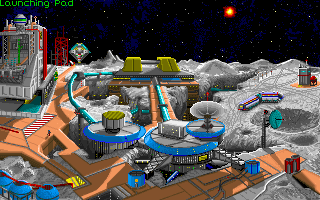
           
Luna Base and its various buildings.
         
The crew consists of four fixed characters. The pilot is William Robert Dean from Tulsa, Oklahoma. Osai Lin Tsakafuchi from Tokyo is the ship's physician and chief scientist. Engineering duties are handled by Nelson T. Ngatadatu of Babaishanda, New Gwelo (a fictional place, but "Gwelo" is a place name in Zimbabwe). The combat specialist (both ground and flight) is Katya A. Mershova from Muntenia, Romania. Each character occupies one of the ship's four stations, some doing double duty if anyone dies. Each character has fixed attributes in body, intelligence, agility, and luck, as well as fixed skills like "Leadership," "Light Weapons," "First Aid," and "Computers." I don't know whether these attributes or skills are capable of developing, but I don't see any sign that they are.
             
Attributes for my engineer.
         
Each character has a personal inventory, drawn from the supplies on Luna Base or found in the galaxy. The first thing I did was give them all flak jackets and weapons.

I found the ship modification process confusing enough that I decided to save it for later and just blasted off in the default ship. Once in space, commands are organized among four "consoles": navigation, weapons, engineering, and science. For instance, to communicate with another ship, you select the "Weapons" console (counterintuitively) and then "Communicate." To heal crewmembers, you select "Science" and then "Heal Crew." There are far less than 26 commands, so I don't understand why each couldn't have its own key. However, Planet's Edge does a little better than previous games using this structure by at least allowing you to hit single keys on the submenus rather than arrowing through them. Also, a few very common commands like Navigation | Starmap and Navigation | Enter Orbit can be called from the main view with individual keys, without having to go into the stations first.
           
I couldn't make heads or tails of this screen.
           
Moving around is a combination of elements seen in Starflight and Star Control II. As you fly away from a planet, the map's scale changes to show a larger area. As you enter a star system, it changes to show a smaller area. When you've locked onto a planet, you O)rbit it, at which point you can S)can it for information or B)eam down if it's appropriate. (There's no landing craft, just a transporter.) Making things a little difficult is that the planets continually whiz around their stars, unrealistically fast, so it's tough to identify which ones you've already approached.
          
Note how the navigator turns and looks at me while waiting for my order.
       
I guess the player is kind of an invisible "fifth" crewmember. I base this on the fact that, according to his mission directives, he's expressly forbidden to beam down with the rest of the crew. Also, when you're activating the consoles in the ship, each of the crewmembers turns and looks at you, as if you're sitting in a central chair. Despite this, you don't get to name yourself or anything.

A map accompanying the game shows Earth's solar system ("Sol") at the center of a galaxy occupying coordinates from -64 to 64 on two axes. Sol is the point of convergence of eight "sectors" which grow outwards from the center like irregular pie wedges: Alnasl, Ankaq, Zaurak, Alhena, Algieba, Caroli, Izar, and Kornephoros. (Most of these are actual stars). There are a handful of systems at the fringes of the map that occupy no sector. It's not really clear at the outset of the game whether the sector designations are geographic or political. Either way, note that the names of the missing parts suggest that we'll find one part per sector.

I had a few false starts as I got used to navigation. Alpha Centauri is so close that it's easy to blow past it on your way out of the solar system. I got killed three times in a row by hostile aliens who either attacked immediately or demanded cargo I didn't have. I haven't even begun to figure out ship combat. Since you can't save in space, I kept restarting on Luna Base and having to try again.
            
Meanwhile, my crew is saying, "Oh my god! It's an alien!"
           
On the fourth try, I took things more slowly and explored the solar system before leaving it, although it appears you cannot land on any of its planets (which makes sense).
       
Mars can be scanned but not visited.
        
I then carefully made my way to Centauri. The first planet, Centauri Prime, was too inhospitable to land. The second wasn't a planet but an "alien outpost." When I scanned it for information, the computer called it the "Omegan Outpost" and said that it was a "contact point for observers who were assisting with the failed Centauri Drive experiment." I guess we know all these things because of data recovered from the crashed alien ship.
            
Orbiting Centauri Prime. It's a nice looking planet, but we can't do anything there. I was hoping we'd meet Londo.
        
The four expendable crewmembers beamed down and were immediately attacked by robots firing laser guns. Combat in the game is turn-based and like nothing that New World has developed before. It is perhaps most like Ultima VI, occurring within the main exploration window and using a targeting cursor to attack particular enemies. In fact, once combat was over, I found that regular exploration was also a lot like Ultima VI. As the leader moves, the other characters kind of organize themselves around him or her. You can switch between lead characters with the number keys (although there's no "solo mode") and do other common things like L)ook, T)alk to NPCs, and do a variety of things with inventory items. You can't manipulate the environment to the same extent as Ultima VI, and (annoyingly) you can't move on the diagonal, but nonetheless, by including this level of ground exploration and combat, New World has definitely gone a step beyond Starflight and Star Control II, even if the rest of the game seems similar.
          
Combat with robots in the outpost.
              
A door led from the surface of the planet to the interior of the "welcome station," where a friendly message invited us to browse various newscasts. As we moved from room to room, we faced several more combats, and I had to use medpacks (which we found strewn around the area) several times. We also found some better armor than we were wearing (kevlar) and some extra weapons.
           
A character inventory.
         
We ran into an android who somewhat explained the situation: the station had been attacked by unknown aggressors who stole "various tactical data about the sectors." Another android offered that the disappearance of Earth was "a tragic accident" and he encouraged us to continue our quest to find the various pieces of the Centauri Device. He specifically recommended going to Algieba Sector since "there's a part that is named after one of that sector's stars, after all."
             
But . . . Earth scientists named that part! They don't know where it really comes from!
            
Beneath a plaque labeled "Sector Izar," we saw an image of a spacecraft that looks a lot like the extraterrestrial ship that visited Earth. A recorded message was saying that "something is malfunctioning with the drive" and "the experiment may have been sabotaged." The overwhelming suggestion is that Earth's disappearance was an accident, but we still don't know what the aliens were trying to accomplish.

There were a couple of alien newscasts to watch. One suggested some kind of war developing in Sector Caroli. Another reported on a "white hole"--a kind of space volcano--forming in Sector Zaurak. Unforutnately, they were just text; they didn't show anything, so we couldn't see what type of alien they were talking about.
    
I was happy to find that you can save while on "away missions" and that you can turn off the relentless soundtrack with ALT-M. The rest of the sound effects are okay, except that when you view inventory, there's an annoying and unnecessary "ding" as you move from one inventory item to another. Scrolling through a lot of them sounds like you're demanding a bride and groom to kiss. On the positive side, every item seems to have a unique description, which I always think is cool.
            
I confess I don't understand this, though. Wouldn't the adjustment have to be on every cartridge?
        
In the final room we explored, an android gave us a key that would unlock the various "android heads" strewn around the base. There were eight heads, each offering information on one or more of the galaxy's eight sectors. Some of them were explicit about the technology and military level of these sectors, I guess suggesting a rough order of exploration. From lowest to highest, these are:
               
  • Sector Algieba, where the Algiebian Empire has a low level of technology. This is the second explicit suggestion to go there first.
  • Sector Zaurak, ruled by the "Rana Collective," which controls the resources and means of production and thus has kept development at a minimum.
  • Sector Kornephoros, settled by refugees fleeing oppressive governments in Sectors Izar and Ankaq. Their technology is mostly good, but inconsistent because it is based on scavenging.
  • Sector Caroli. The android says that at the end of something called the Grand Survey, Sector Caroli was reserved for "recreation and housing for lower tech societies." There, I'll find Oortizam Labs and the Life Gallery. The only native species is the Eldarin.
  • Sector Alhena has no government. Two races called the Evian and the Scroe are in a war for its resources, while a race called the Dhoven tries to negotiate. It is a mix of mid- and high-tech ships and weapons.
  • Sector Ankaq, ruled by a planet called Shadowside, has a high level of technology.
          
The android head's rundown on Ankaq.
        
  • Sector Izar is where Centauri and the station itself are located. The android warns against penetrating further into the sector because the OMEGA (unsure whether this is the race or the name of an organization) is capable of easily destroying everyone but the Ominar.
  • Sector Alnasl, ruled by the Ominar. Lately, they have been reporting bouts of insanity and mass violence, and other races are advised to keep away. "These developments," the head noted, "may well be connected to the disaster of the Sol Experiment."
            
If this really is an exploration order, it's too bad that the developers included it instead of encouraging the more open-exploration approach of both Starflight and Star Control II, not to mention previous New World games. Thus, I decided to defy it by heading direclty for Alnasl, one of the farthest stars in Sector Alnasl. I made it there with no problem, but when I arrived, a scaled alien told me that I was in violation of some "space conducts mandate" and refused to allow me to contact the single space station orbiting the star. I never figured out how this resolved because I had to take a break to reconcile my bank statement with Quicken, and Quicken decided it needed to update and took over my screen with its request for administrative rights, and whatever I did to make my DOSBox sessions survive such screen changes was undone when I restored the default configuration to play Planet's Edge. (In its default configuration, DOSBox always crashes for me any time anything causes a major screen change, including unplugging or plugging in an extra monitor, opening or closing the laptop, and getting a demand for administrative privileges.) Thus, when I reloaded, I was back on the Centauri outpost. I guess this is a good place to end for now.
        
If I'm "irrelevant," why don't you let me land?
         
So far, it's a decent game that evokes the best of Starflight and Star Control II, although I suspect the alien interactions are going to be less interesting and I worry that the blatantly suggested exploration order will be essentially required. I also think it's too bad that New World, which has a lot of experience in more traditional RPGs, didn't bring more of their mechanics to character development and space combat. But it's early. We'll see how it goes.

*****

Time so far: 3 hours