Friday, October 18, 2013

SwordThrust: Walked Through!

You can't really "win" SwordThrust, but here's one of my late-game characters.
   
SwordThrust
United States
CE Software (developer and publisher)
Released 1981 for Apple II
Date Started: 19 September 2013
Date Ended: 18 October 2013
Total Hours: 23
Difficulty: Moderate (3.0/5)
Final Rating: 35
Ranking at Game #402: 288/402 (72%)
   
Since I first posted about SwordThrust a month ago, I've continued to work on it and explore its scenarios. When I was unable to find any walkthroughs--or even discussions of the game--online, I decided to take this opportunity to create my own. Today, I'm semi-proud to present to you:


"Semi-proud" because I didn't quite finish it. The last scenario was too frustrating and was taking too long. I also left some mysteries in some of the first six scenarios. Nonetheless, I think the walkthrough is good for what it covers. I'm hoping someone will use it to give the game a try--and perhaps help me finish it. I want to offer it to GameFAQs, but they don't even have an entry on the game yet, and they have to approve my submission of that, apparently, before they'll allow any walkthroughs submitted for it. (Edit from 12/01/2013: They accepted my submission on the game and then my FAQ. It's available here!)

As you may recall, SwordThrust is a commercial version of Eamon: an all-text RPG that combines some of the puzzle-solving and item-finding of text adventures with RPG combat, attributes, and economy. It features a fantastically complex combat system in which weapon skill, armor weight, armor skill, the type of weapon, attributes, and luck all go into a formula that determines whether you hit, how much damage you do, and whether other things happen, like fumbles, dropped weapons, broken weapons, and critical hits.

The main hall, from which all adventures begin.
 
This combat takes place in the context of larger scenarios, or quests, in which you're usually trying to achieve an explicit goal, sometimes with difficult conditions, and of course a secondary goal of getting out of each dungeon with as much treasure as possible.

The modules varied considerably in quality, but almost all were better than the freeware Eamon modules I tried earlier this year. A quick rundown:

1. The King's Testing Ground. This introductory module was one of my favorites. It had the greatest variety of enemies, treasures, and secret areas to discover. There was no real "theme" to the scenario, but a successful adventurer gets out of the caves with Excalibur, a weapon so powerful that it will easily last her the rest of the game.

2. The Vampyre Caves. A fun but difficult adventure. You start off to slay a vampire but get captured and turned into a vampire yourself! You must pacify a benevolent god so that he'll turn you back into a human and allow you to escape from the caves.

3. The Kidnapper's Cove. A friend's son is kidnapped by bandits, and you're entrusted with the ransom money and some drugs that the boy needs within two hours or he'll die. There's supposedly a way to get out of this one without giving up the ransom, but I couldn't find it.

4. The Case of the Sultan's Pearl. While you're a guest at the sultan's palace, one of his guards is murdered and a pearl is stolen. The twist is that whomever possesses the pearl at midnight becomes the new sultan. The scenario has you searching for clues and interrogating NPCs more than fighting, although its mechanics don't allow for any complex adventure-style puzzle-solving. The funny thing is that the killer is quite close to the beginning of the game, and the game ends when you take the pearl from his body, so once you know the solution, you can just start the scenario, walk a few steps, kill the thief, take the pearl, and return victorious to the main hall.

5. The Green Plague. A plague has descended over the land. Chasing a lead, you fall into a well and wake up in a dungeon only to find that you have the plague yourself. This scenario is unique in that it awards a certain number of points depending on how many of the goals you achieve: cure yourself, destroy the source of the plague, and banish the evil god whose followers created it.

6. The Eternal Curse. You're summoned to a sorcerer's castle by an apparition of a wizard claiming he's imprisoned there and begging for release. But when you arrive, you find that all isn't quite what you expected. The scenario does a nice riff on The Picture of Dorian Gray but is otherwise mostly fighting.

Killing the boss of this scenario.
 
7. The Hall of Alchemie. This is the only one I couldn't finish. In a goofy Mission: Impossible-influenced introduction, the player is given a quest to kill a Master Alchemist and destroy his Philosopher's Stone, capable of turning any object to gold. The level is rife with alchemical ingredients, but I couldn't figure out what to do with them, and the monsters were unbelievably difficult. The hints suggest there's some way to combine or employ items of the same color against specific enemies, but I couldn't make anything work with the limited game commands.

There's some hint in this description, but I couldn't figure it out.
 
Each scenario was originally sold separately. I'm not sure why they stopped at 7, but I suspect they just weren't selling very well. The final scenario is unique in that it was the only one not written by Donald Brown. The game's documentation says that the author, Peter Wityk, sent it to CE Software with a note that it was "the most difficult dungeon ever created." For 1981 or 1982, this may have indeed been true. I suspect Wityk based the geography on a real location, perhaps a university, given the careful layout of the rooms and their detailed descriptions (which seem to have a number of in-jokes). [Later edit: I was wrong about this; see the end.]

I'm going to have a later posting on the process of creating the walkthrough, because I finally had a chance to correspond at length with the King of RPG Walkthroughs, Andrew Schultz. He offered a lot of insights as to the process of making them. I'm synthesizing my interview with him with my own experiences. Look for that in a few weeks. [Ed. Don't look for it; I never wrote it.]

For now, let's GIMLET SwordThrust and close it off my list.

  • 3 points for the game world. There's no consistency to the land of Dirula. It uncomfortably blends Asian, European, and Arabian tropes willy-nilly and doesn't tie its scenarios into any broader themes or a common mythology. But within the modules, there is some thematic consistency and all of the areas are described in vivid prose.
  • 4 points for character creation and development. The creation process is mostly just name and sex, after which the three core attributes are rolled randomly. Characters with wildly varying attributes face very different games, especially at the beginning, which introduces a nice challenge. The development process is quite satisfying, with weapon and armor skills potentially increasing in every combat. (There are otherwise no experience points or leveling). There is even one place where sex makes a difference, although not to any significant degree.

Specifically, it's here: only female PCs can enter the ladies' room. (Yes, Chester is a female. No, I don't know how that happened.) That doesn't explain why my NPC, "Jim," can enter, though.

  • 3 points for NPC interaction. It's fun how certain NPCs can join you and fight by your side, and other creatures and characters react differently based on charisma. In one module, the ability to talk to NPCs (usually not present) is key to the solution. Nonetheless, most of the time there's no way to interact with NPCs except to smile at them.
  • 4 points for encounters and foes. There are a lot of different enemies to face, from evil humans to giant spiders to a dragon, and the game has some fun by giving them the same stats and skills as the PC (they can even increase their skills, just like the PC, with successful actions).  They have some limited AI, and they'll run from combat if seriously wounded. Beyond that, though, the enemies are not well-differentiated. They don't do anything but attack--no spells or special attacks. What I like are several areas in which you can choose to defeat an enemy by either solving a puzzle or just wailing on it with a sword. Enemies "respawn" in the sense that you can try the same scenario multiple times, and there are some clear grinding opportunities in some of them.
  • 3 points for magic and combat. Most of the points go to the complex formulas that make combat nail-biting. You don't really have many actual actions in combat (attack, cast, flee). There are 10 spells, each requiring a certain portion of the caster's fatigue, but I found them almost all worthless except "Heal." Since they have a good chance of failing, and since they can easily exhaust you, leaving you unconscious, they're often more dangerous to the PC than to the foe.

I could not get past this enemy in the final scenario.

  • 3 points for equipment. You're limited to a weapon, armor, and a shield, and if you find any during an adventure, you can't see their related statistics until you return to the Main Hall. Although it was a nice reward, it was too bad that I never found a weapon that outperformed the one I discovered in the first scenario. There are a small number of potions and potion-like items, such as underwater breathing pills. The greater portion of the items you find are either to solve puzzles or treasures, and the game does an okay job within its limited mechanics allowing you to use the items in various ways, from destroying an evil rock by dropping it under water to "rubbing" a tube of vanishing cream on difficult foes.
  • 3 points for economy. A key element of the game is in finding treasures in each of the scenarios, which are automatically cashed in when you return to the Main Hall. You use the proceeds to buy weapons and armor, spells, and training. But the weapons and armor are outclassed by what you find in the scenarios, and as I covered above, I don't think the spells are very useful. The only really good thing you can do with thousands of gold pieces is get some training in various weapons.
  • 5 points for quests. You can regard them as 7 main quests or 7 side quests, but in general, they're varied and fun. I like the mix of conditions, goals, and constraints that the quests offer, and almost all of them have some limited choices that affect the ending, allowing for some limited roleplaying.

Each quest begins with a detailed back story.

  • 2 points for graphics, sound, and inputs. There are no graphics or sound. While the text-based inputs are relatively easy and intuitive, and there's a nice feature that allows you to just hit ENTER to repeat the previous command, I ultimately found the list of available verbs a bit too limiting. The game is also needlessly specific in its nouns, treating you like an idiot if you type GET BATTLE AXE instead of GET STEEL BATTLE AXE.
  • 5 points for gameplay. The seven modules can be attempted in any order, and 2-6 are all pitched at about the same level of difficulty, so there isn't an "obvious" order. The scenarios themselves aren't large enough to be linear or nonlinear, but you can attempt them multiple times and try different options, giving them a decent sense of replayability. With the exception of the final scenario, they're all brisk and challenging but not frustratingly so. In writing my walkthrough, I took about 2.5 hours to complete each one; someone just playing could do it less that two hours. This wouldn't have made me happy if I'd spent $29.95 on each scenario, but it's a good pace for today.

This gives a final score of 35, quite good for a 1981 game series. I hope a few of you are inspired to check out some of the scenarios, read my walkthrough, and give it a try. See if you can do what I didn't, and complete the final scenario!

This kind of game is the spiritual ancestor of the persistent-hero multi-module games we see today, like Neverwinter Nights, and it's too bad that it's not better-remembered. (Granted, Eamon, its predecessor, still thrives.) I couldn't find anything like a walkthrough, summary, or message board on SwordThrust or any of its modules, which isn't a fate that the game deserves.

My next couple of weeks are still going to be very busy, and postings intermittent, but let's see if I can finish Wizardry VI.

*****

Later edit:  Not 10 minutes after I posted this, Peter Wityk called me. I had left a message for several people of that name, hoping to find the right one (I really wanted to win the last scenario). We had a very informative, friendly conversation. Peter indicated he knew Don Brown when he decided to create the Halls of Alchemie scenario, but he otherwise never worked on another game (his career took him into the finance field).

Unfortunately, he didn't remember enough about the scenario--now 32 years old--to help me successfully navigate it, except that one particularly deadly enemy (a giant black scorpion) couldn't be killed through normal means. He also said that despite my assumption, he did not base the Halls on any real location. He mapped it out on paper with the intention of creating a geography that felt real and offered challenges to the player that were different from the rest of the SwordThrust scenarios. He certainly succeeded at that!

Monday, October 14, 2013

Wizardry VI: King of the Mountain

Fighting the Gryns brothers at the top of a mountain, which suspiciously looks just like the inside of a castle.

For a while, I thought that the entirety of Wizardry VI might take place in the confines of the castle. Yes, I'd heard in various places that the game takes "200+ hours," but I've learned to regard such estimations with skepticism, or at least inflated by all of the hardware and software headaches that early players had to endure. When booting the game takes 10 minutes, reloading means swapping disks, and maps have to be made by hand on graph paper, that really pads the time. So I hear something like "200 hours" and I figure subtract 40% for publisher's hyperbole, cut the remainder in half to account for today's better efficiency, subtract a third of whatever's left given that--let's face it--I'm a pretty experienced player, and you've got basically a 40-hour game. 

Thus, when the 20-hour mark came into view, my characters were 2/3 of the way to their max levels, and I was still messing around with castle doors, I figured this was how it was going to play. It wasn't a crazy idea. The castle consists of about 1,500 squares, or roughly half the size of the first Wizardry. The developers had done a pretty good job making it feel nonlinear while still restricting access to certain areas until I solved certain puzzles. I had just discovered a kind-of sub-basement that promised to open up into a larger area. And, after all, the manual's back story didn't promise anything but the castle.

So I was surprised when I followed a route in the castle's dungeon that led me into an enormous area fully of twisty passages and at least four levels of mines with several dozen up and down stairs. It was then, just for curiosity's sake, that I rapidly flipped through the pages of the hint guide JJ sent me--not to look up any spoilers, but just to get a sense of the scope of the game--and I saw like a dozen more large maps. I guess my estimation was a little optimistic.

The game had me follow these mysterious "black women" to the new location, but then I never heard from them again.
The remainder of the castle had very much the feel of an adventure game in which a solved puzzle led to an item that allowed me to solve another puzzle, and so on, all the way to the castle's exit. In reverse order:

1. To get out of the castle dungeon, I had to cross a chasm with a rope and hook.


2. The rope was only available from a locked room in the castle belfry, the key for which was found in a secluded part of the basement.


3. To get into the secluded part of the basement, I needed to go down some stairs that were behind a locked grate on the castle's main floor.

4. To get the grate to open, I needed to perform a ritual at an altar in the living chambers involving something called the "Book of Ramm."


5. To get to the Book of Ramm, I needed to open a door and solve a puzzle in the castle's lowest level. The door only opened with a gold key.

6. The gold key was in a hidden area near the king's bedchambers.


I had to follow a similar flowchart to get the hook for the rope & hook, involving translating a diary with a decoder ring to find out where the Captain buried his treasure (Giant Mountain), give the location to Queequeg for the password to the Captain's Den, and enter the Captain's Den to find the corpse of a pirate with a hooked hand.

"Giant Mountain" is the mountain right outside the castle so, yes, I guess you should have known.

The culmination of all the effort was to find myself in the new area: a land full of chasms in which I had to thread my way carefully lest I fall to my death (which I did repeatedly by just mashing the wrong key).

In real life, I think it would be hard for six people to "accidentally" walk into a chasm.

This area was dominated by a mountain in the center and a series of "mine" entrances on the east side. The mines are multi-leveled, they feature several areas of darkness that you have to map by bumping into walls, and they're connected by a series of maze-like stairways that took me a long time to map. At the bottom of the mine, a wizard is imprisoned in some kind of giant diamond, and the manifest goal of the area seems to be to get him out, though I apparently don't have all the tools for this yet.

One major puzzle here involves the repair of a catapult, which I needed to block a pit so I could proceed to one side of the mountain. To do this, I had to collect several rubber strands from "rubber beasts" in various mine rooms and use the "merge" option in the inventory screen to braid them together into a rubber band. (I'm not sure the author of the game understands how catapults really work.)

"Merging" items in inventory. Two merged strands make a braid, two merged braids make a band.

I also needed to take a broken sprocket to a smith, found in one of the mine rooms, and have him repair it. Finally, I had to scale one side of the mountain (an annoying process because each climb carries the risk of falling for heavy damage) and slay a mountain giant to collect his boulders.

Funny how the "face of the mountain" looks just like a brick wall.

Throughout this process, the game has occasionally provided a role-playing choice. When entering the Captain's Den, I had the option to challenge the rogue leader to a drinking contest or just attack him, and in the mountain area, I had the option to pay a troll to cross his bridge or just kill him. I fear that I chose violence in both cases. The game hasn't been full of these types of encounters, but they're welcome when they happen.

In real life, I would have taken him up on it, but in this case, my party is all women.

"I yare?" How do you not kill this guy?

The game continues its dedication to vivid textual descriptions of the areas, which almost but not quite makes up for its lack of any variance in the graphics. I mean, the graphics in the Gold Box games are sparse, but at least they try to simulate different textures appropriate to the areas. This one has the same brick walls whether you're supposed to be looking at a castle, cavern, mine, or mountain. In this sense, the game is hardly more advanced than the wireframe graphics in the first five Wizardry games.


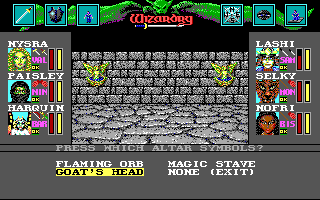
Goats or rams have emerged as a major theme. I found several artifacts "of Ramm" in the castle, the altar ritual involved goat symbology, I found a goat head's mask in a treasure chest (it seems to drain my hit points, so I just put it in a sack), and I hear bleating behind a door I can't enter. As a little side note, until I was about 30 years old, I thought that goats were male sheep. In my defense, you always see them together and they kind of make the same noises. Yes, I'd heard of "rams" and yes, I'd heard of "goat's milk," but I thought they were different names for the same things, like bulls and steers and oxen and whatnot. Irene and I were at a state fair when I said something that made my ignorance apparent, and she explained things after a good laugh. Anyway, I finally have it straight, so this game needs to get its act together on whether it wants to use ram or goat symbology because it's screwing me up again.

A goat's head mask and a "Dagger of Ramm" in the same chest. Make up your damned mind!

There are some other bits of lore that suggest the game might be developing a story. The logbook that described the location of the Captain's buried treasure also had a long account of a party's demise on Giant Mountain, describing the giants but also "dwarf men" who were building the mines and "digging for something" (my guess is the trapped wizard). I've encountered the dwarf men, and they're not friendly. I assume the wizard is either the king or his ally who disappeared more than a century ago while fighting over the Cosmic Forge. I like the idea that a narrative might be building here; I hope the game doesn't disappoint me.

A bit from the logbook. I don't know if this heralds things to come.

In this last session, I've encountered far more trapped chests than before. The game's system for handling traps is reasonably interesting and fun. Just like the first five games, the traps can consist of poison needles, noxious gas clouds, prismatic sprays, and so forth. When you "examine" the trap, it doesn't tell you what the trap is; instead, it gives you a few letters of the trap's name. You have to use those letters to deduce the name. So if it says "ON" on inspection, it could be a "poison needle," but it could also be a "noxious gas cloud." If it says "NOX," then you're certain to pick the right one when you go to disarm.


The letters are basically the game's way of simulating the process of examining a trap and trying to figure out its nature from its "components." It's a fun and innovative way to do it. I just wish my bard was better at it. I've jacked her "skullduggery" score (which covers lockpicking and trap disarming) up to around 40, but she still typically identifies two or three letters at best. I set off as many traps as I disarm.

I also wanted to mention the game's secret doors. Unlike the previous installments in the series--or, really, almost every other dungeon crawler--you don't have to go bashing headfirst into every wall surrounding an unmapped square. There are secret doors, but they don't work that way. Instead, you open them by finding a button to press, or through some kind of puzzle-solving, like using a miner's pick on a recently-built wall. The "scout" skill occasionally clues you in to the presence of such puzzles.

Good thing I found a shovel nearby.

In playing games like this, my normal strategy is to map as far as I can go in a particular direction. Then, if a locked door or puzzle defeats me, I mark it on the map with a yellow square, head back, and try a different direction. Almost inevitably, I'll collect some item (like a key) that will cause me to return to the yellow square, solve the puzzle or open the door, and move onward. I figure as long as I still have open paths, I'm doing all right. But I start to get nervous when I leave too many yellow squares too far behind me, and in my case a couple of them are back at the castle. Here's my full list right now:

  • In the castle's main hall, the portcullis leading back out the way I originally came in. I assume that it's just closed permanently until the end of the game.
  • There's a stairway from the main hall of the castle that takes me up to a small corridor ending at a locked door. Behind the door, I can hear bleating. I don't have a key for this door.

Goats bleat, right? Goats?

  • In the dungeon level of the castle, there's another stairway that goes up to a locked, grated door. (For those who really care, the stairway is about five squares to the east of a room where searching some bones produces an undead enemy who laughs at you. It's exactly two squares north of another stairway that goes to the main hall.)
  • On the lowest level of the castle, consisting of a long corridor, there are two doors I can't open: one grated door (the first you come to), and a door at the end with a mask on it that seems to want a pair of jewels.

The obvious thing would be to find the jewels, but I haven't encountered any yet.

  • I found the "king's journal" in the castle, but it's encrypted and I haven't found any way to decode it.
  • Near the mountain, there's something that says "drawbridge control panel," but I can't open it because it's rusty.
  • On the first mine level, there are two locked, grated doors beyond one of the areas of darkness. They don't open with the only key I've discovered here (the "Key of A Miner"), which seems to open all the other doors I've found.
  • The wizard trapped in the prism. A "miner's chisel" seems to have some effect on the prism, but not enough to destroy it completely. 


  • At the top of the mountain--the area that I went through all the trouble to fix the catapult to access--is the "Guardian of the Rock." He takes one of my boulders and happily munches it and lets me talk to him, but he won't contribute anything useful and if I tell him I'm there to "take the rock," he engages me in combat and absolutely slaughters me.

Calm down, bro. No one said you weren't.

If any of these locations seem like something I should have been able to get past based on my location in the game, a very light hint would be appreciated. But I'm not in any way "stuck"; there's still an entire area of the caverns, labeled "Wizard's Cave," I've yet to explore, as well as some stray passages near the mountain.

My current map of the mountain area.

As I close, all of my characters are Level 8, and development has slowed considerably. I can understand why people start looking forward to changing classes. 

The next post will be my big combat and magic review, but due to some business, I might not be able to play again until late in the week. In the meantime, if I can find time to clean it up, you'll get a post on another old game.


Saturday, October 12, 2013

Wizardry VI: I Capture the Castle

I was apparently wrong that this game gives no credit to the developers of the series.

Both Wizardry and Dungeon Master pioneered the dungeon crawl, but both suffer from a certain feeling of artificiality. Their dungeons are abstractions rather than real places: perfectly symmetrical, impossibly deep into the earth, with layouts that would make little sense even if it was possible to build them. Even the Gold Box games, which do a great job with world-building, have dungeons that feel overly constructed and unrealistic in their perfect 16 x 16 layouts.

Wizardry VI bucks this trend by offering an indoor area (at least during the opening) that feels like the ruins of a real place. The castle is of sensible size, with particular rooms—throne room, guard rooms, kitchen—in sensible locations. It has four small turrets in the corners, a barracks for the guards, and a belfry.

The first two options seem to produce endless encounters with bats, which I suppose is good for grinding.

We're still in the area of graphical minimalism, so we don't actually see the belfry rope or bell, the armory dummy, or the piles of rotted barrels. But the developers have made the castle come alive with solid in-game textual descriptions, at least as good as in the Gold Box games (and without requiring an external document). And while some of the puzzles and NPCs I've encountered have been a little silly, I was remembering Wizardry V and bracing myself for characters like the Duck of Sparks and Lord Hienmitey, so in that sense just a "little" silly is a significant improvement.

A few examples of the game's welcome area descriptions:


The game started me with a vague goal—go into the abandoned castle and see what's what—and hasn't gotten any clearer, though the unstated goal in this phase simply seems to be finding ways to open up areas and continue exploring. At this point, I've mapped about a dozen closed and locked metal doors that require some key or switch to circumvent.

My worst enemy.

Most of the foes in the castle have been vermin, including giant rats, bats, and hostile vines, but there are some inhabitants, too. There appears to be some kind of thieves' guild in the basement that's looking for a password to enter. A nearby NPC named Queequeg says he has the password, but he'll only reveal it if I give him the location of some buried treasure, which I  haven't yet found.

Queequeg, who hangs out in a dilapidated barracks, introduced me to the game's approach to NPCs. I've only encountered two so far, but both were capable of both conversation and trading. The conversations are similar to the system introduced in Wizardry V, by which you can type full sentences. The manual warns you to actually type full sentences and not just keywords, and even to make sure to put a question mark at the end of questions, but I haven't really noticed any difference between typing WHAT IS THE PASSWORD? and PASSWORD. Nonetheless, in the spirit of role-playing, I've been trying to pretend I'm having actual conversations. Here's one with Queequeg after I'd explored a bit of the dungeon.


M: Hello
Q: How may I be of service?
M: Do you have anything to trade?
Q: Possibly...
M: What do you have?
Q: What are you looking for?
M: Weapons, mostly.
Q: You can find items in the dungeon.
M: What dungeon?
Q: Bane of the Cosmic Forge
M: What is this "Captain's Den?"
Q: The local seedy hangout of ill-repute!
M: Who is the Captain?
Q: A rather ominous fellow.
M: Ominous in what way?
Q: I don't know about that.
M: Do you know the password?
Q: I'll tell you the password, but first I need information.
M: What kind of information?
Q: Where did the captain bury his treasure chest?
M: How am I supposed to know?
Q: No buried treasure, no password!
M: Tell me more about the chest.
Q: The captain buried a treasure chest somewhere far away!
M: I need a drink.
Q: Find a fountain.
M: You're a jerk.
Q: That's your opinion.
M: Bye

I'm not saying it passes the Turing Test, but it's pretty good. For fun, I decided to repeat the same conversation with Cleverbot, the latest in conversation-based artificial intelligence, and I got this.

M: Hello
C: How are you?
M: Do you have anything to trade?
C: I wonder if simon larsson likes me.
M: What is the "Captain's Den"?
C: An exam to get into grad school, but that is not what I am taking.
M: Do you know the password?
C:  To what?
M: To the Captain's Den.
C: You are not making sense.
M: Oh, and like you are.
C: Fair enough.

Queequeg also had a little store with him, and I bought some armor upgrades, though I didn't have quite enough money for his potions or magic items. As numerous commenters have noted, NPC inventories reset with every new conversation.


I'm still getting a handle on equipment. Armor is easy to figure out, since "assaying" it while in inventory tells you its protective value. Weapons don't automatically tell you their damage; I understand this comes later with the "identify" spell. The process of trading items among characters (or even switching from character to character) is a bit annoying, and there's an exhausting set of rules about which races, classes, and sexes can handle which equipment, some of them a little inconsistent. My Faerie bard, for instance, couldn't wear the cloth pants and shirt that she started with. I assumed that, being a tiny little thing, she couldn't wear regular armor or clothes, and was thus surprised when she was later able to wear a suede doublet and pants.

Nysra views her sword and its capabilities. Only fighters, valkyries, and lords can wield it.

I've found only a handful of magic items so far: a Sword of Striking, which I gave to my valkyrie; some kind of enchanted shield that disappeared after I "invoked" it (this "invoking" thing first appeared in Wizardry IV, I think, and I still have no idea what it's about), and an Amulet of Life that casts resurrection.

One nice addition to this series is the appearance of "extended" melee weapons—polearms and other weapons that allow characters to attack from the rear three positions. Between those and some missile weapons, all of my characters are able to attack in a combat round, which is particularly nice when you have an easy group of foes and just want to tear through the combat options. Another good addition is the ability to dual-wield certain weapons, giving an extra attack each round.

Most groups of foes stopped being easy after the main castle level. I was losing a character or two in about one-third of my combats for the first few hours of the game, a situation that—although against the spirit of my rules—generally caused me to reload because I didn't have any resurrection alternatives (and it doesn't appear that you can replace party members once you're already in the dungeon) [Later edit: I'm wrong about this. I just missed an option]. The best thing keeping me alive was the bard's instrument-playing ability, which puts groups of enemies to sleep.


My survival ratio improved as I went up a few levels, especially once several of my characters got "Heal Wounds."

The screen that comes up after full character death.

Leveling in the game is an interesting process. As soon as you cross the threshold, you're jerked to a screen in which the game automatically levels you up. The character's attribute scores increase by a few points (randomly, it seems), and sometimes you get points to assign to skills. Whether you get any points, and how many you get, seem to be random. A couple of times, I didn't save after leveling, had to reload, leveled again, and got completely different results. Finally, for spellcasters you get to choose a new spell. As I write this, my characters are all Level 4 or 5.

Assigning skills while leveling up.

Some of the skills (like weapons skills) improve with use, so I've been avoiding wasting leveling points on those. Others, like spellcasting skills, only seem to increase when you assign points to them. I'm going to save a detailed discussion for skills and spellcasting for a later post, after I understand a little more about it. Suffice to say for now that there are six magic "categories" (fire, water, air, earth, mental, and magic), each of which has different spells depending on the "book" used by the caster (mage, priest, alchemy, or psionics). The "spell slot" system used by previous Wizardries is gone. Each caster has a different number of spellpoints assigned to each "book," which increase with each character level, but only after the caster has at least one spell in that book. When you cast a spell, you can choose how many points to put into it (above a certain minimum). Points regenerate over time or by resting.

My gameplay experience has mostly centered around mapping and trying to solve a few puzzles that would get me into new areas. I still don't have the password to the Captain's Den, nor any intel on where he buried his treasure, but I haven't mapped all of the castle's upper level yet. On the lower level, there was an interesting puzzle by which I had to use a block of rotten cheese at a mouse hole, causing an army of rats to blow through the wall and open up a secret passage. (Incidentally, this was the most difficult combat in the game so far. There was one giant rat that hit me multiple times per round and just wouldn't die.)

Each of the four turrets had some kind of special encounter and rewarded me with a (textual) view of something in the distance. Walking off the edge was deadly.


In a jail cell, I found an old logbook with coded scribbles, but I don't seem to have any way to decipher it. I don't know if it has anything to do with the location of the Captain's treasure, but I suspect it does.


A roomful of graffiti indicated that someone named L'Montes was looking for "Snoopcheri." When I asked Queequeg about it, it transpired that L'Montes was a mentally disturbed man who lost his "beloved" and had holed himself up in one of the turrets. I had previously found him there, but he wouldn't open the door and I wasn't sure what to do. When I returned and asked him about Snoopcheri, he asked me to find her. I intuited that "Snoopcheri" was actually a stuffed dog that I'd found somewhere else, gave it to him, and was rewarded with a key in return. Now I need to try the key on all the locked doors I've mapped.


A few miscellaneous notes:

  • The game only offers one save slot, which seems limiting, except in comparison to the permadeath of the previous entries in the series.
  • You can "rest" repeatedly to restore stamina, magic points, and health (though the latter regenerates very slowly). I don't know if there's any disadvantage to resting except that enemies can attack you. I'm not sure if characters age.
  • The game has an annoying copy protection system by which you have to match three runes to a long list and find an associated codeword. It's even more annoying because I bought this one, as part of the Ultimate Wizardry Archives back in 2010, and yet it didn't come with the documentation to enter the right code. I had to download that from an abandonware site like a criminal.

The icons on the screen don't exactly look like the ones in the book, either.

  • I find the sound in the game simply unendurable. An anonymous commenter clued me in that the game's use of Sound Blaster was "nonstandard," and that the PC Speaker option is better, and he's right, but "better" doesn't mean "good." Although the combat and door sounds are okay, they're not worth the godawful racket that accompanies the appearance of every NPC or enemy. I'm playing silent.
  • I still think the keyboard is the best way to navigate the game's options, but the game wasn't really designed for the keyboard. None of the lettered, numbered, or function keys do anything. Instead, you hit ENTER to bring up the menu and then use the directional keys to move around the menus. It would have been a lot nicer if, say, the function keys had brought up each character view, or some key like "L" took you right to the lockpicking screen.
  • At first, I thought the lockpicking screen was a mini-game, where you watched for all green values on the tumblers and then hit ENTER. Now I think the colors probably moved too fast even with era-specific hardware, and there's really no way to "time" when you hit the ENTER key.

It was worth a try.

So far, I'm enjoying the game quite a bit. Its liberal saving and reloading system lacks the first game's nail-biting tactical tension, but it makes up for that with (so far) a good NPC system, equipment system, economy, and—most important—interesting game world. I'm not exactly sure where it's going to take me next, as I seem to have explored most of the castle and I know there's still a lot of game left to play, but I look forward to it.

*****
 
 
Next Wizardry VI entry         
 
04/13/2026 

Thursday, October 10, 2013

Game 120: Wizardry VI: Bane of the Cosmic Forge


I don't know if the definitive history of Sir-Tech has ever been written, but it must make for an interesting drama. From what we can see on the surface:

  • In 1981, Robert Woodhead and Andrew Greenberg wrote Wizardry: Proving Grounds of the Mad Overlord by building upon Oubliette from the PLATO system. As we recently discussed, they appear not to have acknowledged any debt to Oubliette specifically, despite adapting elements of it wholesale.
  • For the next seven years, they kept making basically the same game.
  • David W. Bradley joined the team in 1988 for Wizardry V, the same year that Woodhead departed the company for Japan.
  • Andrew Greenberg left the company sometime after 1988 and later sued Sir-Tech for breach of contract, tying up so much of the company's resources that (at least according to Sir-Tech) it delayed publication of Wizardry VII.
  • Bradley is listed--repeatedly--as the sole designer on Wizardry VI and the game--sorry, fantasy role-playing simulation--radically changes the interface and game elements.
  • For their work in creating the series, the Wizardry VI documentation gives Greenberg and Woodhead the same acknowledgement that they gave Jim Schwaiger and Oubliette: none.

I'm not entirely sure who was responsible for Wizardry VI. Can anyone help?

In my post on Windwalker, I made fun of developer Greg Paul Malone's constant presence in the game materials, and I have to do the same here with David Bradley. His byline is on nearly every page or screen that mentions the game. There's a full dedication page to his mother. But even with that, I was going to leave it alone. So what? I thought. He's proud of the game. He should be. There's no reason an "author" of a game shouldn't be as proud as the author of a book.

Then one of my readers, JJ, mailed me the game's hint guide. Oh, my.

Did anyone tell David that the 90s had begun?

The guide begins with a little chronicle of David Bradley's arrival at Sir-Tech, insisting that he began programming Wizardry V back in the early 1980s, long before his employment at the company, thus completely hand-waving the fact that Wizardry V was almost entirely based on the programming that had gone into Wizardry I-IV. Seriously, check it out. After discussing the founding of Sir-Tech and the publication of the first few games, the guide, using glorious malapropisms, says:

At the same time and on opposite ends of the United States, David W. Bradley had begun to program what would become Wizardry V: Heart of the Malestrom. [Huh? He was in two places at once?] Being a fan of fantasy role playing and computers, David naturally mixed the two. [It was about time someone did!] In the office where he worked, the game passed from disk to disk and person to person. People who were supposed to be typing memos, planning corporate stratums [that's honestly the word it uses] and comparing financial sheets, were instead trouncing through dungeons [it really says that, too], battling dragons and collecting gold pieces. In 1984, David contacted Sir-Tech Software about his program, then called "Dragon's Breath" [given what Wizardry V ultimately looked like, one wonders why]. In just a few weeks, the game was a hit with Sir-Tech's office staff, too. Norm and Rob Sirotek decided it was just too good to pass on, and so set the production wheels in motion. After its release in 1988, Wizardry V won several gaming awards and increased the series' fame to even higher levels. And that's when it happened--David threw the entire system out the door on its ear.

Am I missing something? Wizardry V was basically the same game as Wizardry I-III, right? Same structure, same combat system, same spells, even the same names for the stores on the castle level. Is Bradley really claiming credit for developing it (let alone the CRPG genre in general)? Either he was passing around a completely different game to his co-workers who were supposed to be "planning corporate stratums" (pity those in the lowest caste) or he was passing around a game that plagiarized Wizardry. Either way, this little retconned history is mind-boggling.


But the centerpiece of the hint guide--remember, this is supposed to be a hint guide--is a four-page Q&A with Bradley that reads exactly like a Q&A that someone fantasized for himself while sitting in traffic. The guide's author is given as Brenda Garno, but I have trouble believing that Bradley didn't write both the "Q" and "A" part himself. Among such questions as "How did you become interested in computer programming?" and "What's a typical day while you're in the middle of game design?" and "Once you had finished Bane of the Cosmic Forge, did it turn out to be bigger than you had imagined?," we get this gem of an exchange:

Q: You know, I still remember you saying, "Bane of the Cosmic Larva."
A: I did not say "Bane of the Cosmic Larva."

Q: Yes, you did.
A: Unless we were joking around.

Q: We were going through the dictionary and you were saying "Bane of the Cosmic..." whatever. You were picking out all these names. Eventually, you came out with "Bane of the Cosmic Larva."

No "A" appears to that last "Q," so I guess the facts behind this shocking anecdote will have to remain unknown.

Thus, with a little help from interviewer and subject (all the quotes below, gods' truth, come from the hint guide), let's begin exploring this game.

Q: How did you get the idea for Bane's plot?
A: In a flash. Literally, just like that. Everything that I had thought of, all of my characters and sub-plots, fell into place.

The short back story tells of a thoroughly debauched king (a wizard) and queen. The king and one of his evil wizard allies waged war on all the "evil planes." During one of these wars, after the defeat of an arch-demon ruler, they discovered the "Cosmic Forge," a magical pen with which the wielder could write things into existence. With it, they "began to script such horrors for the universe that no man has since imagined." Ultimately, the two allies had a falling out, went to war, and were never heard from again. (This, of course, sounds absolutely nothing like the story of Trebor, Werdna, and the magic amulet.) Over a century later, the party of six adventurers kicks open the dusty doors to the castle...

Q: If you had to create a David Bradley to go pouncing [yes, "pouncing"] through the dungeon, what type of character would he be?
A: Well, actually, I am in Bane, but I'm all of the other creatures in the game. But just a single character? How about a Samurai scientist.

In addition to the humans, elves, dwarves, gnomes, and hobbits that have been with us since the beginning, Wizardry VI introduces six new races, all magical or bestial: Faeries, Lizardmen, Dracons (sort-of like Draconians from Krynn), Rawulfs (canine humanoids), Mooks (look like Wookies from Star Wars), and Felpurrs (cat people). I'm trying to guess how long it took to come up with "Felpurr" and whether it's any more or less lazy than "Katta."

The pre-game menu.

For classes, the game retains fighters, mages, priests, thieves, samurai, lords, bishops, and ninjas from its predecessors, then introduces rangers, bards, alchemists, psionics, valkyries, and monks. Alchemists and psionics have different spellbooks than mages and priests, and all classes come with a variety of special abilities and equipment.

I decided to try some new things with my party, partly based on some advice I've received in the last few posts, and partly just for fun. The party favors the new races and classes, has no male characters, and has no pure spellcasters. Bragging rights for the first person to figure out the theme.

  • Nysra, a Dwarf valkyrie
  • Selky, a Felpurr monk
  • Lashi, a Mook samurai
  • Paisley, a Dracon ninja
  • Harquin, a Faerie bard
  • Nofri, an Elf bishop

All of the characters have some spellcasting ability, and among the party members, I have access to all the spellbooks, but because none of them are pure, I'll gain spell levels very slowly. We'll see how it works out.

Creating this party, I should mention, took a number of hours. I don't love the character creation process, mostly because there's no way to cancel or back out of it if you realize you're getting a bad character. You have to finish creating her and then decline to keep her.

Q: How did you become interested in computer programming?
A: I didn't become interested. It was an accident and then I got addicted. Now I can't kick the habit. I sat down in front of a computer and started typing some stuff. And I haven't stopped yet.

Once you set the name, race, and sex, the game presents the standard attribute scores and gives you a pool of "bonus" points, ranging from around 5 to 18, and then lets you choose your class. Each class has a minimum for various attributes, and if the bonus points plus the default race/sex scores aren't enough, that class isn't available. If the class is available, and you choose it, the game automatically allocates your bonus points towards the class minimums, then lets you spend whatever is left over.

Some classes, like the ninja, essentially require the maximum number of bonus points, so it took dozens of "false starts" before I was able to create the character.

Creating a character. I needed a bonus roll this high to make the character a monk.

Character creation also involves the allocation of skill points--a first for the series--which I admit had me lost. There are ten weapon skills, six "physical" skills (including scouting, music, ninjutsu, and lockpicking), and eight "academia" skills (mostly magic). Some of them apparently increase with use, but others must have points allocated to them to increase. I did the best I could, putting a few of my monk's points into scouting and a few of my bard's points into lockpicking.

Finally, there's a "Karma" score, which the manual describes as a combination of luck and morality. I'm not sure how it affects gameplay. My random rolls include both high and low values, which the manual suggests is a good thing.

This game is one of the few of the era that allows you to choose your character portrait. There were some odd choices, and it didn't appear to me that Mooks and Dracons had any options (at least, none that looked like their portraits in the manual).

Equipping my starting items.

After I had the six characters rolled, I started the game and began exploring the castle. There's no "town" to visit as in the previous games, nor any long process of buying initial equipment. Instead, you simply begin with default equipment. There must be places to buy things later, because you do find gold at the end of combat.

My map so far of Level 1.

The first floor seems appropriately castle-shaped, with at least nine stairways up and seven stairways down. I say "at least," because there are six doors that I'm unable to open. This seems to be a consequence of choosing a party without a thief and in which no character has particularly high strength. No one can force or pick the locks, and if I try too hard, they "jam," which the manual suggests is bad. I think I'll keep playing and see if I can return to the doors when I have the "knock-knock" spell or a higher lockpicking skill level.

Lockpicking involves a little mini-game where you wait for green bars to appear above all tumblers and hit ENTER at the right moment.

There was one gate that, Dungeon Master-style, required pushing a button on a nearby wall, but I couldn't find a way to open a gate beyond that. Two chests held various potions and magic items, along with some cryptic messages.


I've fought half a dozen random combats against things like vines, rats, and bats. I'm going to hold off describing it until I have a better handle on it, except to say that it's a clear evolution from the previous games in the series. Each character has various attack, defense, and magic options every round, and you "line up" your attacks before executing them all at once. So far, the foes haven't been difficult at all--a big change from the first five titles, which throw you relentlessly into danger in the first hallway.


Q: Before Bane hit the market and all the positive feedback came, what were your initial instincts telling you about it?
A: Ah, you never know. I knew it was going to be a good game, I knew the story and all that went with it, and I loved it. I generally do stuff where it all feels right. But still, you never know.

So far, the graphics and sound seem okay. The sound, while supporting Sound Blaster, either has weird artifacts (intermittent static, pounding) or is supposed to be alerting me to nearby creatures or something. I disabled the mouse and am not having much trouble navigating with the keyboard.

A fountain in the main hall restores stamina.

I'm just getting started with this one, of course, so I can't offer much of an opinion yet. By my next post, I'll have an idea as to whether this party is going to make it. I mentioned having the physical hint guide that JJ sent, but my rules haven't really changed. I glanced at its advice for character creation, but I won't be using it for the maps or puzzles or anything. 

Let's close with some final inspirational words from DWB, which I hope inspired legions of prospective young doctors, crane operators, and jet pilots:

Q: What do you recommend to people who want to do what you're doing?
A: If you want to do something, you just do it. You'll learn all you need to know along the way.