|
| The first party didn't do so well. |
As I said in my first posting, The Dark Heart of Uukrul is "almost roguelike" in its approach to saves. You get one, and the game automatically appropriates it frequently, including after every combat, every character death, and every time something significant happens. Unless you want to cheat with frequent backups of the save folder, you've got to role-play with the punches. Death isn't exactly "permanent," though, in that upon full party death some mysterious Samaritan pays to have your lead character resurrected. If you don't want to pay for the rest, you can dump them and get a new NPC from the Adventurer's Guild--conveniently located right next door to the Mausoleum.
It turns out--and I missed this on the first pass of the manual--that you can "backup" your party every time you visit a sanctuary. If something unpleasant happens after that, you can restore the backup. Some discussion on the board last week suggested that DHoU "purists" regard this as cheating, but screw that: if the game provides it, I'm going to use it. This ends up making the game a little less like Rogue and a little more like Might & Magic, where once you reached a town, you knew your progress was safe.
I hadn't backed up my first party, but we were early enough in the game that I started over, recast my party, and made Plenamujer a little more pious this time. More on that in a bit.
Over the last couple of days, I have made my way through, and mapped, what feels like a decent part of the dungeon. The game comes with a decent automapper, which not only shows the overall contour of the dungeon but also the specific squares your characters have stepped on. You can annotate squares with letters if you want to remember key locations later. But I still find it too limiting, and it fails in certain areas of the dungeon, so I've been making my own maps. In doing so, I'm testing out a java-based Dungeon Mapper created on a whim by reader Pierce Roth. It works pretty well, with keyboard shortcuts to add walls and doors, the ability to paint dungeon squares in various colors and thus track where you've been and where you haven't, and annotation options for individual squares, entire levels, and the map file at large. Pierce has been very responsive to bugs and suggestions that I've sent. This might eventually replace Excel as my default (just in time for tiled first-person CRPGs to disappear, probably).

So far the game has been fairly linear. Numerous up and down staircases defy attempts to organize the dungeon into "levels," but there are definite "areas." Each area might have three or four staircases up or down, but generally all but one lead to a dead-end. Some of them are odd. You'll find a secret door leading to a staircase that leads up to a long corridor ending in...nothing. No treasure, no major encounter. I suppose that's realistic, in a way. I once found a secret room in my attic, but there was nothing in it.
I continue to enjoy the atmosphere the game imparts as you explore new areas. Almost every major room has some brief description attached to it, and many of the fixed encounters are preceded with some textual introduction. Again, it very much reminds me of Pool of Radiance, minus the adventurer's journal.


Not much has unfolded in the plot, so for now I'll just cover the game mechanics in more detail.
 |
| Left unexplained is why Uukrul tolerates, in his own dungeon, a guild full of adventurers who hate him. |
It turns out--and I missed this on the first pass of the manual--that you can "backup" your party every time you visit a sanctuary. If something unpleasant happens after that, you can restore the backup. Some discussion on the board last week suggested that DHoU "purists" regard this as cheating, but screw that: if the game provides it, I'm going to use it. This ends up making the game a little less like Rogue and a little more like Might & Magic, where once you reached a town, you knew your progress was safe.
 |
| An important overlooked function. |
I hadn't backed up my first party, but we were early enough in the game that I started over, recast my party, and made Plenamujer a little more pious this time. More on that in a bit.
Over the last couple of days, I have made my way through, and mapped, what feels like a decent part of the dungeon. The game comes with a decent automapper, which not only shows the overall contour of the dungeon but also the specific squares your characters have stepped on. You can annotate squares with letters if you want to remember key locations later. But I still find it too limiting, and it fails in certain areas of the dungeon, so I've been making my own maps. In doing so, I'm testing out a java-based Dungeon Mapper created on a whim by reader Pierce Roth. It works pretty well, with keyboard shortcuts to add walls and doors, the ability to paint dungeon squares in various colors and thus track where you've been and where you haven't, and annotation options for individual squares, entire levels, and the map file at large. Pierce has been very responsive to bugs and suggestions that I've sent. This might eventually replace Excel as my default (just in time for tiled first-person CRPGs to disappear, probably).

 |
| The same area mapped with the auto mapper and Pierce Roth's Dungeon Mapper. |
 |
| 45 minutes of dungeon crawling to find a crummy commercial? |
I continue to enjoy the atmosphere the game imparts as you explore new areas. Almost every major room has some brief description attached to it, and many of the fixed encounters are preceded with some textual introduction. Again, it very much reminds me of Pool of Radiance, minus the adventurer's journal.


Not much has unfolded in the plot, so for now I'll just cover the game mechanics in more detail.
 |
| I encountered one more Mara apparition, but I don't know who this old man is yet. |
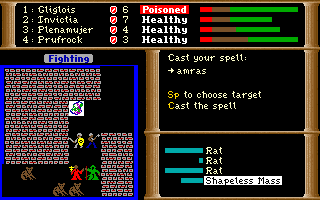
In my first posting, I suggested that I found the combat a little tedious, and I still do, but I have to thank Caron for cluing me in as to the existence of "autocombat," which I had missed in the manual. It's a welcome feature, and I'm using it even in these early stages against rats and other low-level enemies. The AI is reasonably good, and characters will cast both offensive and defensive spells, lay on hands, and otherwise make full use of their abilities. Against uniform enemies, it makes essentially the same decisions I would, but I'm careful to plot my own combats against creatures who can poison, drain experience, or cast spells.
The good thing about combat is that it's not so frequent it's annoying. Each battle feels deliberately and sensibly placed, with rats in caves and orcs patrolling corridors, and undead in dank crypts. You don't encounter them every step; I'd say every 25 or so steps. I haven't quite figured out whether there are "random" combats, exactly; the places that I've re-played, I've encountered combats in essentially the same places (although the foes might be slightly different each time), but sometimes only after walking over the square several times. It appears that there are squares that have a certain probability of combat on each map, but not a lot of completely random encounters. In general, areas I've already traversed remain clear.
The magic system is interesting, but it doesn't give you a lot of choices early on. I'll cover it in more detail in a later posting when I have more of it. Briefly, magician's magic is organized into five classes called "Arkanas": Fire, Frost, Healing, Protection, and Knowledge. Each class has multiple spell levels represented by "rings": iron, copper, silver, gold, platinum, and crystal. Each ring confers one or two spells. At first, I thought you obtained more rings literally by finding or buying them, but it appears you just get them on leveling up. My mage started with iron rings in fire, healing, and knowledge, which gave me five spells: a fire bolt (AMRAS), a fire spell that burns all adjacent enemies (ORLOS), a healing spell (SHUM), a translate spell (NGOS), and light (LUM). Each spell consumes a number of "psychic points."
 |
| Killing an orc with my only viable offensive spell. |
Priest spells are called "prayers" and are organized among four gods, each with different aspects: Ufthu, the God of War; Drutho, the God of the Underworld; Golthur, God of the Physical Self; and Fshofth, God of the Spirtual Self. As with mages, prayers come in six rings, and there's one prayer per ring. My priest started with the ability to pray to Ufthu for a "divine arrow" (RALKOR) or to Golthur to heal everyone (SIRDHE). Each prayer consumes "virtue points." Prayers are notably different from mage spells in that they're more powerful but often--usually, actually--unsuccessful. There's a decent chance that the god will either ignore the prayer or get annoyed and "smite" the priest for bothering him. Given her lack of piety, this happens to Plenamujer a lot.
 |
| Retribution for what? Trying to kill undead? |
There is an additional complexity to prayers in that the actual meaning of some of them isn't certain. Plenamujer got iron-level prayers for Fshofth when we found his altar, but the first prayer, called "The Quiet Room," is a mystery. It goes like this:
Fshofth, On the shore of the lost lake,
There is a house. Though the spell makers talk,
It is quiet still. For though chanting sounds,
It will little disturb the air where they dwell.
There is a house. Though the spell makers talk,
It is quiet still. For though chanting sounds,
It will little disturb the air where they dwell.
Does it silence spellcasters? Only experimentation will tell.
 |
| Plenamujer finds another god to disappoint. |
A few miscellaneous notes:
- I don't know what most of the stuff in my inventory is. The game suggests I will find a sage who can identify it for me. This appears to be the only way to identify equipment in the game. I keep finding things that seem worthless, like bones, skulls, and shreds of cloth, but I'm taking them anyway, just in case. I also have a bunch of gems that either have some plot-related purpose or I'm supposed to sell them.
 |
| Some items that may or may not be important. |
- There isn't a whit of sound in the game. The developers didn't even try. I created a iTunes playlist with every song that has "Heart" or "Dark" in the title. Norah Jones was playing when I started this entry; hence, the title. Yeah, that's right: occasionally I like Norah Jones. I'm sure your libraries are full of nothing but masterpieces of hipsterdom. Jerks.
- I gave up randomly searching for secret doors because it wastes food, and I was hardly ever finding any. The game often gives hints about their locations, such as this map I found on a wall near the secret door's entrance. Still, I hope I'm not missing a lot for which the game doesn't provide hints.

- You have to keep a supply of food going in the game. It's expensive enough that it's cut down on my ability to buy better weapons and armor for my people. So far, the only way I've found to get it is to buy it at the one store in the game.
- Being able to listen at doors is a good idea which is generally useless in practice. I routinely hear things at doors only to find empty rooms beyond, and many encounters are preceded by silence on the other side of the door.
 |
| This is the one time that it's helped. |
- There appear to be no missile weapons in the game.
- I haven't fully gotten a handle on it yet, but I think the game scales experience rewards for combat. Creatures that were giving me 30-40 points at the beginning are giving me single digits now. (My characters are all Level 4.) But even during the same level, the amount of experience I get for combats seems to vary wildly.
- Humor: I walked into a room, and a message said, "A sign at the end of the room reads 'DANGER!'" I walked up to the sign, and it fell on my head.
- "Rancid molds" have become my archnemeses. I hate them. They attack in big groups, poison everyone, and are very difficult to kill.
 |
| Poison slowly depletes health until it wears off. |
- I hate certain undead, too. They can drain hundreds of experience points, which take hours to build up.

I'm enjoying the game, though I hope I get to a point I can identify equipment soon. In the meantime, I wonder if some of you more tech-savvy people might help with a conundrum. I've successfully increased the size and scaling of my DOSBox window so it's got a proper size and resoultion (800 x 600), but the program insists on taking all of the Dark Heart of Uukrul screenshots at 320 x 200, and they're enlarged to make a decent size here in the blog. But for NetHack, DOSBox takes the shots at 800 x 600, and the blog ends up having to shrink them--which, of course, is better for viewing purposes. Why is DOSBox varying the size of the shots, and how can I get it to consistently use the window resolution?